
When Your Freight Hits the Ground: What Liftgate Service Really Means
Liftgate service is a freight delivery add-on that uses a motorized hydraulic platform on the rear of a truck to lower cargo safely from the truck bed to ground level — no loading dock or forklift required.
If you’re a logistics manager trying to find the right provider fast, here’s what you need to know:
Top scenarios where liftgate service is required:
- Delivery locations with no loading dock or forklift on site
- Construction sites and job sites with uneven or open terrain
- Residential or curbside final-mile delivery
- Heavy or oversized freight over 150 pounds
- LTL (Less-Than-Truckload) shipments to non-commercial addresses
Key specs to know before you book:
| Spec | Typical Value |
|---|---|
| Weight capacity | Up to 2,500 lbs |
| Platform width | 80 to 84 inches |
| Platform depth | 55 to 60 inches |
| Control method | Hydraulic switch box |
Every day, freight operations stall because a delivery location has no dock, no forklift, and no plan. A single missed detail — the wrong carrier, an under-specced liftgate, a driver who won’t cross the curb — can cascade into significant delays.
That’s exactly the problem liftgate service solves. But not all providers handle it the same way. The right partner matters as much as the equipment.
This guide breaks down how liftgate delivery works, when you need it, and what separates a reliable liftgate provider from one that leaves your freight stranded at the curb.
Understanding the Mechanics of a Liftgate Service
At its core, a liftgate service is about bridging the gap between the truck bed and the pavement. For those of us in the logistics trenches, it is the difference between a successful delivery and a rejected shipment. When we talk about logistics service, we are talking about solving the physical impossibility of moving a 2,000-pound pallet off a truck without a ramp.
How does a liftgate service work?
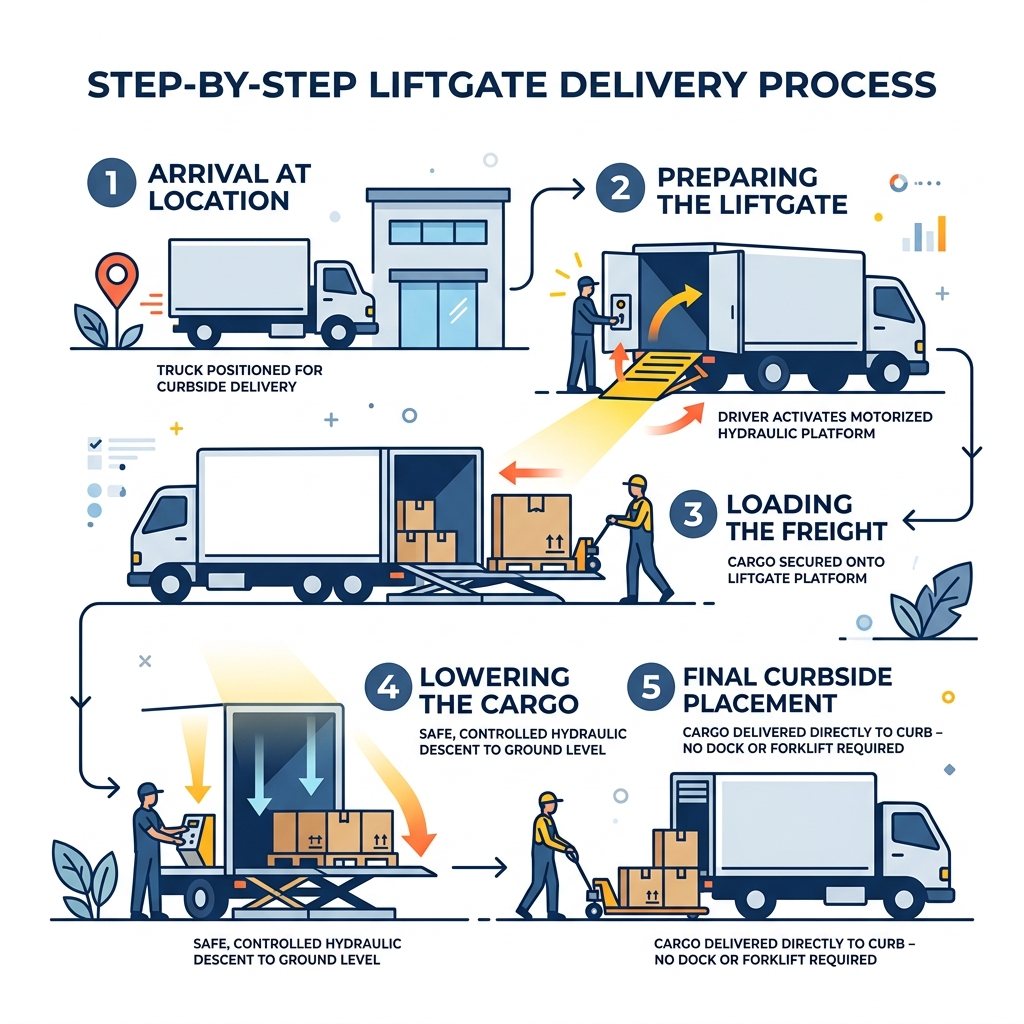
The process is a marvel of simple hydraulic engineering. A motorized platform is attached to the back of the freight trailer or box truck. When the driver arrives at a site without a loading dock, they deploy this platform. It moves vertically, acting as a motorized bridge.
The driver uses a manual pallet jack to move the freight from the nose of the trailer onto the platform. Using a switch box, the driver then lowers the platform until it is flush with the ground. This allows the pallet jack to be rolled right off onto the sidewalk or driveway. It is a seamless transition that eliminates the need for a team of people to manually break down a pallet at the tailgate.
Essential components for reliable operation
To ensure your high-value cargo doesn’t end up tipped over in a gutter, several components must work in harmony. You can learn more about specific hardware like pickup liftgate repair in San Diego | Liftgate repair & service to see how these systems are maintained.
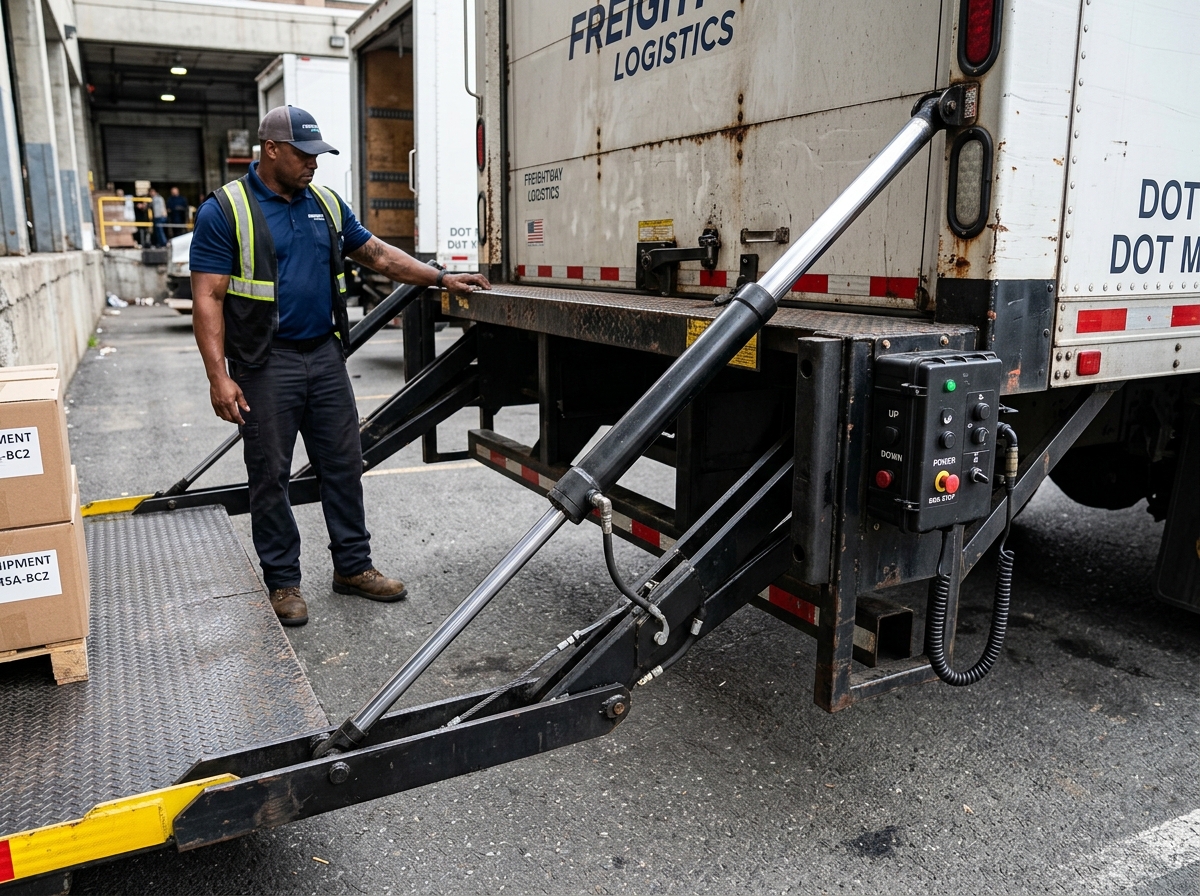
- Hydraulic Cylinders: These provide the “muscle” to lift thousands of pounds.
- Heavy-Duty Platforms: Usually made of steel or aluminum, these must be large enough to hold a standard 48″ x 48″ pallet with room to spare.
- Switch Box Control: A simple up/down interface that allows the operator to maintain a clear line of sight to the cargo during movement.
- Safety Rails and Snubbers: These prevent the cargo from shifting or rolling off the edge while the platform is in mid-air.
Critical Scenarios Requiring Liftgate Delivery
In our nearly two decades of experience at Pro Express Inc., we’ve seen that the need for a liftgate service is rarely a luxury—it’s a necessity. If your delivery site lacks a raised concrete loading dock or a functioning forklift, you are in “liftgate territory.” This is particularly true for expedited ground services, where speed is the priority and there is no time to wait for a forklift rental.
When is liftgate service necessary for freight deliveries?
If you are shipping to any of the following, you should assume a liftgate is required:
- Construction Sites: These locations are notorious for lacking infrastructure. Heavy materials need to get to the ground, and a standard trailer isn’t going to cut it.
- Residential Areas: Most neighborhoods aren’t zoned for loading docks. If you’re sending a commercial-grade oven or a pallet of flooring to a home, a liftgate is the only way to get it off the truck.
- Small Businesses: Many retail storefronts or small workshops operate out of standard buildings without freight bays.
- Final Mile Delivery: As the last link in the supply chain, the final mile often involves the most restricted access.
Handling heavy and oversized cargo
Standard parcel carriers cap out at 150 pounds for a reason. Once you cross that threshold, manual lifting becomes a massive safety risk. Heavy items like medical equipment, HVAC units, and industrial machinery require the steady hand of a hydraulic lift. For example, most keg refrigerators must be shipped via freight because of their weight and bulk. Without a liftgate repair & service plan in place for the carrier’s equipment, these deliveries can result in damaged goods or injured workers.
Technical Specifications and Equipment Limitations
Not all liftgates are created equal. One of the most common mistakes in logistics is assuming any truck with a gate can handle any load. Under-specifying a liftgate can lead to equipment failure or, worse, a tipping hazard that destroys your shipment.
Weight, size, and pallet limitations for liftgates
Most standard liftgates in the LTL (Less-Than-Truckload) world have a maximum capacity of approximately 2,500 pounds. However, some carriers may cap their pallet weight at 2,000 pounds for certain service levels.
| Feature | Standard Limit | Risk Factor |
|---|---|---|
| Weight | 2,500 lbs | Exceeding this can cause hydraulic “bleeding” or platform collapse. |
| Width | 80 – 84 inches | Pallets wider than this won’t fit safely. |
| Depth | 55 – 60 inches | Overhanging pallets shift the center of gravity. |
It is vital to check the Tommy Gate – liftgate service and parts specifications if you are using specialized equipment. A 96-inch long pallet sitting on a 60-inch deep liftgate creates a 3-foot overhang. This isn’t just a tight fit; it’s a tipping hazard that most professional drivers will—and should—refuse to handle.
Alternatives to liftgate service
If a liftgate isn’t available or the freight is too heavy (e.g., a 5,000-pound machine), you have three main options:
- Forklifts: The gold standard for unloading, provided you have one on-site and a certified operator.
- Loading Docks: If the recipient has a dock, the truck simply backs up, and the freight is rolled off at bed height.
- Terminal Pickup: If the delivery site is too difficult to reach or the freight is too large for a gate, the recipient can pick up the cargo at the carrier’s local terminal using their own flatbed or trailer.
Strategic Benefits for High-Stakes Logistics
When we handle freight service at Pro Express Inc., we view the liftgate as a tool for risk management. It isn’t just about moving a box; it’s about protecting the driver, the recipient, and the cargo.
Reducing risk and improving productivity
The power liftgate market is booming—expected to hit nearly $7 billion by 2033—because businesses realize that manual labor is resource-intensive and injuries are even more detrimental to operations. Using a liftgate service reduces operator fatigue and virtually eliminates the back injuries associated with “tailgating” (manually moving freight to the edge of the truck). It also speeds up the transloading process, allowing our drivers to complete more deliveries on time, which is critical for our white glove courier services.
Ensuring successful curbside drop-offs
A successful delivery requires more than just a working liftgate; it requires site preparation.
- Flat Pavement: Hydraulic gates and pallet jacks don’t play well with gravel, grass, or steep inclines.
- Maneuverability: A 53-foot trailer needs significant room to turn and park. If the street is too narrow, the delivery might fail.
- Recipient Presence: Most freight carriers provide “curbside” delivery only. This means the driver gets the item to the ground, but they won’t bring it inside your garage or warehouse unless you’ve booked a premium service.
Frequently Asked Questions about Liftgate Service
What are the weight limits for a liftgate service?
While some heavy-duty systems can withstand thousands of pounds, the industry standard for a truck-mounted liftgate is 2,500 pounds. Always factor in the weight of the pallet itself (usually about 50 lbs) and the pallet jack. If your cargo is pushing 2,400 lbs, you are cutting it very close to the safety margin.
What should recipients do if items are damaged during delivery?
Safety and documentation are your best friends here. If you see a hole in the packaging or a dent in the machinery:
- Note it on the Delivery Receipt: Do not sign until you have written down the specific damage (e.g., “crushed corner,” “missing 1 of 3 pieces”).
- Take Photos: Document the cargo while it is still on the truck or the liftgate.
- Notify Us Immediately: Contact your provider within one business day to start the claims process. Signing a “clean” receipt without notes often waives your right to a claim later.
How does liftgate service apply to LTL shipping?
In LTL, the liftgate service is almost always an optional add-on that must be requested at the time of booking. Because LTL trucks carry freight for multiple customers, not every truck in the fleet is equipped with a gate. If you don’t request it upfront, the carrier might send a standard “van” trailer, resulting in a failed delivery and the need for a scheduled redelivery.
Conclusion: Trust the Experts at Pro Express Inc.
When your delivery is time-sensitive and the stakes are high, you can’t afford to guess whether your carrier has the right equipment. At Pro Express Inc., we bring nearly two decades of experience to every shipment. With over 6,000 successful deliveries and a 99% client satisfaction rate, we understand that a liftgate service is more than just a hydraulic platform—it’s the final, critical step in your supply chain.
Whether you need a hot-shot delivery to a remote construction site or a white-glove drop-off at a corporate office, our US-wide operations and 24/7 customer support ensure your freight never gets stranded. We specialize in the urgent, the oversized, and the “impossible” deliveries that standard carriers shy away from.
Don’t let a missing loading dock stand in the way of your business goals. Request a Quote Today and let our team handle the heavy lifting for you.