
What is a Residential Delivery — and Why Does It Require Specialized Logistics?
What is a residential delivery is one of the most critical questions in logistics. The answer affects your shipping strategy, your timeline, and whether your freight actually makes it through the front door.
Here’s the short answer:
A residential delivery is the transportation of goods — typically large, heavy items exceeding 150 lbs — to a private home, apartment, condo, farm, or home-based business, rather than a commercial loading dock.
Because homes lack the infrastructure of commercial warehouses (no loading docks, no forklifts, often no wide access roads), carriers treat these deliveries as a separate — and more complex — service category.
Key facts at a glance:
| Factor | Residential Delivery | Commercial Delivery |
|---|---|---|
| Destination | Home, condo, farm, home business | Warehouse, store, office |
| Loading dock available | Rarely | Usually yes |
| Liftgate required | Almost always | Often not needed |
| Appointment scheduling | Standard | Less common |
| Service Requirements | Specialized equipment needed | Standard dock delivery |
| Delivery efficiency | Lower (spread-out routes) | Higher (dense zones) |
Residential deliveries use LTL (less-than-truckload) freight carriers for anything that standard parcel services cannot accommodate — shipments over 150 lbs or exceeding standard size limits. Think furniture, appliances, exercise equipment, or bulk pallet orders headed to a front driveway instead of a loading bay.
The operational challenge is real. A driver in an industrial zone might complete 10 stops in a single hour. That same driver could spend an hour navigating a residential neighborhood just to reach one address.
That’s why understanding this delivery category matters — especially if you’re managing time-sensitive shipments where a missed delivery window or an unprepared receiver can derail an entire operation.
Defining the Logistics: What is a Residential Delivery?
When we talk about what is a residential delivery, we are looking at any destination where people legally reside. This isn’t just limited to suburban houses. It includes apartment complexes, condominiums, townhomes, and even rural locations like farms or ranches. In the eyes of a logistics provider, if there isn’t a dedicated commercial loading dock and a forklift ready to receive the goods, the address is effectively residential.
One area that often surprises our clients is the classification of home-based businesses. Even if you are running a high-volume e-commerce operation from your garage, carriers will still classify your address as residential. This is because the physical constraints of the neighborhood—narrow streets, low-hanging trees, and lack of industrial turnarounds—remain the same regardless of your business’s legal status.
The Role of LTL Freight
In residential shipping, there is a clear divide between parcel and freight. Parcel delivery is generally for items under 150 lbs that can be carried by a single driver. However, when we move into the territory of heavy furniture, industrial kitchen appliances, or palletized materials, we enter the realm of Less-Than-Truckload (LTL) freight.
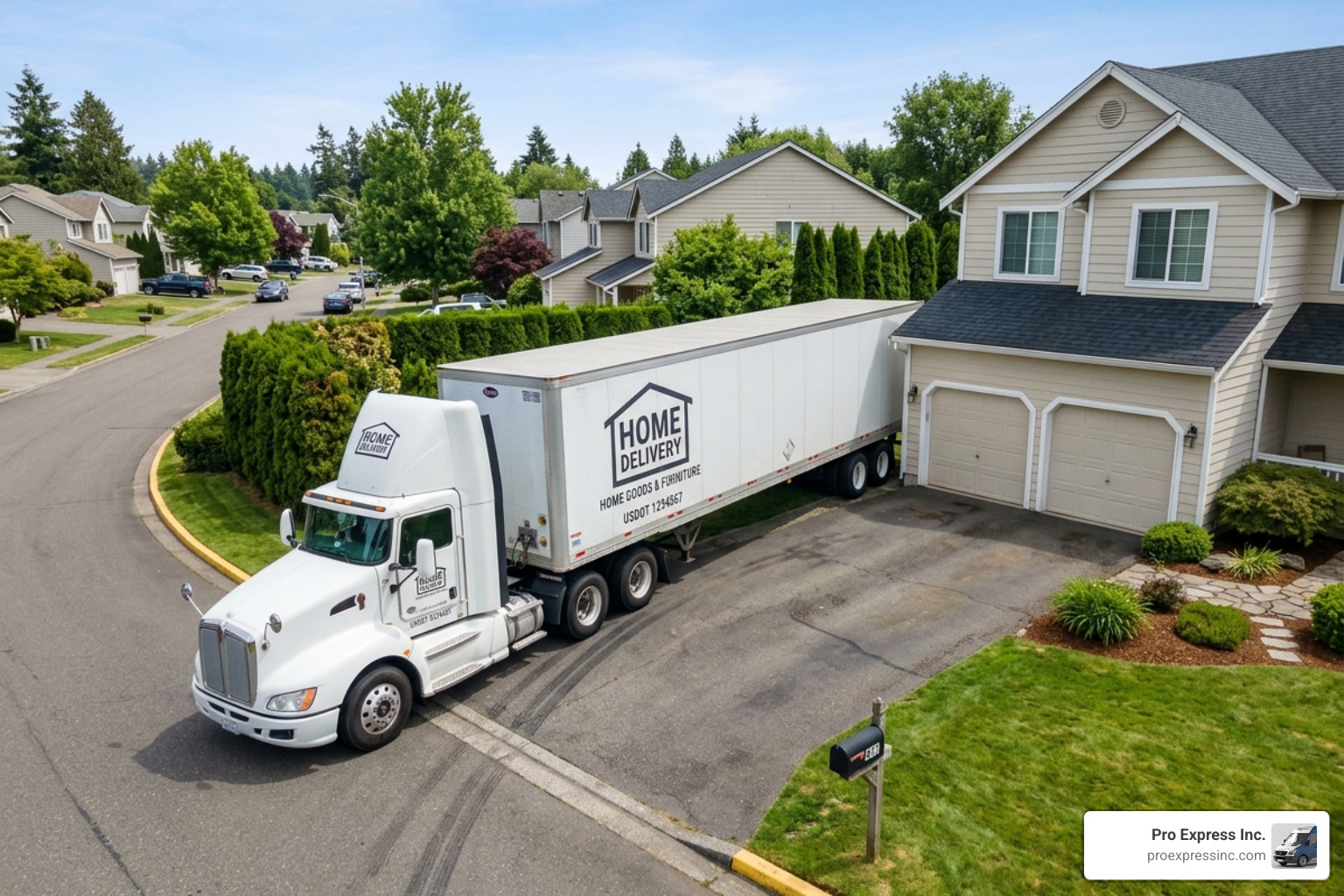
LTL is the backbone of what is a residential delivery. It allows multiple shippers to share space on a single trailer, making it a viable option for moving heavy items to homes. However, because these trucks are typically 53-foot trailers designed for industrial hubs, bringing them into a cul-de-sac requires specialized planning and equipment.
Key Differences in What is a Residential Delivery
The primary difference between commercial and residential delivery is infrastructure. A commercial warehouse is a “plug-and-play” environment for a truck driver. They back into a dock that is exactly the same height as their trailer, a warehouse worker zips in with a forklift, and the pallet is gone in seconds.
Residential areas offer none of these luxuries. We often encounter “infrastructure limitations” that turn a simple drop-off into a complex logistical puzzle.
- Street Accessibility: Many neighborhoods have weight limits or “no truck” signs. Low-hanging power lines and tight corners can make it impossible for a standard tractor-trailer to reach the curb.
- The “Last Mile” Density: In a commercial district, businesses are clustered together. In residential areas, addresses are spread out. This “last mile” is notoriously the most complex and time-consuming part of the shipping journey.
- Loading Docks vs. Driveways: Without a dock, the freight must be lowered from the truck bed to the ground. This is where specialized equipment becomes non-negotiable.
To understand why these differences matter for your shipment, you can read more in our guide: Don’t Get Let Down by Your Freight Liftgate Delivery Explained.
Address Classification and Carrier Standards
How does a carrier decide what is a residential delivery? It isn’t always as simple as looking at a map. Carriers use a combination of zoning laws, historical data, and automated verification tools to flag addresses.
Zoning and Discretion
While city zoning laws provide a baseline, carriers have the final say. If a business is located in a residentially zoned area, it will almost certainly require specialized residential handling. Conversely, some large apartment complexes that have a dedicated receiving office and a commercial-style loading area might be classified as commercial by certain carriers, though this is the exception rather than the rule.
Mixed-Use Properties
We frequently handle shipments to mixed-use developments—buildings with retail on the ground floor and apartments above. These are the “wild cards” of logistics. If the delivery is for the retail store, it may be commercial; if it’s for a resident upstairs, it’s residential. Accuracy in the initial quote is vital here to avoid unexpected delays.
For a deeper dive into how different delivery modes are categorized at a national level, the Postal 101 – Mode of Delivery provides excellent background on how the infrastructure of the U.S. affects delivery points.
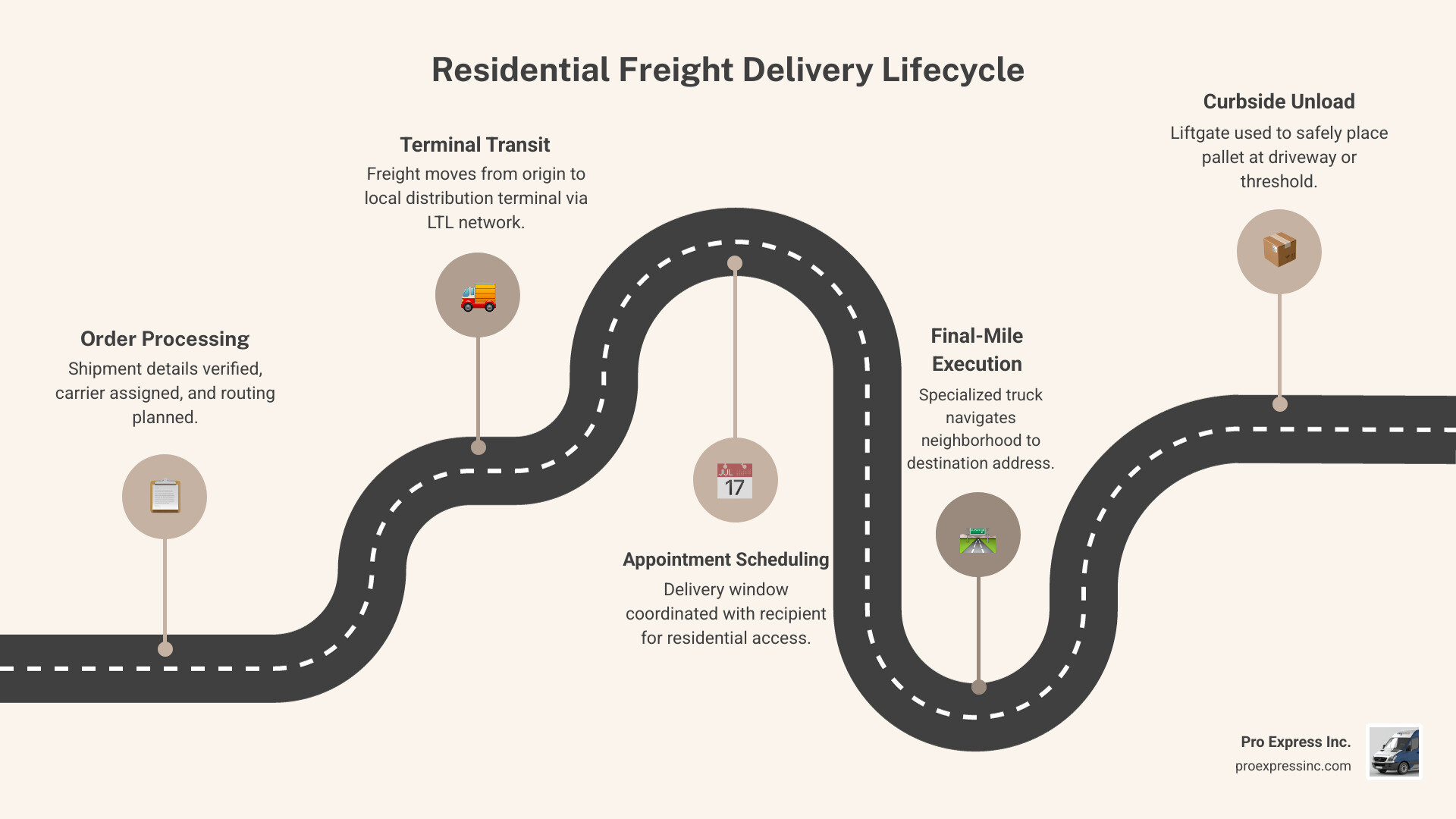
The Step-by-Step Process of Residential Freight
Navigating what is a residential delivery involves a more rigorous workflow than business-to-business (B2B) shipping. Here is how we manage the journey from the warehouse to your front door:
- Order Processing and Pickup: The freight is palletized, shrink-wrapped, and picked up from the shipper. At this stage, it must be clearly marked as a residential delivery on the Bill of Lading (BOL).
- Terminal Transit: The shipment moves through a network of terminals. It is sorted and moved closer to the destination city.
- Appointment Scheduling: Unlike commercial deliveries, which happen during standard business hours, residential freight requires an appointment. The carrier will call the receiver once the freight arrives at the local terminal to schedule a delivery window—usually 2 to 4 hours.
- Final-Mile Execution: The driver arrives. If the street is too narrow, the freight may have been transferred to a smaller “box truck” at the local terminal.
- Unloading: The driver uses a liftgate to lower the pallet to the ground.
Workflow Comparison: Standard LTL vs. Expedited Residential
| Step | Standard LTL Residential | Pro Express Expedited Residential |
|---|---|---|
| Transit Time | 3–7 business days | Same-day or Next-day |
| Appointments | Scheduled when at terminal | Pre-coordinated for urgency |
| Handling | Multiple terminal transfers | Minimal touch / Direct |
| Support | General customer service | 24/7 Dedicated logistics team |
Service Levels for What is a Residential Delivery
Not all residential deliveries end at the curb. Depending on the needs of the receiver, there are several service levels available.
Curbside Delivery
This is the standard for LTL. The driver lowers the pallet to the ground at the end of the driveway. They are generally not required to move the item onto the porch or into the garage. This is the most common answer to what is a residential delivery in its basic form.
Threshold Service
A step up from curbside, threshold delivery involves moving the package just inside the first dry area of the home, such as a garage or a front hallway. This protects the shipment from the elements but does not include unpacking.
White Glove and Room-of-Choice
For high-value or extremely heavy items, white glove service is the gold standard. This includes two-man delivery teams who carry the item to the specific room of choice, perform light assembly, and remove all packaging debris.
We specialize in these high-touch scenarios. You can learn more about the specifics in our article: Everything You Need to Know About White Glove Home Delivery.
The Role of Specialized Equipment
You cannot perform a residential freight delivery with just any truck. Because there are no docks, the truck must be an “independent unit” capable of unloading itself.
- The Liftgate: This is a hydraulic platform on the back of the truck. It is essential for any pallet over 75–100 lbs. Without it, there is no safe way to get the freight off the truck.
- Pallet Jacks: Once the freight is on the ground, the driver uses a pallet jack to move it. Pallet jacks only work on flat, paved surfaces like concrete or asphalt; they cannot roll over gravel or grass.
- Smaller Box Trucks: Often, we utilize smaller vehicles for the final mile to ensure we can navigate tight residential turns that would trap a 53-foot trailer.
For more information on the vehicles and specialized tools used in these deliveries, check out our Courier Delivery Services overview.
Overcoming Limitations in Residential LTL Shipping
While we strive for 100% success, there are inherent limitations to what is a residential delivery can achieve.
Weight and Size Thresholds
Most residential LTL freight falls between 150 lbs and 15,000 lbs. If a single piece exceeds the weight capacity of a standard liftgate (usually around 2,000 to 2,500 lbs), specialized “flatbed with crane” or “movers” services may be required.
Hazardous Materials
Many carriers will not deliver “Hazmat” (hazardous materials) to residential addresses. This includes certain chemicals, large quantities of batteries, or flammable liquids. Neighborhood safety regulations and insurance liabilities often prohibit these types of shipments from entering residential zones.
Best Practices for Seamless Home Freight Arrival
To ensure a smooth experience, preparation is key. We recommend the following steps for every residential shipment:
- Verify the Address: Double-check the zip code and ensure the phone number provided is for someone who will actually answer to schedule the appointment.
- Clear the Path: Ensure the driveway is clear of cars, low-hanging branches are trimmed, and there is a clear path for the pallet jack.
- Inspect Immediately: When the truck arrives, do not sign the delivery receipt (POD) until you have inspected the freight.
- Note Any Damage: If there is even a small tear in the shrink wrap, write “Subject to Inspection” or “Damaged” on the receipt before the driver leaves. This is critical for any future claims.
Frequently Asked Questions
How do carriers determine if an address is residential?
Carriers look at the “neighborhood characteristics.” If the area is primarily housing, has limited access for large trucks, and lacks a loading dock, it is residential. They also use commercial databases that flag addresses based on zoning and business registration data.
When is a liftgate required for residential delivery?
A liftgate is required for any shipment that is too heavy to be offloaded by hand (typically anything over 75–100 lbs) and where no loading dock is present. For residential deliveries, this is almost 99% of all freight shipments.
What is the difference between residential and final-mile delivery?
“Final-mile” is a broad industry term that refers to the last leg of a shipment’s journey. What is a residential delivery is a specific type of final-mile service. While all residential deliveries are final-mile, not all final-mile deliveries are residential (some are to retail stores or offices).
Conclusion: Reliable Logistics When Every Minute Counts
Understanding what is a residential delivery is the first step in mastering your supply chain. Whether you are a business shipping high-end furniture or an operation needing urgent replacement parts delivered to a home-based technician, the complexity of the residential landscape requires an expert hand.
At Pro Express Inc., we bring nearly 20 years of experience to the table. With a track record of over 10,000 successful shipments and a 99% client satisfaction rate, we understand that “residential” shouldn’t mean “delayed.” We specialize in expedited ground services, including same-day, next-day, and hot-shot deliveries across the US, Alaska, and Hawaii.
When your regular carrier fails or a deadline is at risk, our 24/7 customer support is ready to step in with reliable, time-sensitive solutions. From standard curbside drops to specialized White Glove Services, we ensure your freight doesn’t just take the scenic route—it takes the most efficient one.
Don’t let residential logistics slow you down.
Request a Quote or Contact Us Today to see how we can streamline your most urgent deliveries.