
What Liftgate Delivery Meaning Really Is (And Why It Matters for Freight)
The liftgate delivery meaning is straightforward: it refers to a freight delivery service where the truck is equipped with a hydraulic platform mounted on its rear, used to safely raise or lower heavy cargo between the truck bed and the ground — no loading dock or forklift required.
Here’s a quick breakdown:
| Term | Definition |
|---|---|
| Liftgate | A hydraulic or electric platform attached to the rear of a delivery truck |
| Liftgate delivery | A shipment service where this platform is used to unload freight at locations without a loading dock |
| When it’s needed | Any time freight exceeds 150 lbs and there’s no dock, forklift, or ramp at the delivery location |
| Who operates it | The truck driver or a lumper (hired unloading worker) |
| Common locations | Residential addresses, construction sites, small businesses, remote sites |
Now, here’s why this matters to you as a logistics or operations manager.
Picture this: a critical shipment of industrial equipment arrives at your customer’s facility. There’s no loading dock. No forklift on site. The driver can’t manually unload hundreds of pounds of freight — and shouldn’t. The NIOSH safe manual lifting limit is just 51 pounds under ideal conditions. Without a liftgate arranged in advance, that delivery fails. Your customer is frustrated. Redelivery fees stack up. Your timeline collapses.
This is exactly the situation a liftgate service exists to prevent.
Liftgate delivery is classified as an accessorial service in freight shipping — meaning it’s an add-on to standard LTL (less-than-truckload) shipping. The standard freight model assumes dock-to-dock delivery. But the real world rarely works that cleanly, especially for time-sensitive, high-value, or heavy freight headed to non-commercial locations.
With nearly 20 years of experience and 10,000+ shipments delivered, Pro Express Inc. understands that when a critical delivery hits a location without dock access, having the right equipment — and the right partner — makes all the difference.
Understanding the Liftgate Delivery Meaning and Mechanism
When we talk about the liftgate delivery meaning, we are describing more than just a piece of metal on the back of a truck. We are talking about a sophisticated mechanical system designed to bridge the gap between a high truck bed and the ground. Most standard semi-trailers and straight trucks have beds that sit 48 to 52 inches off the ground. Without a loading dock to meet that height, gravity becomes a significant enemy of your cargo’s integrity.
A liftgate acts as a vertical elevator. It is a hydraulic or electric platform permanently mounted to the rear of a delivery vehicle. Its primary job is to move freight vertically, ensuring that palletized goods or heavy machinery can be transitioned from the truck bed to the pavement safely and efficiently. This is a core component of Expedited Ground Services, where speed and safety must go hand-in-hand.
As noted in this guide on what a liftgate is and how it works, these systems are essential for maintaining the flow of goods in modern logistics. They eliminate the need for external heavy machinery like forklifts at the destination, making them a versatile tool for any supply chain.
Technical Components of a Liftgate
To truly grasp the liftgate delivery meaning, it helps to understand what makes the equipment move. A standard liftgate system consists of several key components:
- Hydraulic Piston or Electric Motor: This provides the power needed to lift or lower the platform. Most heavy-duty gates use hydraulic pressure to handle thousands of pounds.
- Switch Box: Usually mounted on the side or rear of the truck, this allows the operator (typically the driver) to control the up and down movement with precision.
- Platform: This is the flat metal surface where the freight sits. Standard dimensions often hover around 72″ L x 48″ W, though high-capacity versions can be larger.
- Weight Capacity: This is the most critical spec. Standard liftgates often handle 1,300 to 1,500 lbs, but heavy-duty options can support between 3,500 and 6,600 lbs.
How the Liftgate Delivery Meaning Applies to LTL Shipping
In Less-Than-Truckload (LTL) shipping, the liftgate delivery meaning shifts slightly toward the administrative side. In LTL, the “standard” service is dock-to-dock. This assumes both the shipper and the receiver have a raised concrete platform that allows a pallet jack or forklift to roll directly into the trailer.
When that dock isn’t there, liftgate service becomes an “accessorial.” This means it is an additional service requested beyond the standard transit. It transforms a delivery from a “driver-wait” scenario into a “curbside delivery.” The driver uses the liftgate to lower the pallet to the ground and then uses a pallet jack to move it to a safe spot, such as a curb or a driveway. Without this service, the carrier may refuse to unload the freight, leading to a failed delivery attempt and significant delays for your time-sensitive operations.
Operational Scenarios Requiring Liftgate Assistance
Understanding the liftgate delivery meaning is vital because many shippers assume their destination is “commercial” and therefore “equipped.” However, many modern business sites lack the traditional infrastructure of a warehouse.
We frequently see the need for liftgate services in the following scenarios:
- No Loading Dock: This is the most common reason. If the truck bed is 4 feet higher than the ground and there is no ramp or platform, you need a liftgate.
- Forklift Absence: Even if a site is at ground level, if there is no forklift to pull the pallet out of the truck and lower it, the delivery cannot proceed.
- Job Site Logistics: Construction sites are dynamic environments. Often, materials like HVAC units or heavy crates need to be dropped off before a loading bay is even built.
- Retail Storefronts: Strip malls and downtown boutiques rarely have rear loading docks. Freight must be lowered to the sidewalk and wheeled through the front door.
Our Logistics Service team specializes in identifying these needs before the truck leaves the terminal, ensuring that your expedited freight doesn’t get stuck at the finish line.
Identifying the Liftgate Delivery Meaning for Heavy Freight
When does an item become “too heavy” for manual handling? While a single person might manage a 40-lb box, freight shipping involves much larger scales.
The general industry rule is that any single piece of freight weighing more than 150 lbs (68 kg) requires a liftgate if no dock is available. This isn’t just a suggestion; it’s a safety requirement. NIOSH (The National Institute for Occupational Safety and Health) suggests a safe manual lifting limit of only 51 pounds under perfect conditions. Expecting a driver to manually move a 200-lb crate off a truck bed is a recipe for worker injury and cargo damage.
For high-value or fragile heavy items, we often recommend our White Glove Services. This ensures that not only is the liftgate used, but the freight is handled with the highest level of care from the truck bed to its final room of choice.
Common Delivery Locations
The liftgate delivery meaning extends to various non-traditional delivery zones. In our nearly two decades of experience, we’ve found that these locations almost always require liftgate-equipped trucks:
- Construction Sites: Delivering building materials, heavy tools, or generators where permanent infrastructure is absent.
- Small Businesses: Offices, clinics, and retail stores in urban areas.
- Remote Locations: Rural sites or research facilities that cannot accommodate 53-foot trailers with standard docks.
- Urban Delivery Zones: Narrow streets where a smaller straight truck with a liftgate is the only way to navigate the traffic and still deliver heavy pallets.
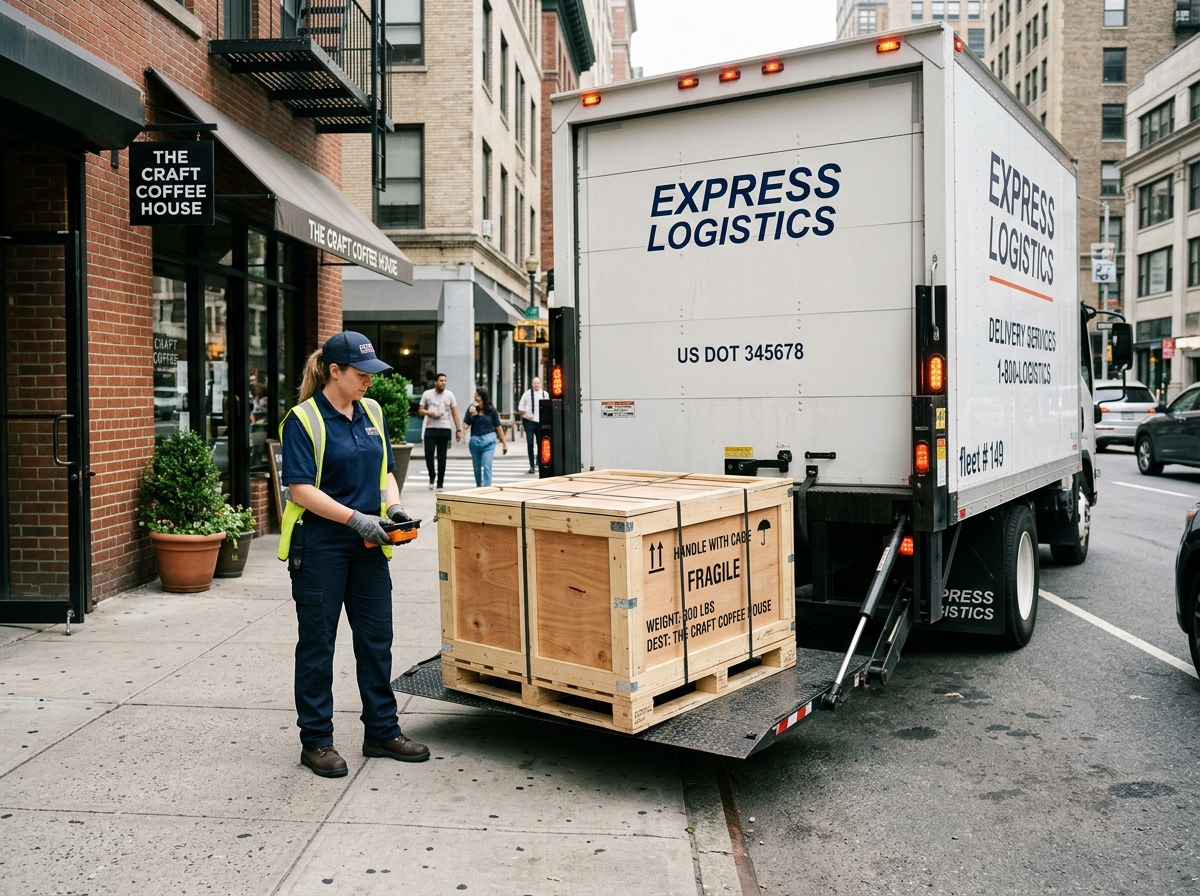
The Step-by-Step Liftgate Delivery Process
So, how does it actually work once the truck arrives? The process is a coordinated effort to ensure that thousands of pounds of freight move vertically without a hitch.
| Step | Action | Why It Matters |
|---|---|---|
| 1. Site Assessment | Driver finds level ground and clears the area. | Prevents the truck or liftgate from tipping. |
| 2. Inspection | Driver checks the liftgate for hydraulic leaks or debris. | Ensures mechanical reliability during the lift. |
| 3. Positioning | The pallet is moved to the rear of the truck bed using a pallet jack. | Centers the weight on the liftgate platform. |
| 4. Lowering | The driver operates the switch box to lower the platform to ground level. | Controlled descent prevents jarring the cargo. |
| 5. Placement | The pallet is moved off the gate to the curb or driveway. | Completes the “curbside” delivery requirement. |
| 6. Securement | The liftgate is raised and locked back into its travel position. | Safety for the truck’s return journey. |
Our Courier Delivery Services follow these protocols strictly to maintain our 99% client satisfaction rate.
Ensuring Safety and Efficiency in Liftgate Delivery Meaning
Safety is the most important part of the liftgate delivery meaning. A malfunctioning gate or an untrained operator can lead to catastrophic results.
- Weight Distribution: Cargo must be centered on the platform. If a 2,000-lb pallet is placed on the very edge of a 2,500-lb capacity gate, the leverage can strain the hydraulics or cause the platform to tilt.
- Weather Considerations: Rain, ice, and snow make metal platforms incredibly slick. Drivers must use caution to ensure the pallet jack doesn’t slide off the gate during transit.
- Operator Training: Only professional drivers should operate this equipment. It involves high-pressure hydraulics that require respect and knowledge.
- Damage Mitigation: Using a liftgate significantly reduces the risk of “dropping” freight, which is a common cause of claims in Freight Service when manual unloading is attempted.
Post-Unloading Responsibilities
Once the freight is on the ground, the liftgate delivery meaning concludes, but the delivery process doesn’t.
- Curbside Placement: The driver’s responsibility typically ends at the first flat surface (curb or driveway). They are generally not required to move the freight inside the building unless “Inside Delivery” was also requested.
- Recipient Inspection: This is your time to shine. Check the pallet for any signs of tilt, crushed corners, or broken shrink wrap.
- Documentation: Sign the Bill of Lading (BOL). If you see damage, note it before the driver leaves.
- Carrier Communication: If there were any issues with the liftgate operation, notifying the carrier helps maintain the fleet for future shipments.
Frequently Asked Questions about Liftgate Services
As an expert in expedited logistics, we hear many questions regarding the liftgate delivery meaning and its practical application. Here are some of the most common:
- What are the different types of liftgates?
- Tuck-under: Folds and stores underneath the truck bed. Very common for its versatility.
- Rail Gate: Moves straight up and down on a rail system. Great for heavy, level loads.
- Column Lift: High-capacity gates often found on larger trailers.
- Cantilever: Can tilt to act as a ramp or bridge.
- Does a liftgate affect delivery speed? While it takes a few extra minutes to operate, it is much faster than a failed delivery. For same-day or next-day expedited freight, having a liftgate-equipped truck is often the only way to meet the deadline.
What are the weight limits for a standard liftgate?
Standard liftgates on most straight trucks handle between 1,500 and 2,500 lbs. If your shipment is heavier, you must specify this during the booking process. Some heavy-duty trailers are equipped with gates that can handle up to 6,600 lbs, but these are less common and must be reserved in advance. Always confirm your pallet weight to avoid exceeding the gate’s capacity, which could lead to equipment failure or the driver refusing the load.
Can I request a liftgate for hot-shot shipping?
Absolutely. In fact, for hot-shot shipping — which involves urgent, often smaller-scale freight — a liftgate is frequently required because these shipments often go to non-dock locations like construction sites or small labs. At Pro Express Inc., our US-wide operations ensure we can provide liftgate-equipped vehicles for your most urgent, time-sensitive deliveries.
What happens if a liftgate is not arranged in advance?
If the driver arrives and realizes a liftgate is needed but not present, the delivery will likely be marked as a “failed attempt.” The truck will return to the terminal, and you will be charged for the redelivery and the liftgate service. This can add days to your timeline. It is always better to over-communicate the lack of a dock than to assume the carrier can “figure it out” on-site.
Conclusion: Partnering for Reliable Expedited Logistics
The liftgate delivery meaning is more than just a logistical definition; it is a critical safeguard for your freight, your timeline, and your bottom line. Whether you are shipping industrial machinery to a remote site or urgent retail fixtures to a downtown storefront, the right equipment is non-negotiable.
At Pro Express Inc., we bring nearly two decades of experience to every shipment. With a track record of 10,000+ successful deliveries and a 99% client satisfaction rate, we know how to handle the complexities of US-wide logistics, including the specialized needs of Alaska and Hawaii.
Don’t let a missing loading dock stand between you and a successful delivery. From same-day hot-shot shipping to specialized white glove handling, our 24/7 customer support team is ready to ensure your freight is never let down.
Need a reliable partner for your next time-sensitive shipment?