
When Is a Liftgate Required for Delivery?
A liftgate is required for delivery any time freight needs to be loaded or unloaded at a location that lacks a loading dock, a forklift, or other mechanical unloading equipment.
Here is a quick summary of the most common situations:
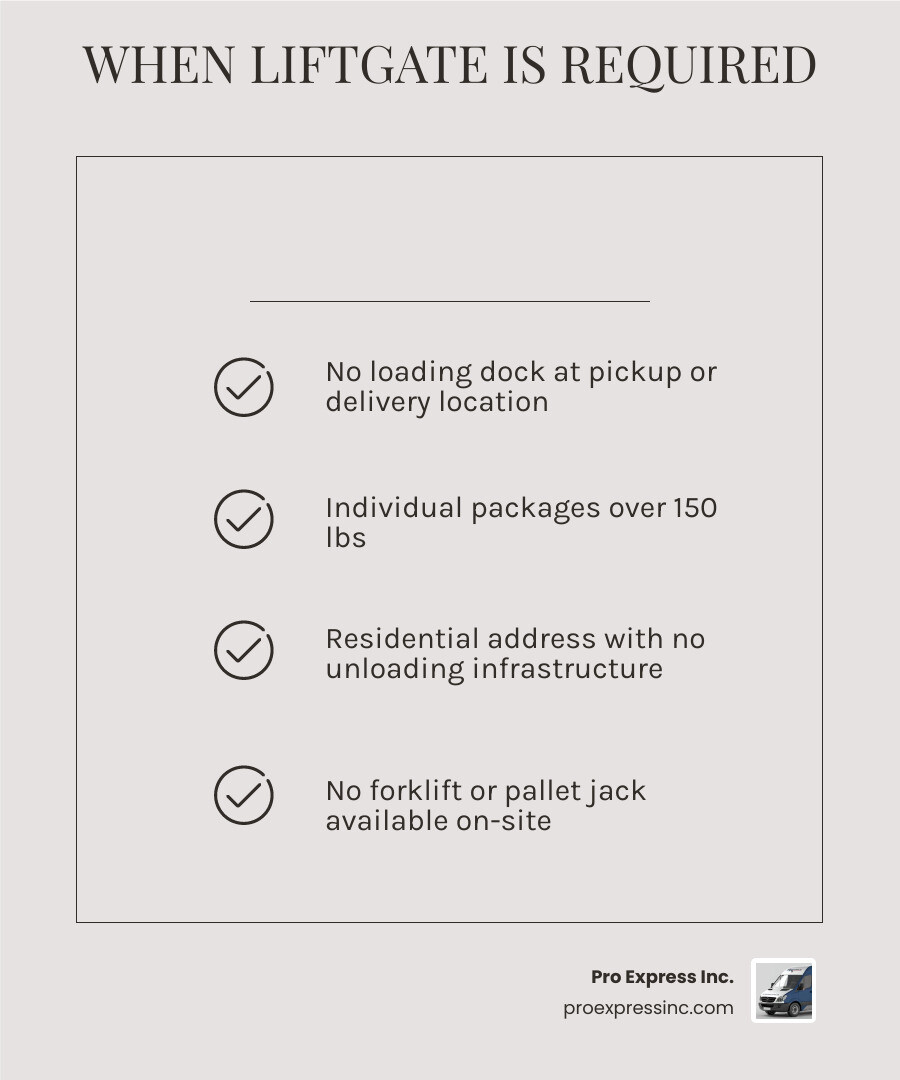
- No loading dock at the pickup or delivery location
- Individual packages weigh more than 150 lbs and cannot be safely hand-carried
- Residential address with no commercial unloading infrastructure
- Construction site, small business, or school without dock-height access
- No forklift or pallet jack available on-site
If any of the above apply to your shipment, a liftgate is almost certainly required.
Think of it this way: a standard freight truck bed sits roughly 48–52 inches off the ground. Without a dock that matches that height, there is no safe way to bridge that gap for heavy freight — unless a liftgate does it mechanically.
This is not a minor detail. Skipping liftgate service when it is needed can result in a failed delivery, redelivery fees, and frustrated customers. For logistics managers running on tight deadlines, that kind of disruption is costly.
With nearly 20 years of experience handling time-sensitive freight across the US, Pro Express Inc. has seen how a missed liftgate request can derail an otherwise smooth shipment. Planning for it upfront is always the right move.
Understanding the Mechanics: What is a Liftgate?
At its core, a liftgate is a motorized, foldable platform mounted to the rear of a truck or trailer. It acts as a mechanical bridge between the truck bed and the ground. When a shipment arrives at a destination that doesn’t have a loading dock—which is typically 48 to 52 inches high—the liftgate does the heavy lifting, quite literally.
The operation is powered by hydraulic or electric systems. A driver or operator uses a switch box to control the vertical movement, allowing the platform to stay level as it transitions from the height of the truck deck down to the pavement. This ensures that palletized goods remain stable during the move.
In modern logistics, technology has advanced significantly. For instance, the Tommy Gate – V2 Series Internal Liftgates for Delivery Vans showcases how these systems are now integrated into smaller delivery vehicles, offering features like auto-open and close functions to maximize efficiency in tight urban spaces.
Common Types of Liftgates
Depending on the vehicle and the cargo, different mechanical designs are used:
- Tuck-under Liftgates: These fold up and store neatly under the truck frame when not in use, allowing the truck to still back into standard loading docks without interference.
- Railgates: These are mounted to the rear frame of the truck and travel vertically along tracks. They often provide a larger, more stable platform for oversized items.
- Column Lifts: Often found on larger trailers, these use vertical tracks on the sides of the rear door and can handle much higher weight capacities, sometimes exceeding 6,000 lbs.
Determining if a Liftgate Required for Delivery is Necessary
The decision to request a liftgate shouldn’t be left to chance. As we often emphasize at Pro Express Inc., knowing the infrastructure of your pickup and delivery points is the first step in Don’t Get Let Down by Your Freight Liftgate Delivery Explained.
Standard LTL (Less-Than-Truckload) shipping is generally “dock-to-dock.” This means the carrier assumes there is a raised platform at both ends. If your recipient is a small business in a strip mall or a job site in the middle of a field, that assumption fails. Without a liftgate, the driver cannot safely get the pallet off the truck. Curbside delivery becomes impossible without this mechanical assistance.
| Feature | Loading Dock Delivery | Liftgate Delivery |
|---|---|---|
| Equipment Needed | Pallet Jack / Forklift | Hydraulic Liftgate |
| Site Requirement | 48″-52″ Raised Dock | Level Ground / Street |
| Speed | Very Fast | Moderate (Manual setup) |
| Typical Locations | Warehouses, DCs | Retail, Construction, Residential |
Weight Thresholds for a Liftgate Required for Delivery
Safety is the primary driver behind liftgate requirements. While a fit person might be able to lift a 40-lb box, freight is a different beast. Freight packages weighing more than 150 lbs (68 kg) generally require a liftgate service if no loading dock is available.
To put this in perspective, the National Institute for Occupational Safety and Health (NIOSH) suggests a safe upper limit of just 51 pounds for manual lifting under ideal conditions. When you are dealing with industrial equipment or heavy machinery that weighs 500, 1,000, or 1,500 lbs, manual handling is not just difficult—it is a massive liability. Scientific research on liftgate necessity and safety highlights that using mechanical lifts significantly reduces workplace injuries and cargo damage.
Alternatives to a Liftgate Required for Delivery
There are times when you might not need to pay for a liftgate service, provided you have other resources:
- On-site Forklift: If the receiver has a forklift and a certified operator, they can pull the pallet directly from the back of the trailer.
- Terminal Pickup: The receiver can choose to pick up the freight at the carrier’s local terminal, where loading docks are always available.
- Breaking Down Pallets: If the shipment consists of many small boxes on a pallet, the driver might allow the receiver to break the shrink wrap and unload the boxes one by one by hand. However, this is time-consuming and many drivers will refuse this due to tight schedules.
Common Commercial Scenarios for Liftgate Assistance
In our nearly 20 years of experience, we have found that certain industries almost always need a liftgate. If you are managing Expedited Ground Services for any of the following, make sure the “liftgate required” box is checked:
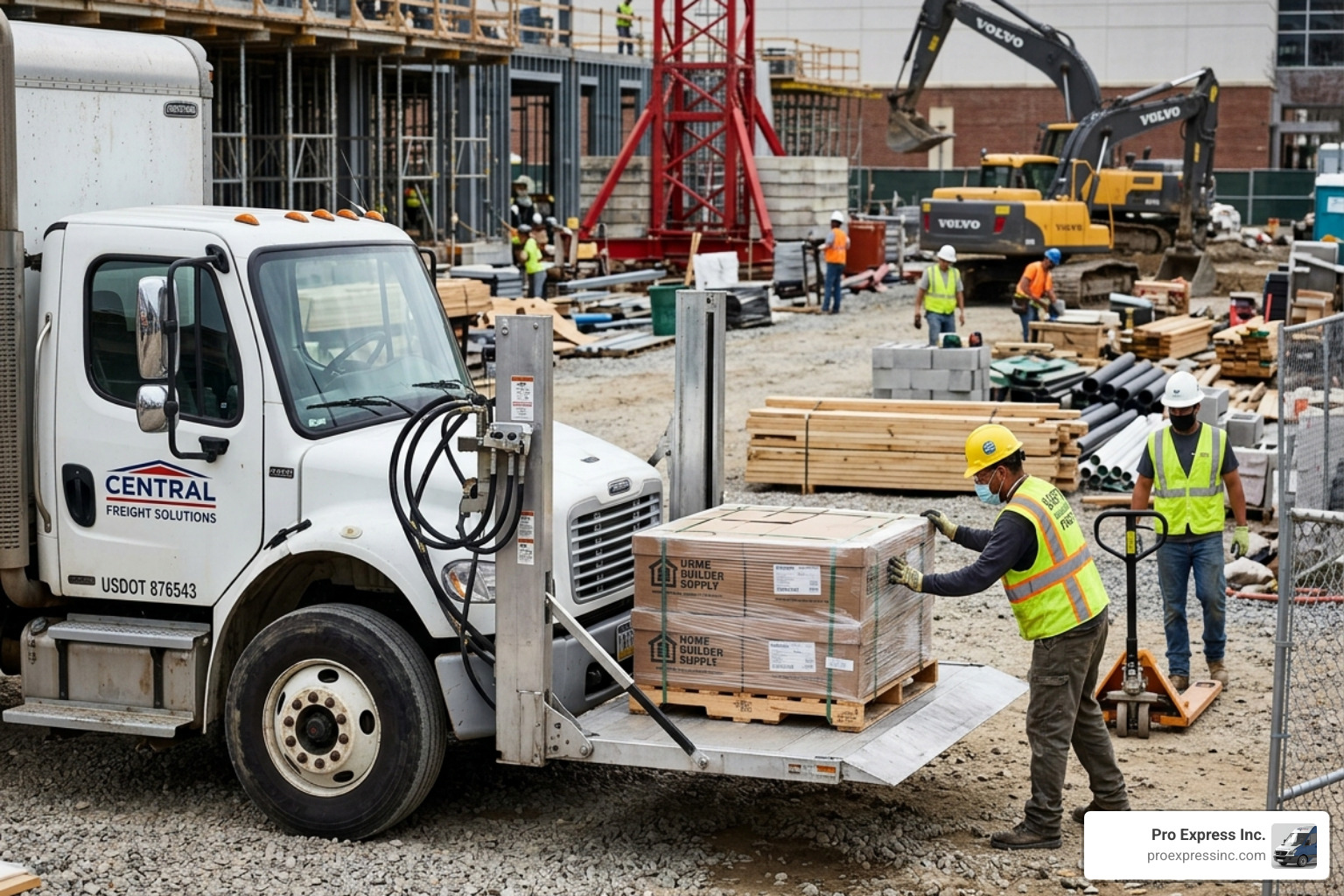
- Construction Sites: These locations rarely have permanent docks. Delivering raw materials, HVAC units, or flooring often requires a liftgate to get the goods to ground level so a pallet jack can move them around the site.
- Retail Strip Malls: Most small shops receive deliveries at the front door or a small back alley. Neither usually has a dock.
- Schools and Churches: These institutions often order large quantities of supplies or furniture but lack the industrial infrastructure of a warehouse.
- Remote Warehouses: Even some older storage facilities may have “drive-in” doors rather than “dock-high” doors, making a liftgate necessary for unloading.
The Step-by-Step Liftgate Delivery Process
Understanding how the delivery unfolds helps operations managers prepare their teams. At Pro Express Inc., we prioritize reliability and transparency in every Freight Service. Here is the typical flow:
- Truck Positioning: The driver arrives and identifies a level, safe area to park. Stability is key for hydraulic operation.
- Preparation: The driver opens the rear doors and moves the pallet to the very edge of the truck bed using a pallet jack.
- Deployment: The driver unfolds the liftgate and raises it to the height of the truck bed.
- Loading the Platform: The pallet is rolled onto the liftgate. The driver must ensure the weight is centered to prevent the platform from tipping.
- Lowering: Using the switch box, the driver lowers the platform to the ground.
- Final Placement: Once at ground level, the pallet is rolled off the platform. Standard liftgate service is “curbside,” meaning the driver is only responsible for getting it off the truck. If you need it moved inside, you should request “Inside Delivery” or “White Glove” services.
For more complex moves, you can explore our full range of specialized freight services.
Frequently Asked Questions about Liftgate Requirements
Do I need a liftgate if I have a forklift on-site?
Technically, no. If you have a forklift and a qualified operator ready at the time of delivery, you do not need a liftgate. However, you must ensure the forklift can reach into the back of a standard trailer. If there is any doubt about the forklift’s availability or capacity, requesting a liftgate is a safe insurance policy to avoid a failed delivery.
What happens if a driver arrives and I don’t have a liftgate?
If the liftgate required for delivery was not specified and the driver arrives to find no dock or forklift, they will likely deem the shipment “undeliverable.” The truck will return to the terminal, and you will be charged a redelivery fee. This can also cause a 24-to-48-hour delay, which is unacceptable for time-sensitive, expedited shipments.
What is the maximum weight a standard liftgate can handle?
Most standard liftgates on LTL trucks have a weight capacity between 1,500 lbs and 2,500 lbs. However, some specialized heavy-duty liftgates can handle up to 3,000 or even 5,000 lbs. Always verify your pallet weight with us before booking so we can ensure the equipment dispatched matches your needs. If a pallet is too heavy for the liftgate, it cannot be safely unloaded.
Conclusion
Navigating freight doesn’t have to be a headache. Whether you are shipping heavy industrial machinery or high-value retail goods, understanding when a liftgate required for delivery is essential will save you time, money, and stress.
At Pro Express Inc., we specialize in the urgent and the complex. With nearly two decades of experience, US-wide operations (including Alaska and Hawaii), and a 99% client satisfaction rate, we know how to handle your time-sensitive deliveries with precision. From same-day hot-shot loads to specialized white-glove service, our team is available 24/7 to ensure your 10,000+ yearly shipments arrive safely and on time.
Don’t let a missing liftgate stand in the way of your deadline. Rely on the experts who have seen it all and delivered it all.
Ready to move your freight with confidence? Contact Us Today for a reliable, expedited shipping solution.