
What “Inside Delivery” Really Means (And Why It Matters for Your Shipments)
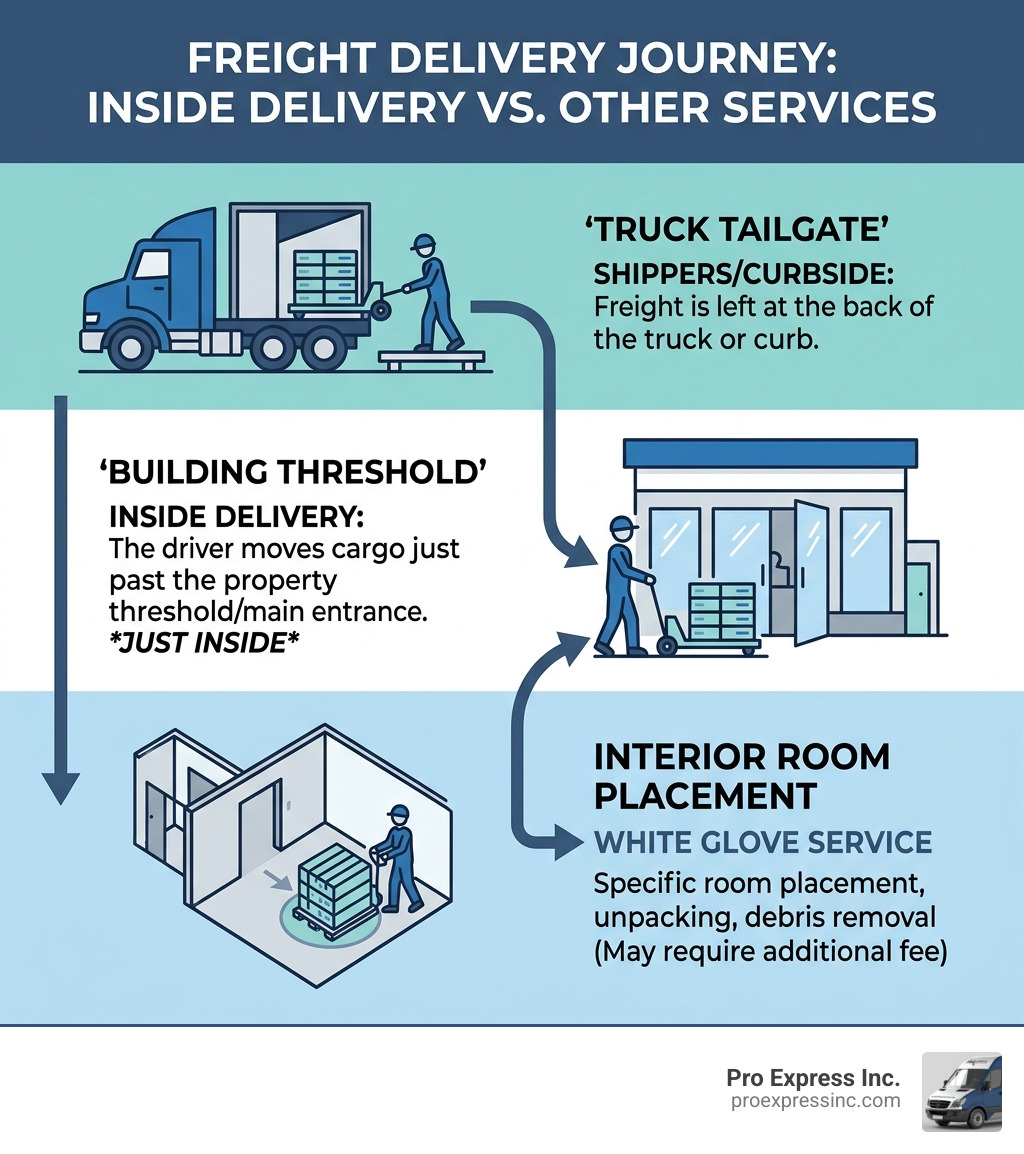
Inside delivery is a freight service where the carrier moves your shipment past the property threshold — through the main entrance and just inside the building — rather than leaving it at the curb or loading dock.
Here’s a quick breakdown of what it means in practice:
| Delivery Type | Where Freight Is Left |
|---|---|
| Curbside | At the curb or tailgate of the truck |
| Loading dock | At the dock door — standard for most commercial freight |
| Inside delivery | Just past the main entrance threshold, inside the building |
| White glove | Specific room, with unpacking, assembly, and debris removal |
Inside delivery does not include unpacking, room placement, stair navigation, or assembly — those require white glove service.
Many logistics managers and operations teams run into the same problem: a shipment is marked “inside delivery” and they assume the freight will be placed where they need it. Then the driver leaves a pallet just inside the front door — and the team is left figuring out how to move a 500-pound piece of equipment down the hallway.
That disconnect between expectation and reality causes real operational headaches. Missed deadlines. Scrambled staff. Damaged goods.
This guide cuts through the confusion. Whether you’re tracking a shipment and seeing “in delivery” on your screen, or trying to decide between inside delivery and white glove for a high-value cargo move, you’ll find clear, practical answers here.
What is Inside Delivery in Freight Shipping?

In logistics, inside delivery is classified as an “accessorial charge.” This means it is a supplemental service added to a standard freight quote. While standard Freight Service typically ends at the loading dock or the back of the truck (the tailgate), this service requires the driver to move the cargo beyond that point.
According to the Inside Delivery Definition, the service involves moving the freight through the first threshold of the building. For a commercial facility, this usually means the front lobby or a designated entryway. It is important to note that the driver’s responsibility typically ends just a few feet inside that door. They are not required to navigate through the building, take the freight to a specific back office, or move it to a different floor.
For Less-Than-Truckload (LTL) shipping, this service is a lifesaver for businesses that operate out of storefronts or office parks without a dedicated loading dock. Without it, your high-value cargo might be left on the sidewalk, exposed to the elements or theft.
Distinguishing “In Delivery” from Inside Delivery
One of the most common points of confusion for operations managers is the tracking status. If you see “In Delivery” or “Out for Delivery” on your tracking dashboard, it simply means the truck has left the terminal and is in transit to your location. It describes the status of the journey.
Inside delivery, on the other hand, describes the level of service. A shipment can be “In Delivery” while also having an “Inside Delivery” requirement attached to it. If your tracking doesn’t explicitly list the inside service, the driver may refuse to bring the pallet past the curb, leading to a “refused delivery” status and significant delays for your time-sensitive project.
Common Products Requiring Inside Delivery
Not every shipment needs to go inside immediately, but for certain industries, it is a non-negotiable requirement. At Pro Express Inc., we frequently handle specialized cargo that demands immediate interior placement to ensure safety and climate control.
- Medical Equipment: Sensitive diagnostic tools and laboratory machinery cannot be left on a damp dock.
- IT Servers and Racks: High-value technology requires immediate security within a climate-controlled lobby.
- Industrial Machinery: While heavy, some precision robotics need to be moved through the threshold to prevent exposure to industrial park dust or moisture.
- Trade Show Displays: When timing is everything, getting crates through the door of a convention center is the first step to a successful event.
For these types of urgent moves, our Courier Delivery Services ensure that the “last mile” isn’t the “last hurdle” for your business.
Inside Delivery vs. White Glove: Choosing the Right Service
Choosing the wrong service level is one of the fastest ways to blow a logistics budget or delay a critical installation. While inside delivery gets the freight through the door, it often leaves the heavy lifting of uncrating and positioning to your staff.
| Feature | Curbside | Inside Delivery | White Glove |
|---|---|---|---|
| Drop-off Point | Street/Driveway | Just inside front door | Specific room of choice |
| Unpacking | No | No | Yes |
| Debris Removal | No | No | Yes |
| Assembly | No | No | Yes |
| Stairs/Elevator | No | Usually No | Yes |
If your team is prepared to handle the pallet once it’s inside the lobby, then the standard inside service is sufficient. However, if you are delivering a 700-pound industrial printer to a third-floor office with no freight elevator, you need to step up to White Glove Services.
When to Upgrade Beyond a Standard Inside Delivery
We recommend looking at the “Scope of Work” for your delivery. If the shipment requires any of the following, standard inside delivery will likely fail:
- Multi-story Transport: Most LTL drivers will not take a pallet jack into an elevator or up a flight of stairs.
- Product Assembly: If the item arrives in a crate and needs to be functioning by end-of-day, you need Everything You Need to Know About White Glove Home Delivery to ensure technicians are on-site to assist.
- Debris Removal: Pallets and crates take up massive amounts of space. White glove services include the removal of all packaging materials, leaving your facility “broom clean.”
The Role of Specialized Equipment
A successful delivery often comes down to the tools on the truck. You cannot have an inside delivery if the truck doesn’t have a way to get the freight to the ground. This is where the liftgate comes in. If your facility doesn’t have a loading dock, you must ensure your carrier uses a liftgate-equipped vehicle.
As we explain in our guide, Don’t Get Let Down By Your Freight: Liftgate Delivery Explained, the liftgate is the platform on the back of the truck that safely lowers freight to street level so it can be wheeled through your front door.
Navigating the Logistics of Inside Delivery for Businesses
For a business, the arrival of a heavy shipment can be disruptive. For the delivery to go smoothly, coordination is key. Unlike a loading dock delivery where a driver can quickly back up and unload, an inside delivery takes more time and physical effort.
At Pro Express Inc., we specialize in Expedited Ground Services, meaning we understand that every minute a truck sits at your front door is a minute of lost productivity. Effective planning prevents “refused deliveries” and keeps your operations moving.
Preparing for a Successful Inside Delivery
To avoid surprise fees or failed attempts, follow these preparation steps:
- Measure Everything: Ensure the pallet width is smaller than your door frame. Drivers will not “break down” a pallet to make it fit.
- Clear the Path: Remove rugs, furniture, or displays that might obstruct a heavy pallet jack.
- Check Floor Ratings: Ensure your lobby floor can handle the concentrated weight of a 1,000-pound pallet plus the weight of the driver and equipment.
- Coordinate Personnel: Have someone ready to sign for the shipment the moment it crosses the threshold.
Our broader Delivery Services are designed to handle these complexities, but a little site prep on your end goes a long way.
Limitations of Standard Inside Delivery
It is a common myth that “inside” means “anywhere I want it.” In reality, carriers have strict safety protocols.
- Distance Caps: Many carriers limit the distance a driver can move freight—often no more than 50 feet from the truck.
- Safety Hazards: Drivers will not move freight over gravel, steep inclines, or through areas they deem unsafe.
- Weight Restrictions: Items over 500-750 pounds may require specialized “two-man” crews or heavy-duty motorized jacks that aren’t standard on every truck.
Solving Tracking Status Mysteries and Delivery Delays
When you are managing a hot-shot shipment, seeing a “delayed” status can be stressful. Often, these delays happen during the final mile. Understanding the Services you’ve booked helps you interpret why a shipment might be stalled.
Why Shipments Get Stalled at the Threshold
If your shipment is out for delivery but doesn’t arrive, check for these common “threshold” issues:
- Access Issues: The driver arrived but found the front door locked or the entryway blocked.
- Equipment Failure: The liftgate malfunctioned, or the pallet jack couldn’t clear a small step at the entrance.
- Documentation Errors: The bill of lading (BOL) didn’t specify inside delivery, and the driver is waiting for authorization to charge the additional fee before proceeding.
Ensuring Reliability in Time-Sensitive Logistics
In expedited freight, there is no room for “maybe.” When a regular carrier fails to get your equipment through the door, you need a partner with a track record of reliability.
Pro Express Inc. offers US-wide operations and 24/7 customer support to solve these mysteries in real-time. Whether it’s a next-day delivery of critical components or a hot-shot move across state lines, we provide the visibility and specialized handling required to ensure your freight doesn’t just arrive at the curb—it arrives exactly where it needs to be.
Frequently Asked Questions about Freight Logistics
Which carriers offer inside delivery services?
Most major LTL (Less-Than-Truckload) providers offer this service as an accessorial option. However, their terms vary wildly. Some may only offer it for shipments under a certain weight, while others might charge a high minimum fee. Specialized couriers and expedited freight companies like Pro Express Inc. provide more flexible and reliable inside delivery, especially for time-sensitive or high-value cargo that requires more care than a standard LTL carrier can provide.
How does inside delivery differ for residential vs. business addresses?
This is a critical distinction. For business addresses, the driver typically brings the freight just inside the main door or lobby. For residential addresses, “inside delivery” is much more limited. Due to liability and safety concerns, most freight drivers will not enter a private home. Instead, they will leave the pallet in the garage, on the porch, or in the driveway. If you need a shipment moved into a specific room of a house, you must book a white glove service.
What preparation is required for heavy freight arrival?
Before the truck arrives, perform a site inspection. Measure the width and height of all doorways the freight must pass through. Check for any “lips” or steps at the entrance—even a two-inch step can stop a manual pallet jack in its tracks. Finally, ensure you have a designated person on-site with the authority to inspect the cargo and sign the proof of delivery (POD).
Conclusion: Trust the Experts for Your Most Critical Deliveries
Navigating the nuances of inside delivery and tracking statuses shouldn’t be a full-time job for your operations team. When the stakes are high and the timeline is tight, you need a logistics partner that treats your shipment with the urgency it deserves.
Pro Express Inc. brings nearly two decades of experience to the table. With over 10,000 shipments delivered and a 99% client satisfaction rate, we have mastered the art of the “last mile.” We don’t just drop pallets at the curb; we provide the ground-expedited, same-day, and white glove solutions that modern businesses demand.
Don’t let your critical freight get stuck at the door. From the moment you book until the final threshold is crossed, we are with you 24/7.
Ready to ensure your next shipment is handled with precision? Request a Quote for White Glove and Inside Delivery Services today and experience the Pro Express difference.