
The Mechanics of Direct Warehouse Delivery Hawaii
Understanding the journey of freight in the islands is essential for any operations manager or logistics coordinator. Unlike the contiguous United States, where a truck might roll across state lines without a second thought, Hawaii logistics are defined by the Pacific Ocean and the regulatory framework of the Jones Act, which governs maritime commerce in U.S. waters. The process of direct warehouse delivery Hawaii begins the moment a container hits the dock or a pallet is offloaded from a cargo plane.

In Honolulu, the primary gateways are Honolulu Harbor and Daniel K. Inouye International Airport. Once cargo arrives, the “drayage” process begins—this is the short-haul movement of containers from the terminal to a nearby warehouse. Efficiency here is measured in minutes and hours, not days. Strategic warehouse locations are often situated within a five-minute radius of the harbor or airport to ensure that “container spotting”—the placement of a full container at a specific site for unloading—happens as quickly as possible. For B2B operations, this speed is the difference between meeting a project deadline and facing a costly work stoppage.
Once the container is spotted at the warehouse, the “breakdown” begins. This is where the bulk shipment is opened, and the individual items are sorted. For many Hawaii importers, this stage is a lifesaver. If you are bringing in floor-loaded containers from Asia or the mainland, you know that manual unloading can take two to three hours per 40-foot container, compared to just 30 minutes for palletized goods. Having a professional team handle this breakdown allows your business to stay lean while we manage the heavy lifting. More info about logistics services can help you understand how these moving parts fit together to create a seamless flow.
Streamlining the Supply Chain with Direct Warehouse Delivery Hawaii
The real magic of direct warehouse delivery Hawaii happens inside the four walls of the fulfillment center. It isn’t just about storage; it’s about preparation for the final mile. When cargo is “broken down,” it undergoes a series of value-added steps designed to optimize the B2B supply chain:
- Sorting and Segregating: Items are separated by SKU, destination, or priority. This is critical for retail replenishment where different stores require specific inventory mixes.
- Palletizing and Shrink-Wrapping: Loose boxes are secured onto pallets and wrapped for stability during ground transport. This minimizes the risk of damage during the “last mile” delivery.
- Inventory Control: Using advanced Warehouse Management Systems (WMS), every item is tracked. This provides real-time visibility, which is a non-negotiable requirement for modern B2B operations that rely on just-in-time inventory.
- Cross-Docking: For urgent shipments, cargo is moved directly from the receiving dock to the shipping dock with minimal storage time, ensuring that “hot-shot” deliveries stay on schedule.
By the time the freight is loaded onto a box van or flatbed for delivery, it has been transformed from a chaotic container load into a streamlined, ready-to-use shipment. This level of organization is what prevents missed deadlines and ensures that retail shelves are replenished in manageable, “store-ready” quantities.
Specialized Handling and Direct Warehouse Delivery Hawaii Requirements
Not all cargo is created equal. Some shipments require a “white-glove” touch, especially when dealing with high-value electronics, medical supplies, or delicate furniture. White-glove service goes beyond the curb; it includes inside delivery, placement in a specific room (even up multiple flights of stairs), light assembly, and the removal of all packaging debris. This is particularly vital for medical facilities and corporate offices where staff cannot be diverted to handle heavy equipment.
Furthermore, Hawaii’s unique environment necessitates strict adherence to regulatory requirements. This often includes USDA inspections for certain goods to protect the islands’ fragile ecosystem. For those involved in government contracting or military base deliveries, the security requirements are even more stringent. Navigating the access protocols for Pearl Harbor, Hickam, or Kaneohe Bay requires a logistics partner with the right credentials and experience.
Whether it is refrigerated storage for perishables or “hot-shot” delivery for an urgent repair part, specialized handling ensures that the integrity of the cargo is maintained from the warehouse to the doorstep. For more on how we handle these sensitive movements, check out More info about courier delivery services.
Overcoming Island Logistics Challenges with Expedited Solutions
Hawaii’s geography is stunning, but for a logistics coordinator, it’s a series of hurdles. The “Neighbor Islands”—Maui, Kauai, the Big Island, Lanai, and Molokai—depend heavily on the Honolulu hub. This hub-and-spoke model means that any delay in Honolulu ripples across the entire state.
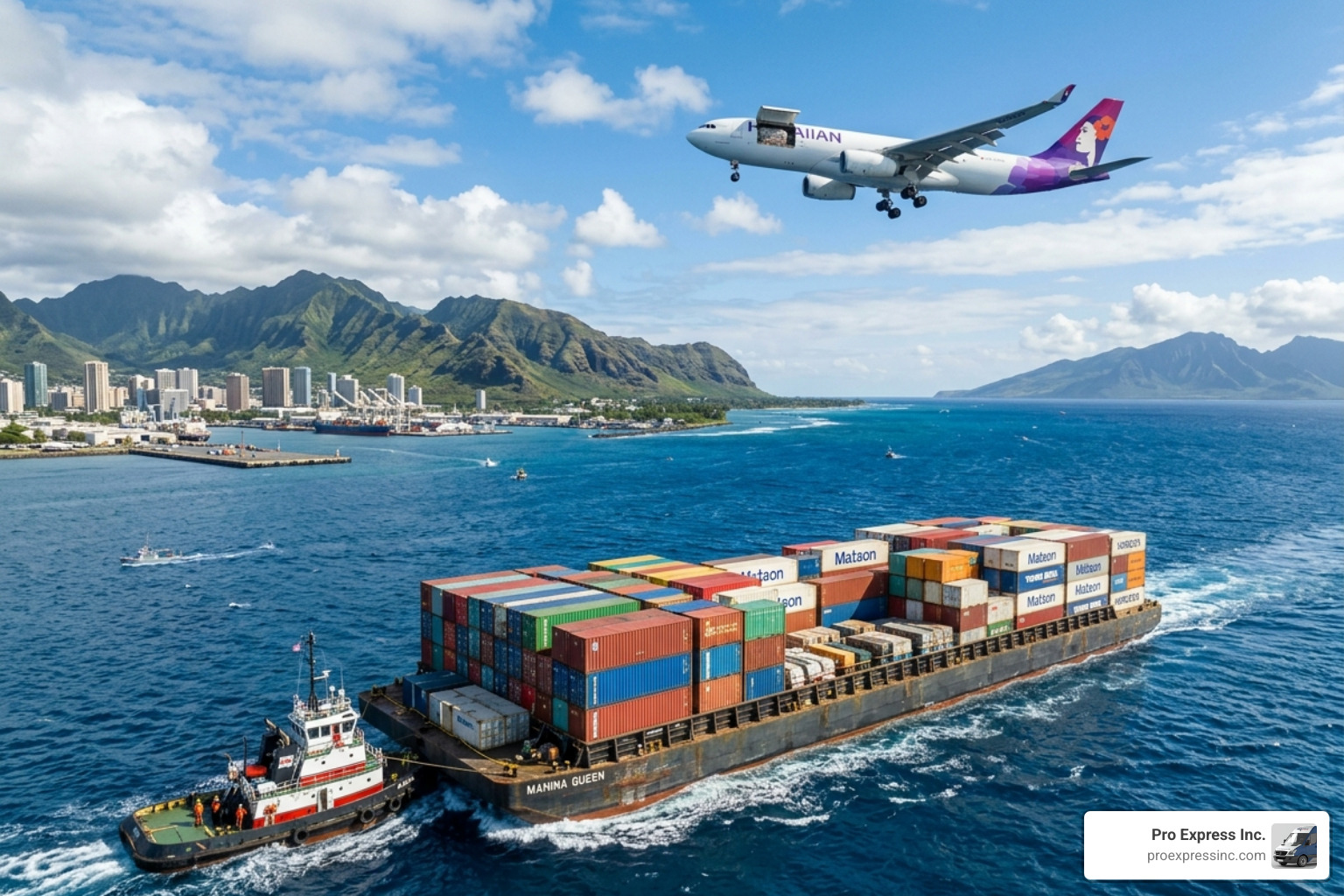
Most freight arrives first on Oahu. From there, it must be “transloaded.” This means the cargo is removed from its original ocean container and moved into smaller containers or onto pallets for inter-island transit. This is where timing becomes critical. Inter-island barges operate on fixed schedules, and missing a sailing can mean a several-day delay for a project on Maui or Kauai. For construction firms or medical providers, these delays are unacceptable.
To bypass the slower barge schedules, many businesses opt for airline-enabled delivery. This allows for next-day service between islands, which is vital for medical supplies, emergency parts, or high-turnover retail goods. By integrating warehouse storage with expedited ground and air options, we help businesses maintain a “mainland-style” supply chain in the middle of the Pacific. Our expertise in transloading ensures that cargo is handled only as much as necessary, reducing the risk of transit damage and ensuring that the direct warehouse delivery Hawaii process remains as fast as possible. Whether it is a single pallet of electronics or a full load of industrial equipment, the goal is always the same: minimize dwell time and maximize reliability.
Strategic Advantages of Outsourced Warehouse Logistics
For many Hawaii importers and B2B enterprises, the cost of maintaining a private warehouse is prohibitive. Real estate is at a premium, and the labor market is tight. Outsourcing to a third-party logistics (3PL) provider offers a scalable solution that turns fixed overhead into a flexible, variable model that grows with your business volume.

A professional warehouse facility in Hawaii typically features:
- High-pitched ceilings (20′ to 30′): Maximizing vertical space for better storage density and air circulation.
- Multiple roll-up doors: Ensuring that several containers can be worked simultaneously to avoid bottlenecks during peak arrival days.
- 24/7 Security: Monitored cameras, gated access, and alarm systems to protect high-value assets and sensitive cargo.
- Fleet Diversity: Access to a wide range of vehicles, including P-vans, box vans with liftgates, flatbeds, and tractors for heavy hauling.
When you outsource, you aren’t just renting space; you are gaining a fleet and a dedicated team. We provide the 24/7 customer support and the decade-plus of experience needed to handle time-sensitive cargo. This allows your team to focus on core strengths—like sourcing, sales, and customer relationship management—while we handle the “heavy lifting” of the physical supply chain. This is especially critical when your regular carrier fails or when a last-minute urgent shipment requires immediate attention. More info about freight services provides a deeper look at how these assets work for you to ensure your operations never skip a beat.
Frequently Asked Questions about Hawaii Warehouse Logistics
How long do direct warehouse deliveries typically take?
Transit times in Hawaii are heavily influenced by the arrival of the “mother ships” from the mainland (usually twice weekly). Once the cargo is grounded in Honolulu, direct warehouse delivery Hawaii can often be completed the same day or next day for Oahu locations. For Neighbor Islands, transit times typically range from 48 hours to 5 days, depending on whether you choose expedited air or standard barge transloading. Our “hot-shot” services are designed to minimize these windows for critical freight.
What types of cargo are best suited for this service?
This service is ideal for any “dry cargo” that requires professional handling and rapid distribution. Common items include:
- Appliances and Electronics: Items that need careful offloading and white-glove setup.
- Medical Supplies: Time-critical freight that requires high-visibility tracking and climate-controlled environments.
- Retail Replenishment: Consumer goods like toys, cosmetics, and household items destined for store shelves.
- Oversized Loads: Construction materials like concrete slabs, lumber, or machinery that require flatbed transport and specialized rigging.
How are inter-island deliveries managed?
Everything flows through the Honolulu hub. Cargo is received at the port or airport, processed at the warehouse, and then “cross-docked” to the appropriate inter-island carrier. We utilize a mix of inter-island barges for bulk freight and air cargo for expedited shipments. Our satellite presence and established partnerships on the Neighbor Islands ensure that the “last mile” is just as reliable as the first.
Can you deliver to military bases or restricted areas?
Yes. Delivering to Joint Base Pearl Harbor-Hickam (JBPHH), Marine Corps Base Hawaii (MCBH), or other military installations requires specific driver credentials and vehicle insurance. Our team is experienced in navigating these security protocols, ensuring that your delivery is not turned away at the gate, which is a common pain point for mainland carriers unfamiliar with island security requirements.
Conclusion
Navigating the complexities of the Hawaii supply chain requires more than just a truck; it requires a strategic partner who understands the rhythm of the islands and the urgency of B2B commerce. Direct warehouse delivery Hawaii is the key to maintaining speed and reliability in a market where delays are costly and inventory gaps can halt operations.
At Pro Express Inc., we bring nearly two decades of experience to the table. With over 6,000 shipments delivered and a 99% client satisfaction rate, we specialize in the high-pressure, time-sensitive “hot-shot” and expedited deliveries that keep Hawaii moving. Whether you are dealing with a carrier failure, a last-minute urgent shipment, or a complex white-glove installation, our 24/7 support and US-wide operations ensure your freight is never left stranded.
Ready to streamline your island operations and ensure your cargo arrives on time, every time? Contact Pro Express Inc. for Services today and experience the reliability and professional logistics support your business deserves.