
When Every Hour Counts: What Is a Hot Shot Delivery?
What is a hot shot delivery is one of the most searched questions in expedited logistics — and the answer is straightforward:
Hot shot delivery is a dedicated, on-demand freight service that moves a single customer’s time-sensitive load directly from pickup to destination using a medium-duty truck or similar vehicle — with no terminals, no consolidation, and no waiting.
At a glance:
| Feature | Hot Shot Delivery |
|---|---|
| Load type | Smaller than full truckload (LTL or less) |
| Vehicle | Class 3-5 trucks, dually pickups, sprinter vans |
| Routing | Direct, point-to-point — no stops |
| Speed | Same-day or within 24 hours |
| Trigger | Urgent, time-critical freight need |
| Ideal for | Equipment failures, production stoppages, AOG situations |
Picture this: a production line goes down at 2 a.m. The replacement part is 400 miles away. Standard carriers won’t move it until morning — and by then, your customer has lost tens of thousands of dollars in downtime. That’s exactly the gap hot shot delivery was built to fill.
The U.S. trucking industry moves 11 billion tons of freight per year across a $987 billion market. But when speed is the only variable that matters, most of that infrastructure is too slow, too rigid, and too dependent on scheduled routes and hub networks.
Hot shot delivery bypasses all of it. One truck. One load. One destination. No delays built into the system.
For logistics managers handling urgent, high-value, or fragile freight across the U.S., understanding how hot shot delivery works — and when to use it — is a critical operational advantage.
Understanding What is a Hot Shot Delivery in Modern Logistics
The term “hot shot” carries a sense of urgency that dates back to the 1970s Texas oil fields. During that era, if a drill rig failed, the financial losses were catastrophic. To solve this, drivers in pickup trucks would wait outside manufacturing plants for a single replacement part. As soon as the part was finished, the driver would “hot shot” it directly to the well site.
Today, while the technology has advanced, the core philosophy remains the same: a single-load commitment focused entirely on point-to-point transport. In a massive industry where 8.5 million people are employed to move freight, The Ultimate Guide to Hot Shot Trucking Services highlights how this niche service provides the agility that massive Class 8 rigs simply cannot offer.
Modern hot shot delivery is defined by its Definition of Hot Shot Trucking. It isn’t just about the size of the truck; it’s about the dedication of the driver and the vehicle to a single client’s deadline. Whether it is moving 11 billion tons of annual freight or a single 500-pound valve, hot shotting ensures that the most critical items move first.
Key Advantages: Why Choose What is a Hot Shot Delivery?
The primary reason operations managers choose this service is the total elimination of terminals. In standard shipping, your freight is handled multiple times as it moves through a “hub-and-spoke” network. This creates “built-in” delays.
With Hot Shot Logistics USA and the Experts Who Rule the Road, those delays vanish. Because we use a dedicated vehicle for your shipment, there is no consolidation with other customers’ goods. This means:
- 24-hour delivery windows: Most shipments are delivered same-day or overnight.
- Reduced handling risks: Since the cargo stays on the same truck from pickup to drop-off, the risk of damage during cross-docking is eliminated.
- Remote access: Medium-duty trucks can navigate tight construction sites or remote oil rigs where a 53-foot trailer would get stuck.
Hot Shot vs. Traditional LTL and Expedited Freight
It is easy to confuse hot shot delivery with other expedited services, but the differences are significant for your bottom line.
| Feature | Hot Shot Delivery | Less-Than-Truckload (LTL) | Full Truckload (FTL) |
|---|---|---|---|
| Routing | Direct Point-to-Point | Hub-and-Spoke (Milk Runs) | Direct Point-to-Point |
| Vehicle Size | Class 3-5 (Medium Duty) | Class 8 (Heavy Duty) | Class 8 (Heavy Duty) |
| Exclusivity | 100% Dedicated | Shared with other shippers | 100% Dedicated |
| Speed | Immediate / On-Demand | 2-5 Days | Scheduled |
While standard LTL relies on “milk runs”—where a truck makes dozens of stops—Exclusive Hot Shots focus on a hub-and-spoke bypass. We don’t wait for a trailer to fill up. We dispatch as soon as you call, providing a level of fleet agility that traditional freight companies can’t match.
Specialized Equipment and Trailer Configurations
When you look at a hot shot rig, you’ll usually see a heavy-duty pickup truck, often a “one-ton dually” like a Ford F-350 or RAM 3500. These are not your average consumer pickups; they are workhorses designed for constant hauling.
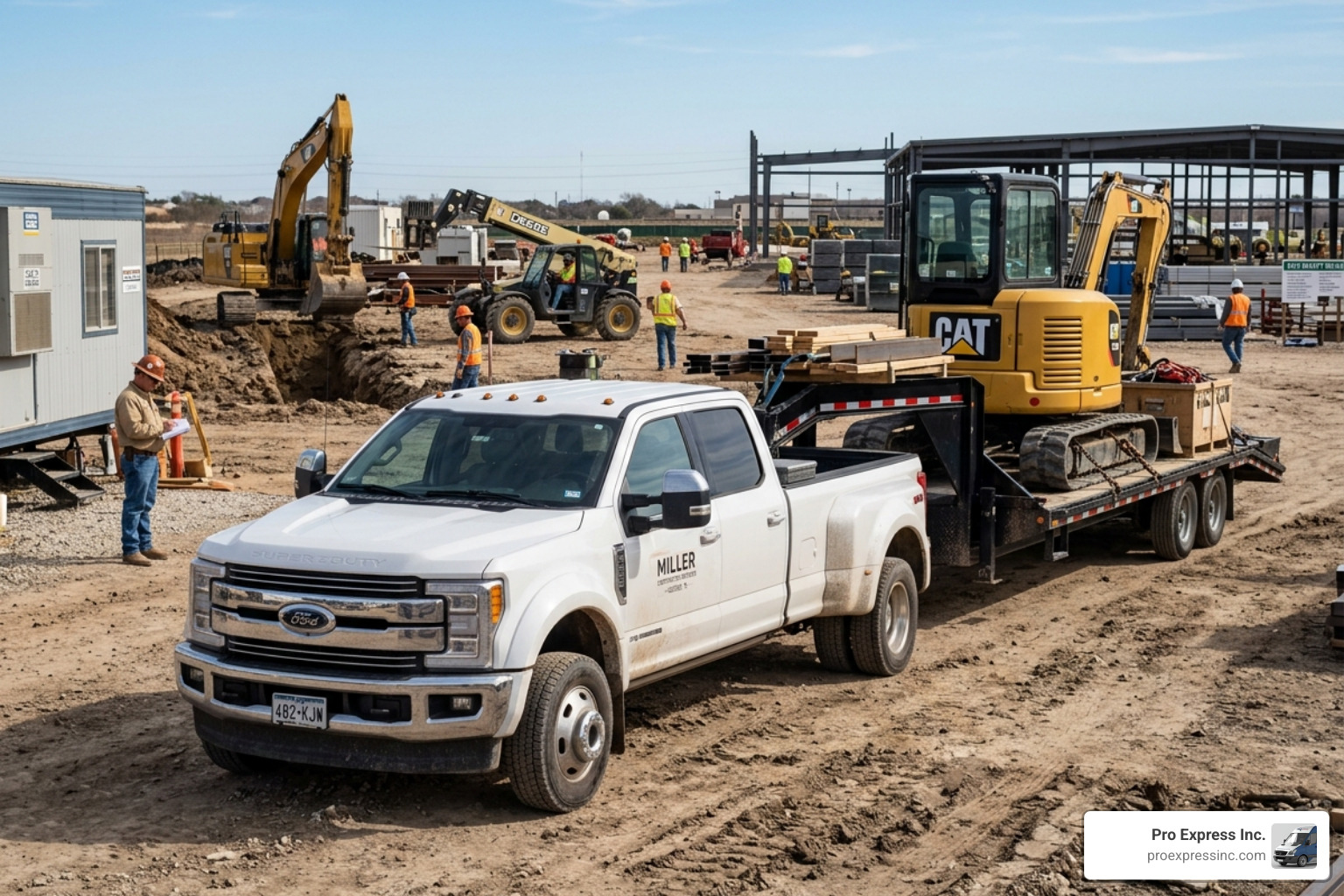
The industry categorizes these vehicles by their Gross Vehicle Weight Rating (GVWR):
- Class 3 Trucks: 10,001–14,000 lbs.
- Class 4 Trucks: 14,001–16,000 lbs.
- Class 5 Trucks: 16,001–19,500 lbs.
Beyond pickups, The Best Hot Shot Freight Haulers and Parts Delivery Services often utilize sprinter vans for smaller, high-value cargo or box trucks for items that need protection from the elements.
Common Trailer Types for Hot Shot Loads
The trailer is what makes a hot shot truck versatile. Depending on the load, a driver might use:
- Gooseneck Trailers: These are the gold standard for stability. They hitch into the bed of the truck, allowing for heavier loads and better maneuverability.
- Lowboy Trailers: Used for tall equipment, these sit very low to the ground to provide extra overhead clearance.
- Tilt Decks: Perfect for machinery that needs to be driven or rolled onto the trailer.
- Bumper Pull Trailers: Generally shorter and easier to hitch, these are ideal for lighter loads and drivers operating without a CDL.
- Dovetail Trailers: These feature a ramp-like end, making it easier to load wheeled equipment like forklifts or tractors.
Regardless of the trailer, professional securement is non-negotiable. Our drivers utilize heavy-duty chains, straps, and tarps to ensure that even on bumpy backroads, your cargo doesn’t budge.
Regulatory Compliance and Safety Standards
Just because the trucks are smaller doesn’t mean the rules are thinner. Hot shot trucking is heavily regulated by the Federal Motor Carrier Safety Administration (FMCSA). Any driver operating commercially across state lines must have a USDOT number and Motor Carrier (MC) Authority.
The Requirements for Hotshot Trucking also include:
- Unified Carrier Registration (UCR): A mandatory filing for interstate carriers.
- International Fuel Tax Agreement (IFTA): Necessary for tracking fuel taxes across different states.
- Hours of Service (HOS): Drivers must use Electronic Logging Devices (ELDs) to ensure they aren’t driving beyond legal safety limits.
CDL vs. Non-CDL Requirements
A common question is whether a hot shot driver needs a Commercial Driver’s License (CDL). The answer depends on the weight:
- Non-CDL: If the Gross Combined Weight Rating (GCWR)—the weight of the truck plus the trailer and the load—is under 26,001 lbs, and the trailer itself is under 10,000 lbs, a CDL is often not required.
- CDL Required: If the combined weight exceeds 26,000 lbs, the driver must have a Class A CDL.
Even for non-CDL operations, drivers must maintain a DOT medical card and carry significant commercial insurance. The federal minimum for general freight is $750,000 in primary liability, though many high-value shippers require even higher limits. At Pro Express Inc., we ensure every driver meets these rigorous standards so your cargo is always in professional hands.
Strategic Benefits for Time-Critical Logistics
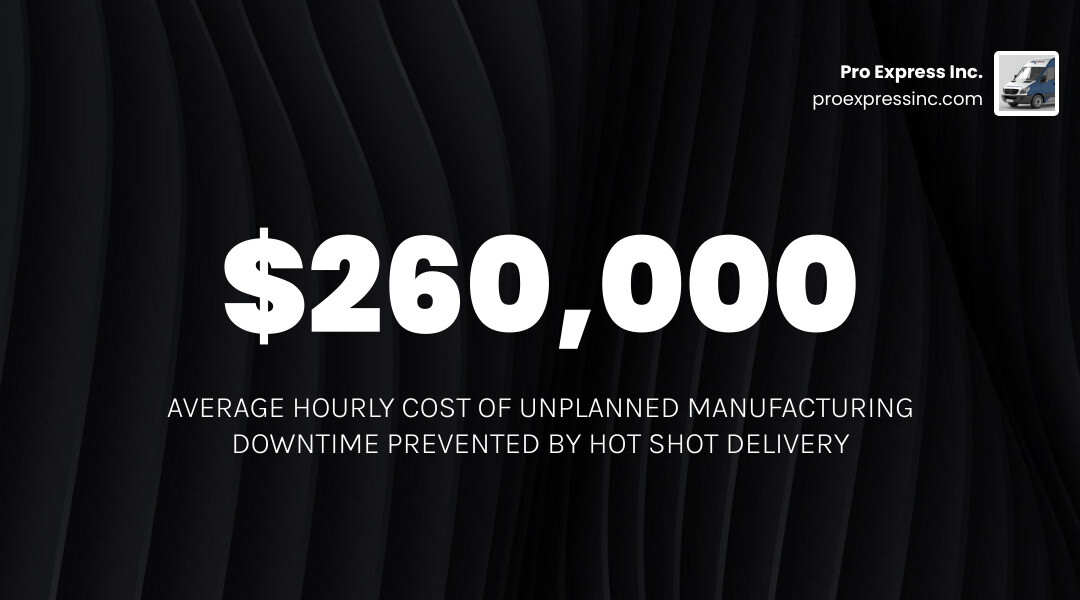
In B2B operations, the cost of waiting is often higher than the cost of shipping. Research shows that unplanned downtime can cost a manufacturing facility up to $260,000 per hour. When a critical component fails, waiting three days for a standard LTL shipment is not a viable financial option.
Hot shot delivery supports Just-in-Time (JIT) manufacturing by acting as a safety net. It allows companies to maintain leaner inventories because they know they can get parts delivered in hours, not days. This supply chain agility is what separates market leaders from those struggling with backlogs.
Whether you are navigating Midwest Hot Shot Services or shipping across the country, visibility is key. We provide real-time GPS tracking and Electronic Proof of Delivery (ePOD), which can reduce manual data entry for your team by up to 80%. You’ll know exactly where your freight is and exactly when it arrives.
Industry Applications and Use Cases
While it started in the oil fields, hot shot delivery is now a “secret weapon” for a variety of sectors:
- Oil and Gas: Rushing replacement valves or drill bits to remote rigs to prevent environmental or operational failures.
- Construction: Moving concrete saws, generators, or small excavators between job sites to keep crews working.
- Aerospace (AOG): When an “Aircraft on Ground” situation occurs, every minute the plane isn’t flying costs thousands. We rush avionics and engine parts to hangars immediately.
- Medical and Pharmaceutical: Transporting time-sensitive or temperature-controlled supplies that cannot sit in a warehouse.
- Event and Venue Logistics: Delivering stage equipment or AV gear for concerts and trade shows with zero-tolerance timelines.
The Operational Process: How to Request What is a Hot Shot Delivery
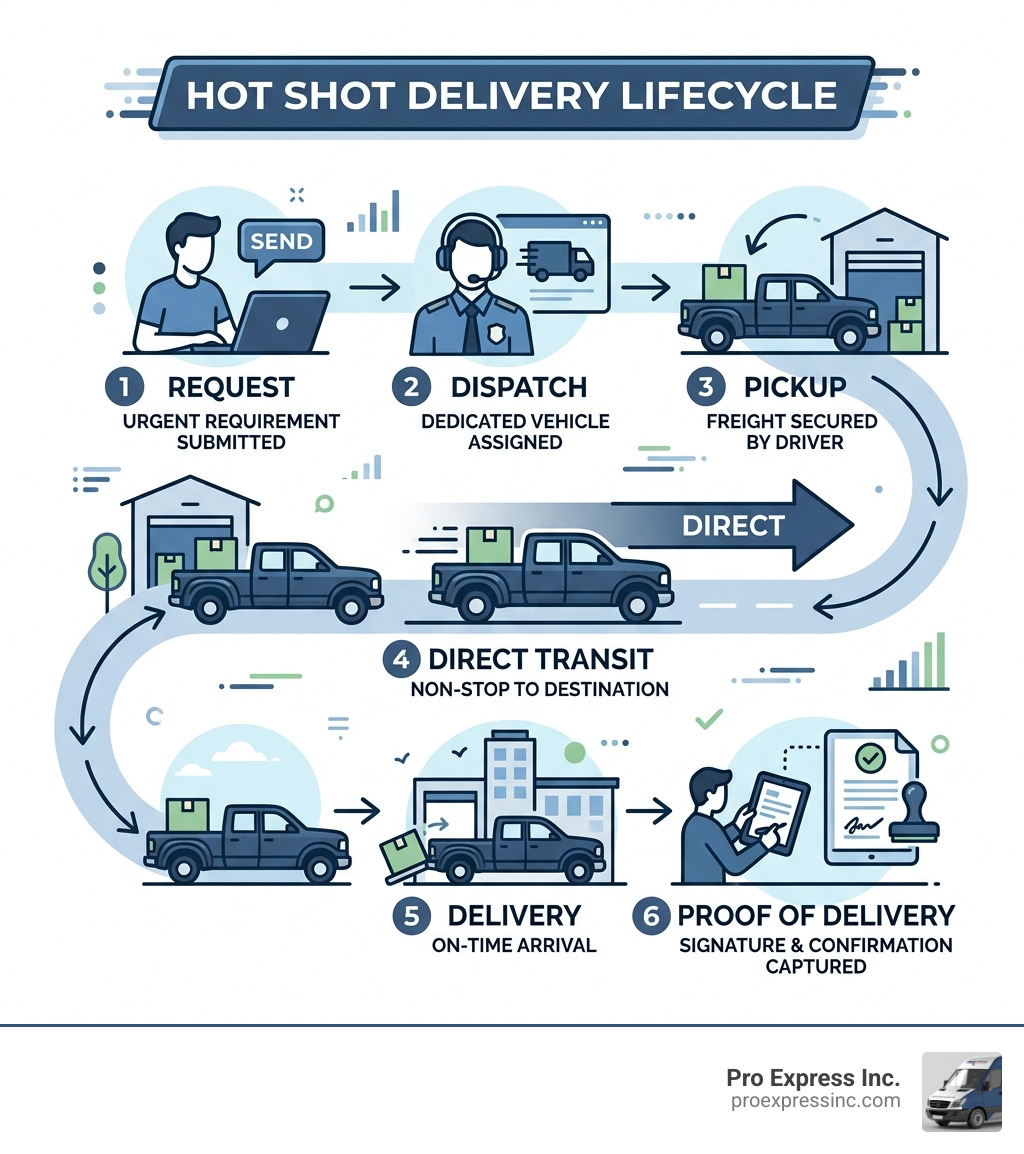
Getting a hot shot delivery moving is designed to be as fast as the delivery itself.
- Cargo Specification: You provide the pickup location, destination, and the dimensions/weight of the load.
- Vehicle Matching: We match your load to the most efficient vehicle—whether it’s a sprinter van for a single pallet or a 40-foot gooseneck for heavy machinery.
- Immediate Dispatch: We don’t wait for a schedule. We find the nearest driver in our network to head to your location.
- Direct Transit: The driver goes straight from your dock to the destination. No stops, no detours.
- 24/7 Support: Our team monitors the shipment around the clock, maintaining a strict chain of custody until the final signature is captured.
Frequently Asked Questions about Hot Shot Delivery
What is the difference between hot shot and expedited delivery?
While the terms are often used interchangeably, “expedited” is a broad category that includes air freight and van couriers. Hot shot delivery is a specific niche within expedited shipping that focuses on ground transport using medium-duty trucks and trailers for dedicated, one-time loads.
Do hot shot drivers need a CDL?
Not always. If the total weight of the truck, trailer, and load is under 26,001 pounds, a driver can often operate without a CDL. However, they still must comply with DOT safety regulations, medical exams, and logbook requirements.
What industries use hot shot services most frequently?
The most frequent users are manufacturing, construction, energy (oil/gas), and aerospace. Any industry where the cost of a delay is significantly higher than the cost of a dedicated truck will benefit from hot shot services.
Conclusion
When your regular carrier fails or a critical deadline is at risk, you need a partner who understands that “tomorrow” isn’t good enough. At Pro Express Inc., we have nearly two decades of experience in ensuring time-sensitive deliveries reach their destination without a hitch.
With over 6,000 successful shipments and a 99% client satisfaction rate, we provide the US-wide ground expedited solutions your business needs to stay operational. Our 24/7 reliability means we are always ready to move, whether it’s a holiday, a weekend, or 3 a.m. on a Tuesday.
Stop letting carrier failures and hub delays dictate your production schedule. Choose the speed and dedication of a proven logistics leader.
Request a Quote for Exclusive Hot Shots Today or contact us to see how our fleet can solve your toughest logistics challenges.