
When Every Hour Counts: Your Guide to Next Day Mail Delivery
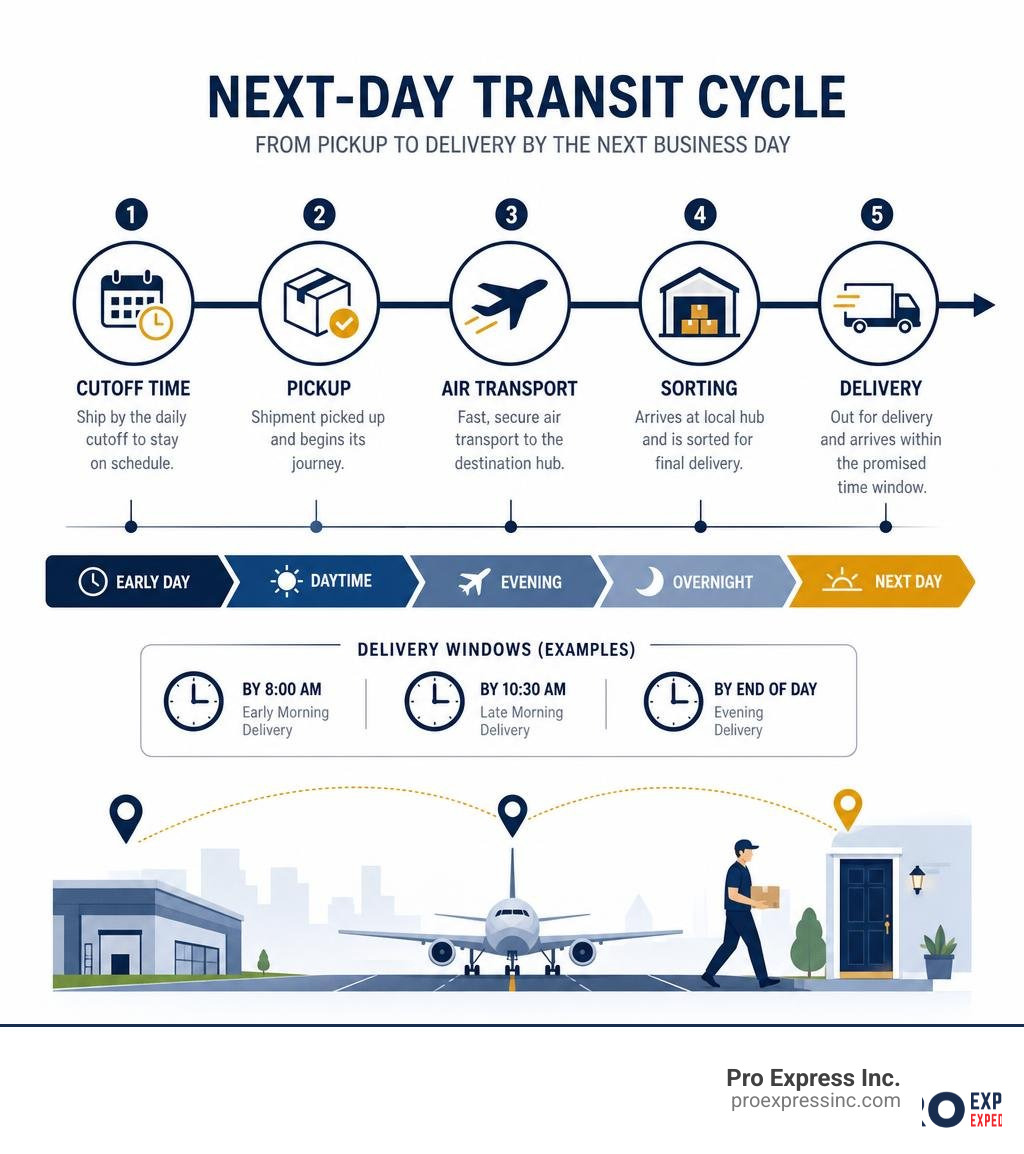
Next day mail delivery is a guaranteed shipping service that gets your shipment to its destination by the following business day — typically within a specific time window such as 8:00 a.m., 10:30 a.m., or end of day.
Here’s a quick breakdown of the main service tiers available for urgent shipments:
| Service Tier | Typical Delivery Window | Operational Focus |
|---|---|---|
| Early Morning | By 8:00 a.m. – 9:00 a.m. | Critical parts, urgent documents, and manufacturing inputs |
| Mid-Morning | By 10:30 a.m. – 12:00 p.m. | High-priority business replenishment and inventory |
| End of Day | By 5:00 p.m. – 6:00 p.m. | Standard expedited business shipments |
For logistics managers and operations teams, the difference between “delivered on time” and “missed the window” can mean a halted production line, a failed compliance deadline, or a lost client. That pressure is real — and it’s exactly why understanding your next day delivery options matters.
Nearly 40% of online shoppers have abandoned a cart due to slow shipping options. In B2B logistics, the stakes are even higher. Time-sensitive freight doesn’t wait for a carrier that can’t commit.
In this guide, Pro Express Inc. — with 17+ years of experience in expedited freight and time-critical logistics — breaks down everything you need to know: how next day delivery works, which service fits your shipment, and what to do when your regular carrier falls short.
Key terms for next day mail delivery:
Understanding Next Day Mail Delivery and How It Works

When an operational emergency strikes, standard transit schedules simply will not suffice. To move critical parts, legal documents, or medical supplies across the country overnight, logistics networks must operate with surgical precision.
To understand the mechanics of next day mail delivery, it helps to look behind the scenes of the modern logistics network. The entire process relies on a highly coordinated system of evening collections, regional sorting hubs, dedicated air transport fleets, and early-morning ground distribution. The underlying hub-and-spoke distribution model allows carriers and expedited logistics providers to consolidate freight through key facilities, then push shipments rapidly toward final delivery routes. When you drop off a time-critical shipment or schedule an evening pickup, your cargo does not sit in a warehouse. It is immediately routed to a local processing center, loaded onto a cargo aircraft or an expedited ground vehicle, and transported through a network designed to keep freight moving continuously through the night.
For businesses looking to integrate these high-speed options into their operations, checking out a foundational resource like Next Day Delivery 101 is an excellent way to grasp the core logistics structures that keep North American supply chains moving.
Key Differences Between Standard Shipping and Next Day Mail Delivery
Standard shipping is built for volume and predictable schedules, often resulting in transit times that span several business days. Under standard protocols, shipments may sit at regional hubs waiting for trucks to reach maximum capacity before dispatching.
In contrast, next day delivery prioritizes velocity and guaranteed transit windows. Key differences include:
- Dedicated Routing: Next-day shipments bypass standard consolidation queues and are loaded directly onto the fastest available transport.
- Transit Priority: From sorting facilities to the final mile, expedited cargo receives physical “first-on, first-off” loading priority.
- Supply Chain Velocity: Instead of moving only during standard business hours, next-day networks operate 24/7, utilizing overnight flights and team drivers to eliminate dwell time.
For a deeper dive into how these expedited systems operate compared to standard ground routes, you can consult our comprehensive overnight shipping guidelines.
Critical Cutoff Times and Transit Processes
The most important operational detail of any overnight shipment is the cutoff time. Because transport aircraft and expedited ground networks must depart on strict schedules to meet morning delivery guarantees, carriers enforce rigid cutoff times – typically between 4:00 p.m. and 6:00 p.m. local time.
If your shipment is not processed, labeled, and in the carrier’s possession by this deadline, it will not ship until the following day, delaying delivery by a full 24 hours. Managing these tight windows requires proactive coordination. To learn how to streamline your internal processes so you never miss a critical dispatch window, read Next Day Shipping: A Guide for People Who Needed It Yesterday.
Operational Requirements for Expedited Shipments

To guarantee that a critical shipment arrives safely and on time, shippers must adhere to strict operational guidelines. When cargo is moving at maximum speed through automated sorting hubs and rapid transit vehicles, improper packaging or incorrect labeling can lead to immediate delays or damage.
For logistics managers, understanding how to prepare and package time-critical shipments is just as important as choosing the right transport method. You can find detailed preparation advice in The Ultimate Guide to Expedited Shipping.
Weight, Size, and Packaging Standards for Next Day Mail Delivery
Standard parcel networks and expedited freight systems enforce distinct physical limitations. While small documents and parcels can easily utilize flat-rate packaging, larger industrial shipments require robust preparation:
- Weight and Size Thresholds: Standard overnight parcel services generally handle packages up to 150 lbs. For items exceeding this limit, specialized expedited freight services are required.
- Palletization: Heavy or bulk shipments must be securely banded and stretch-wrapped to pallets with a minimum of 3.5 inches of forklift clearance. This ensures rapid loading and unloading during tight transit windows.
- Nonstandard Shapes: Shipments with irregular dimensions or non-stackable configurations may require specialized handling and can be subject to additional operational requirements.
To ensure your cargo meets all compliance rules for rapid transit without getting held up at a sorting facility, review our guide on expedited shipping standards.
Delivery Time Guarantees and Time-Definite Windows
When shipping high-value or time-sensitive cargo, you cannot rely on “end of day” estimates. Most overnight services offer specific, time-definite delivery windows. These typically range from early morning commitments (such as 8:00 a.m. or 9:00 a.m.) for critical documents and manufacturing components, to mid-day or late afternoon deliveries for general business replenishment.
Selecting the right window requires balancing the urgency of your operations with the capabilities of your logistics provider. For a practical look at how to secure early morning delivery slots reliably, read our breakdown on How to Get Next Day Morning Delivery Without the Reddit Rants.
Navigating Carrier Restrictions and Service Exceptions
Even the most sophisticated logistics networks encounter operational boundaries. Severe weather, regional infrastructure bottlenecks, and remote destinations can all impact the feasibility of next-day transit. For operations managers, knowing these limitations in advance is key to maintaining supply chain resilience.
Understanding the strengths and limitations of overland expedited transport is crucial; learn more by exploring our insights on Expedited Ground Shipping.
Geographic Limitations and Delivery Exceptions
While next-day delivery is widely available across major metropolitan areas in North America, remote or rural locations often present challenges. Deliveries to locations outside major transit corridors—such as certain regions in Alaska, Hawaii, or rural areas—may require an additional transit day or specialized transport solutions.
For example, geographic constraints in remote regions often alter standard overnight commitments. To learn how to navigate regional routing challenges and ensure your cargo reaches its destination on time, read our guide on regional transit specifications.
Tracking, Insurance, and Proof of Delivery Features
When shipping critical business assets, real-time visibility and security are non-negotiable. Modern expedited services offer advanced tracking and risk mitigation features to ensure your peace of mind:
| Feature | Standard Express | Premium Ground Expedited |
|---|---|---|
| Tracking Frequency | Milestone-based scans | Real-time GPS tracking |
| Proof of Delivery | Standard signature | Photo, signature, and direct confirmation |
| Liability Coverage | Limited standard coverage | High-value declared protection options |
| Customer Support | Automated hotlines | 24/7 dedicated dispatch teams |
For standard shipments, utilizing advanced tracking and liability coverage is essential to protect high-value cargo. To ensure complete visibility and security during transit, operations teams should partner with providers that offer real-time updates and dedicated support, bypassing the limitations of standard postal networks.
Frequently Asked Questions About Expedited Shipping
What is the latest cutoff time for next-day transit?
For most standard national networks, the cutoff time for next-day transit ranges between 4:00 p.m. and 6:00 p.m. local time at the origin facility. However, specialized ground-expedited and hot-shot services can often accommodate later pickups because they utilize dedicated vehicles that bypass traditional carrier sorting hubs entirely.
How do time-definite delivery windows work?
Time-definite delivery windows are service commitments guaranteed by the carrier. When a shipment is booked under a specific time-definite tier (such as pre-9:00 a.m. or pre-noon), the logistics network prioritizes that cargo during morning sorting and routes it onto the first delivery vehicles dispatched for the day.
What happens if a time-critical shipment is delayed?
If a time-critical shipment is delayed due to weather, mechanical issues, or carrier failures, standard carriers may offer a service refund depending on their terms. However, in B2B operations, a refund does not solve a down assembly line. That is why having a backup plan with a dedicated expedited partner is essential for rapid recovery logistics.
Conclusion
When standard shipping networks experience disruptions, missed cutoff times, or capacity bottlenecks, your business cannot afford to wait. Securing a reliable partner for your most critical logistics challenges is the key to keeping your operations running smoothly.
At Pro Express Inc., we provide fast, dependable ground-expedited shipping services across the United States, Alaska, Hawaii, and North America. With nearly two decades of experience, we specialize in:
- Same-day, next-day, and hot-shot delivery
- White-glove and two-man delivery services
- Liftgate-equipped vehicles and expedited freight transport
- 24/7 dedicated customer support to monitor your shipments in real time
With over 6,000 shipments successfully delivered and a 99% client satisfaction rating, we are the trusted partner logistics managers call when failure is not an option.
Don’t let shipping delays disrupt your supply chain. Request a Quote Today and let our team handle your next urgent shipment with the speed and care it deserves.