
When Your Shipment Can’t Wait: Understanding Expedited Parcel Shipping
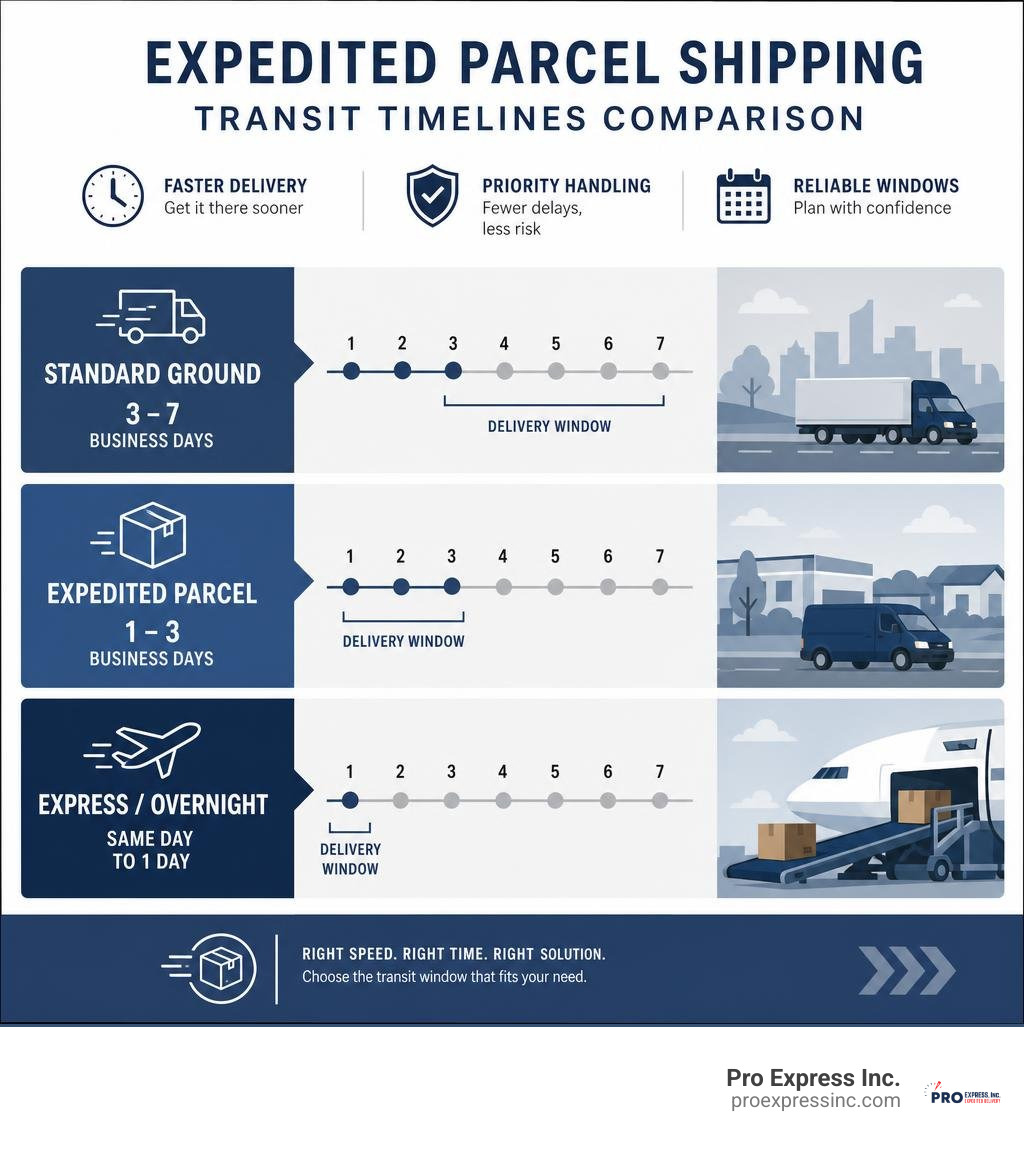
Expedited parcel shipping is a faster-than-standard delivery service that moves time-sensitive freight in 1–3 business days — compared to 3–7 days for standard ground shipping. It sits between standard ground and express shipping in terms of speed, cost, and priority handling.
Quick answer for logistics managers:
| Service Type | Typical Transit Time | Best For |
|---|---|---|
| Standard Ground | 3–7 business days | Non-urgent, cost-sensitive freight |
| Expedited Parcel | 1–3 business days | Time-sensitive B2B shipments |
| Express / Overnight | Same day to 1 day | Critical emergencies, line-down situations |
Your regular carrier just failed. A production line is at risk. A client deadline is two hours away. These are the moments when knowing your expedited shipping options — and having a reliable freight broker already on the phone — is the difference between a close call and a costly disruption.
Expedited parcel shipping isn’t just about moving faster. It’s about priority routing, fewer handoffs, and firm delivery windows that protect your operations when it matters most.
At Pro Express Inc., with nearly 20 years of experience coordinating time-critical freight and 10,000+ shipments arranged through a vetted carrier network, we’ve seen what happens when businesses don’t have a backup plan. This guide gives you the clarity to act fast and choose right.
Handy expedited parcel shipping terms:
What is Expedited Parcel Shipping and How Does It Work?
In high-stakes business-to-business (B2B) logistics, speed is more than a convenience—it is a operational requirement. When standard transit schedules threaten your timelines, high-priority shipping services step in to bridge the gap.
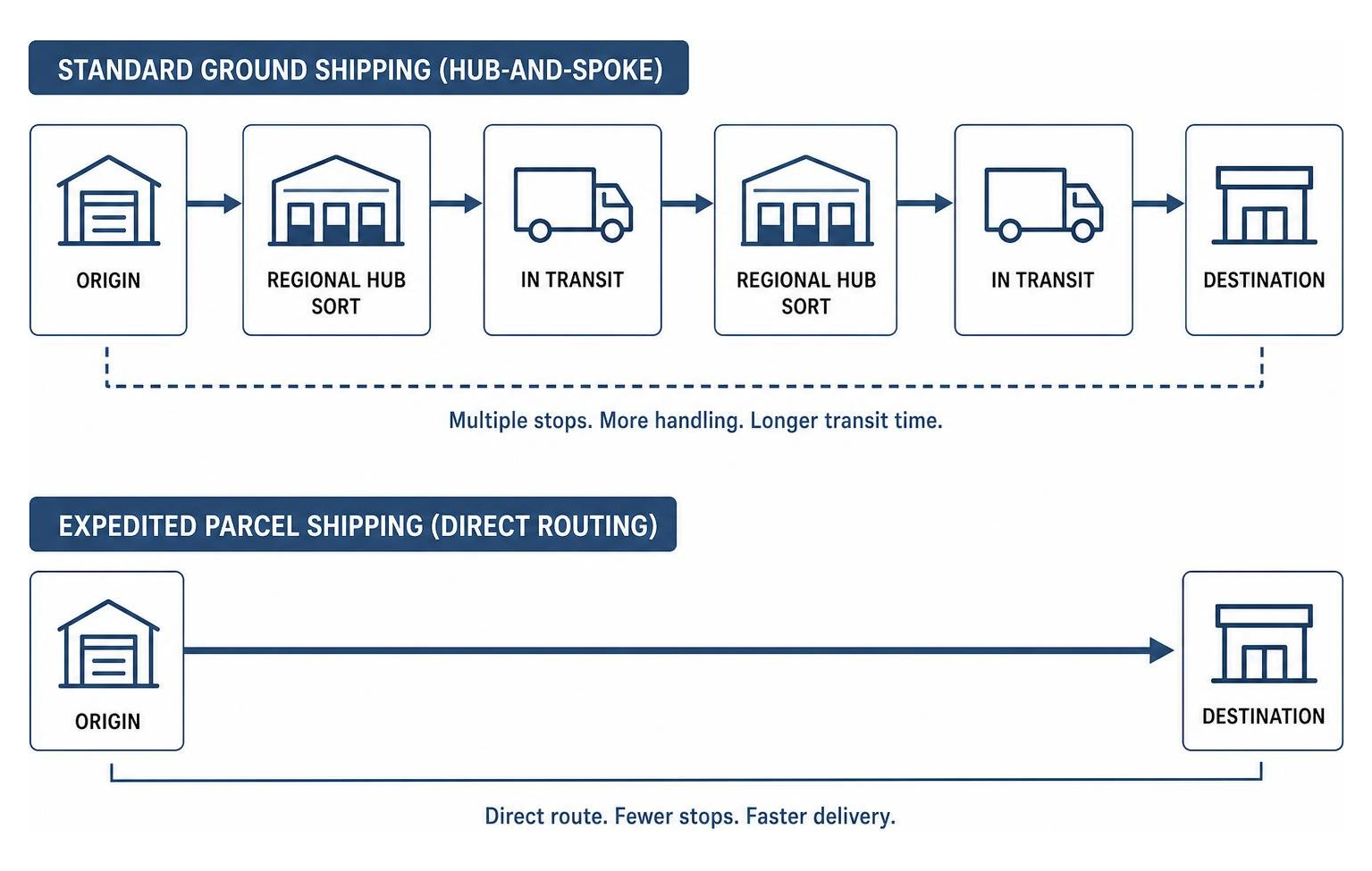
According to our Expedited Shipping: Your Complete 2026 Guide, the core mechanism of expedited transport relies on reducing the idle time a shipment spends in warehouses, distribution hubs, and sorting facilities. Standard shipping methods operate on a consolidation model, where cargo is held until a vehicle is completely full, often stopping at multiple terminals along the route.
Expedited logistics, by contrast, prioritizes direct routing. The moment a critical parcel is ready, it is dispatched. By skipping the traditional consolidation phase and bypassing regional sorting centers, the transit timeline is compressed. This specialized workflow ensures that urgent cargo remains in continuous motion from the point of origin directly to the destination.
Defining Expedited Parcel Shipping in B2B Logistics
Within B2B logistics, expedited parcel shipping represents a highly structured tier of transit designed for commercial cargo that must arrive ahead of standard schedules. Unlike residential parcel delivery, B2B expedited shipping is engineered to support complex supply chains, sensitive medical networks, and demanding manufacturing schedules.
As outlined in Expedited shipping: The ultimate guide to …, this class of shipping involves dedicated handling protocols. It is characterized by strict business-day cutoff times, direct terminal-to-terminal routing, and a significant reduction in physical touchpoints. Because every handoff introduces a potential risk of delay or damage, minimizing physical handling is crucial for maintaining both transit speed and cargo integrity. For logistics managers, this service serves as a reliable mechanism to keep operations running smoothly when time is the limiting factor.
Expedited vs. Standard and Express Shipping
Understanding the distinction between standard, expedited, and express shipping tiers is essential for making informed logistics decisions. Each tier serves a specific operational purpose based on the level of urgency.
- Standard Shipping: This is the baseline ground service. It is highly consolidated, relies on regional sorting hubs, and features the longest transit windows (typically 3 to 7 business days). It is best suited for routine inventory replenishment where delivery dates are flexible.
- Expedited Shipping: This tier accelerates transit by bypassing intermediate hub stops and utilizing direct routing. Delivery is typically completed within 1 to 3 business days. It serves as the primary solution for time-critical commercial cargo that must meet strict delivery windows.
- Express Shipping: This represents the fastest possible transit level, often utilizing air transport or dedicated hot-shot ground services to achieve same-day or next-day delivery. It is reserved for critical emergencies where any delay carries severe operational consequences.
| Logistics Metric | Standard Ground Shipping | Expedited Parcel Shipping | Express / Overnight Shipping |
|---|---|---|---|
| Typical Transit Window | 3 to 7 Business Days | 1 to 3 Business Days | Same-Day to Next-Day |
| Routing Method | Hub-and-Spoke Consolidation | Direct Terminal-to-Terminal | Direct Routing / Air Freight |
| Handling Frequency | High (Multiple Hub Sorts) | Minimal (Direct Handling) | Absolute Minimum |
| Primary Use Case | Routine Stock Replenishment | Critical B2B Shipments | Production Emergencies |
Key Features of High-Priority Shipping Services
When coordinating high-priority shipments, success relies on specialized service features that go far beyond standard parcel transport. High-priority logistics requires a combination of continuous tracking, enhanced security, and specialized physical handling to ensure cargo arrives safely and on time.
Real-Time Tracking and Visibility
For high-priority shipments, standard tracking updates are insufficient. When cargo is time-sensitive, logistics coordinators rely on continuous, real-time visibility. Modern tracking systems utilize advanced GPS monitoring and cellular sensor technology to provide constant status updates.
Instead of waiting for a package to be scanned at a physical terminal, logistics managers can monitor the exact location of the transport vehicle throughout its journey. This level of oversight is discussed in detail in our resource on Tracking Your Package at 3 AM and Other Expedited Service Perks. Real-time visibility allows logistics teams to verify milestones as they happen, receive immediate notifications of any transit deviations, and proactively manage receiving operations at the destination.
Specialized Handling and Delivery Options
Urgent commercial cargo often requires more than just rapid transit; it frequently demands specialized handling at the point of pickup and delivery. High-priority shipping services offer tailored solutions to accommodate complex delivery environments:
- White Glove Service: This option is designed for highly sensitive, high-value, or delicate equipment. It includes careful loading, unloading, and inside placement by experienced professionals, ensuring the cargo is protected at every stage.
- Liftgate Service: Many commercial destinations lack a dedicated loading dock. In these scenarios, vehicles equipped with hydraulic liftgates are arranged to safely lower heavy cargo from the truck bed to ground level.
- Two-Man Delivery Teams: For heavy, bulky, or awkward shipments, coordinating a two-man delivery team ensures that cargo is handled safely without risking damage to the items or the facility.
- Inside Delivery: Rather than leaving critical shipments at a loading dock or entryway, inside delivery ensures the cargo is brought directly into the designated office, lab, or production floor.
When to Choose Expedited Ground Shipping for Your Business
Deciding when to transition a shipment from standard ground to an expedited service requires a careful evaluation of your operational needs. While standard ground is highly efficient for routine freight, certain business scenarios demand the speed and reliability of expedited coordination.
Critical Scenarios for Expedited Parcel Shipping
For many businesses, utilizing Expedited Ground Shipping is a strategic decision to prevent costly operational disruptions. Several key scenarios call for high-priority ground transport:
- Production Line-Down Situations: In manufacturing, a single missing component can halt an entire production line, resulting in significant idle-labor costs. Arranging a hot-shot delivery for the required parts is essential to restore operations immediately.
- Medical and Pharmaceutical Replenishment: Healthcare facilities rely on the steady, urgent delivery of medical devices, diagnostic equipment, and temperature-sensitive pharmaceuticals. Ensuring these items arrive within tight, guaranteed windows is critical for patient care.
- Automotive Supply Chain Demands: The automotive industry operates on strict just-in-time manufacturing schedules. Upstream delays can quickly cascade, making expedited ground shipping necessary to keep assembly plants on schedule.
- Strict Retail Compliance Windows: Large retailers enforce demanding delivery windows. Missing these slots often results in financial penalties or chargebacks. Expedited delivery helps businesses meet these strict compliance targets consistently.
To learn more about managing these high-stress situations, explore our guide on Beating the Clock with Expert Time-Sensitive Shipments.
Mitigating Carrier Failures and Supply Chain Disruptions
Even the most carefully planned supply chains can experience unexpected disruptions. Weather events, terminal backlogs, and standard carrier service failures can leave critical cargo stranded in transit.
When a primary carrier fails to meet a deadline, having a reliable backup logistics strategy is vital. Partnering with a freight broker that maintains a vetted carrier network allows you to quickly arrange alternative transport. This specialized backup system ensures that when standard networks fail, your urgent cargo is immediately recovered and rerouted via dedicated ground transport, protecting your business from extended downtime.
Navigating Cross-Border and Nationwide Expedited Logistics
Managing expedited shipments across long distances or international borders requires specialized expertise. Whether you are shipping nationwide—including to challenging destinations like Alaska and Hawaii—or coordinating cross-border transport, navigating regulatory and physical requirements is key to maintaining speed.
For cross-border shipping, such as moving cargo between Canada and the United States, customs clearance is often the most common source of delay. Utilizing established services like the Expedited Parcel – USA – Canada Post framework highlights the importance of complete documentation and pre-clearance protocols. To keep cross-border shipments moving without interruption, all customs paperwork, commercial invoices, and harmonized system (HS) codes must be perfectly prepared before the vehicle departs.
Weight, Size, and Packaging Requirements
To ensure expedited cargo moves through transit networks without delay, shipments must comply with specific physical requirements. When coordinating parcel and light freight shipments, understanding these physical boundaries is essential:
- Weight Restrictions: Standard expedited parcel services typically accommodate packages up to 70 lbs or 150 lbs, depending on the carrier network. For shipments exceeding these weights, specialized expedited freight solutions must be arranged.
- Dimensional Limits: Combined length and girth measurements must stay within strict limits to avoid nonstandard handling delays. Shippers should refer to guidelines like the Priority Mail Express Shipping | USPS specifications to ensure their packaging meets standard requirements.
- Packaging Standards: High-priority cargo must be packaged in durable, double-walled corrugated boxes or properly secured on sturdy pallets. Proper cushioning, secure sealing, and clear, unobstructed labeling are critical to preventing transit damage and sorting errors.
Frequently Asked Questions about Expedited Shipping
How fast is expedited ground shipping compared to standard?
Expedited ground shipping significantly reduces transit times compared to standard services. While standard ground shipping typically takes 3 to 7 business days to move cargo across the country, expedited ground services complete deliveries in 1 to 3 business days. For regional shipments, expedited transit can often achieve same-day or next-day delivery by utilizing direct routing and avoiding time-consuming hub transfers. Learn more about these transit standards by reading about Expedited Ground Services.
What industries rely most on expedited freight services?
High-priority shipping services are vital across several key industries where timing is critical:
- Automotive: To keep assembly lines running and support just-in-time manufacturing.
- Medical & Pharmaceutical: For the urgent delivery of lifesaving medical devices, temperature-sensitive medicine, and clinical trial materials.
- Manufacturing: To transport critical replacement parts and raw materials, preventing costly production downtime.
- High-End Lighting & Electronics: For high-value cargo requiring specialized, secure transport.
For a deeper look into industry-specific logistics, check out The Complete Guide to Expedited Freight Services 2026 Guide.
How do businesses integrate expedited shipping into their operations?
Businesses can integrate expedited shipping into their daily operations by partnering with an experienced third-party logistics (3PL) provider or freight broker. This partnership gives logistics managers access to a vetted carrier network and advanced Transportation Management Systems (TMS). By integrating these tools, businesses can quickly arrange expedited transport, monitor shipments in real time, and easily scale their logistics operations to handle unexpected disruptions.
Conclusion
In the world of B2B logistics, having a reliable partner for your most urgent shipments is essential. Since 2007, Pro Express Inc. has specialized in coordinating time-critical ground shipping across the nation. Founded by Peter Jałowiec, we have spent nearly 20 years building a trusted reputation, successfully arranging more than 10,000 shipments with an exceptional 99% client satisfaction rate.
We connect businesses with an extensively vetted carrier network to coordinate same-day, next-day, and hot-shot deliveries. Whether your operations require specialized solutions like liftgate transport, two-man delivery teams, or white glove handling, we have the expertise to arrange the exact service you need.
Don’t let a carrier failure or a tight deadline disrupt your business. Contact our logistics specialists today to secure your supply chain.