
What You Need to Know About Overseas Parcel Delivery
Overseas parcel delivery is the process of shipping goods across international borders — and getting it right requires more than just dropping a box at the post office.
Here is a quick overview of the main options available:
| Service Type | Typical Transit Time | Best For |
|---|---|---|
| Express/Expedited | 1-3 business days | Time-sensitive, high-value shipments |
| Standard | 3-10 business days | Reliable delivery, moderate urgency |
| Economy | 10+ business days | Non-urgent, high-volume freight |
| Economy Sea Mail | 2-3 months | Bulk, non-urgent consignments |
Key things every shipper needs to know:
- Major global carriers reach over 200 countries and territories
- Customs forms and accurate item declarations are mandatory — errors cause delays, rejections, or seizures
- Weight limits vary significantly by carrier and service tier (ranging from lightweight postal limits up to 150 lbs or more for commercial express networks)
- Tracking, insurance, and signature options differ by service tier and destination
- Prohibited and restricted items vary by country — always verify before shipping
For logistics managers handling time-sensitive international freight, the stakes are high. A missed customs declaration, the wrong service tier, or a carrier that lacks reach in your destination country can derail an entire supply chain. Global cross-border eCommerce is projected to reach $2.2 trillion by 2026 — meaning competition for reliable international delivery capacity is only intensifying.
This guide breaks down everything operations and logistics professionals need to make confident, informed decisions on international shipments — from service selection and customs compliance to packaging, tracking, and bulk shipping tools.
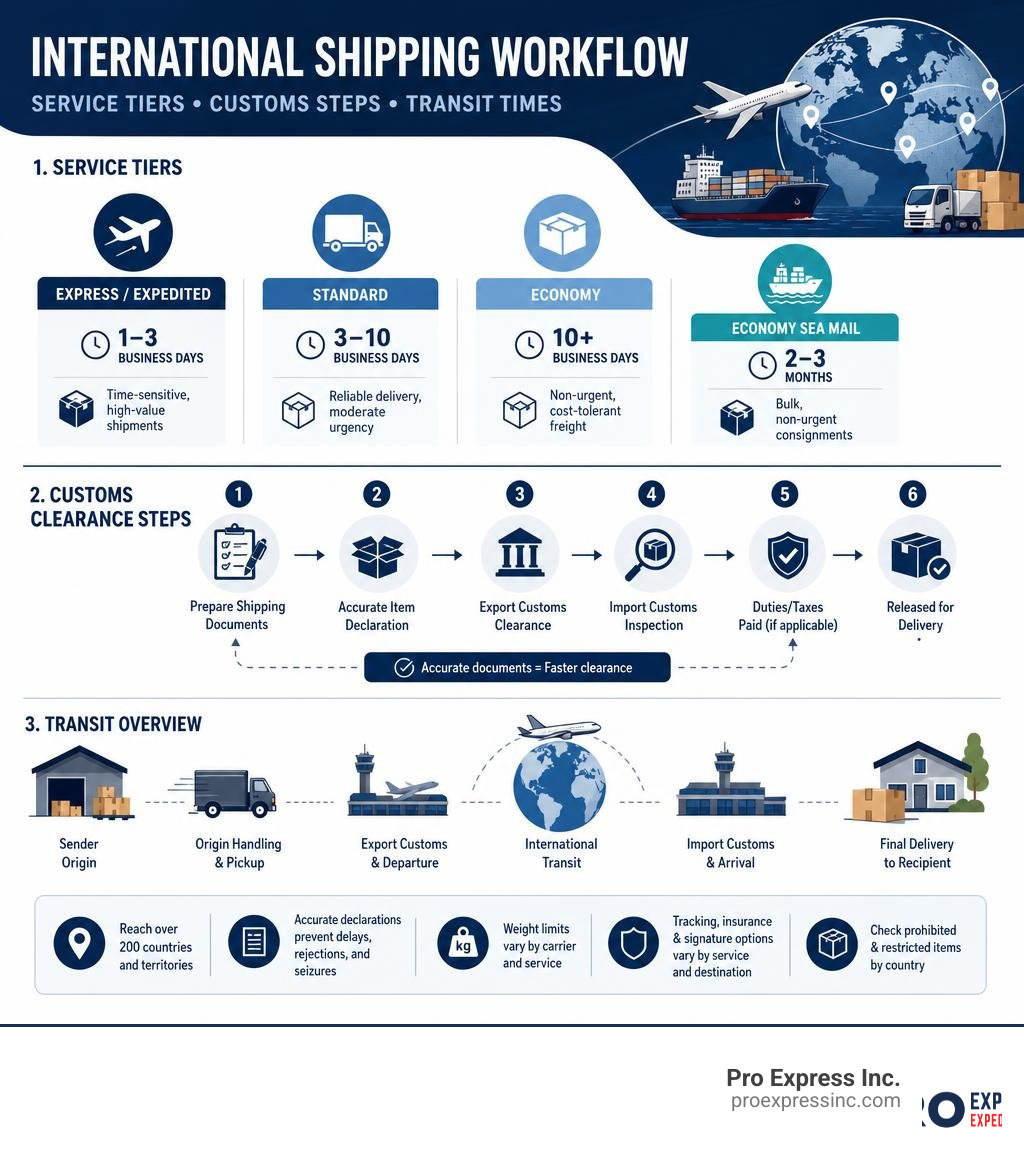
Simple guide to overseas parcel delivery:
Key Service Tiers for Overseas Parcel Delivery
When managing global supply chains, selecting the correct service tier is a balancing act between urgency, cargo safety, and transit guarantees. Every shipment has different requirements, and relying on a single speed tier for every scenario can lead to operational inefficiencies.

To navigate the complex world of international shipping, logistics managers must evaluate carriers based on their operational footprints, customs handling capabilities, and transit guarantees. To understand how various global carriers stack up, consult this comprehensive resource on the Top 10 International Shipping Services – The Complete Guide.
Express and Expedited Overseas Parcel Delivery Options
For critical shipments where delays are not an option, express and expedited services provide time-definite, prioritized transit. These services rely on dedicated air logistics networks and cargo aircraft to bypass standard postal bottlenecks, offering end-to-end visibility and priority customs clearance.
If your operations require immediate, high-priority transport, understanding the underlying mechanics of priority logistics is essential. You can learn more about managing high-velocity shipments in The Ultimate Guide to Expedited Shipping.
Expedited services typically guarantee delivery within 1 to 3 business days to major global hubs. Features of these premium services include:
- Time-Definite Delivery: Specific morning commitments (such as 9:00 AM, 10:00 AM, or noon) to key international markets.
- Priority Customs Handling: Electronic customs pre-clearance while the aircraft is in transit, minimizing tarmac delays.
- Enhanced Security: Strict chain-of-custody protocols, making them ideal for high-value industrial components, medical devices, and sensitive legal documentation.
Standard and Economy Overseas Parcel Delivery Services
For shipments where speed is secondary to reliable day-definite delivery, standard and economy tiers offer a dependable alternative. These services are highly effective for replenishing inventory, shipping non-critical service parts, or fulfilling standard customer orders.
Standard services generally leverage a mix of commercial air transport and local postal networks, yielding transit times of 3 to 10 business days. While standard services operate on a slightly longer timeline, they still provide milestone tracking and basic liability coverage.
For businesses coordinating deliveries with international networks, understanding how global postal agencies structure their tiered offerings can provide valuable operational context. Standard international handoffs are typically managed across borders through bilateral postal agreements, ensuring reliable final-mile delivery even for non-urgent cargo.
Navigating Customs, Compliance, and Documentation
The most common point of failure in overseas parcel delivery is the customs clearance process. When a shipment crosses international borders, it must comply with the strict regulatory standards of both the exporting and importing nations. A single documentation error can result in impounded freight, unexpected regulatory fees, or complete shipment rejection.

For organizations dealing with complex distribution networks, establishing a robust compliance workflow is critical. Manufacturers and distributors face unique challenges when moving specialized components across borders. To optimize your operational approach to heavy-duty and bulk logistics, read our specialized guide on B2B Shipping for Manufacturers Distributors.
Essential Customs Declarations and Forms
Every international shipment requires clear, accurate documentation that details the exact nature of the goods being transported. The primary documents used in global trade include:
- Commercial Invoices: The foundational document for customs clearance. It must state the shipper and recipient details, a detailed description of the contents, the country of origin, and the transaction value.
- CN22 and CN23 Customs Declarations: Used primarily for postal channel shipments. These forms require precise descriptions, weight metrics, and Harmonized System (HS) codes.
- Electronic Advance Data (EAD): Many destination countries require digital transmission of customs information prior to the physical arrival of the package. Failure to transmit EAD can lead to automatic returns.
A critical compliance update for all North American shippers: effective August 29, 2025, the de minimis exemption for U.S. imports under $800 was suspended. This regulatory shift means that duties and taxes now apply to all commercial imports entering the United States, requiring absolute accuracy in documentation to prevent severe border delays.
Prohibited and Restricted Items Globally
Before preparing an international shipment, logistics managers must verify that the contents are legally permitted to enter the destination country. Failing to identify restricted or prohibited items can lead to immediate confiscation and regulatory penalties.
- Dangerous Goods: Items such as lithium batteries, aerosol cans, flammable liquids, and certain chemical compounds must adhere strictly to International Air Transport Association (IATA) Dangerous Goods Regulations.
- Country-Specific Prohibitions: Many nations restrict the import of specific materials to protect local industries or biosecurity. For example, agricultural products, textiles, and specific electronics may require specialized import permits.
- Regulatory Verification: Always cross-reference the destination country’s individual registry listings. If you are shipping specialized equipment or batteries, ensure the packaging carries the appropriate warning labels and is accompanied by a Material Safety Data Sheet (MSDS).
Best Practices for Packaging and Preparing Shipments
International transit subjects cargo to significant physical stress. From automated sorting conveyors to turbulent flights and multiple handling points, your packaging must be engineered to withstand the journey. Proper preparation prevents physical damage and ensures the carrier’s automated systems can process your shipment without delay.
Familiarizing your team with warehouse packaging standards is a simple way to eliminate transit damage. For a complete breakdown of packaging fundamentals, review Sending a Parcel 101.
Accurate Measurement and Labeling
Carriers calculate capacity and transit requirements using both physical weight and dimensional (volumetric) weight. Accurate measurements prevent unexpected adjustments and ensure proper vehicle allocation.
- Volumetric Weight Formula: Most international carriers use a standard volumetric calculation. For example, the metric formula is: $$text{Volumetric Weight (kg)} = text{Height (m)} times text{Length (m)} times text{Depth (m)} times 200$$ The shipment will be billed based on whichever is greater: the actual physical weight or the volumetric weight.
- Address Formatting: International addresses must follow the specific conventions of the destination country. Ensure the recipient’s name, street, postal code, and province are clearly legible. Always write the destination country name in BLOCK CAPITALS on the final line of the address.
- Duplicate Address Slips: A highly recommended practice is to place a duplicate copy of the shipping label and the commercial invoice inside the box before sealing it. If the exterior label is scraped off during transit, customs officials or carrier staff can open the package and retrieve the routing information.
Securing Tracking, Insurance, and Signature Options
For high-value or time-sensitive B2B shipments, maintaining visibility and security throughout the delivery cycle is paramount. Standard shipping options should be augmented with professional tracking and security features:
- End-to-End Tracking: Ensure your selected service tier provides real-time tracking updates across all transit legs, including international handoffs.
- Signature on Delivery: Restricts delivery to authorized personnel at the destination facility, providing an indisputable proof of delivery (POD) record.
- Declared Value Coverage: Standard carrier liability is often limited. For high-value cargo, secure additional insurance coverage to protect against loss or damage during transit.
To understand the logistics of scheduling pickups and managing cargo handoffs from your facility, read our guide on Everything You Need to Know About a Parcel Pickup Service.
Streamlining B2B Logistics and Bulk Shipping Operations
For enterprises managing high-volume international shipping, manual processing of individual labels and customs forms is highly inefficient. Streamlining your global logistics requires integrating automated software, leveraging consolidated shipping systems, and coordinating with expert domestic expedited networks to manage critical first-mile and last-mile operations.
To optimize the domestic legs of your global supply chain, check out our insights on Expedited Ground Shipping.
When shipping to non-contiguous US states or specialized domestic regions, standard shipping networks can struggle with speed and reliability. Navigating these regional challenges requires specialized knowledge. For shipments heading to the far north, read the Shipping to Alaska Guide to understand the unique transit requirements of the region. Likewise, if you are coordinating deliveries to the Pacific, consult the resource on Shipping to Hawaii Options or partner with an experienced domestic expedited carrier like Pro Express Inc. to maintain operational velocity across non-contiguous routes.
Frequently Asked Questions about International Shipping
What are the standard size and weight limits for international shipments?
Size and weight limits vary depending on the carrier and service tier. For standard postal channels, the maximum weight is typically 70 lbs (approx. 31.5 kg) per package, with a maximum combined length and girth of 108 inches.
Express carriers can accommodate larger shipments, with limits extending up to 150 lbs (68 kg) per individual package and dimensions up to 108 inches in single-side length. For detailed specifications, always consult your selected carrier’s official service directory before preparing your cargo.
How can businesses prevent customs delays for overseas shipments?
The most effective way to prevent customs delays is to ensure absolute accuracy and completeness of your documentation. Always provide precise descriptions of the items (e.g., “stainless steel industrial valves” instead of “hardware parts”) and include the correct 6-digit HS Tariff codes. Additionally, utilize digital customs submission tools to transmit your Electronic Advance Data (EAD) to the importing customs authority before the shipment physical arrives at the border.
What is the difference between DDU and DTP delivery terms?
These terms define who is responsible for paying import duties and taxes:
- Delivery Duty Unpaid (DDU): The recipient is responsible for paying all import duties, VAT, and local customs fees before the package is released by customs. This can cause delivery delays if the recipient is unprepared to pay.
- Delivered Taxes Paid (DTP / DDP): The sender assumes full responsibility for all import duties and taxes. The carrier bills these fees back to the sender, allowing the package to clear customs seamlessly and proceed directly to delivery without recipient intervention.
Conclusion
Successfully executing overseas parcel delivery requires careful planning, strict regulatory compliance, and robust operational execution. When standard shipping networks face bottlenecks or critical deadlines are at risk, having a premium, highly responsive logistics partner is the key to maintaining supply chain integrity.
Pro Express Inc. provides fast, reliable ground-expedited shipping services—including same-day, next-day, hot-shot, and white glove delivery—engineered specifically for time-sensitive B2B logistics. With US-wide operations (including seamless coverage to Alaska and Hawaii) and nearly two decades of experience, we have successfully managed over 10,000 critical shipments with a 99% client satisfaction rate. Supported by our 24/7 customer service team, we ensure your high-priority cargo moves without delay.
When your regular carrier fails or an urgent shipment demands immediate action, do not let your supply chain stall. Partner with the expedited logistics experts. Contact Us Today to Request a Quote and experience the difference of premium, high-velocity transport.