
Why Fragile Parcel Delivery Fails — And How to Get It Right
Fragile parcel delivery is one of the highest-risk operations in logistics — and the numbers prove it.
Quick answer: How to ship fragile items safely
- Assess the item — identify fragility, weight, dimensions, and impact sensitivity
- Choose the right container — use a new, double-walled corrugated box with a minimum 32 ECT rating
- Wrap individually — apply at least 3 inches of air-cellular cushioning around every item
- Fill all voids — eliminate internal movement with foam, packing peanuts, or air pillows
- Seal securely — use the H-taping method with pressure-sensitive tape on every seam
- Label correctly — mark “Fragile,” “This Side Up,” and orientation arrows on multiple sides
- Choose the right carrier — use a dedicated, expedited service with real-time tracking and a no-double-handling policy
Somewhere between 7% and 12% of home deliveries arrive damaged. About 10% of all packages get damaged in the mail. With over 15 billion packages shipped in 2022 and 2023 alone (according to the Pitney Bowes Shipping Index), that puts roughly 1.5 billion shipments at risk of damage.
For logistics managers handling high-value or time-sensitive cargo, that’s not a statistic — it’s a business crisis waiting to happen.
The hard truth? Most fragile shipment failures aren’t the carrier’s fault alone. Inadequate cushioning, wrong box sizes, poor sealing, and skipping proper labeling are the leading causes of damage. And when a shipment fails, 81% of those returns trace back to damage in transit.
At Pro Express Inc., we’ve handled thousands of critical, high-value shipments across the US — and we know exactly where the process breaks down. This guide walks you through 7 proven steps to make sure your next fragile shipment arrives intact, on time, and without costly claims.
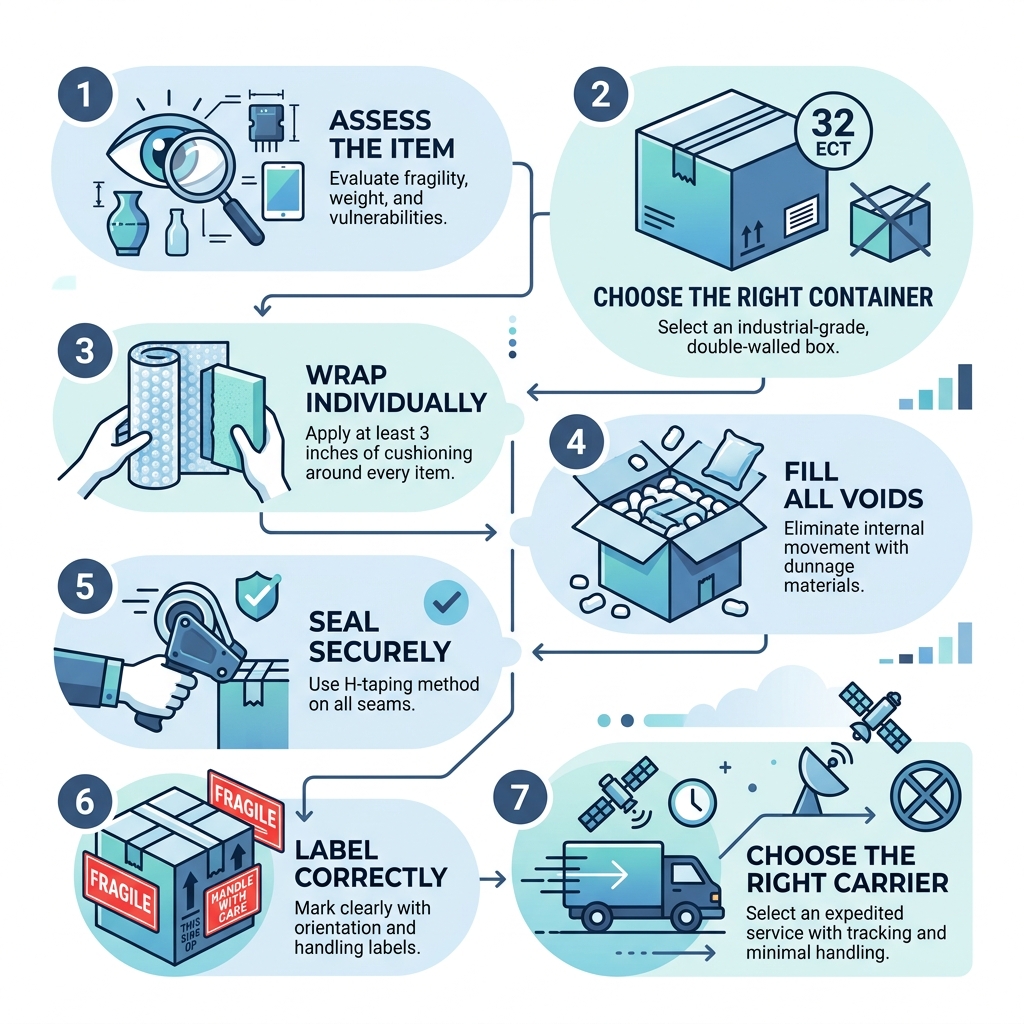
Step 1 & 2: Assessing Risk and Selecting Industrial-Grade Containers
Before a single piece of tape touches a box, we must understand the nature of the cargo. A “one-size-fits-all” approach is the fastest way to end up with a broken shipment. Every fragile parcel delivery begins with a rigorous item inspection and fragility assessment.
We look at more than just the price tag. We evaluate the item’s weight, dimensions, and specific vulnerabilities. Is it sensitive to vibrations? Does it have protruding parts that could snap under pressure? Is it susceptible to temperature fluctuations? Understanding these factors allows us to build a protective barrier that actually works.
Identifying High-Value Fragile Parcel Delivery Requirements
Different types of freight require vastly different levels of “TLC.” For instance, sensitive electronics often require anti-static environments and moisture barriers to prevent internal component failure. Fine art and antiques may need acid-free tissue paper to protect delicate surfaces from chemical reactions with packing materials.
Medical equipment and laboratory instruments often have internal calibration that can be thrown off by even minor impacts. When the stakes are this high, standard shipping protocols aren’t enough. You need specialized courier delivery services that understand the nuances of high-value, impact-sensitive freight.
Container Specifications for Heavy-Duty Protection
The box is your first line of defense. For fragile parcel delivery, we never recommend reusing old boxes. Every time a corrugated box is handled, its structural integrity degrades. Instead, we insist on new, double-walled corrugated boxes.
Pay close attention to the Manufacturer’s Stamp, which lists the Edge Crush Test (ECT) rating. For fragile or heavy items, a minimum 32 ECT rating is the industry standard, though higher ratings are often necessary for industrial equipment.
We also utilize the “box-in-box” method for maximum security. This involves placing the wrapped item in an inner box, then placing that box inside a larger outer container. A critical rule of thumb is the 6cm (or roughly 2-inch) clearance rule: there should be at least 6cm of space between the inner box and the walls of the outer box to allow for sufficient cushioning.
Step 3 & 4: Precision Wrapping and Internal Cushioning Standards
Once the right container is selected, the goal is to create a “floating” environment for the item. If an item can move inside the box, it can break. Our standard for fragile parcel delivery is zero movement.
Advanced Cushioning for Fragile Parcel Delivery
Effective cushioning is about shock absorption and vibration dampening. We recommend wrapping each item individually in a minimum of 3 inches of air-cellular cushioning (bubble wrap). For heavy industrial goods, we often move beyond standard bubbles to foam-in-place systems or molded inserts that contour exactly to the item’s shape.
For electronics, anti-static materials are non-negotiable. Standard plastic wrap can create static discharge that fries circuit boards before the package is even opened. In these cases, specialized pink anti-static bubble wrap or conductive foam is required to ensure the item arrives in working order.
Wrapping Techniques for Irregularly Shaped Freight
Not everything fits perfectly in a square. When dealing with irregularly shaped freight—like specialized machinery parts or large sculptures—we use a multi-layered approach. This starts with surface shielding to prevent scratches, followed by corner protectors to reinforce the most vulnerable points of the object.
Void fillers like packing peanuts, air pillows, or crumpled kraft paper are then used to fill every cubic inch of remaining space. A quick “shake test” is the best way to verify your work: if you feel or hear anything shifting when the box is gently moved, you need more padding. For more complex logistics needs involving non-standard cargo, you can explore our other services designed for specialized transport.

Step 5 & 6: Secure Sealing and Labeling for Fragile Parcel Delivery
A perfectly packed box is useless if it pops open during transit or is handled upside down by a worker who didn’t see the warnings. Sealing and labeling are the final “software” updates to your physical “hardware” protection.
Why Orientation Matters in Fragile Parcel Delivery
We use the “H-taping” method for all fragile parcel delivery shipments. This involves applying a strip of pressure-sensitive, nylon-reinforced tape across the center seam and both end seams of the box, forming the letter “H.” This seals every possible point of entry for dust or moisture and prevents the flaps from sagging.
Labeling must be redundant and highly visible. “Fragile” and “Handle with Care” stickers should be placed on every side of the box. Even more important are “This Side Up” indicators and upward arrows. These tell logistics handlers how to orient the package on a truck or pallet to ensure the center of gravity remains stable and delicate components aren’t resting on their weakest points.
Visibility and Real-Time Monitoring
In modern logistics, “out of sight” should never mean “out of mind.” Real-time tracking is a critical component of managing high-stakes deliveries. By utilizing advanced logistics services, shippers can gain total visibility into their cargo’s journey.
For the most sensitive shipments, we go beyond standard GPS. IoT shock sensors can be attached to the freight to monitor for excessive G-forces, while temperature sensors ensure climate-sensitive items stay within their required range. If an “exception” occurs—such as a route delay or a handling alert—our 24/7 support team receives a notification instantly, allowing for proactive problem-solving before the delivery is compromised.
Step 7: Selecting Expedited Logistics for Critical Shipments
The final and most important step in fragile parcel delivery is choosing the right transportation model. Traditional hub-and-spoke networks involve multiple “touchpoints” where your box is moved from a van to a conveyor belt, to a sorter, to a long-haul truck, and back again. Every “touch” is a new opportunity for damage.
Eliminating Transit Risks with Dedicated Transport
To minimize risk, we advocate for a “no-double-handling” policy. This is achieved through ground-expedited services like hot-shot trucking or point-to-point delivery. In this model, your cargo is loaded onto a vehicle and stays there until it reaches its destination.
For items that require more than just transport, white glove services provide the ultimate level of care. This often includes two-man handling teams, liftgate-equipped vehicles to prevent jarring drops, and inside delivery or setup at the final destination.
Frequently Asked Questions about Fragile Parcel Delivery
What are the most common causes of damage during transit?
Inadequate internal cushioning is the number one culprit. When items have room to move, they gain momentum during shifts in the vehicle, leading to high-impact collisions with the box walls. Other common causes include using the wrong box size, reusing weakened containers, and failing to use proper “This Side Up” labeling.
When is double-boxing necessary for high-value freight?
Double-boxing is recommended for any item that is extremely fragile, has a high financial value (typically over $500), or is irreplaceable. It provides two layers of structural protection and an extra buffer zone of cushioning that can absorb significant external impacts.
How does real-time tracking improve fragile shipment security?
Real-time tracking allows logistics managers to monitor for “exceptions.” If a truck is stuck in extreme weather or a package is diverted, the shipper can intervene. Advanced sensors can even detect if a package has been tilted or dropped, providing immediate documentation for insurance purposes and allowing for an inspection as soon as the item arrives.
Conclusion
At Pro Express Inc., we believe that fragile parcel delivery shouldn’t be a gamble. With nearly two decades of experience and over 10,000 successful shipments delivered, we’ve maintained a 99% client satisfaction rate by treating every piece of freight as if it were irreplaceable.
From our 24/7 customer support to our carrier network capable of same-day and hot-shot deliveries across the US, we provide the reliability that standard carriers simply can’t match. Whether you’re shipping sensitive medical tech to Hawaii or fine art across the continental United States, our team has the expertise to get it there in one piece.
Don’t leave your critical shipments to chance. When your regular carrier fails or a deadline is at risk, trust the experts who specialize in urgency and precision.