
When Your Shipment Can’t Wait Until Tomorrow
Next day shipping is exactly what it sounds like: you order or tender a shipment today, and it arrives at its destination the following business day.
For logistics managers handling time-sensitive freight, that single sentence carries a lot of weight.
Here’s a quick breakdown of how next-day delivery compares to other shipping speeds:
| Shipping Method | Typical Transit Time | Best For |
|---|---|---|
| Same-Day | Hours (same calendar day) | Extreme urgency, local runs |
| Next Day | Next business day | Urgent freight, SLA commitments |
| 2-Day | 2 business days | Planned replenishment |
| Standard | 3–6 business days | Non-urgent, cost-sensitive loads |
But here’s the reality: next-day shipping is only as good as the network behind it.
Cutoff times, service area coverage, freight type, carrier reliability — all of it determines whether that “next day” promise holds when your production line is down or a client is waiting on a critical delivery.
This guide breaks down exactly how next-day shipping works in real operations — from service tiers and cutoff windows to carrier commitments and what to do when your regular carrier fails you.
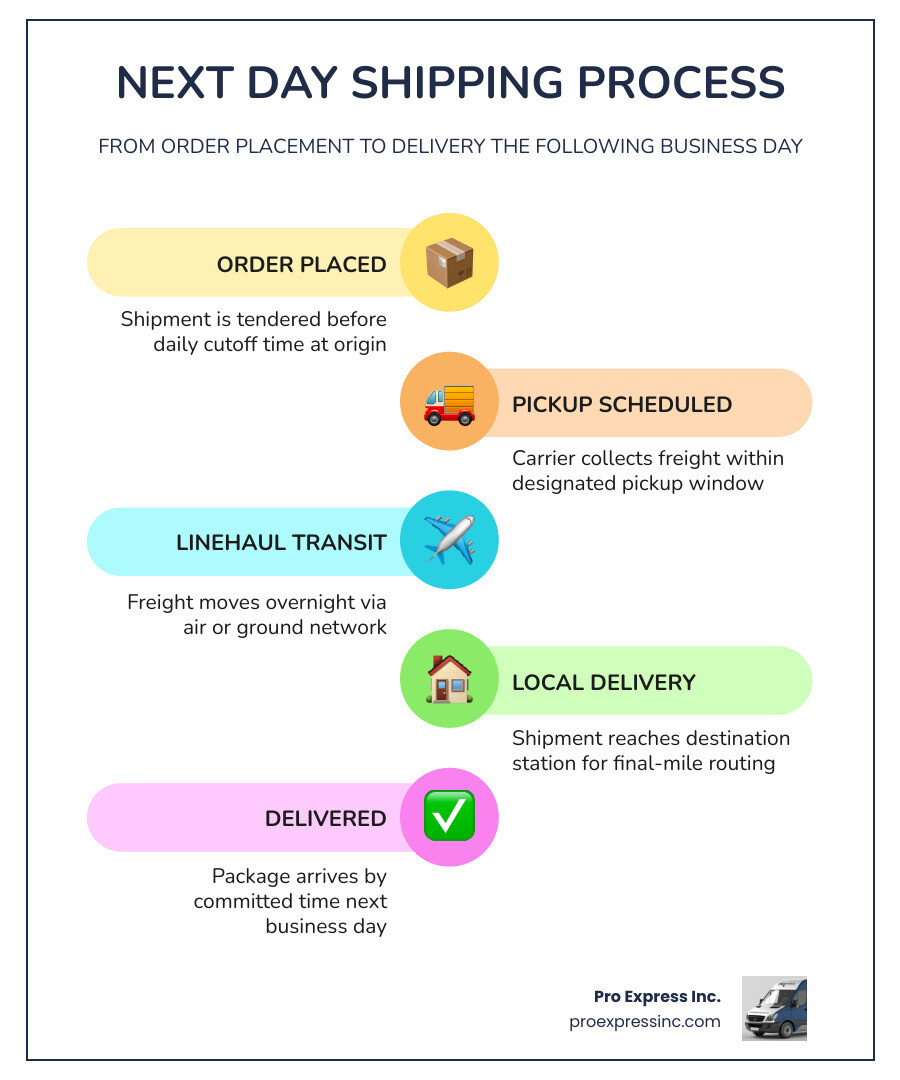
Next day shipping terms to learn:
What Next Day Shipping Means in Real Operations
In logistics, next day shipping usually means next-business-day delivery, not automatically “within 24 hours.” That distinction matters. A shipment picked up late on Friday may not land on Saturday unless that lane and service level support weekend delivery.
In real operations, the promise depends on five things:
- When the shipment is ready
- The local cutoff time
- Origin and destination service areas
- The type of freight being moved
- Whether the provider can control handoffs and exceptions
For business shippers, next-day service is less about speed for speed’s sake and more about protecting uptime, customer commitments, and production schedules.
Next day shipping vs same-day delivery vs standard shipping
Same-day delivery means pickup and delivery happen on the same calendar day. It is the right fit when every hour matters: line-down emergencies, replacement parts, medical logistics, or critical legal documents.
Next day shipping gives you more planning room. It still moves fast, but it usually relies on a defined tender window today for delivery tomorrow. That makes it ideal for urgent but manageable deadlines.
Standard shipping is the opposite end of the spectrum. It is designed for routine freight that can move through a broader network over several business days.
A simple way to think about it:
- Same-day = emergency
- Next-day = urgent
- Standard = planned
The funny part is that “overnight” sounds dramatic, but in practice it often just means next-business-day service with a specific delivery window.
When next day shipping is the right choice for shippers
Next-day service makes sense when delay creates operational pain. Common examples include:
- Inventory replenishment before a stockout hits
- Service parts needed before the next shift
- Medical or laboratory shipments with strict timing
- Legal or compliance documents with hard deadlines
- Customer SLA commitments that cannot slip
- Retail or field service support where missed delivery creates downstream failure
If your team is constantly balancing urgency against control, our Next Day Delivery 101 guide goes deeper into how these services are typically structured.
Why reliability matters more than speed alone
A fast promise is useless if nobody can tell you where the shipment is.
That is why reliability usually beats raw speed. Operations teams care about:
- Tracking visibility
- Clear proof of delivery
- Fewer handoffs
- Faster exception response
- Better communication when something goes wrong
Many missed commitments happen not because the lane is impossible, but because a shipment was handed off too many times, scanned incorrectly, or discovered too late when a delay could no longer be fixed.
That is also why we put so much value on time-sensitive execution and after-hours support. For a closer look at that side of the process, see Beating the Clock with Expert Time-Sensitive Shipments.
Service Levels, Cutoff Times, and Delivery Commitments
Not all next-day services are created equal. “Next day” can mean early morning, mid-morning, noon, afternoon, or end-of-day delivery depending on the provider and lane.
Common next-day service tiers and commit times
Across the market, the most common next-day tiers look like this:
| Service Tier | Typical Commit Window |
|---|---|
| Early morning | 8:00 a.m. to 9:30 a.m. |
| Mid-morning | Around 10:30 a.m. |
| Noon service | By 12:00 p.m. |
| Afternoon service | Around 3:00 p.m. to 5:00 p.m. |
| End-of-day service | Later in the delivery day depending on the lane |
Examples from major U.S. shipping networks show how these windows vary:
- Overnight parcel and freight providers commonly offer early-morning, mid-morning, and later next-business-day options depending on the destination.
- Postal express services may offer 1 to 3 day delivery with tracking and limited guarantees in eligible cases.
- Air express networks typically provide multiple next-day tiers with time-definite commitments by lane.
- Regional carriers may publish narrow commit windows such as 8:30 a.m., 10:30 a.m., or 3:00 p.m. within their own footprints.
- For palletized shipments over 150 lbs., next-business-day freight service may be available in qualifying lanes with morning or midday commitments.
The key takeaway: always ask for the actual commit time, not just the label “next day.”
How cutoff times affect eligibility for next day shipping
Cutoff time is the gatekeeper. Miss it, and tomorrow becomes “tomorrow-ish.”
Eligibility depends on:
- Local station or terminal hours
- Whether pickup is required or drop-off is allowed
- Warehouse pack-out speed
- Label creation time
- Distance between origin and destination ZIP codes
- Whether the shipment needs special handling
A retailer may show a checkout message such as “order by 3:45 p.m. local time for next-day delivery.” Another market might allow orders until 6:00 p.m. local time. In many operations, order-by times vary by metro, item type, and fulfillment point.

For carriers, the same principle applies operationally:
- Late tender can miss the outbound linehaul
- Missed sort windows can push freight a full day
- Pickup windows may close earlier than published drop-off times
- Special services like liftgate or inside delivery may require more lead time
So if the freight is critical, do not ask only, “Can it get there tomorrow?” Ask, “What is the latest tender time for this exact lane and service type?”
Weekend, holiday, and rural-area exceptions to expect
This is where many next-day promises get tripped up.
Common exceptions include:
- Saturday delivery available only in select ZIP codes or markets
- Sunday or holiday service limited to certain providers and locations
- Rural or extended-area destinations with later delivery windows
- Alaska and Hawaii lanes with different service standards than the contiguous U.S.
- Peak-season operating changes
For example:
- Sunday and holiday delivery may be available in some major markets for certain express services, usually with extra conditions.
- Saturday delivery is often available only in certain areas for some overnight services.
- Freight providers may offer Saturday pickup or delivery only in major markets.
- Some service references exclude Alaska, Hawaii, or Puerto Rico from standard delivery tables, which is why those shipments should always be checked lane by lane.
Holiday schedules deserve special attention. Some providers also suspend or adjust service guarantees during peak periods or capacity crunches.
Carrier examples of delivery commitments
Here is a simplified comparison of commonly published service windows:
| Provider Type | Example Service | Published Commitment |
|---|---|---|
| Postal express | Priority express service | 1-3 days, guarantee in eligible cases |
| Overnight parcel network | Early overnight | Next business day as early as 8:00 a.m. in many areas |
| Overnight parcel network | Priority overnight | Next business day by about 10:30 a.m. for many businesses |
| Overnight parcel network | Standard overnight | Next business day later in the day |
| Air express network | Next-day air service | Time-definite next-day commitments by lane |
If you want to compare baseline service descriptions from major public networks, review USPS Priority Mail Express and this overview of overnight shipping service options. These examples are useful benchmarks, but for urgent business freight, we always recommend confirming the exact lane, freight profile, and handoff structure before trusting the published standard.
Where Next-Day Availability Changes by Region, Freight Type, and Network
Next-day coverage is never uniform. It changes based on geography, shipment characteristics, and network design.
Metro markets vs rural lanes
Dense metro areas generally get the best next-day coverage because the service density is high. More pickups, more terminals, more linehaul frequency, and more delivery routes create better odds of success.
Retail expansion data shows this clearly. Target announced in May 2026 that next-day delivery would reach 60% of the U.S. population across more than 50 top metro areas. The same company reports broader reach for slower services, including 80% population coverage for same-day delivery and 99% for two-day shipping. That is a useful reminder that faster service is usually narrower service.
Rural lanes, remote areas, and island locations are different:
- Final-mile coverage is thinner
- Delivery windows are broader
- Weekend options are more limited
- Recovery options are fewer if a sort or linehaul is missed
That is especially important in Alaska and Hawaii, where service standards can differ from the contiguous U.S. and some next-day products have lane-specific limitations.
Parcel, freight, and specialized next-day shipments
A document envelope, a pallet, and a white glove delivery do not move through the same operational playbook.
Common categories include:
- Documents and small parcels
- Cartons and boxed commercial shipments
- Palletized freight over 150 lbs.
- Liftgate-required freight
- White glove or inside delivery
- Two-man delivery
- Temperature-sensitive shipments
- Fragile equipment or high-value freight
Public carrier information often draws a hard line at 150 lbs. Under that threshold, parcel-style overnight networks may work. Over it, freight rules and packaging requirements usually take over.
If your shipment is large, sensitive, or requires appointment-based handling, a specialized expedited solution is often the better fit. Our guide on expedited freight covers why.
Why some freight qualifies and some does not
Not every shipment can move next day, even if the lane looks short on a map.
Common blockers include:
- Hazardous materials restrictions
- Oversized dimensions
- Improper packaging
- Fragile contents requiring special handling
- Temperature-control requirements
- Limited-access delivery locations
- Liftgate or inside-delivery needs
- Late freight availability at origin
Parcel carriers may also use dimensional weight, which means large lightweight shipments can be rated by size rather than actual weight. That matters for planning, but operationally the bigger issue is whether the shipment physically fits the network and service lane.
How retailers and marketplaces determine eligibility
Retailers and marketplaces do not promise next-day delivery on every item. Eligibility is usually based on:
- SKU-level rules
- Inventory location
- Fulfillment node proximity
- Item size and handling requirements
- Ship-from-store capability
- Destination ZIP code
- Checkout cutoff time
- Whether the order must be split into multiple shipments
Common eligibility blockers include:
- Oversized items
- Furniture or bulky goods
- Hazardous or regulated goods
- Items stocked too far from destination
- Multi-item carts with mixed availability
- Orders placed after local cutoff
- Remote delivery addresses
That is why one item in a cart may show next-day delivery while another does not.
What Drives Performance in Next Day Shipping
Execution is where theory meets reality. A next-day promise can look perfect at 2:00 p.m. and still fail by morning if the operation is not tight.
The biggest factors behind delays and missed commitments
The most common causes of next-day failure are surprisingly unglamorous:
- Weather disruptions
- Peak-season volume surges
- Late tender from the shipper
- Incorrect or incomplete addresses
- Label and scan errors
- Missed hub connections
- Limited weekend or holiday staffing
- Packaging failures
- Access issues at pickup or delivery
For cross-border shipping, customs can also disrupt expedited timelines, but for domestic U.S. lanes the bigger risks are usually operational and network-related.
How shippers improve next-day success rates
The best operations teams do not just book next-day service. They engineer for success.
That usually means:
- Booking early in the day
- Confirming exact cutoff and commit times
- Staging freight before dispatch
- Using real-time tracking and exception alerts
- Building contingency plans for weather or capacity issues
- Reducing handoffs where possible
- Having an after-hours escalation path
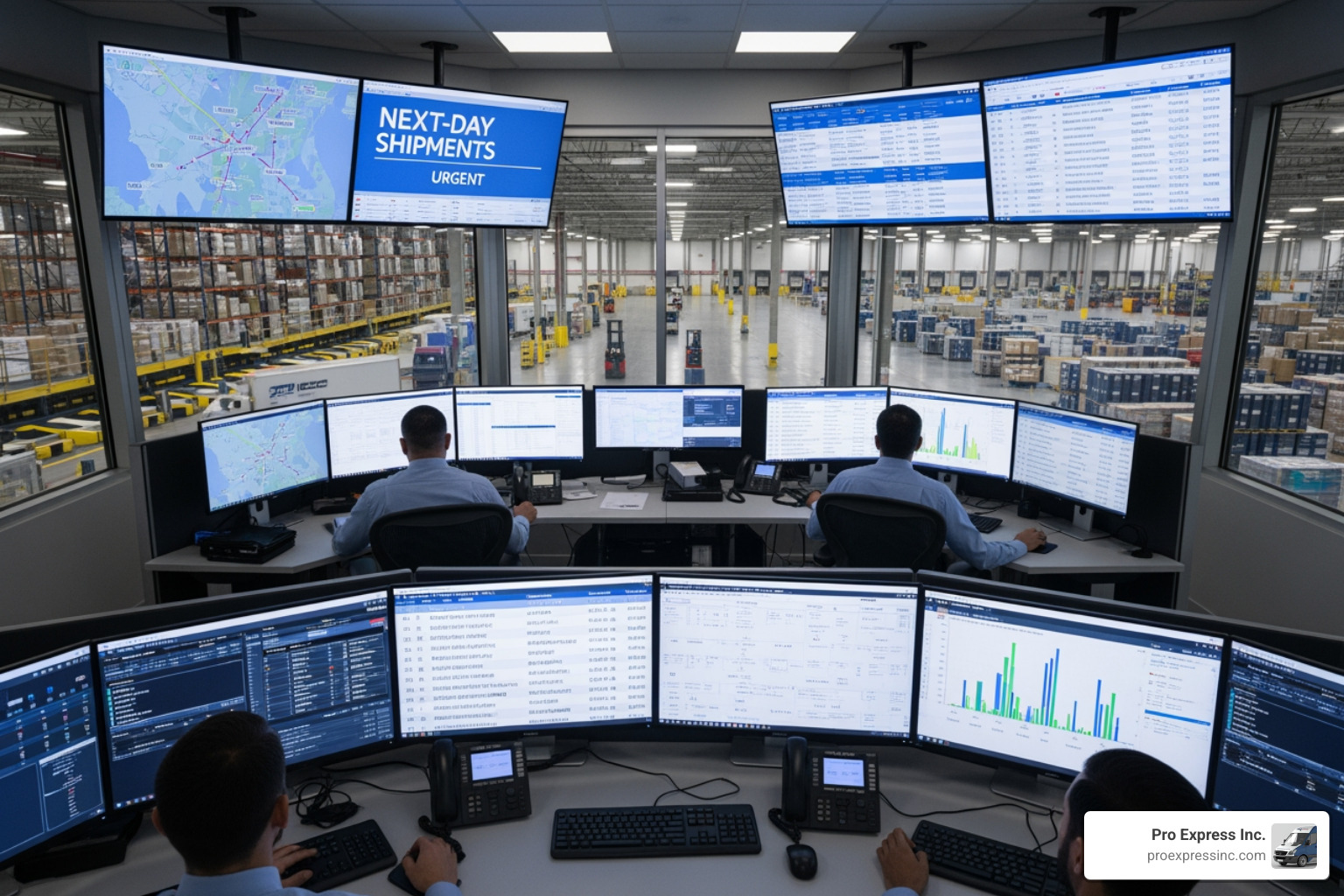
This is where a dedicated expedited partner can outperform a broad network model. When someone is actively managing exceptions instead of simply waiting for the next scan, the odds of recovery improve fast.
When expedited ground beats air-based overnight
Air sounds faster. It is not always the better operational choice.
For regional lanes and short-haul urgent freight, expedited ground can beat air-based overnight because it often involves:
- Fewer handoffs
- Less hub dependency
- More direct dock-to-door control
- Better handling for specialized freight
- Easier recovery when something changes after pickup
That is especially true for hot-shot moves, critical parts, line-down support, and freight requiring liftgate, white glove, or dedicated handling. Our page on expedited ground shipping explains when this model makes more sense.
What operations teams should ask before booking
Before you rely on a next-day commitment, ask these questions:
- What is the latest pickup deadline?
- What is the exact delivery commit time?
- Is the service next-day or next-business-day?
- Are weekends or holidays included?
- Are Alaska or Hawaii exceptions in play?
- Does the shipment require liftgate, appointment, inside delivery, or two-man handling?
- What proof of delivery will be provided?
- How are delivery exceptions escalated?
- What happens if the regular network fails?
Our ultimate guide to expedited shipping is a good next step if your team is comparing service models.
Choosing the Right Next-Day Strategy for Urgent Shipments
The right strategy depends on what you are moving, where it is going, and how much operational risk you can tolerate.
Best fit for documents, parcels, freight, and high-touch deliveries
Here is a practical framework:
- Documents: usually fit air-express or dedicated courier models
- Cartons: may fit parcel overnight or expedited ground depending on lane
- Pallets: often require freight-capable next-day service
- Medical or fragile equipment: may require monitored handling
- White glove deliveries: need appointment coordination and inside placement
- Liftgate freight: needs equipment planning at pickup, delivery, or both
- Two-man deliveries: need labor scheduling, not just transit speed
In other words, “next day” is not a single product. It is a service objective delivered through different operating models.
When to use same-day, next-day, or hot-shot service
Use same-day when waiting until tomorrow causes immediate operational damage.
Use next day shipping when the shipment is urgent but still fits a planned overnight cycle.
Use hot-shot or direct-drive solutions when you need tighter control than a hub-and-spoke network can provide.
Typical decision guide:
- Same-day: line-down emergencies, medical criticals, immediate legal deadlines
- Next-day: replenishment, SLA protection, scheduled service parts
- Hot-shot: direct-run freight, remote lanes, high-value cargo, recovery after network failure
For a broader planning view, see The 24-Hour Shipping Service Survival Guide.
Building a backup plan when your regular carrier fails
If next-day service is mission-critical, your plan cannot stop at “book and hope.”
A solid backup plan includes:
- A secondary expedited provider
- After-hours dispatch support
- Clear escalation contacts
- Alternate routing options
- Shipment recovery procedures
- Real-time status visibility
- A documented playbook for missed scans or delayed tenders
This is exactly where a responsive expedited partner makes a difference. When your regular carrier misses the mark, recovery speed matters as much as linehaul speed. Our article on getting next day morning delivery right walks through that process.
Frequently Asked Questions About Next Day Shipping
Does next day shipping always mean delivery within 24 hours?
No. Usually it means next-business-day delivery if the shipment is tendered before cutoff. Weekends, holidays, and local service rules can change the timeline. A Friday evening pickup may not deliver Saturday unless that lane specifically supports weekend service.
Is next day shipping available for freight and specialized deliveries?
Yes. Next-day service can apply to palletized freight, liftgate freight, white glove shipments, medical logistics, and other specialized moves. The exact option depends on the shipment’s size, handling requirements, and service lane.
What should businesses verify before they rely on a next-day commitment?
Verify:
- Pickup cutoff time
- Delivery commit window
- Service area coverage
- Freight eligibility
- Weekend or holiday limitations
- Tracking visibility
- Proof of delivery process
- Exception handling and after-hours support
Conclusion
When the shipment is urgent, the real question is not whether next day shipping exists. It is whether the service you choose can actually deliver under pressure.
At Pro Express Inc., we focus on speed, urgency, and reliability for businesses that cannot afford missed deliveries. With 17+ years of experience, 6,000+ shipments delivered, 99% client satisfaction, and 24/7 support, we help teams move critical freight through same-day, next-day, hot-shot, white glove, and other time-sensitive logistics services across the U.S., including Alaska and Hawaii.
If your regular carrier has failed, your deadline is at risk, or your freight needs more control than a standard network can provide, do not leave it to chance.
Request a Quote or Contact Us Today to talk with our team about the right expedited solution for your shipment.