
When Your Supply Chain Can’t Wait: What Expedited Transportation Services Actually Mean
Expedited transportation services are specialized shipping solutions designed to move freight faster than standard carriers — using dedicated vehicles, direct routing, and priority handling to meet same-day, next-day, or time-definite deadlines.
Quick answer:
| Feature | Expedited Transportation Services |
|---|---|
| What it is | Priority freight shipping with dedicated capacity and direct delivery |
| Who it’s for | Businesses with time-critical, high-value, or mission-critical freight |
| Key modes | Ground (sprinter van, hot shot, FTL), air freight, air charter |
| Core benefit | Faster transit, no stops, no co-mingling, real-time visibility |
| When to use it | Supply chain emergencies, JIT manufacturing, medical, aerospace, and more |
Every logistics manager has been there. A critical shipment is late. The production line is stalling. Your regular carrier can’t commit to a delivery window. And the clock is running.
This is exactly the scenario expedited freight exists to solve.
Standard shipping moves freight on shared networks — your cargo stops at terminals, gets sorted, and shares space with dozens of other loads. It’s efficient for routine shipments. But when a deadline is non-negotiable, that model breaks down fast.
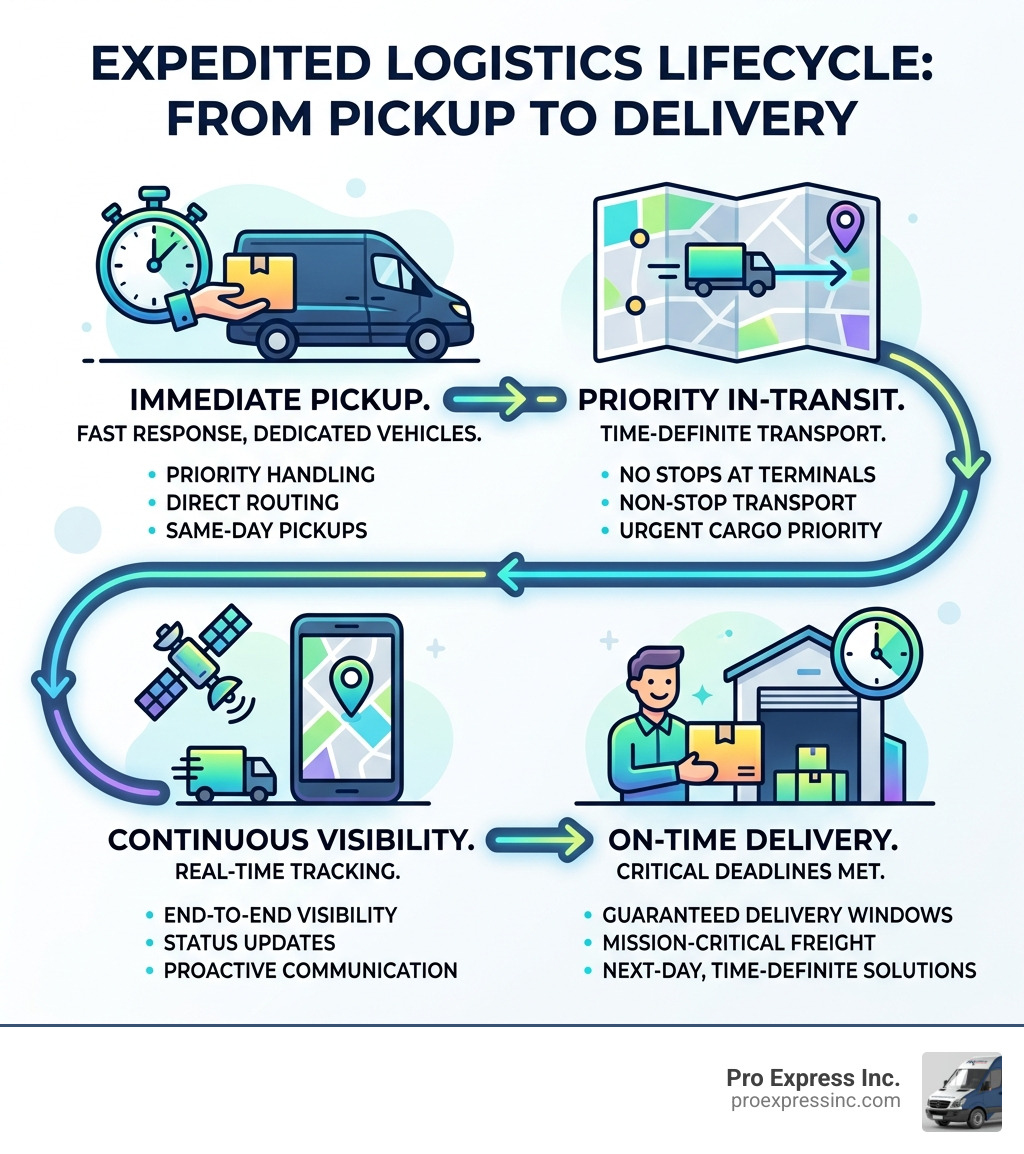
Expedited services work differently. A dedicated vehicle picks up your freight and drives it — without stopping — straight to the destination. No break-bulk terminals. No co-mingling. No waiting on another shipper’s schedule.
The stakes are real. Automotive plants running just-in-time inventory can lose thousands of dollars per hour when a part doesn’t arrive. Hospitals can’t wait on standard transit times for critical medical supplies. A single missed delivery can cascade into a full supply chain disruption.
Pro Express Inc. has spent 17+ years handling exactly these situations — same-day pickups, next-day critical deliveries, and last-minute freight rescues across the US.
Defining expedited transportation services for Mission-Critical Freight
When we talk about mission-critical freight, we aren’t just talking about a package that needs to get there “soon.” We are talking about shipments where every minute of delay has a tangible, often expensive, consequence. The Need for Speed: Top Rapid Response Courier Solutions are built on the philosophy that the cargo must move on your timeline, not the carrier’s convenience.
In expedited transportation services, the primary focus is on time-sensitivity and non-stop delivery. Unlike standard logistics, which might let a trailer sit in a yard for twelve hours waiting for a full load, expedited freight moves the moment it hits the deck. This creates a level of supply chain resilience that allows businesses to recover from manufacturing delays, supplier errors, or unexpected spikes in demand.
To make this work, 24/7/365 support is an absolute necessity. At Pro Express Inc., we know that supply chain emergencies don’t respect business hours. Whether it’s 3 AM on a Tuesday or noon on a Sunday, an expeditor must be ready to source a vehicle and get the wheels turning immediately.
How Expedited Shipping Differs from Standard Freight
The biggest difference lies in the “touch points.” In standard shipping, your freight is handled multiple times. It goes from a local truck to a sorting hub, then perhaps to a long-haul trailer, then another hub, and finally a delivery van. Every touch point is an opportunity for a delay or damage.
Expedited transportation services utilize direct routing. We provide a dedicated vehicle that goes from Point A to Point B with no stops in between. There is no co-mingling, meaning your high-value electronics or sensitive medical equipment isn’t rubbing shoulders with a pallet of garden mulch.
Furthermore, you get a single point of contact. Instead of navigating a massive call center, you work with an expert who knows exactly where your truck is. This leads to real-time visibility that standard freight simply can’t match. If you’ve ever wondered How to Get Next Day Morning Delivery Without the Reddit Rants, the answer is simple: stop using shared networks and start using dedicated expedited capacity.
Core Types of Rapid Response Logistics
Not all urgent freight is the same size. Sometimes you need to move a single box of semiconductor chips; other times, you need to move 20 pallets of automotive stampings. That is why Expedited Ground Services offer a variety of vehicle types to “right-size” the solution.
Courier Delivery Services often utilize:
- Sprinter Vans: Perfect for smaller, palletized loads or loose boxes. They are nimble, fast, and can navigate urban environments easily.
- Straight Trucks: These are the workhorses of the expedited world, often equipped with liftgates for locations without loading docks. They can handle payloads up to 12,500 lbs.
- Full Truckload (FTL): For large-scale emergencies, a dedicated 53-foot trailer with a team of drivers ensures the freight never stops moving, even when one driver needs to sleep.
Ground vs. Air: Choosing the Right expedited transportation services
While ground transport is often the most reliable for regional and mid-distance hauls, some deadlines require the sky. Choosing between ground and air depends on the distance, the weight of the cargo, and the absolute “drop-dead” delivery time.
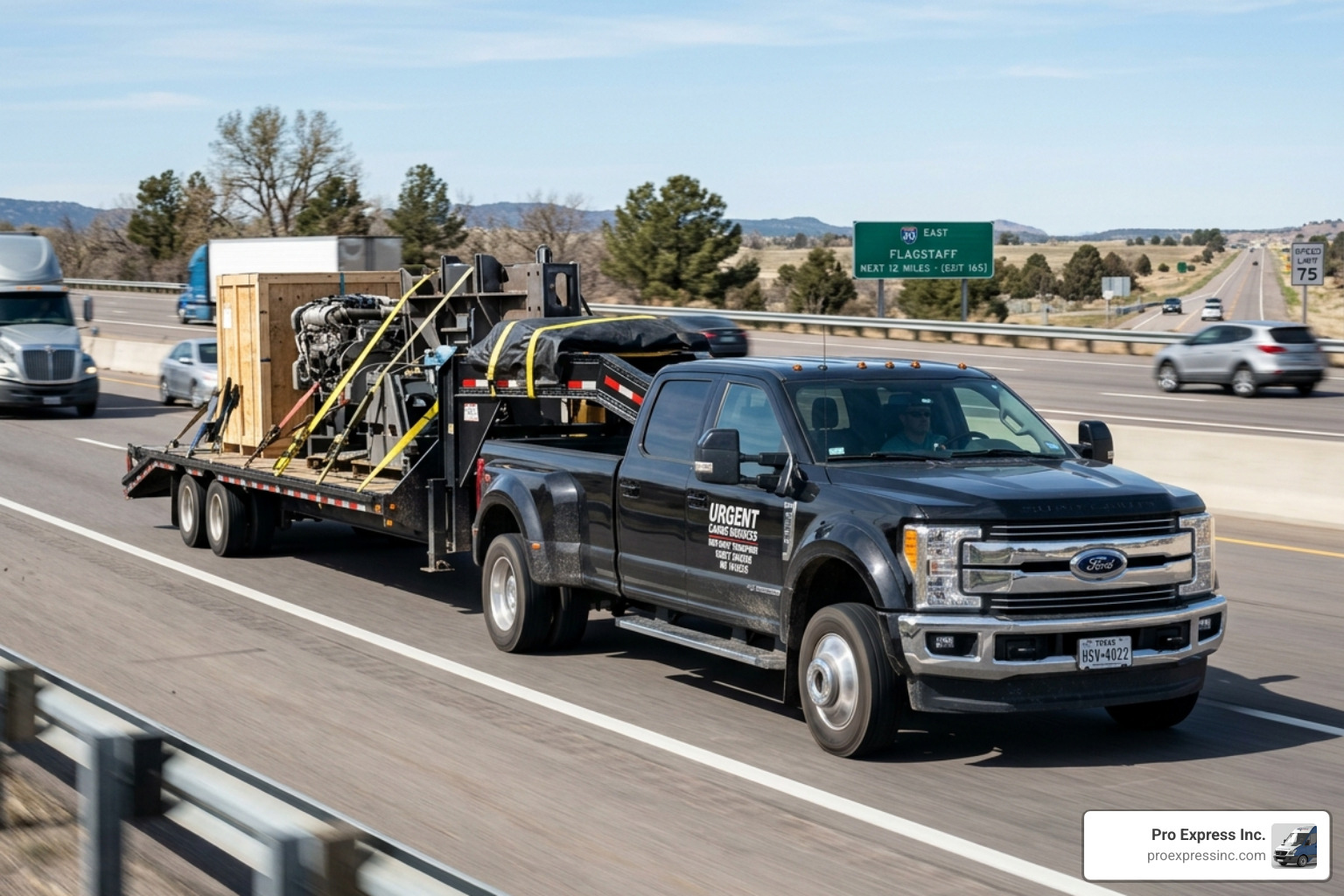
Hot shot trucking is the gold standard for ground urgency. It involves a dedicated truck (often a heavy-duty pickup with a trailer or a straight truck) moving a specific load for a single customer. It’s the “ambulance” of the highway.
On the other hand, Expedited Transportation | ExpeditedTransportation.com highlights that air options are unbeatable for transcontinental needs. These include:
- Air Charter: The fastest possible way to move freight. You rent the entire plane. It flies on your schedule and can often use smaller regional airports to get closer to the final destination.
- Next Flight Out (NFO): Your cargo is placed on the very next available commercial flight.
- Onboard Courier (Hand Carry): For the most sensitive items, a dedicated courier literally carries the shipment onto a plane as luggage and hand-delivers it to the recipient.
Critical Industries and Specialized Applications
Certain industries simply cannot function without expedited transportation services. In the automotive world, Just-In-Time (JIT) manufacturing is the law of the land. If a Tier 1 supplier is late with a shipment of door handles, the entire assembly plant might grind to a halt, costing millions. Expedited freight acts as the safety net for these high-pressure environments.
Medical supplies and pharmaceuticals are another high-stakes area. Whether it’s radioactive cancer medication with a short half-life or emergency surgical kits, the delivery window is often measured in hours, not days. Similarly, the aerospace industry relies on “Aircraft on Ground” (AOG) logistics to get repair parts to stranded planes so they can return to service.
Specialized expedited transportation services for High-Stakes Cargo
Beyond just speed, many shipments require specialized handling. This is where a comprehensive Logistics Service proves its value. Expedited Transport Services | Trucking Services notes that personalized solutions are key for cargo that is more than just “urgent.”
- White Glove Delivery: This isn’t just dropping a crate at a dock. It involves inside delivery, unpacking, and debris removal. It’s common for high-end medical equipment or sensitive electronics.
- Temperature-Controlled: For biologics, vaccines, or specialty chemicals, maintaining a strict temperature range (from frozen at -25°C to controlled room temperature) is non-negotiable.
- Hazardous Materials: Shipping flammable gases, corrosives, or explosives requires 49CFR certified drivers and specialized safety protocols.
- High-Security Transport: For government documents, arms, or high-value retail goods, providers offer constant surveillance, dual-driver teams, and GPS-monitored secure parking.
Technology, Visibility, and Cross-Border Logistics
In the modern era, “blind” shipping is unacceptable. If you are paying for speed, you deserve to know exactly where your investment is. Tracking Your Package at 3 AM and Other Expedited Service Perks include the peace of mind that comes from 24/7 visibility.
Modern expedited logistics use a combination of GPS tracking, satellite communication, and automated customer portals. This “logistics intelligence” allows managers to see milestones in real-time and adjust their operations based on accurate ETAs.
| Feature | Expedited Visibility | Standard Visibility |
|---|---|---|
| Update Frequency | Real-time / Every few minutes | At major hub scans only |
| Accuracy | Precise GPS coordinates | “In Transit” generalities |
| Communication | Proactive alerts & dedicated agent | Automated emails / Call centers |
| Transparency | Door-to-door tracking | Terminal-to-terminal tracking |
Navigating International and Cross-Border Shipments
Moving freight across the borders of Canada or Mexico adds a layer of complexity that can easily derail an urgent shipment. This is where Freight Service expertise in customs clearance becomes vital.
For shipments to Canada, experienced providers can often achieve conventional customs clearance in an average of 45 minutes. Successful cross-border expedited shipping often involves “strategic mode switching”—perhaps flying a part to a border city and then using a hot-shot truck for the final leg to avoid congested international hubs. It also requires a deep understanding of regulatory compliance to ensure that paperwork errors don’t turn a 24-hour delivery into a three-day ordeal at the border.
Frequently Asked Questions about Expedited Freight
What is the fastest ground shipping option for heavy freight?
The fastest ground option for heavy freight (up to 44,000 lbs) is a dedicated Full Truckload (FTL) with a team of two drivers. This allows the truck to stay in motion 24/7, stopping only for fuel, effectively cutting transit times in half compared to a single-driver truck.
When should a business transition from standard to expedited services?
A business should transition when the cost of a delay exceeds the cost of the expedited service. Common triggers include:
- Inventory stock-outs that halt production.
- Contractual penalties for late delivery to a client.
- Perishable goods at risk of spoilage.
- Emergency repair parts needed to restore essential services.
How do providers ensure security for high-value expedited shipments?
Security is ensured through “exclusive use” vehicles, meaning your freight is never left alone while the driver picks up other loads. Additionally, providers use dual-driver teams (so the truck is never unattended), GPS geofencing, and 24/7 command center monitoring to intervene if the vehicle deviates from its planned route.
Conclusion
When supply chains are increasingly lean and global, expedited transportation services are the “turbo boost” that keeps industry moving. Whether it’s a hot-shot truck racing across the Midwest or an air charter crossing the Pacific, the goal is always the same: reliability when it matters most.
At Pro Express Inc., we bring nearly two decades of experience to every shipment. With a track record of over 6,000 successful deliveries and a 99% client satisfaction rate, we specialize in the high-stakes world of ground-expedited shipping. From white-glove service to hot-shot trucking, our US-wide operations are designed to rescue your supply chain from the brink of disaster.
Don’t let a carrier failure or a manufacturing delay break your business. Explore our full range of Services and see how we can help you hit your next “impossible” deadline.
Ready to get your freight moving? Contact Us Today for a rapid response and a custom logistics plan.