
When Your Freight Can’t Afford to Wait: What You Need to Know About FTL Ground Freight Delivery
FTL ground freight delivery dedicates an entire trailer to your shipment — no shared space, no intermediate stops, no unnecessary handling. If you’re a logistics manager facing a tight deadline, this is the fastest and most reliable way to move large freight across the US.
Quick answer — when does FTL make sense?
- Your shipment exceeds 15,000 lbs or 10 pallets
- Your cargo is time-sensitive, fragile, or high-value
- You need direct, point-to-point delivery with no consolidation stops
- You require specialized equipment such as a reefer, flatbed, or dry van
- You can’t afford the risk of damage or delay from shared-trailer handling
For operations and supply chain teams managing critical freight windows, the difference between FTL and LTL isn’t just operational — it’s the difference between a delivery that arrives on time and one that doesn’t.
Ground freight already costs 4–5 times less than air freight. When your volume hits FTL thresholds, you also gain speed, security, and control that LTL simply can’t match.
At Pro Express Inc., with nearly 20 years of experience and 10,000+ shipments delivered nationwide, we specialize in same-day and next-day FTL solutions built for logistics teams who can’t afford carrier failures or missed windows.
This guide covers everything you need to make a confident FTL decision — from weight thresholds and equipment types to managing time-critical and high-value cargo.
Understanding FTL Ground Freight Delivery and How It Differs from LTL
To make the right decision for your supply chain, you must first understand how full truckload (FTL) and less-than-truckload (LTL) systems operate behind the scenes.
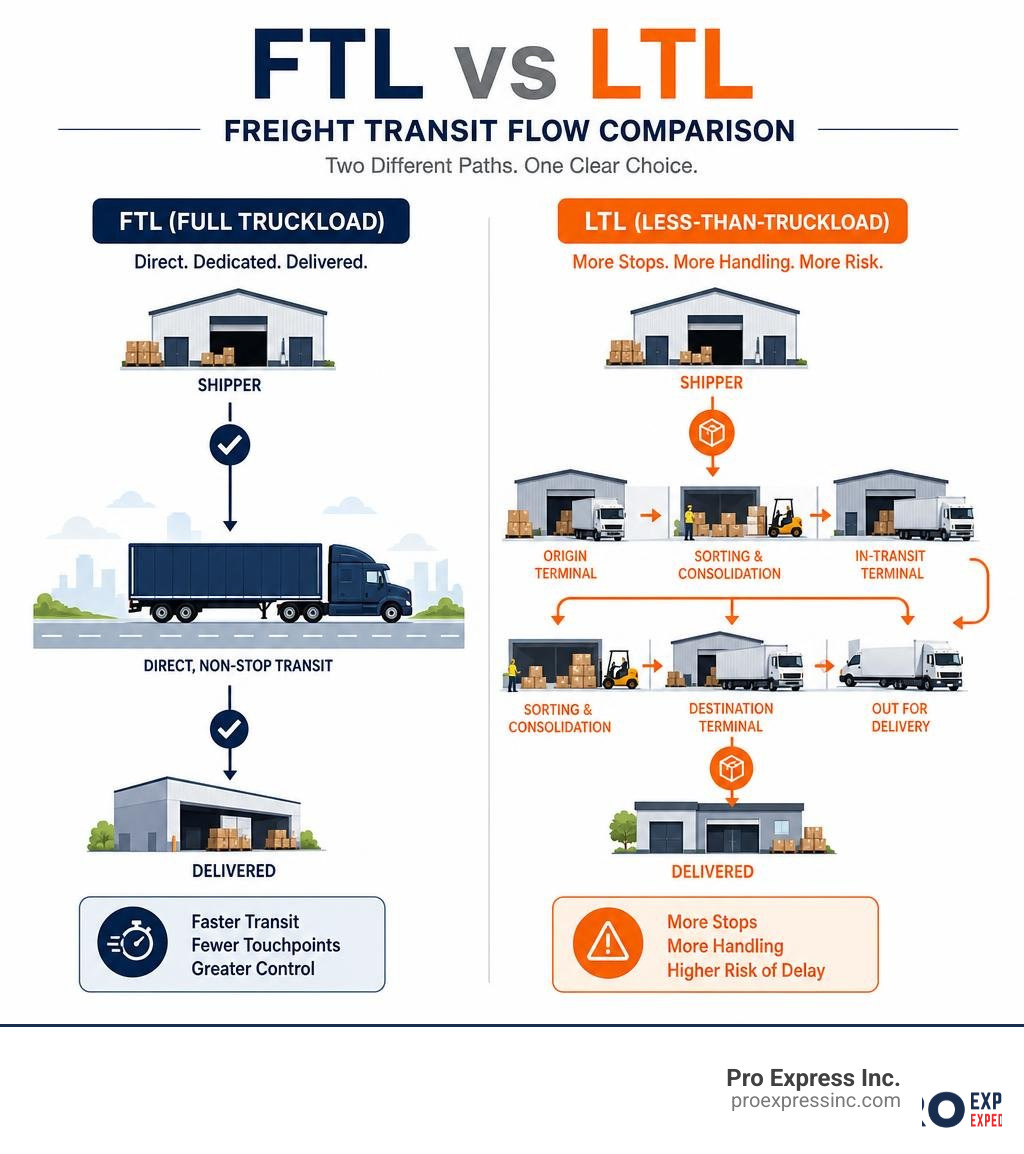
When you book an LTL shipment, your cargo shares trailer space with goods from several other businesses. While this is highly practical for small, non-urgent shipments, it introduces a complex web of hub-and-spoke consolidation. Your freight is loaded, unloaded, sorted, and reloaded at multiple transit terminals along its journey. Every single touchpoint introduces a statistical risk of handling damage, misrouting, or unexpected transit delays.
In contrast, ftl ground freight delivery secures a dedicated trailer exclusively for your cargo. From the moment our team seals the trailer doors at your loading dock, the shipment remains untouched until it reaches its final destination. There are no intermediate hubs, no sorting facilities, and zero detours. The truck travels a direct, point-to-point route, maximizing security and transit speed.
Understanding these differences is crucial for selecting the right mode, which you can explore further in this guide to LTL vs FTL ground shipping. For businesses with urgent timelines, securing a dedicated capacity option through More info about expedited ground services ensures your cargo bypasses the traditional freight network bottlenecks entirely.
| Operational Feature | Full Truckload (FTL) | Less-Than-Truckload (LTL) |
|---|---|---|
| Trailer Space | 100% Dedicated to one shipper | Shared among multiple shippers |
| Routing Path | Direct point-to-point | Multi-stop hub-and-spoke network |
| Handling Points | Loaded once, unloaded once | Repeated loading and sorting at hubs |
| Risk of Damage | Minimal (trailer is sealed at origin) | Higher (due to frequent handling) |
| Delivery Schedules | Strict, hard-set appointment windows | Estimated delivery windows |
| Specialized Equipment | Widely available (reefer, flatbed, etc.) | Limited to standard trailer configurations |
Key Operational Thresholds for FTL Ground Freight Delivery
Determining whether your cargo requires FTL or LTL shipping typically comes down to physical volume and weight constraints.
As a general industry standard, FTL shipping is recommended once a shipment exceeds 15,000 lbs or requires more than 10 to 12 pallets. A standard North American Class 8 tractor-trailer utilizes a 53-foot dry van, which can accommodate up to 26 single-stacked standard pallets (48″ x 40″) or up to 52 pallets if they are double-stacked and weight limits allow.
When your volume sits in the middle ground — such as 6 to 12 pallets or weights between 5,000 and 15,000 lbs — you may encounter “Volume LTL” or “Partial Truckload” options. Volume LTL bridges the gap by utilizing automated capacity on trailers that aren’t fully loaded. However, for critical B2B logistics, relying on partial networks still subjects your freight to terminal delays.
If your cargo is heavy, bulky, or takes up significant linear footage, securing a dedicated box truck or full trailer is the safest path forward. You can learn more about utilizing optimized space for mid-sized heavy shipments with More info about full box truck loads.
When to Choose FTL Ground Freight Delivery Over LTL
While physical size is a major factor, operational urgency and cargo characteristics often dictate the need for FTL, even if your goods do not fill an entire 53-foot trailer. You should choose FTL ground freight delivery over LTL in the following scenarios:
- Strict Delivery Windows: If your customer — such as a major retail distribution center or an automotive assembly plant — enforces hard-set delivery appointments with severe penalties for delays, FTL is non-negotiable.
- High-Value Assets: Electronics, industrial machinery, and pharmaceuticals are highly vulnerable to theft or damage when left in shared warehouses. FTL offers a secure, sealed environment from dock to dock.
- Fragile or Unpackaged Freight: If your cargo cannot easily be palletized or is highly sensitive to vibrations and shifting, keeping it on a single, dedicated vehicle eliminates the physical stress of terminal transfers.
- Urgent Supply Chain Disruptions: When a manufacturing line is at risk of shutting down, every hour counts. FTL bypasses all distribution networks to deliver your parts immediately.
For manufacturers and industrial suppliers, matching the correct shipping method to your customer’s urgency is key to maintaining long-term contracts. Discover how to streamline these critical operations by reading More info about B2B shipping for manufacturers and distributors.
Key Benefits of Full Truckload Shipping for Urgent Supply Chains

In the high-stakes world of modern logistics, speed and reliability are your primary competitive advantages. When regular shipping networks experience seasonal backlogs or carrier failures, FTL ground freight serves as an elite, high-performance solution.
The primary benefit of FTL is unmatched transit speed. Because the driver does not stop to unload other shippers’ cargo, FTL transit times are incredibly predictable. For instance, a dedicated truck can complete a cross-country run from Los Angeles to New York in approximately 3.5 days using a team-driver configuration, whereas standard LTL networks can easily take 5 to 7 business days or longer. To benchmark your shipping schedules, you can review detailed data on FTL transit times by distance.
Beyond speed, FTL provides maximum cargo security. Once the truck is loaded at your facility, a high-security bolt seal is applied to the trailer doors. The seal number is documented on the Bill of Lading (BOL). This seal remains intact until the consignee cuts it at the final destination, virtually eliminating the risk of cargo theft, tampering, or loss.
Furthermore, reduced handling translates directly to fewer damage claims. In an LTL environment, forklifts constantly move your pallets to reorganize the trailer at every stop. In FTL shipping, your cargo is loaded once and stays put. For companies managing fragile, industrial, or highly sensitive goods, this structural stability is invaluable.
When your business faces a logistics emergency, pairing FTL with specialized expedited handling ensures your supply chain remains resilient. Learn how we optimize these operations by reading More info about expedited ground shipping.
Equipment Types and Specialized Services in FTL Logistics
To execute a successful FTL shipment, you must match your cargo with the appropriate trailer type. Different industries require specialized configurations to protect their products and facilitate efficient loading and unloading.
- Dry Van (53-Foot): The workhorse of ground transportation. These fully enclosed trailers protect general palletized freight, consumer packaged goods, and industrial components from weather elements.
- Refrigerated Trailers (Reefers): Equipped with active climate-control units, reefers maintain precise temperature ranges (from deep-freeze to heated environments). They are essential for food, beverages, cosmetics, and medical supplies.
- Flatbeds: Lacking sides or a roof, flatbed trailers are designed for oversized, heavy, or oddly shaped cargo that must be loaded from the side or overhead via crane. This includes construction equipment, structural steel, and large machinery.
- Specialized and Step-Deck Trailers: Used for extremely tall or heavy industrial loads that require low-profile trailers to clear highway bridge heights.
For a deeper dive into choosing the right trailer type for your freight, consult this breakdown of Full truckload equipment options.
At Pro Express Inc., we understand that standard transit isn’t always enough. When your cargo requires specialized care, our team provides tailored white-glove, liftgate, and two-man delivery options to handle complex logistics challenges. Explore our full suite of solutions with More info about expedited ground freight solutions.

Best Practices for Managing Time-Critical and High-Value FTL Shipments
Managing high-stakes FTL shipments requires proactive planning and robust technology. To ensure your most critical deliveries arrive on time, incorporate these operational best practices:
- Leverage Real-Time GPS Tracking: Do not rely on daily check-calls. Work with logistics providers who offer continuous, satellite-enabled GPS tracking so you can monitor your trailer’s location and receive precise, live ETAs.
- Implement Strict Carrier Vetting: Ensure every driver and carrier hauling your freight has verified safety records, active operating authority, and comprehensive insurance coverage designed for high-value cargo.
- Establish Clear Yard Protocols: Minimize facility dwell times by preparing your loading docks, packaging materials, and paperwork in advance. High dwell times delay drivers and disrupt transit schedules.
- Utilize Trailer Pooling (Drop-and-Hook): For high-volume, recurring shipping lanes, drop-and-hook services allow carriers to drop an empty trailer at your facility and immediately hook up a pre-loaded one. This eliminates loading delays entirely.
By integrating these strategies into your daily operations, you can shield your business from the chaos of supply chain disruptions. For a complete look at how to navigate the modern shipping landscape, read More info about expedited shipping in 2026.
Frequently Asked Questions about FTL Shipping
What is the average transit time for a domestic FTL shipment?
Because FTL shipments travel directly from the shipper to the receiver without stopping at terminal hubs, transit times are determined primarily by distance and Department of Transportation (DOT) Hours of Service (HOS) regulations.
A single driver can legally drive up to 11 hours within a 14-hour window, covering roughly 500 to 600 miles per day. For ultra-urgent shipments, utilizing team drivers (where two operators take turns driving and resting) allows the truck to keep moving almost continuously, covering over 1,000 miles in a 24-hour period.
To understand how expedited transit models can accelerate your delivery timelines, check out More info about the ultimate guide to expedited shipping.
Can FTL accommodate specialized temperature-controlled or fragile cargo?
Yes. FTL is actually the preferred shipping method for sensitive cargo. Because the trailer is dedicated to a single shipper, you have complete control over the environmental conditions inside. Refrigerated reefer units can maintain tight temperature tolerances to preserve pharmaceuticals or agricultural products.
Additionally, because there are no intermediate sorting hubs, fragile cargo is not subjected to forklift handling during transit, drastically reducing the risk of structural damage.
Does FTL support cross-border shipping between the US, Canada, and Mexico?
Yes, FTL is highly effective for North American cross-border trade flows. Dedicated trailers can travel seamlessly across borders, provided that all customs paperwork, commercial invoices, and broker integrations are prepared in advance. Working with an experienced logistics provider ensures your freight clears customs without sitting at border crossings, maintaining your supply chain’s momentum.
Conclusion
When your regular shipping methods fall short, or an urgent supply chain emergency threatens your operations, ftl ground freight delivery is the ultimate tool to regain control. By dedicating an entire vehicle to your shipment, you eliminate terminal delays, maximize cargo security, and guarantee direct, point-to-point speed.
At Pro Express Inc., we have spent nearly two decades perfecting the art of time-sensitive transportation. Our team is fully equipped to handle your most demanding logistics challenges with US-wide coverage, 24/7 customer support, and a proven 99% client satisfaction rate. Whether you need same-day hot-shot delivery, specialized temperature control, or white-glove handling, we are committed to keeping your business moving forward without interruption.
Don’t let carrier delays put your business relationships at risk. Contact our logistics experts and Book reliable freight services today to secure the dedicated capacity your supply chain deserves.