
Choosing Reliable Fulfillment Companies in USA
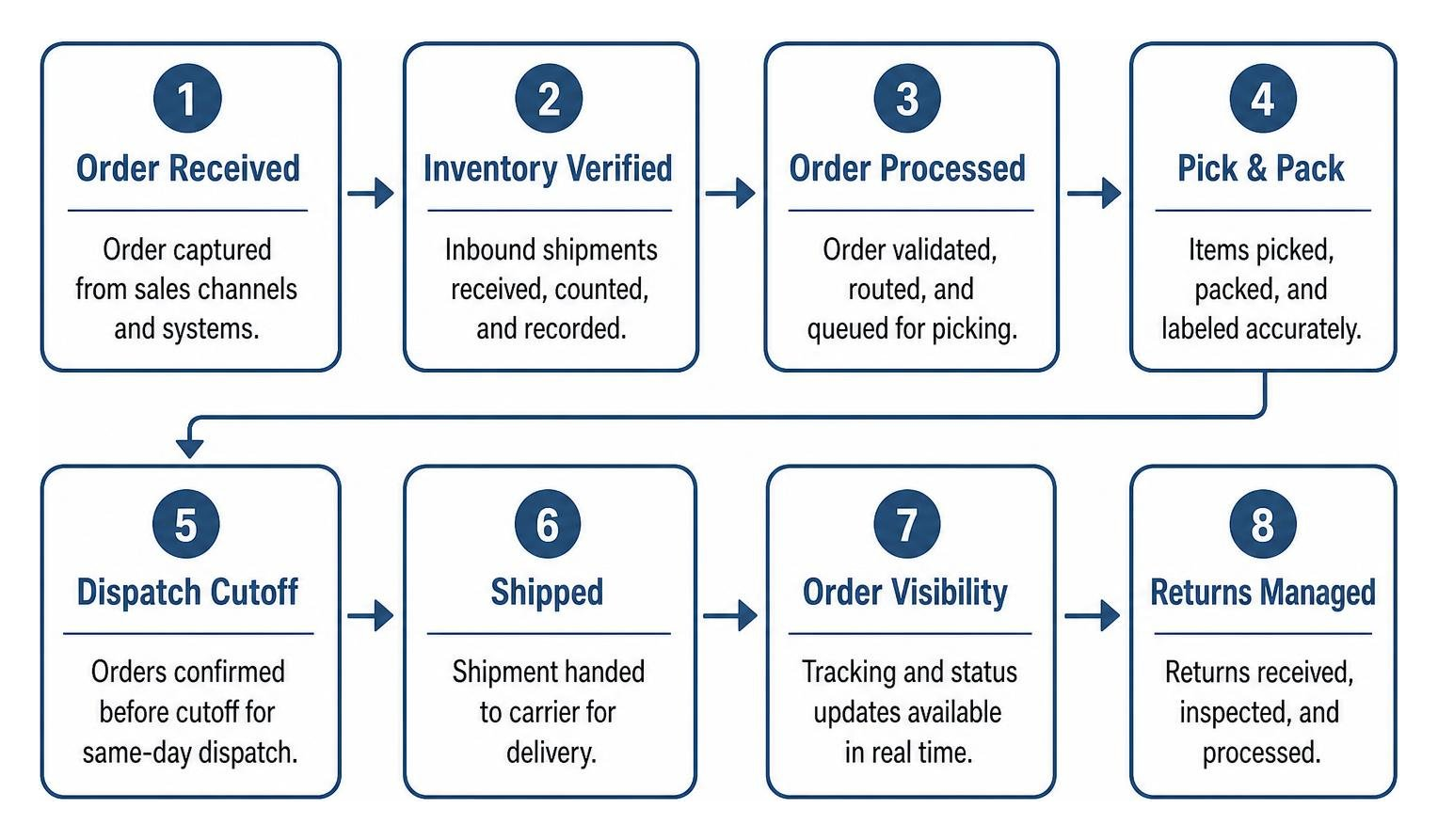
The best fulfillment companies in USA do more than store and ship products. They should verify inbound inventory, connect cleanly with your sales and warehouse systems, meet documented dispatch cutoffs, provide live order visibility, and manage returns without creating operational exceptions.
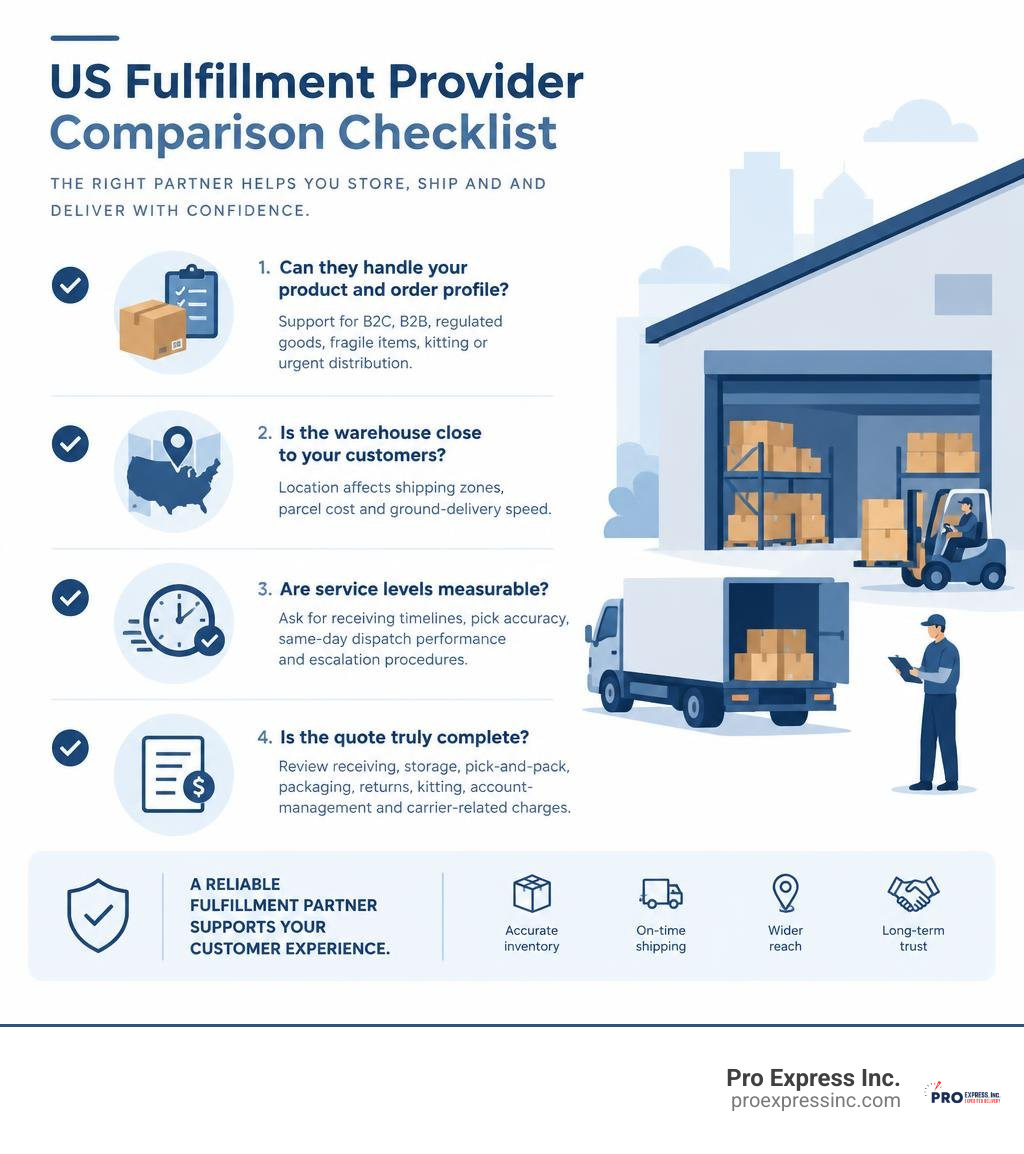
When comparing providers, start with these four questions:
- Can they handle your product and order profile? Confirm support for B2C parcels, B2B orders, regulated goods, fragile items, kitting, or urgent distribution needs.
- Is the warehouse close to your customers? Location affects shipping zones, transit speed, and ground-delivery performance.
- Are service levels measurable? Ask for receiving timelines, pick accuracy, same-day dispatch performance, and escalation procedures.
- Are the operational terms clearly documented? Review receiving, storage, pick-and-pack, packaging, returns, kitting, account-management, and carrier-related service expectations.
A fulfillment partner becomes part of your customer experience. A receiving error, missed carrier pickup, or late order sync can quickly turn into stock discrepancies, delayed deliveries, and lost trust. For operations teams, reliability matters more than an attractive baseline service promise.
Pro Express Inc. brings nearly 20 years of freight-broker experience to time-sensitive logistics coordination, with 10,000+ shipments coordinated. That perspective is useful when fulfillment performance depends not only on warehouse execution, but also on responsive carrier communication and delivery follow-through.
This guide explains how to compare US fulfillment providers, pressure-test their service claims, and choose a setup that supports dependable order delivery as volume grows.
Fulfillment companies in usa vocab to learn:
Evaluating Top Fulfillment Companies in USA for Your Supply Chain

Selecting an outsourced logistics partner requires looking beyond high-level marketing promises. Operations leaders need concrete assurances regarding physical throughput, system uptime, and exception handling. When evaluating candidate facilities across the United States, logistics managers must evaluate core operational workflows from initial dock intake to the moment freight is tendered to a carrier.
Core Capabilities of Fulfillment Companies in USA
A high-performing facility must demonstrate mastery over both high-velocity direct-to-consumer packing and complex business-to-business retail distribution. Core capabilities should include:
- Strict Dispatch Cutoff Enforcement: Leading facilities maintain strict daily cutoff windows (such as 12:00 PM, 2:00 PM, or 5:00 PM local facility time) to guarantee same-day release for outbound shipments.
- Specialized Handling Protocols: Infrastructure configured for fragile cargo, climate-controlled storage, or hazardous materials requiring specific certifications.
- Omnichannel Distribution Support: The flexibility to process high-volume parcel orders alongside palletized freight movements requiring liftgate or inside delivery coordination.
- Real-Time Visibility Portals: Cloud-based warehouse management systems (WMS) that provide live operational status across every SKU.
Independent industry directory evaluations often reveal that the operational gap between average and top-tier providers lies in consistent labor scheduling and linehaul coordination. When regular carriers fail or surge volumes create backlogs, having established freight brokerage channels ensures critical freight continues moving without disruption.
Inventory Receiving Accuracy and Quality Control
The entire order fulfillment chain depends on dock-to-stock accuracy. When inventory arrives at a facility, errors in piece counts or SKU mislabeling create downstream phantom stock, backorders, and mis-picks that disrupt client trust.
Best-in-class operations complete inbound receiving and system booking within a strict 24-to-48-hour window. The receiving protocol must incorporate barcode scanning at the carton and unit level, photographic documentation of damaged freight, and structured stock reconciliation workflows. Without rigorous verification at the dock, inventory shrinkage escalates, making reliable dispatch impossible.
Geographic Placement: Single vs. Multi-Warehouse Strategies
Warehouse placement dictates delivery transit times and baseline transportation efficiency. Storing inventory in a single location simplifies stock management but limits expedited ground coverage across nationwide delivery zones. Conversely, distributing stock across multiple regional nodes positions goods closer to key commercial corridors.
When planning distribution networks, companies often balance domestic staging with specialized carrier coordination. Effective logistics strategies link regional fulfillment hubs with expedited transit options, ensuring seamless connections across e-commerce fulfillment last mile shipping channels.
Selecting Multi-Node Fulfillment Companies in USA
A distributed network model typically utilizes facilities situated across key logistics corridors—such as the Midwest, Mid-Atlantic, Southeast, and West Coast—to provide 1- to 2-day ground coverage to the vast majority of the domestic population.
- Central Distribution Hubs: Strategic inland locations (such as Ohio, Texas, or Tennessee) provide broad multi-region ground transit reach.
- Bi-Coastal Facilities: Operating facilities on both coasts minimizes long-haul linehaul transit, ensuring rapid delivery to densely populated metropolitan areas.
- Regional Access Points: Leveraging targeted regional warehouse distribution guides helps operations managers identify specialized regional nodes tailored to specific industry requirements.
Distributing inventory requires careful demand forecasting to avoid overstocking slow-moving SKUs in secondary nodes while fast-moving stock depletes in primary markets.
Zone Skipping and Transit Time Optimization
Zone skipping involves consolidating regional shipments into full or partial truckloads and transporting them directly to a destination carrier hub, bypassing intermediate sortation centers.
| Fulfillment Strategy | Geographic Coverage | Average Transit Time | Operational Complexity | Ideal Volume Profile |
|---|---|---|---|---|
| Single Central Hub | Nationwide from one node | 2–4 Business Days | Low (Single inventory pool) | Emerging brands (<1,000 orders/mo) |
| Bi-Coastal Setup | East & West Coast nodes | 1–3 Business Days | Moderate (Split replenishment) | Growing brands (1,000–5,000 orders/mo) |
| Multi-Node Distributed | 3+ Strategic regional hubs | 1–2 Business Days | High (Algorithmic allocation) | Enterprise volume (5,000+ orders/mo) |
Through coordinated linehauls and scheduled freight handoffs, multi-node strategies eliminate unnecessary touchpoints, lower transit times, and protect sensitive cargo from multi-terminal handling damage.
Evaluating Operational Workflows and Service Accountability
Selecting a fulfillment partner requires a detailed review of how warehouse teams execute daily workflows, manage exceptions, and uphold service-level commitments. While baseline service structures often appear straightforward, total operational reliability is heavily influenced by labor scheduling, handling protocols, and escalation procedures.
Standard Receiving, Picking, and Value-Added Processing Standards
Fulfillment agreements generally define standard warehouse activities through distinct operational categories:
- Storage Management: Monthly pallet, shelf bin, or cubic footage allocation, with clear rules for seasonal inventory expansion and space reservation.
- Inbound Receiving Procedures: Documented dock-to-stock timelines, barcode verification requirements, and handling rules for unpalletized or containerized freight.
- Pick-and-Pack Workflows: Order processing steps, per-item handling protocols, and additional accessorial procedures for fragile items or dangerous goods.
- Kitting and Assembly: Custom bundling, multi-pack assembly, subscription box collating, and specialized packaging executed according to documented quality standards.
Managing Exceptions in Returns and Value-Added Services
Reverse logistics and value-added project work represent areas where operational gaps frequently occur. Operations teams must clarify exact handling terms for:
- Returns Inspection and Restocking: Per-item inspection, defect grading, sanitization, repackaging, and system re-entry procedures.
- Packaging and Dunnage Protocols: Custom box utilization, branded tape, protective void fill, and labeling compliance standards.
- Address Correction and Carrier Coordination: Escalation workflows triggered when label discrepancies require carrier intervention or re-routing.
Maintaining effective logistics service coordination ensures that freight movements, warehouse workflows, and carrier handoffs remain synchronized, preventing administrative discrepancies and operational bottlenecks.
Technology Integration and Platform Synchronization
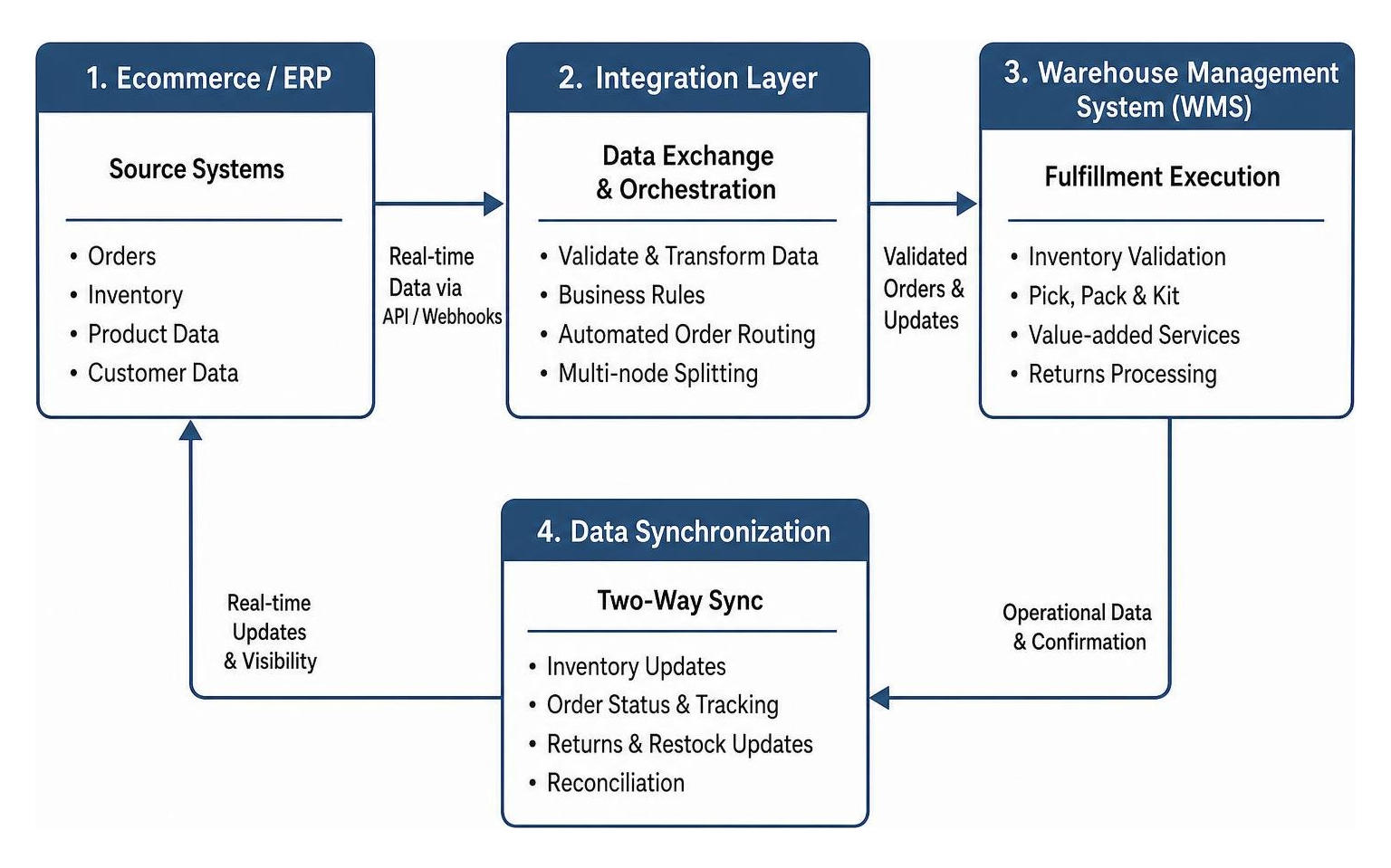
Modern fulfillment execution relies entirely on seamless data exchange between your enterprise resource planning (ERP) or e-commerce platform and the warehouse management system. Manual order uploads and batched inventory reconciliations introduce delays that disrupt operational timing.
Ecommerce Cart and WMS Connectivity
A robust integration architecture must provide two-way, real-time data synchronization using direct API endpoints or webhooks. Key technical capabilities include:
- Automated Order Routing: Direct ingestion of orders with immediate inventory validation and automated splitting across regional warehouse nodes.
- Real-Time Inventory Synchronization: Instantaneous stock deductions across all sales channels to eliminate overselling during promotional spikes.
- Order Modification Handling: The ability to process address changes, order cancellations, or item swaps prior to picking release.
- Bundle Mapping and SKU Translation: Dynamic translation of virtual bundle SKUs into physical component inventory picks on the warehouse floor.
Vetting Providers During Demos and Discovery Calls
Before signing a logistics agreement, operations leaders should conduct thorough technical and operational vetting. Use this evaluation checklist during discovery calls and software demonstrations:
- Dock-to-Stock SLA: What is your documented time frame for receiving inbound freight and making it available for sale in the WMS?
- Same-Day Dispatch Guarantee: What is the daily order cutoff time, and what percentage of orders meet same-day carrier handoff?
- Inventory Discrepancy Protocol: How are physical cycle counts conducted, and what is your documented error resolution and shrinkage liability policy?
- Carrier Contingency Planning: How do you handle missed carrier pickups or regional transit disruptions to prevent delayed customer shipments?
- System Uptime and Integration Support: What is your historic WMS platform uptime, and what dedicated engineering support is provided during onboarding?
Partnering with an experienced team when finding reliable shipping companies ensures that unexpected logistics disruptions are met with immediate, structured freight brokerage solutions.
Frequently Asked Questions about US Order Fulfillment
What is the average order error rate for top domestic 3PLs?
Top-performing domestic fulfillment providers maintain order error rates between 0.01% and 0.05%, reflecting an overall pick-and-pack accuracy benchmark of 99.5% or higher. Premium providers often back these metrics with explicit service level guarantees that provide operational credits or mis-ship compensation if accuracy thresholds are breached.
How do warehouse locations impact final delivery performance?
Warehouse placement directly determines the shipping zones traversed by each outbound order. Shipping an order across multiple zones increases transportation transit time and elevates carrier handling requirements. Positioning inventory closer to primary commercial centers reduces total zone travel, enabling rapid ground transit that matches expedited service levels.
When should an ecommerce brand transition from a single hub to distributed warehousing?
Brands typically evaluate distributed warehousing when consistent monthly shipping volumes exceed 1,000 to 2,000 orders and customer geographic density is evenly spread nationwide. At this stage, the reduction in transit times and zone-based handling requirements offsets the operational complexity of managing split inventory allocations across multiple facilities.
Conclusion
Building a dependable supply chain requires aligning your business with fulfillment partners and freight specialists that execute with precision. Warehouse capabilities, inventory accuracy, platform integrations, and carrier reliability collectively determine whether your fulfillment operation accelerates growth or creates bottlenecks.
When critical deadlines are at risk, standard transit channels fail, or urgent freight must move immediately, Pro Express Inc. delivers the responsive support your operations demand. With nearly 20 years of freight-broker experience, 10,000+ shipments coordinated, and a 99% client satisfaction record, we specialize in arranging nationwide expedited ground transportation—including exclusive hot shots, white glove, two-man, liftgate, and inside delivery services through our vetted carrier network.
Optimize your time-sensitive supply chain operations today. Explore our comprehensive expedited freight and logistics services and contact our team to discuss your critical transport requirements.