
Find a Reliable Pallet Courier Service When Time Is Critical
When a regular carrier fails or a delivery deadline is at risk, choose a pallet courier service by confirming four things before dispatch:
- Dedicated or shared transit: Dedicated transport is usually the right fit for urgent, high-priority freight. Shared pallet networks can suit less time-sensitive loads.
- Equipment at both sites: Confirm dock access, forklift availability, liftgate needs, pallet-jack use, and any loading restrictions.
- Load details: Give the exact loaded pallet dimensions, total weight, stackability, and commodity type.
- Visibility and proof: Request live tracking updates, clear collection and delivery milestones, and electronic proof of delivery.
For manufacturers, distributors, and medical suppliers, pallet shipping is not simply about moving freight. It is about protecting production schedules, customer commitments, and supply-chain continuity.
Pro Express Inc. coordinates urgent pallet delivery through a vetted carrier network. With nearly 20 years as a freight broker and 10,000+ shipments coordinated, we help logistics teams secure responsive capacity when standard shipping plans break down and critical freight needs to move.
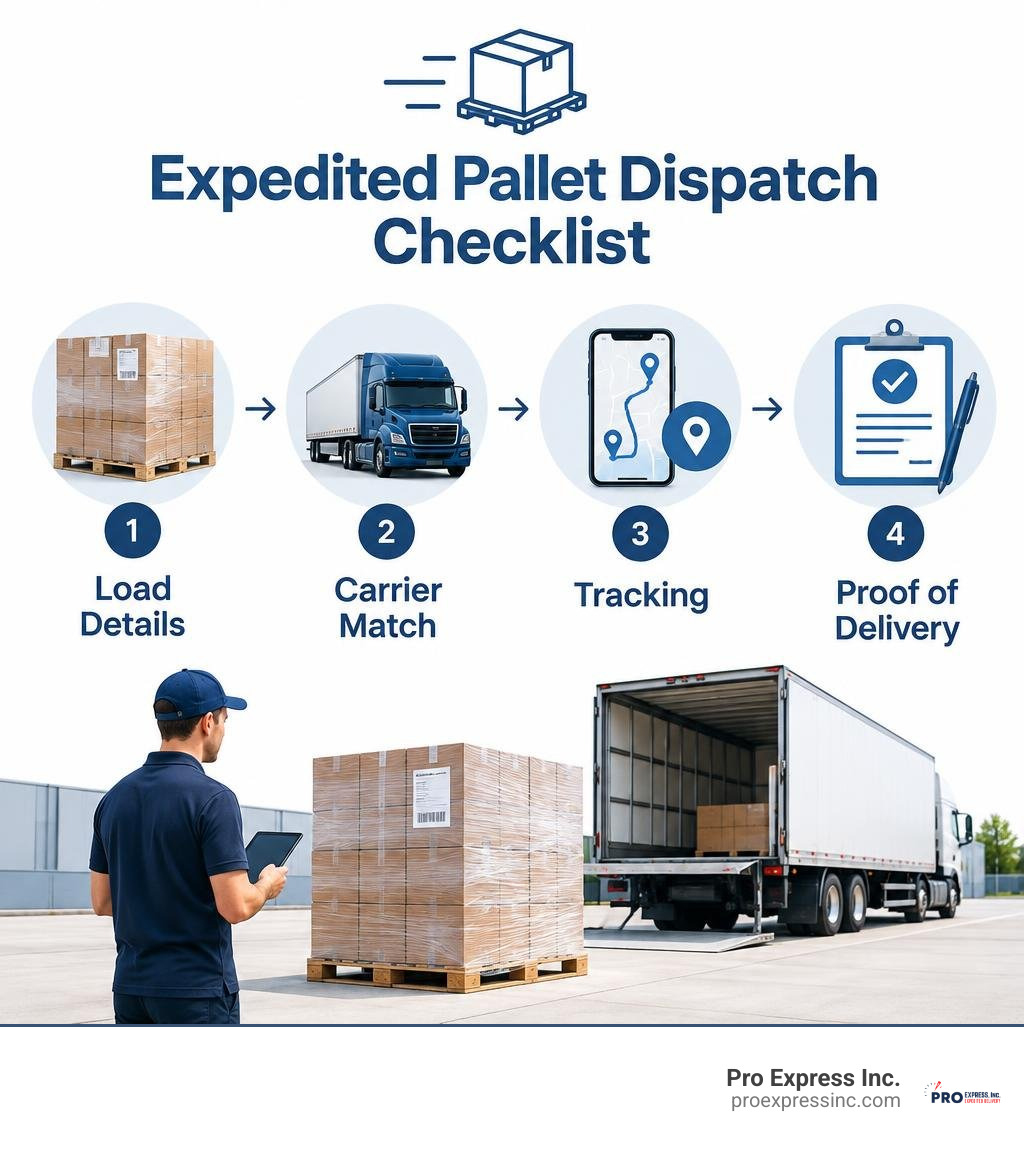
Simple pallet courier service word guide:
Critical Freight Capabilities in Pallet Transport
Securing reliable pallet transportation requires a clear understanding of freight specifications, structural stability, and cargo dimensions. In commercial freight logistics, even a minor discrepancy between reported and actual pallet dimensions can cause terminal delays, improper vehicle matching, or freight re-handling.
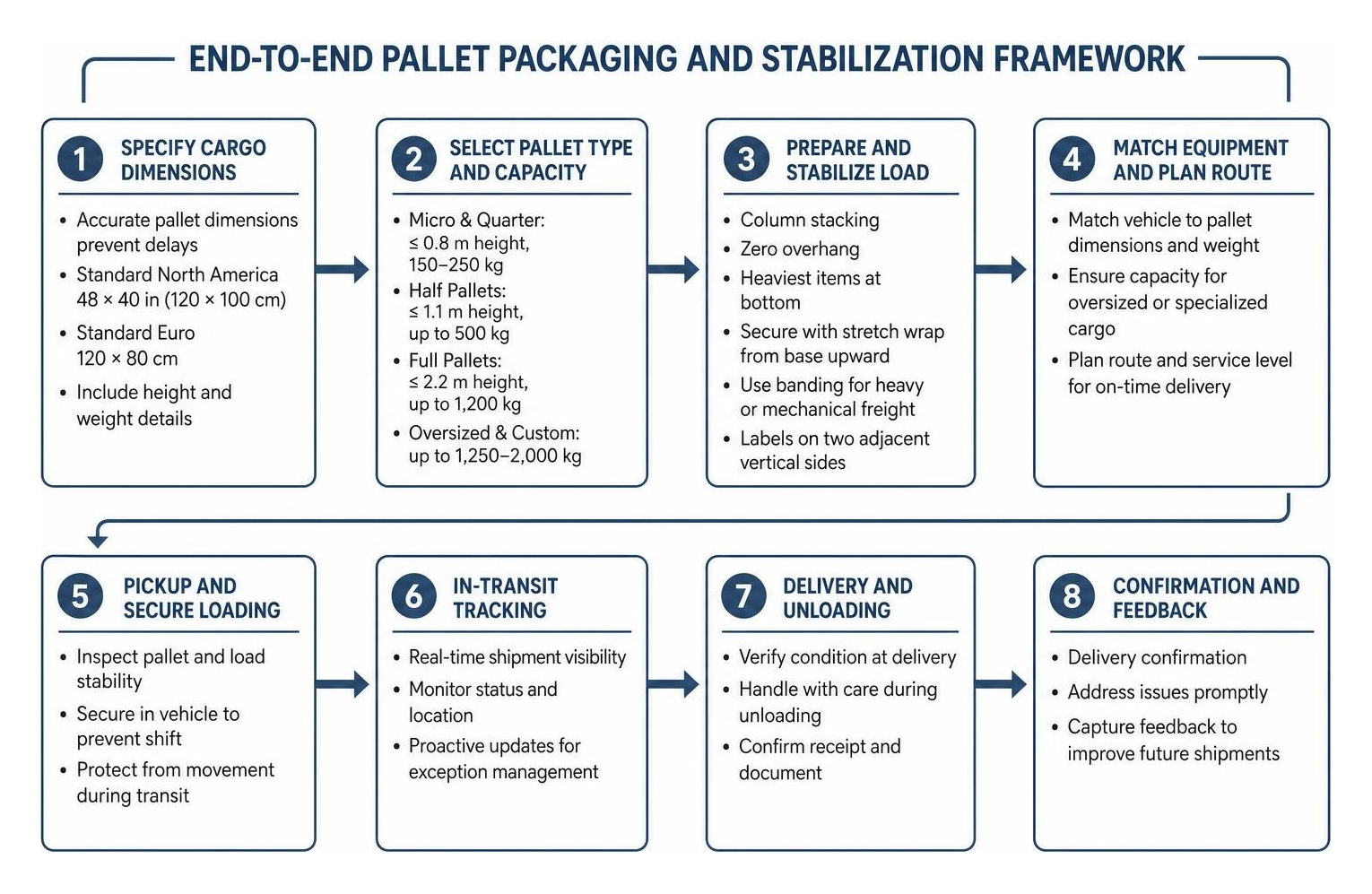
Palletized transport encompasses standard industrial dimensions as well as specialized cargo footprints. The standard US pallet measures 48 × 40 inches (120 × 100 cm), while standard Euro pallets measure 120 × 80 cm. When shipments exceed standard dimensions or require specialized securing, working with an experienced freight broker ensures that the assigned equipment matches your precise specifications. For full loads and high-volume distributions, reviewing full box truck load delivery services helps logistics managers align full-capacity freight with time-sensitive delivery schedules.

Standard, Mini, and Custom Pallet Specifications
Categorizing pallet dimensions accurately ensures that freight brokers match the correct commercial vehicle space to the load:
- Micro and Quarter Pallets: Ideal for small component runs, sub-assemblies, or replacement parts. Typically restricted to heights under 0.8 meters with weight capacities up to 150–250 kg.
- Half Pallets: Frequently used for medium-density shipments, such as commercial lighting fixtures, lab supplies, or retail restocks, generally supporting heights up to 1.1 meters and weights up to 500 kg.
- Full Pallets: The backbone of industrial logistics, accommodating loads up to 2.2 meters in height and standard freight weights up to 1,200 kg.
- Custom Pallets: Encompassing machinery parts, crated engines, or generator assemblies on pallets that exceed standard footprints, often reaching up to 1,250–2,000 kg.
When staging freight across multi-modal hubs or regional distribution routes, consulting standard guidelines for ocean and regional freight staging helps maintain structural stability and seamless interline transfers.
Secure Stacking and Load Preparation Protocols
Proper cargo preparation protects goods from shifting during sudden deceleration or tight transit maneuvers. Applying professional packing protocols before dispatch ensures total cargo integrity:
- Column Stacking: Align cartons directly over lower layers to utilize the structural strength of corner posts. Avoid pyramid stacking, which leaves upper units vulnerable to compression.
- Zero Overhang: Ensure that cartons remain strictly within the pallet deck boundaries. Even a one-inch overhang significantly reduces carton compression strength and exposes freight to transit abrasion.
- Weight Distribution: Position the heaviest goods at the bottom deck level to maintain a low center of gravity.
- Industrial Wrapping and Strapping: Apply high-gauge stretch film starting at the wooden base, wrapping upward with tight overlaps. Use heavy-duty polyester or steel banding for heavy mechanical freight to secure the load firmly to the pallet deck.
- Label Visibility: Place clear freight labels and handling instructions on at least two adjacent vertical sides to maintain clear identification during every transit scan.
Key Criteria for Choosing a Pallet Courier Service
Selecting the right logistics partner involves evaluating carrier screening protocols, real-time tracking visibility, and operational responsiveness. A reliable freight brokerage maintains a strictly vetted carrier network, verifying insurance compliance, safety scores, and operational performance before dispatching a single truck.
| Operational Criteria | Shared Pallet Networks | Dedicated Expedited Coordination |
|---|---|---|
| Transit Model | Multi-stop cross-docking through central sorting hubs | Direct, point-to-point transit on a single dedicated vehicle |
| Handling Frequency | Multiple forklift transfers between collection and delivery | Single load at origin, single unload at destination |
| Transit Speed | Scheduled multi-day transit windows | Immediate dispatch with direct same-day or next-day delivery |
| Risk Profile | Standard exposure across multiple consolidation hubs | Minimized touchpoints; direct door-to-door chain of custody |
| Equipment Customization | Standard linehaul trailers with terminal cross-docks | Tailored capacity (Sprinters, Straight Trucks, Liftgates) |
Evaluating Dedicated vs. Shared Pallet Courier Service Options
When deciding between shared network capacity and dedicated vehicle coordination, evaluate the time sensitivity and fragility of your shipment. Shared networks distribute palletized freight across regional hubs, which works well for standard warehouse replenishments.
However, when production lines face shutdowns or hospitals await urgent diagnostic equipment, dedicated transit eliminates intermediate sorting hubs. Utilizing expedited ground freight through dedicated hot-shot coordination ensures that cargo moves non-stop from the shipper’s dock directly to the receiver.

Specialized Handling and Accessorial Equipment
Industrial facilities and commercial job sites often present unique pickup and delivery challenges. A dependable freight brokerage coordinates the exact accessorial equipment required to prevent delivery failures:
- Hydraulic Liftgates: Essential when either the origin facility or the delivery destination lacks a loading dock or on-site forklift, enabling smooth ground-level loading.
- Manual and Electric Pallet Jacks: Coordinated for seamless maneuvering inside facilities, staging areas, or tight warehouse aisles.
- Inside Delivery and Two-Man Handling: Deployed for high-value medical, lab, or electronic equipment requiring careful transport beyond the delivery threshold.
- White Glove Services: Providing uncrating, room-of-choice placement, and debris removal for high-end retail, trade show, or specialized installations.
When non-standard freight must move urgently without dock access, arranging heavy lifting on short notice ensures the proper vehicles and liftgate equipment are in place from the start.
Expedited and Same-Day Pallet Transit Strategies
When emergency situations arise, speed and precision become critical. An effective expedited pallet logistics strategy relies on immediate broker responsiveness, rapid carrier dispatch, and continuous route optimization.
Whether managing urgent factory restocks or time-critical spare parts, our arranged same day delivery service connects shippers with vetted regional carriers capable of immediate pickup. Understanding how to speed up your cargo with expedited freight delivery allows logistics coordinators to streamline loading windows, clear paperwork quickly, and maintain non-stop transit.
High-Priority Cargo Protocols for a Pallet Courier Service
Different industries require specific handling procedures to protect critical supply chains:
- Automotive and Assembly: Moving urgent stamping dies, powertrain components, and assembly line parts under strict time-definite windows to avoid line halts.
- Medical and Pharmaceutical: Coordinating the transport of temperature-sensitive therapies, surgical devices, and clinical equipment requiring tight chain-of-custody controls.
- Industrial Machinery: Transporting critical pumps, hydraulic valves, and replacement motors for urgent repair operations.
- Commercial Lighting and Architecture: Managing fragile, bulky fixtures and architectural components directly to active construction sites.
Deploying tailored expedited shipping services ensures that specialized handling requirements and strict delivery timelines are maintained across every mile.
Tracking Milestones and Chain of Custody Verification
Modern pallet logistics requires complete visibility from pickup to drop-off. By coordinating dedicated carriers equipped with GPS tracking, freight brokers provide continuous transit updates at every milestone:
- Carrier Dispatch and Arrival at Origin: Verifying vehicle specs, liftgate functionality, and loading readiness.
- Departure and Real-Time Tracking: Providing continuous en-route location tracking and proactive transit updates.
- Delivery Arrival and Offloading: Coordinating site access, inside placement, or liftgate offloading at the destination.
- Electronic Proof of Delivery (ePOD): Capturing immediate digital signatures and time-stamped delivery confirmations.
Frequently Asked Questions About Pallet Logistics
What Equipment Is Necessary When a Pickup Facility Lacks a Loading Dock?
When a pickup or delivery facility lacks a dock or forklift, the freight broker coordinates a truck equipped with a hydraulic liftgate and a pallet jack. The driver lowers the freight from the truck bed to ground level safely, ensuring smooth transfer without facility delays.
How Quickly Can Urgent Palletized Freight Be Collected and Dispatched?
For time-critical shipments, a dedicated freight broker can source and dispatch an appropriately sized vehicle from a vetted carrier network within hours. Exploring the fastest same day shipping options helps logistics managers identify the most responsive routing strategies for immediate dispatch.
What Documentation Is Required for Commercial Pallet Shipments?
Commercial pallet shipments traveling interstate or across specialized jurisdictions require a clean Bill of Lading (BOL), accurate commodity descriptions and declared values, and any required shipping documents to ensure smooth transit.
Conclusion
When critical delivery deadlines are at risk or regular transportation plans fall through, businesses need a trusted freight brokerage that responds immediately. With nearly 20 years of industry experience, Pro Express Inc. coordinates seamless, reliable pallet transportation nationwide.
Having successfully arranged over 10,000 shipments across the contiguous United States, we leverage an extensive vetted carrier network to keep your supply chain moving. When every minute counts, turn to our specialized courier delivery services to coordinate your urgent pallet shipments with speed, precision, and unwavering reliability.