
Protect High-Value Freight With Direct Ground Transport
For fragile, high-value commercial freight, request dedicated direct ground transport with suitable packaging, secure bracing, and documented handoffs. Fewer transfers mean fewer chances for a crate to be dropped, a delicate surface to be scratched, or a delivery window to be missed. When transporting sensitive commercial assets, safeguarding high-value freight requires specialized transport protocols, point-to-point transit, and continuous chain-of-custody oversight from origin loading to destination placement.
White glove handling adds meticulous care at pickup and delivery, including specialized handling equipment, inside placement, threshold crossing, and facility surface protection whenever sensitive shipments require it. For urgent industrial loads, line-down emergencies, and sensitive equipment installations, Pro Express Inc. coordinates dedicated same-day, next-day, and hot-shot ground transport through vetted carrier partners across the contiguous United States.
Shippers depend on expedited white glove shipping when precision and punctuality are non-negotiable, supported by dedicated 24 hour shipping service coordination.
Understanding White Glove Freight Handling vs Multi-Stop Terminal Handling
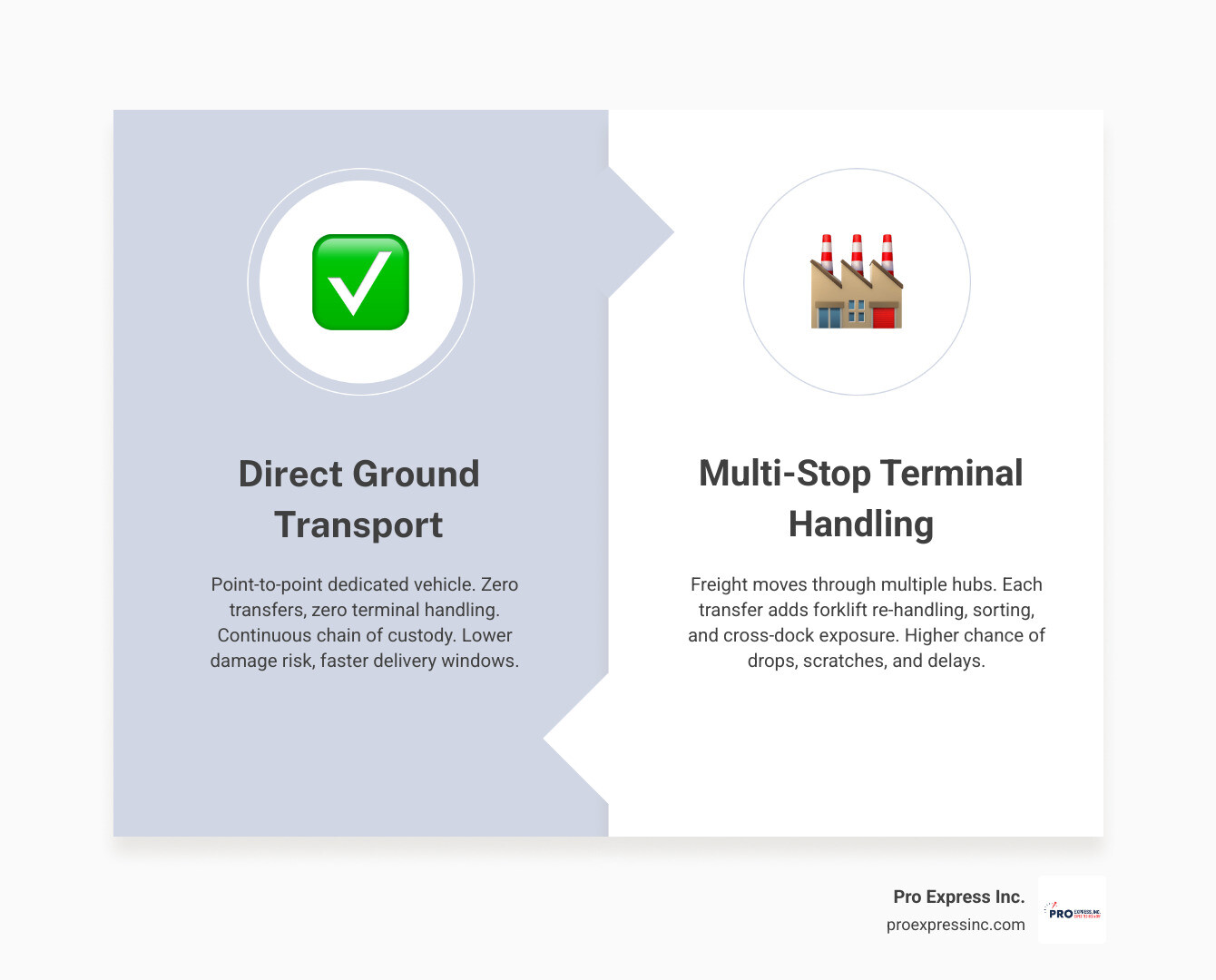
Transporting precision commercial freight through standard Less-Than-Truckload (LTL) networks exposes delicate machinery and architectural pieces to severe operational hazards. In a conventional hub-and-spoke system, cargo is loaded, unloaded, re-sorted, and restacked across multiple regional freight transfer terminals. Every cross-dock event introduces forklift impacts, drops, tipping risks, and shifting loads caused by co-mingled industrial freight.
Dedicated ground transport replaces this chaotic cycle with a secure, exclusive point-to-point route. As outlined in logistics analyses of white glove delivery: meaning, benefits, and drawbacks, specialized handling focuses on cargo touchpoint reduction, maintaining continuous chain-of-custody protocols from the initial pickup dock directly to the final delivery threshold. Eliminating intermediate terminal cross-docks removes the primary source of in-transit freight claims and physical packaging degradation.
When you book specialized white glove services, your freight broker aligns carrier equipment requirements—such as air-ride suspension, specialized strapping, and liftgates—specifically to the dimensions and vulnerabilities of your cargo.
| Handling Factor | Multi-Stop Terminal Network | Dedicated Direct White Glove Transport |
|---|---|---|
| Cargo Touchpoints | 4 to 8 cross-dock transfers | Exactly 2: Initial loading and final inside delivery |
| Co-Mingled Freight | High risk from heavy, unstable adjacent pallets | Zero co-mingling; exclusive-use vehicle capacity |
| Handling Equipment | Standard terminal forklifts operating at high speeds | Specialized padded hand trucks, pallet jacks, and liftgates |
| Chain of Custody | Fragmented across regional terminal shifts | Continuous, documented, and monitored point-to-point |
| Delivery Placement | Curbside or standard loading dock drop-off | Inside facility placement, threshold crossing, and uncrating |
5 Critical Protections for High-Value Freight

Safely transporting white glove high-value items requires strict physical and operational risk mitigation protocols. By coordinating exclusive nationwide white glove delivery, shippers protect equipment from mechanical shock, vibration wear, and site-level damage across five primary pillars.
Packaging Considerations for Sensitive Assets
Physical preservation starts at the crating stage. Standard cardboard or basic pallet stretch wrap cannot protect optical lenses, medical analyzers, or architectural fixtures against micro-abrasions and static discharge. High-value cargo demands custom wooden crating constructed to exact machine tolerances, combined with Ethafoam cushioning that absorbs harmonic road vibrations. Delicate electronic assemblies require anti-static wrap and vapor-corrosion-inhibiting moisture barrier bagging. Polished metal and glass surfaces receive non-marring surface guards and reinforced corner edge protection to prevent cosmetic rub damage during transit.
Managing Declared Value and Liability for Commercial Freight
A major financial vulnerability in freight shipping involves cargo liability limitations. Under standard motor carrier baseline rules, carrier liability is restricted to statutory limits that are often calculated by weight rather than actual value. For a lightweight, high-precision optical laser or diagnostic sensor, basic released-rate coverage yields a recovery payout far below the equipment’s true replacement cost in a total loss scenario. Shippers of critical commercial assets must secure dedicated declared-value coverage and comprehensive all-risk transit protection tailored to full replacement value rather than raw weight.
Site Preparation and Facility Surface Preservation
Delivery damage frequently happens outside the truck—on finished executive flooring, tight commercial corridors, or high-traffic hospital hallways. White glove protocols mandate site preservation:
- Thick neoprene floor runners along high-traffic paths to prevent scuffs, wheel marks, and moisture tracks.
- Padded door jamb protectors positioned on narrow doorways and entry thresholds.
- Interlocking Masonite pathing laid across marble, hardwood, or raised computer room floors to distribute wheel weight.
- Elevator cab padding and corner wall shielding to prevent impacts in commercial office high-rises.
Equipment-Specific Handling and Delivery Coordination
Heavy, sensitive instruments cannot simply be rolled off a standard trailer. Direct ground logistics coordinators arrange heavy-duty liftgate delivery vehicles equipped with hydraulic leveling systems to eliminate violent bumps. White glove freight moves utilize two-man handling teams equipped with non-marking pallet jacks, stair-crawlers, and machinery skates. Logistics planners map every doorway, turn radius, and elevator ceiling height in advance to ensure continuous vibration isolation and steady horizontal transport through building thresholds.
Direct Route Security and Continuous Chain of Custody
Every unscheduled stop or freight switch creates a vulnerability window. Dedicated ground shipping secures your cargo inside an exclusive-use vehicle equipped with real-time GPS tracking and tamper-evident numbered seals. The carrier partners transport your load straight along planned direct facility routes without intermediate stops at multi-carrier terminals, preserving an unbroken custody record from dispatch to signoff.
High-Value Commercial Cargo Categories That Demand Dedicated Handling

Certain industrial, medical, and commercial assets cannot endure standard freight network handling:
- Sensitive Laboratory & Medical Instrumentation: Mass spectrometers, MRI components, diagnostic imaging units, and robotic surgical analyzers requiring calibration retention, clean handling, and strict anti-vibration care during ground transit.
- High-End Lighting Fixtures & Architectural Elements: Custom crystal chandeliers, large-scale commercial luminaires, and fragile glass installations requiring specialized interior suspension, custom wooden crating, and padded mechanical securement.
- Advanced Robotics & Semiconductor Hardware: Cleanroom-ready automation modules, wafer-handling robots, and sensitive server racks vulnerable to electrostatic shock, tilting, and rough forklift movements.
- Custom Commercial Displays & Prototypes: One-of-a-kind engineering prototypes, trade show demonstration kiosks, and retail architectural displays that cannot be replaced from off-the-shelf inventory and must arrive fully intact for time-critical presentations.
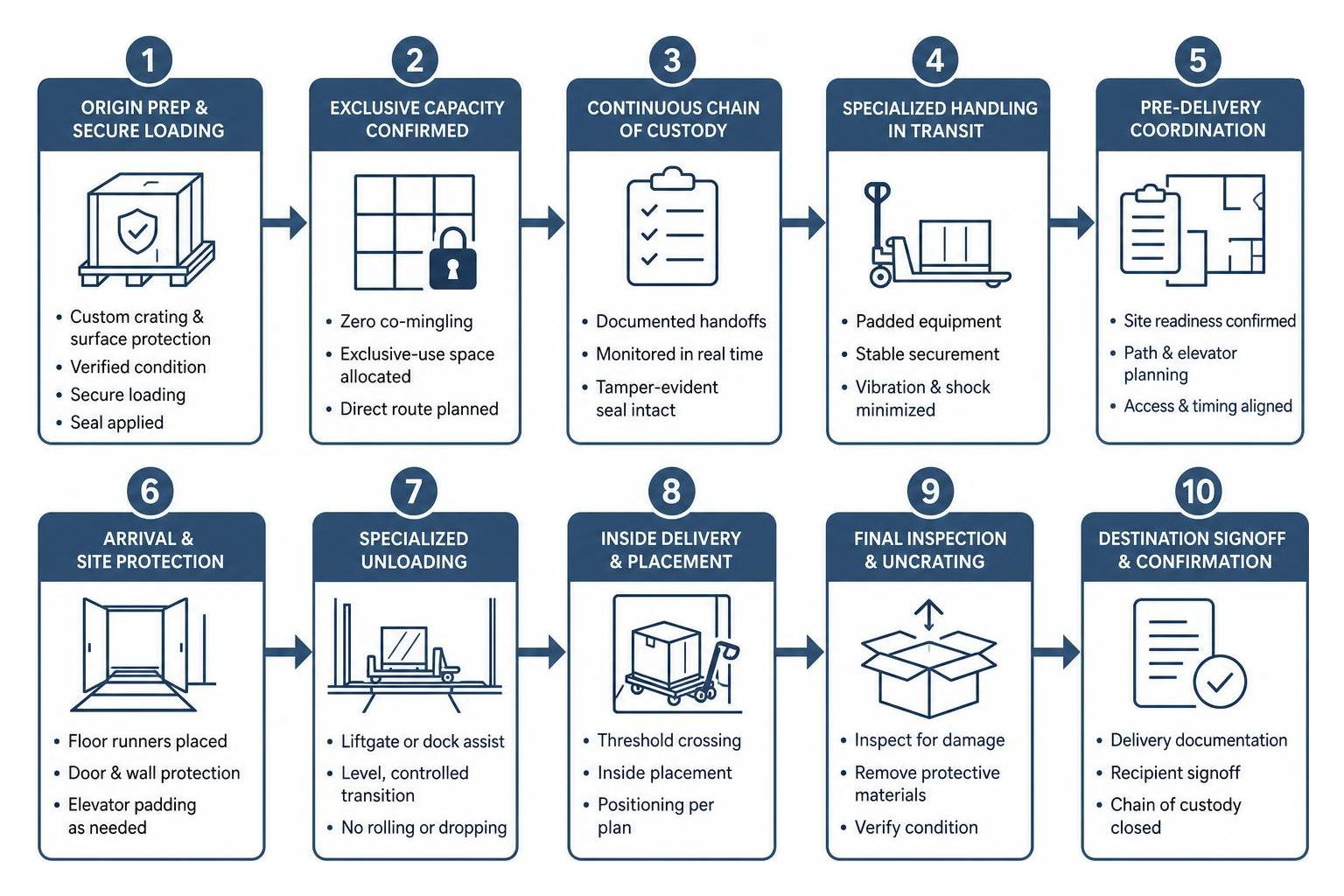
Operational Protocol: From Initial Dispatch to Final In-Facility Placement
To maintain total cargo integrity, dedicated ground logistics follows an uninterrupted operational framework:
- Pre-Transit Site Assessment: Evaluating shipper and consignee dock heights, door clearances, ramp angles, and freight elevator weight limits.
- Carrier Partner Vetting & Dispatch: Matching the load with a vetted ground carrier equipped with air-ride suspension, e-track tie-down rails, liftgates, and specialized rigging gear.
- Loading & Securement: Securing custom crates using heavy-duty ratchet straps, load-distributing load bars, and anti-slip friction mats.
- Monitored Point-to-Point Ground Transit: Maintaining continuous communication and live tracking across the entire route.
- Inside Delivery & Final Placement: Deploying floor protection, maneuvering the unit through facility thresholds, uncrating the asset, and removing packing debris from the work area.
Frequently Asked Questions About High-Value Cargo Transport
Why is standard carrier liability insufficient for high-value delicate freight?
Standard freight carrier liability is legally capped at minimum baseline levels under statutory motor carriage regulations. This weight-based calculation creates severe liability shortfalls for lightweight, high-value technological, optical, and medical equipment. Shippers must arrange explicit declared value coverage or specialized all-risk cargo insurance before dispatch.
How does dedicated point-to-point ground transport reduce handling-related damage exposure?
Dedicated transport eliminates the intermediate freight terminals, forklift transfers, and cross-dock rehandling that cause the vast majority of shipping damage. The cargo is loaded once at the origin facility, secured directly to the vehicle chassis using specialized restraints, and transported straight to the receiving dock without ever changing hands or sharing cargo space with rough freight.
What facility access protocols are required for complex commercial delivery sites?
Complex commercial, corporate, and healthcare delivery locations often enforce strict access controls. Coordination typically requires pre-booking dedicated loading dock time slots, reserving freight elevators, submitting carrier certificates of insurance to building management, laying down Masonite floor protection along finished corridors, and coordinating off-peak or after-hours delivery windows to prevent disruptions to active operations.
Conclusion
When critical supply chains, high-value prototypes, or sensitive architectural equipment are on the line, standard hub-and-spoke shipping exposes your business to unacceptable risks. Pro Express, Inc. operates as a specialized freight brokerage focused exclusively on expedited ground transport, including hot-shot ground delivery, inside placement, and two-man logistics.
In business since 2007 with nearly 20 years of experience, we have successfully managed over 10,000 shipments with a 99% client satisfaction rating and business partners returning for over 13 years. We coordinate every delivery through our rigorously vetted carrier network across the contiguous United States, backed by dedicated 24/7 operations support.
Protect your critical freight and streamline your operations with our dedicated ground shipping solutions. For specialized, time-sensitive ground transport, contact us today to coordinate your high-value shipment.