
Keep B2B Shipping Moving When Every Delivery Window Matters
For B2B shipping manufacturers distributors, the right provider does more than move freight. It must match your load, equipment needs, pickup timing, and delivery appointment to a vetted carrier that can execute reliably.
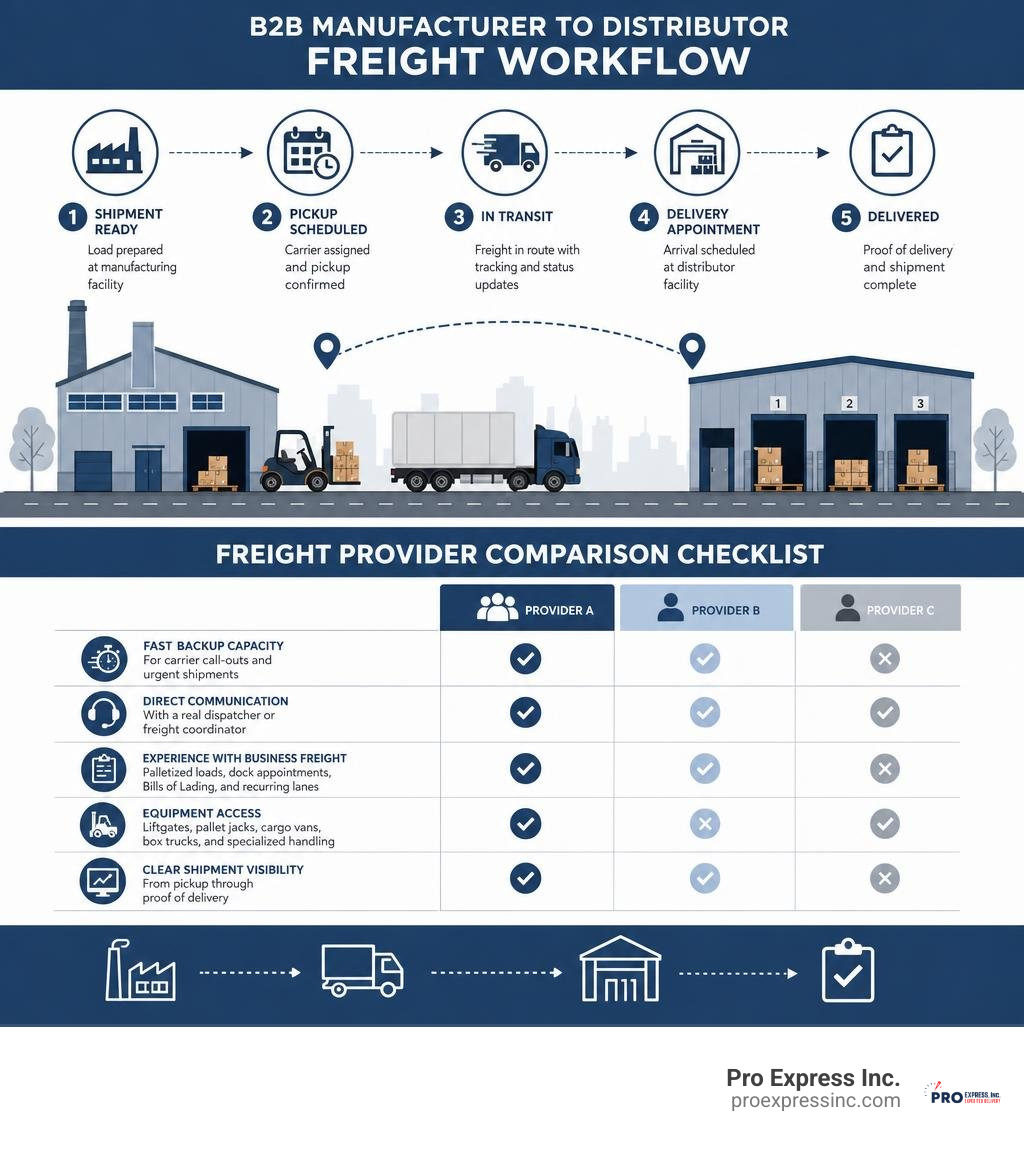
When comparing providers, prioritize:
- Fast backup capacity for carrier call-outs and urgent shipments.
- Direct communication with a real dispatcher or freight coordinator.
- Experience with business freight, including palletized loads, dock appointments, Bills of Lading, and recurring lanes.
- Equipment access for liftgates, pallet jacks, cargo vans, box trucks, and specialized handling.
- Clear shipment visibility from pickup through proof of delivery.
B2B freight is not ordinary parcel shipping. Manufacturers and distributors often move raw materials, machine parts, cases, pallets, and finished goods on strict timelines. A missed pickup can delay a dock appointment, leave a distributor without inventory, or put a production line at risk.
Modern buyers also expect a smoother, faster ordering and delivery experience. With 83% of B2B buyers preferring to order online, dependable fulfillment and accurate shipment updates are now part of doing business.
For nearly 20 years, Pro Express Inc. has arranged urgent and scheduled freight through a vetted carrier network. When a regular carrier cannot cover a critical shipment, the priority is simple: quickly coordinate the right capacity and keep freight moving toward its required delivery window.
Core Dynamics of B2B Shipping Manufacturers Distributors
Industrial freight moves in a fundamentally different operational realm than consumer parcel logistics. While retail parcel shipping focuses on individual residential addresses, commercial freight between manufacturing facilities and wholesale hubs involves heavy cargo, multi-tiered schedules, and specialized handling requirements.
| Operational Metric | B2B Industrial Freight | B2C Parcel Delivery |
|---|---|---|
| Typical Load Profile | Bulk pallets, skids, full truckloads, heavy machinery | Individual parcels, padded mailers, small boxes |
| Routing Strategy | Point-to-point dedicated linehauls or scheduled lanes | Multi-touch hub-and-spoke sorting facilities |
| Delivery Scheduling | Strict facility dock appointments, firm delivery windows | Multi-day delivery windows, residential drop-offs |
| Documentation | Bills of Lading (BOL), Advance Shipping Notices (ASN), EDI | Standard courier tracking numbers, postal manifests |
| Handling Equipment | Pallet jacks, dock levelers, liftgates, flatbeds | Lightweight conveyor belts, single-driver vans |
| Operational Stakes | Assembly line shutdowns, retail scorecard penalties | Rescheduled residential redeliveries |
Understanding these distinctions helps operational leaders recognize why consumer-grade networks cannot support complex manufacturing workflows. When multi-ton industrial loads are routed through multi-stop parcel hubs, transit times increase and the risk of structural cargo damage escalates.
How B2B Shipping Manufacturers Distributors Manage Critical Freight Flow
Maintaining predictable freight movement between production plants and regional distribution hubs is essential for just-in-time (JIT) manufacturing. Raw materials—such as raw sheet metal, engineered plastics, electronic assemblies, and specialized chemical compounds—must arrive in synchronized intervals to prevent factory floor idle time.
When establishing regular linehauls between assembly centers, distribution points, and end commercial facilities, many companies rely on the complete guide to FTL ground freight delivery services to structure direct point-to-point routes without intermediate terminal transfers.
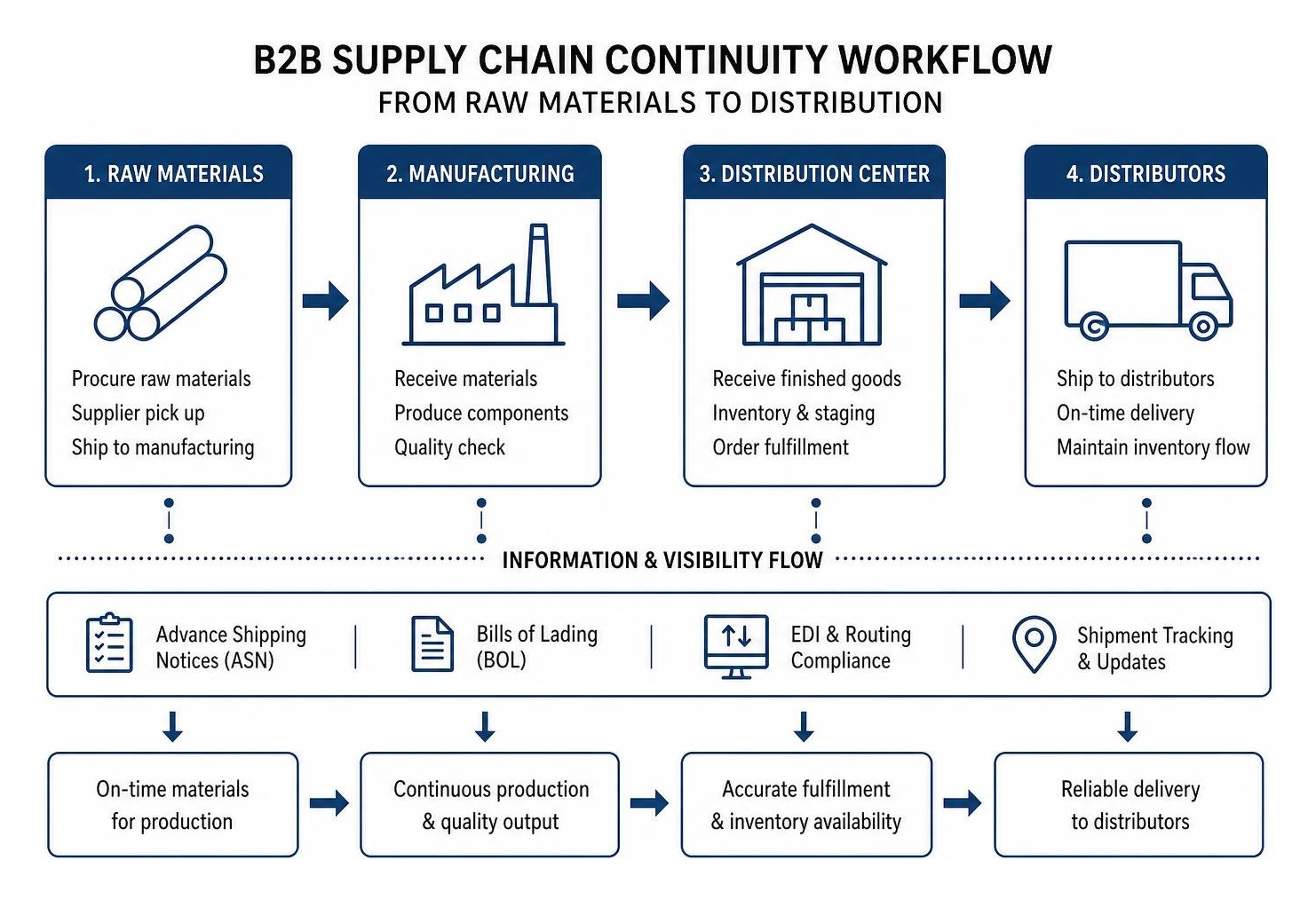
When inter-facility component transfers operate on tight production schedules, uncoordinated handoffs disrupt downstream sub-assemblies. Synchronizing recurring shipping corridors ensures commercial suppliers maintain continuous product availability across national distributor networks.
Compliance, EDI, and Routing Standards for B2B Shipping Manufacturers Distributors
Modern distribution centers enforce strict vendor routing guides. Non-compliance often results in dock rejections, chargebacks, and damaged vendor scorecards.
Essential operational compliance standards include:
- Electronic Data Interchange (EDI): Standardized digital communication frameworks (such as EDI 850 for purchase orders and EDI 856 for ASNs) that notify receiving facilities of exact shipment contents prior to arrival.
- Advance Shipping Notices (ASNs): Digital manifests detailing pallet configurations, carton counts, and serialized tracking data to accelerate intake scanning.
- Bill of Lading (BOL) Precision: Legally binding shipping records that document commodity classifications, exact piece counts, carrier information, and accessorial instructions.
- Standardized Pallet Labeling: GS1-128 compliance barcode labels affixed to outer cartons and pallet wraps to enable immediate intake processing at distribution centers.
Key Logistics Capabilities to Evaluate in B2B Providers
Selecting a freight brokerage to manage industrial transit requires assessing carrier vetting standards, network scalability, and communication responsiveness. Partnering with a logistics broker that maintains a nationwide network ensures urgent freight receives appropriate equipment and execution.

Reviewing industry performance benchmarks across US freight providers—as explored in detailed reviews of the top 10 logistics companies USA—highlights the importance of strict carrier safety screening, insurance verification, and operational reliability.
When evaluating a prospective provider, verify:
- Rigorous Carrier Onboarding: Active verification of operating authority, safety ratings, and cargo liability coverage.
- Direct Dispatch Access: Immediate phone or digital contact with dedicated coordinators rather than automated call centers.
- Geographic Reach: Capacity coverage across the contiguous United States, with routing for both regional and long-haul interstate lanes.
- Service-Level Agreement (SLA) Tracking: Continuous performance auditing covering on-time pickup, transit execution, and on-time delivery percentages.
Specialized Freight Handling and Equipment Options
Industrial and commercial facilities often lack standard loading docks, requiring specialized accessorial equipment and dedicated handling personnel.
- Liftgate Services: Mechanical platforms that lower heavy palletized freight directly from trailer beds to ground level at sites without loading bays.
- Inside Delivery: Moving skids, crates, or equipment past the receiving threshold and into interior production areas or storage bays.
- Two-Man Delivery Crews: Coordinated handling teams assigned to navigate heavy or sensitive commercial goods through challenging facility layouts.
- Custom Commercial Handling: Delicate freight—such as commercial lighting, medical systems, or precision tools—frequently requires why your business needs the white glove treatment for shipping to ensure secure placement, uncrating, and debris removal.
- Matched Vehicle Capacity: Matching load parameters to nimble cargo vans (up to 3,200 lbs) or straight box trucks with liftgates (up to 10,000 lbs) to maintain direct, point-to-point transit.
Expedited Ground Freight and Emergency Contingency Planning
When an assembly line faces an unexpected part shortage or a primary carrier fails to show up, standard freight transit is rarely sufficient. A single delayed component can stall an entire manufacturing facility, leading to severe downstream backlogs.
Logistics coordinators maintain operational stability by referencing expedited ground freight a strategic guide for logistics managers 2026 guide to structure emergency transport protocols. Dedicated ground transit routes cargo directly from the supplier origin to the manufacturing floor without intermediate terminal cross-docking, eliminating unnecessary touchpoints and transit delays.
Technology and Visibility Transforming B2B Supply Chains
Real-time visibility tools and digital tracking systems provide supply chain managers with continuous oversight of critical freight. Modern logistics coordination leverages advanced telematics, Internet of Things (IoT) sensors, and cloud-based management software to maintain end-to-end accountability.

Key technological capabilities transforming industrial freight include:
- Real-Time GPS Tracking: Precise, continuous geolocation data that monitors transit progress against scheduled dock appointments.
- IoT Environmental Sensors: Real-time monitoring of shock, tilt, humidity, and temperature for sensitive electronic, automotive, or medical shipments.
- Automated Milestone Alerts: Instant notifications generated at key transit checkpoints: pickup departure, transit milestones, out-for-delivery status, and digital Proof of Delivery (POD).
- Integrated Brokerage Platforms: Utilizing modern freight broker services the 2026 guide for urgent B2B shipping to source vetted capacity rapidly and resolve routing exceptions proactively.
Mitigating Carrier Failures Through Centralized Freight Brokerage
Carrier fallouts and missed pickups pose immediate risks to production timelines and distributor relationships. When an assigned carrier fails to arrive, navigating individual asset fleets from scratch wastes critical hours.
Working with an established freight broker streamlines emergency capacity sourcing. Logistics teams interested in the operational mechanics of third-party coordination can consult what is a freight broker the 2026 guide to understand how brokerages secure replacement capacity.
By maintaining direct communication with a centralized freight coordinator, shippers avoid communication silos and secure rapid carrier redeployment to keep time-critical shipments on schedule.
Frequently Asked Questions About B2B Industrial Shipping
What is the primary difference between B2B freight and standard parcel shipping?
B2B freight moves commercial cargo—such as raw materials, crated machinery, and palletized inventory—using dedicated vehicles, straight trucks, or full trailers routed point-to-point on strict dock appointments. Parcel shipping relies on shared hub-and-spoke networks with multi-day transit windows designed for small, individual consumer packages.
How do manufacturers handle unexpected carrier call-outs or line-down emergencies?
When an assigned carrier fails a load or an assembly plant faces an emergency line shutdown, shippers coordinate dedicated exclusive-use ground transport. Logistics managers explore why your business needs a hot shot delivery partner to quickly source vetted carriers capable of immediate same-day dispatch and direct transit without intermediate freight transfers.
What role does EDI compliance play in wholesale distribution?
Electronic Data Interchange (EDI) enables standardized, automated data transmission between suppliers, logistics providers, and wholesale distribution hubs. It streamlines purchase order ingestion, generates Advance Shipping Notices (ASNs), coordinates dock scheduling, and verifies load contents, helping shippers avoid retailer chargebacks and delivery delays.
Conclusion
Navigating the demands of modern industrial distribution requires logistics partners capable of responding quickly when timelines are critical. For nearly 20 years, Pro Express Inc. has brokered urgent, scheduled, and specialized freight for manufacturers and distributors across the contiguous United States. Having coordinated over 10,000 successful shipments, our team connects businesses with a thoroughly vetted carrier network to move critical cargo safely and on schedule.
Whether your operations demand exclusive hot-shot ground transit, liftgate-equipped straight trucks, cargo vans, two-man crews, or specialized white-glove handling, our dispatch coordinators provide continuous oversight and reliable capacity. When regular carriers fall short or critical delivery windows are at stake, connect with Pro Express Inc. to arrange a freight service tailored to your operational requirements.