
How to Arrange Critical Hot Shot Delivery
Critical hot shot delivery moves urgent freight by dedicated ground transport, typically straight from pickup to drop-off instead of through standard freight terminals. To arrange it, give a broker the cargo’s size and weight, pickup and delivery details, and deadline. Confirm the vehicle needed, how the freight is packaged, and how you’ll receive shipment updates.
When a missed delivery could stall production or disrupt a customer order, speed alone is not enough. Pro Express Inc. coordinates urgent ground shipments through a vetted carrier network, with 24/7 coordination across the contiguous United States.
Critical hot shot delivery basics:
What Is Critical Hot Shot Delivery and How Does It Function?
In modern supply chain operations, unexpected delays can bring an entire production facility to a standstill. When vital replacement machinery, raw materials, or specialized components are needed immediately, traditional freight methods often fall short. Dedicated ground transport steps in to bridge this gap, ensuring that time-sensitive loads move without interruption from origin to destination across the lower 48 states.
To understand why this model works so effectively for mission-critical freight, it helps to compare dedicated expedited transport with standard linehaul logistics:
| Feature | Critical Hot Shot Delivery | Standard Freight Shipping |
|---|---|---|
| Vehicle Assignment | Exclusively dedicated to your shipment | Shared trailer space with multiple shippers |
| Routing Method | Direct point-to-point transit | Hub-and-spoke network with terminal transfers |
| Handling Risk | Minimal handling (loaded once, unloaded once) | Frequent cross-docking and sorting |
| Dispatch Timing | Immediate on-demand dispatch 24/7 | Scheduled pickup windows based on fixed routes |
| Tracking Visibility | Continuous real-time GPS telemetry updates | Periodic checkpoint and terminal scans |
Defining Critical Hot Shot Delivery Versus Standard Freight
The foundational difference between conventional freight and dedicated ground transport lies in how cargo moves through the network. Standard freight relies on hub-and-spoke networks where shipments are consolidated, sorted at intermediate terminals, and transferred between multiple trucks. While this approach works well for regular inventory replenishment, cross-docking introduces handling risks and transit delays that can jeopardize time-sensitive operations.
Dedicated point-to-point transit eliminates these intermediate touchpoints entirely. When arranging hot shot delivery using small trucks for big deadlines, a dedicated vehicle—such as a cargo van, sprinter van, or straight truck—is assigned solely to your freight. The driver proceeds directly from your pickup dock to the delivery site. Because your cargo is loaded once and unloaded once, transit times are streamlined and the risk of physical damage during cross-docking is substantially reduced.
Essential Industries Requiring Urgent Ground Transport
Urgent freight demands arise across multiple commercial sectors where even an hour of operational downtime carries severe operational consequences. Understanding why your business needs a hot shot delivery partner starts with recognizing the industries that rely heavily on direct ground transit:
- Automotive Assembly: Assembly lines operate on precise just-in-time schedules. If a specific batch of stamping dies, wiring harnesses, or electronic modules fails to arrive on time, an entire assembly shift can grind to a halt.
- Heavy Manufacturing & Industrial Machinery: When a primary CNC machine, hydraulic press, or turbine breaks down, replacement parts must move across state lines without delay to restore production capacity.
- Oilfield & Energy Operations: Remote drilling sites and refining facilities operate around the clock. Equipment failures require rapid dispatch of valves, drill bits, and pump assemblies to maintain environmental and operational safety.
- Commercial Construction Projects: Missing specialized structural hardware, high-end architectural fixtures, or replacement generator parts can force general contractors to pause work, delaying project milestone completion.

Critical Operational Requirements and Compliance Standards
Executing an expedited ground transport run requires coordinated logistics planning, advanced tracking systems, and strict adherence to federal safety mandates. Navigating real-world transit conditions across the contiguous United States requires round-the-clock operational oversight.
Route Optimization and Dispatch Availability
Managing unexpected road closures, severe weather events, and regional traffic congestion is essential for maintaining dependable transit schedules. According to the Bureau of Transportation Statistics Freight Data, commercial trucks move the vast majority of the nation’s freight by value and tonnage, making dynamic highway management a vital part of transportation planning.
Our operations team coordinates shipments 24/7, using live GPS tracking and telemetry tools to monitor vehicle progress continuously. By evaluating weather forecasts and real-time highway conditions, dispatchers can adjust route recommendations dynamically. This continuous communication between dispatch coordinators and vetted drivers ensures that unexpected delays are recognized early and managed effectively.
Adhering to FMCSA Hours of Service Regulations
Speed must never come at the expense of safety or federal regulatory compliance. Professional freight brokers and independent motor carriers must strictly observe the safety standards established by the FMCSA Hours of Service Regulations. These rules limit maximum driving hours and mandate structured rest periods to prevent driver fatigue on long-haul routes.
To ensure lawful, safe transit on cross-country ground runs across the lower 48 states, carriers utilize Electronic Logging Devices (ELDs) to record drive time accurately. When freight must cover long distances continuously without intermediate rest stops, we coordinate shipments utilizing team drivers. With two qualified drivers sharing the cab, the vehicle maintains continuous, compliant forward progress while adhering strictly to all Department of Transportation safety requirements.
Best Practices for Managing Urgent Freight Shipments
Successfully coordinating time-critical freight requires clear communication, detailed documentation, and a systematic preparation checklist. Logistics managers should follow structured guidelines, including the 5 critical steps to find an emergency hot shot courier service, to maintain control over urgent dispatches.
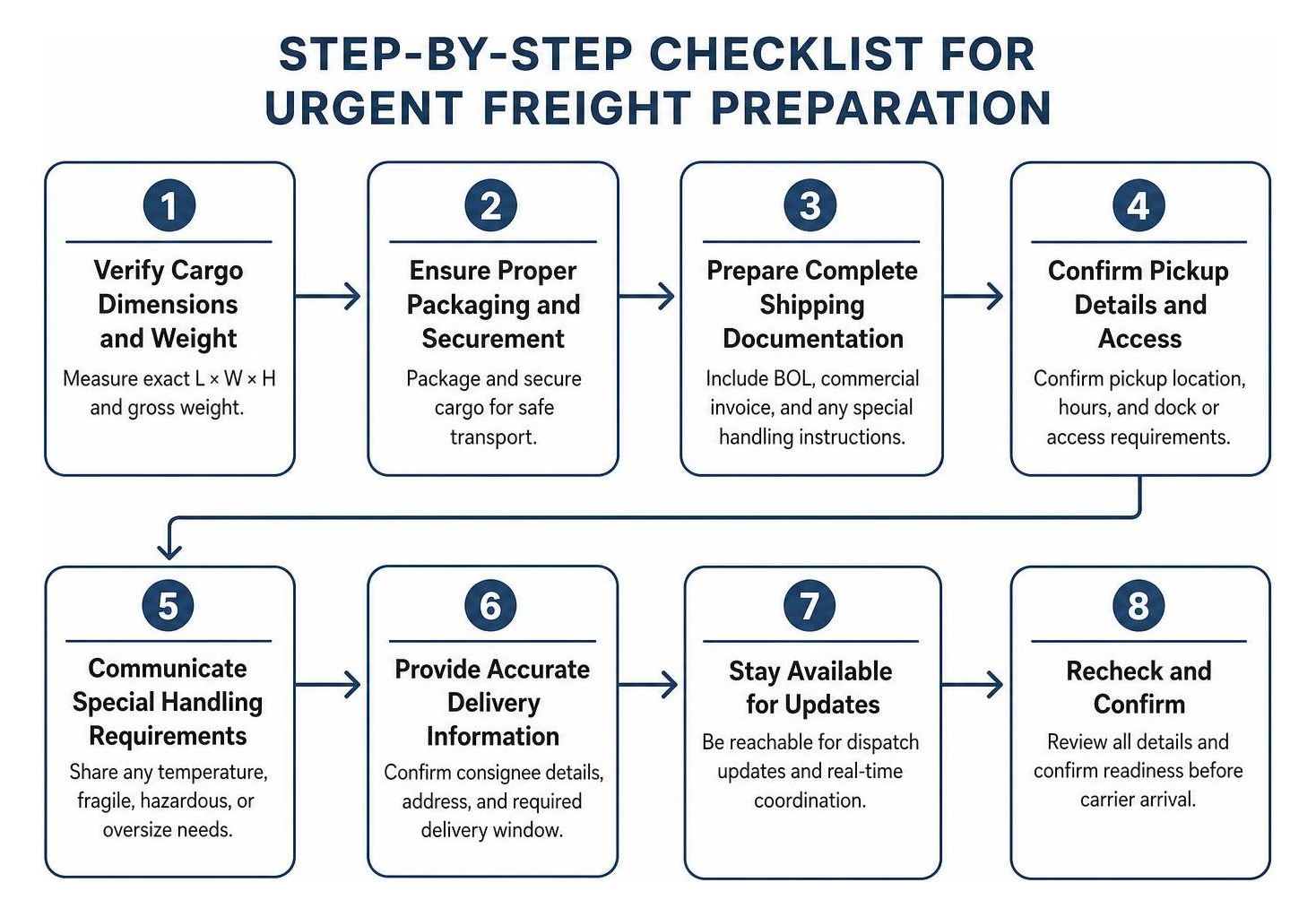
Preparing Cargo and Documentation for Critical Hot Shot Delivery
Before a carrier arrives at your shipping dock, your internal warehouse team should perform several essential preparation checks:
- Verify Cargo Dimensions and Total Weight: Measure the exact length, width, height, and gross weight of the freight. Accurate measurements ensure the broker selects the appropriate vehicle type and weight capacity.
- Inspect Packaging Integrity: Palletize, crate, or strap items securely. High-value machinery parts must be shrink-wrapped and protected with corner guards to prevent shifting during transit.
- Complete the Bill of Lading (BOL): Ensure the BOL clearly lists the accurate pickup address, site contact names, direct phone numbers, delivery receiving windows, and any specialized handling notes.
- Identify Dock Capabilities: Determine whether the origin or destination requires specialized equipment, such as a liftgate for ground-level loading or two-man inside delivery assistance.
- Establish Point-of-Contact Protocols: Provide primary and secondary emergency contact numbers so dispatch teams can share transit milestones and delivery confirmations immediately upon drop-off.
Criteria for Selecting a Vetted Expedited Broker
Choosing the right freight brokerage is one of the most critical decisions an operations manager makes when dealing with high-stakes freight. For comprehensive guidance on vetting standards, review the ultimate guide to choosing a hot shot trucking service.
When evaluating potential brokerage partners, ensure they maintain rigorous carrier vetting procedures:
- Active Operating Authority and Safety Records: Verify that every motor carrier in the network possesses active Federal Motor Carrier Safety Administration (FMCSA) operating authority and satisfactory safety measurement scores.
- Appropriate Cargo Insurance Verification: Confirm that the carrier assigned to your load maintains sufficient cargo and auto liability insurance coverage matched to your shipment’s total value.
- 24/7 Dispatch and Dedicated Support: Ensure the broker provides continuous dispatch availability, offering direct human communication rather than automated phone trees during after-hours emergencies.
- Access to Diverse Ground Equipment: Look for a broker capable of arranging a wide range of dedicated ground transport, including cargo vans, sprinter vans, small straight trucks, and large straight trucks with liftgates.
Frequently Asked Questions About Critical Hot Shot Logistics
What vehicles are most commonly used for urgent hot shot loads?
Dedicated hot shot freight relies on a variety of commercial ground vehicles suited to specific load sizes. Common equipment includes cargo vans and sprinter vans for smaller palletized freight and 24- to 26-foot straight trucks (often equipped with liftgates) for heavier skids and industrial equipment moving throughout the lower 48 states.
How quickly can dedicated ground freight be dispatched?
Because dedicated logistics coordinators operate 24/7, carrier identification and dispatch coordination begin immediately once shipment specifications are confirmed. A vetted carrier located near the pickup facility is dispatched directly to the shipper’s dock to secure the freight and start transit without delay.
How do safety regulations affect time-sensitive transit across the lower 48 states?
All commercial motor carriers must comply with FMCSA Hours of Service mandates, which restrict consecutive driving hours to maintain road safety. For urgent freight requiring continuous, long-distance ground transit, brokers arrange team-driver operations so the vehicle can remain in motion legally while both drivers alternate compliant rest shifts.
Conclusion
When operational continuity hangs in the balance, having a dependable expedited ground freight plan is essential for preventing costly facility downtime. Coordinating time-critical freight requires active communication, dedicated equipment, and strict compliance with federal safety regulations.
At Pro Express Inc., we bring nearly 20 years of experience as an expedited freight broker to every shipment. Having coordinated over 10,000 delivered shipments with a 99% client satisfaction rate, our team works around the clock to arrange dependable ground transport across the contiguous United States through our vetted carrier network.
Explore our dedicated exclusive hot shot delivery solutions or reach out directly to secure rapid transport for your urgent freight.