
How to Ship Bakery Goods for Next-Day Delivery
For next day bakery shipping, start with the product’s shelf life and temperature needs. Cool baked goods before packing, use food-safe containers that prevent movement, and add insulation when the product needs it. Then set an order cut-off that leaves time to pack, stage, and hand off the shipment before the carrier’s pickup deadline.
For commercial kitchens, the challenge is keeping that plan intact when an order is urgent or a carrier falls through. Expedited ground transport can help, but the bakery and carrier need to agree on handling needs and the delivery window before dispatch.
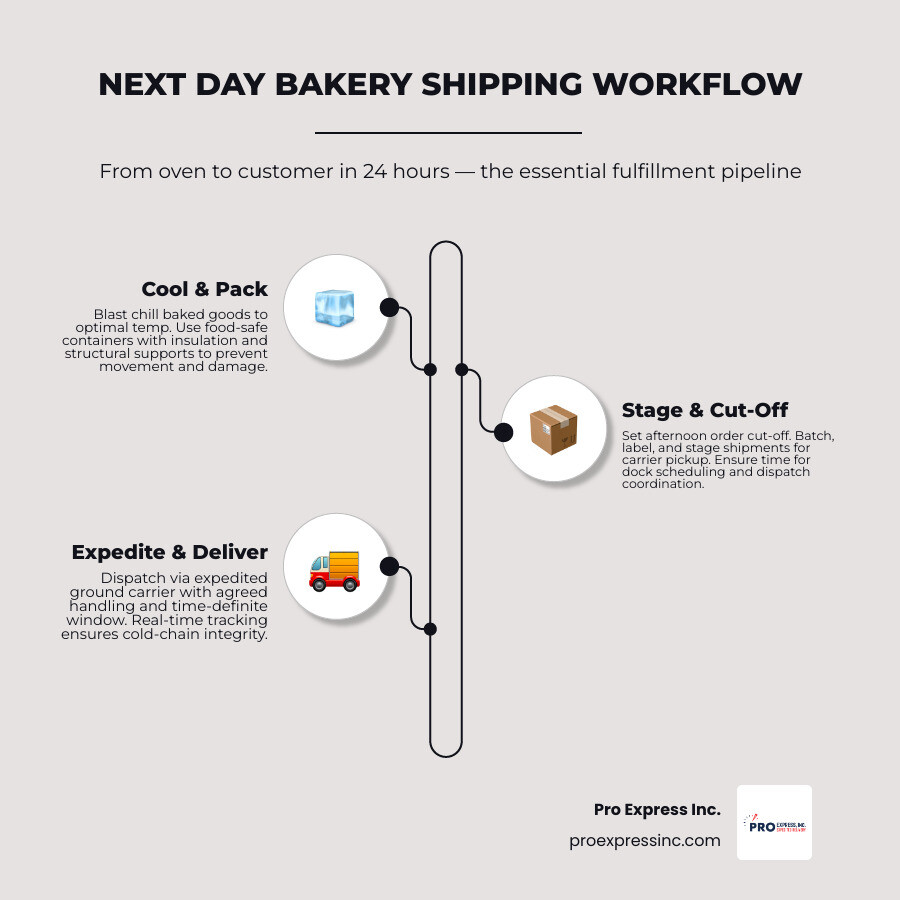
Next day bakery shipping terms explained:
Mastering Next Day Bakery Shipping Logistics for Commercial Kitchens
Managing perishable goods across tight transit windows requires disciplined freight handling. When commercial kitchens scale wholesale operations, corporate catering contracts, or regional retail distribution, logistics become an extension of the kitchen itself. Operating in a commercial environment means understanding that once an item leaves the loading dock, environmental control and transit velocity dictate customer satisfaction.
Reviewing the fundamentals of next day delivery 101 highlights why commercial food shippers must eliminate transit friction. Bakery goods are highly vulnerable to humidity shifts, mechanical impact, and biological spoilage. Whether distributing par-baked baguettes, delicate artisan pastries, or tiered celebration centerpieces, commercial kitchens must establish clear transit parameters with their transportation partners before tendering freight.
Maintaining Perishable Quality Across Overnight Ground Transit
The biological and chemical integrity of baked goods begins changing the moment products leave the oven. Starch retrogradation—the process where amylose and amylopectin molecules realign and force moisture out of the crumb—accelerates dramatically within specific temperature zones. Keeping bread between 35°F and 45°F without proper packaging actually accelerates staling faster than room-temperature storage.
To preserve product quality, kitchens must align their packaging recipes with transit timelines. Utilizing expedited overnight shipping prevents goods from lingering in sorting hubs where ambient temperatures fluctuate. High-fat pastries require barriers against oxidation, while crusty breads require breathable barriers or controlled-atmosphere packaging to prevent crust softening.
Mitigating Vibration and Shock During Transit
Road vibration is a major cause of structural failure in delicate pastries and tiered cakes. Standard freight transport exposes cargo to continuous harmonic vibration and sudden lateral shocks from braking and cornering. Without stabilization, internal structures crack, buttercreams shear, and delicate sugar work shatters.
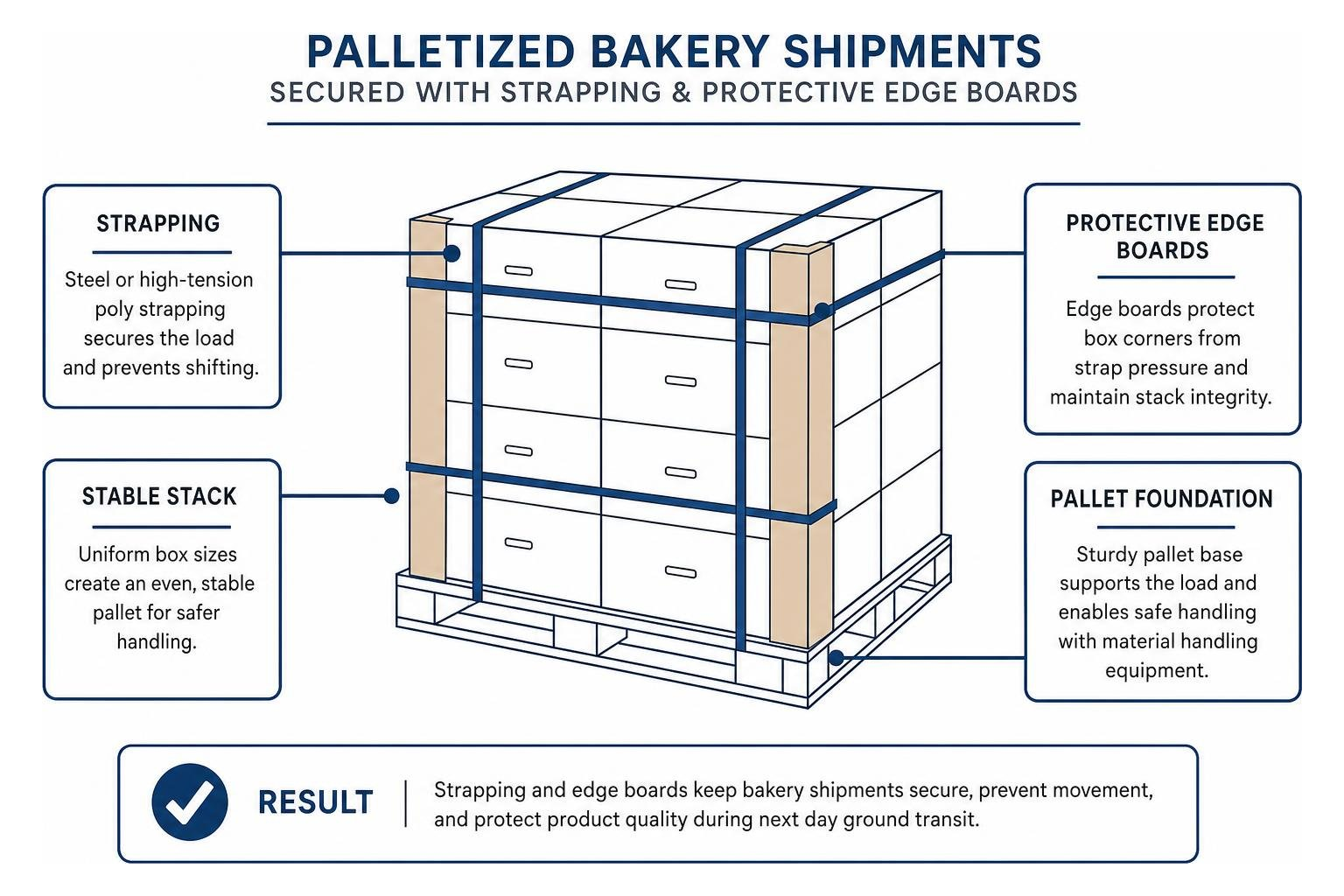
Commercial logistics strategies require vehicles with air-ride suspension and specialized cargo-securing systems. Selecting courier handling for fragile goods ensures freight is not co-mingled with heavy industrial cargo or subjected to rough sorting belts. Pallet-level shipments should utilize anti-vibration deck pads, tight stretch-wrapping, and corner edge-boards to maintain structural integrity across every mile.
Packaging Protocols to Protect Fragile Baked Goods
Packaging perishable food items requires balancing food contact safety, structural rigidity, and thermal management. Secondary and tertiary packaging must withstand vertical compression during transit without transferring force to the internal product.
| Packaging Material | Thermal Performance | Structural Rigidity | Moisture Resistance | Best Use Case |
|---|---|---|---|---|
| Expanded Polystyrene (EPS) | High (R-value ~4.5/in) | Moderate to High | Excellent | Frozen doughs, heavy multi-tier cakes |
| Recycled Cotton / Denim Liners | Moderate to High | Low (Flexible) | Moderate (Requires barrier film) | Pastry assortments, ambient insulated treats |
| Corrugated ClimaLiner Panels | Moderate | High (Crush-resistant) | High | Tiered artisan breads, regional catering pans |
| Vacuum Insulated Panels (VIP) | Extreme (R-value ~30/in) | Very High | High | Temperature-critical specialty confections |
Essential Thermal Packaging and Temperature-Control Supplies
Maintaining thermal stability during overnight ground shipping requires precise phase-change materials (PCMs) and insulation. Sweating ice packs ruin corrugated structural integrity and introduce excess moisture to crisp pastries. Solid gel refrigerants enclosed in puncture-resistant poly pouches prevent condensation issues while absorbing ambient heat.
Kitchens should calculate refrigerant mass based on total payload weight, transit duration, and expected seasonal temperature extremes. Ambient thermal barriers protect delicate crusts from freezing when shipped alongside chilled components, maintaining distinct microclimates within a single master shipping container.
Specialized Structural Packing for Multi-Tiered Cakes and Breads
Large celebration cakes and structural bakery displays require internal engineering before entering the shipping box. Multi-tiered cakes must be anchored through food-safe center dowels locked directly into high-density wooden or heavy composite baseboards.
The baseboard must lock mechanically into the outer corrugated transport unit, preventing any lateral shifting. Enclosing structural tiers within rigid clamshell supports lined with custom food-grade foam inserts protects delicate piping, sugar flowers, and soft frostings from making contact with container walls.
Operational Workflows: Cut-Off Windows and Carrier Coordination
Executing reliable overnight delivery requires synchronized workflows between the kitchen production line and the logistics dock. When dealing with urgent next day transport, commercial bakeries cannot afford staging delays or miscommunicated handoff schedules.
Streamlining Kitchen Fulfillment for Next Day Bakery Shipping
Kitchen workflows must align backwards from carrier dock cut-off times. Establishing order batching windows allows the production team to group items by thermal profiles and final destinations.
- Order Finalization: Establish clear mid-day ordering cut-offs to lock in production quantities.
- Cooling Cycles: Implement commercial blast chilling to pull core temperatures down rapidly without creating internal condensation.
- Packaging Assembly: Package items in certified cleanrooms or dedicated staging zones using pre-chilled containers.
- Verification & Labeling: Apply automated 2D barcode labels linked directly to manifest data to prevent misrouting.
Managing Regional Direct-Drive Routes and Ground Couriers
Standard hub-and-spoke distribution networks often involve multiple cross-dock handling steps, which increase the risk of physical damage and thermal degradation. Direct-drive ground transport eliminates intermediary handling by moving shipments straight from the kitchen dock to the receiving facility.
Utilizing dedicated hot-shot ground transport allows commercial operations to bypass traditional terminal transfers. For high-volume catering, corporate headquarters, or hotel distribution, arranging specialized ground freight with inside delivery and liftgate services ensures products move smoothly from the truck bed into client refrigeration without being left on warm loading docks. Shippers looking to optimize early arrivals can implement proven early morning delivery strategies to meet breakfast service deadlines.
Leveraging Technology and Dispatch Systems for Overnight Perishables
Modern commercial bakery distribution relies on integrated logistics technology to maintain quality visibility. Connecting kitchen enterprise resource planning (ERP) systems with specialized bakery delivery routing platforms enables seamless coordination between bakers, dispatchers, and receiving docks.
Real-Time Tracking and Cold-Chain Monitoring
High-value commercial bakery shipments often incorporate single-use or reusable smart data loggers. These Bluetooth or cellular-enabled sensors monitor real-time internal temperature, relative humidity, and three-axis shock events throughout transit.
Geofencing tools alert logistics teams the moment a vehicle approaches the destination, triggering receiving kitchen staff to clear dock space and prepare refrigeration. Establishing this unbroken chain of custody provides complete verification that temperature-sensitive products remained within safe parameters throughout their journey.
Overcoming Delay Exceptions in Next Day Bakery Shipping
Even well-planned shipping operations encounter weather disruptions, road closures, and traffic bottlenecks. Mitigating these risks requires active exception management rather than reactive customer support.
Working with an experienced freight broker provides commercial kitchens with rapid re-dispatching options when primary lanes face unexpected closures. Vetted carrier networks with regional ground coverage can deploy secondary vehicles to complete the final leg of transit, ensuring perishable baked goods arrive before product degradation occurs.
Frequently Asked Questions About Commercial Bakery Shipping
How are perishable items kept cold during overnight transport?
Perishable baked items rely on passive cold-chain systems inside insulated master containers. Phase-change gel packs or dry ice blocks are matched to the specific payload volume, thermal liner R-value, and ambient transit conditions. Pre-chilling corrugated shipping boxes and staging products in refrigerated holding rooms prior to carrier loading prevents thermal spikes during transit.
What operational cut-off times work best for commercial bakeries?
Most commercial bakeries establish an order and production cut-off between 11:00 AM and 2:00 PM for next-day ground delivery. This window provides the culinary team adequate time for final baking, controlled cooling cycles, protective packing, and dock staging prior to late-afternoon carrier pickups.
How do commercial kitchens prevent structural cake collapse?
Preventing structural collapse requires mechanical stabilization. Bakers use food-grade wooden or plastic internal dowels that lock the cake tiers to a heavy-duty baseboard. That baseboard is secured within a rigid, shock-absorbing outer crate lined with dense foam inserts to eliminate lateral movement and dampen road vibrations during transit.
Conclusion
Successfully scaling next-day ground delivery for commercial bakery goods requires a combination of precise packaging, thermal planning, and dependable freight brokerage coordination. When timelines are tight and cargo is highly perishable, kitchen operations need logistics partners who understand the critical nature of time-definite ground transit.
At Pro Express, Inc., we specialize in expedited ground freight brokerage across the contiguous United States. In business since 2007 with nearly 20 years of experience, we have coordinated over 10,000 shipments with a 99% client satisfaction rating and loyal clients returning for over 13 years. Our team provides 24/7 logistics coordination, connecting your commercial operation with a vetted carrier network for hot-shot, liftgate, and specialized courier delivery services.
Contact Us Today to coordinate your urgent commercial ground shipments.