
What Is a Courier Pick Up — and Why It Matters for Your Operations
A courier pick up is when a carrier comes directly to your location — your warehouse, facility, or office — to collect a shipment, so you never have to drop it off yourself.
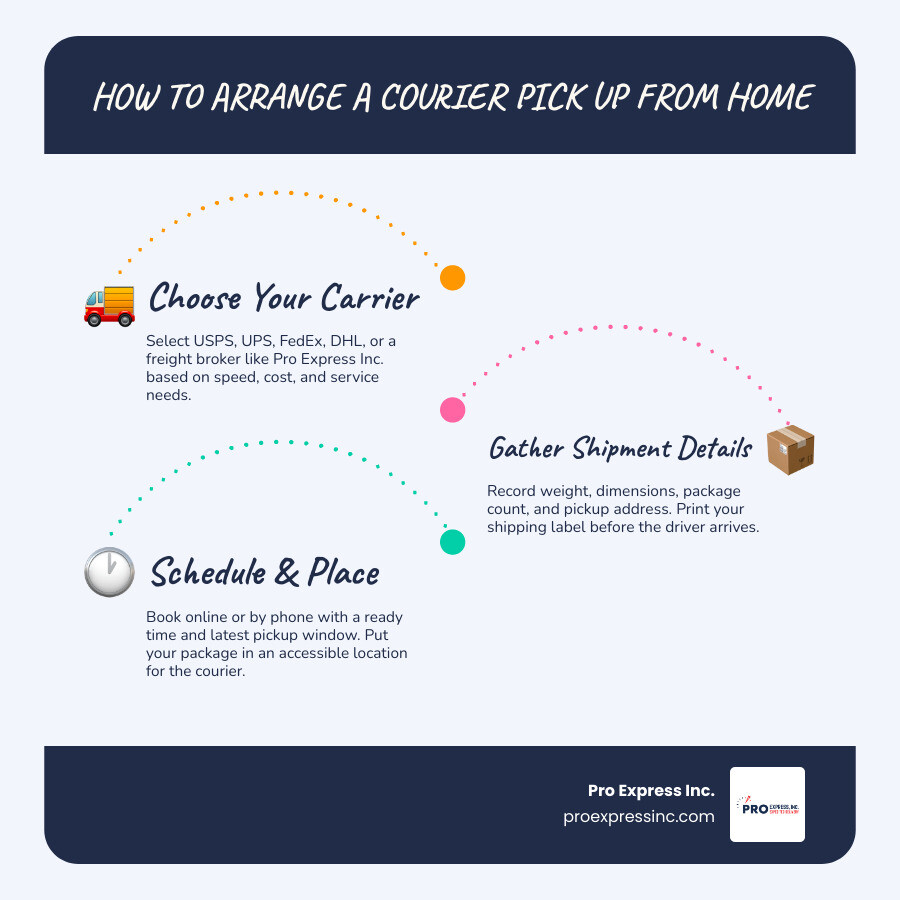
Here is how to arrange one quickly:
- Choose your carrier — select a national parcel carrier or a specialized freight broker like Pro Express Inc.
- Gather your shipment details — weight, dimensions, package count, and pickup address
- Schedule online or by phone — set a ready time and a latest available pickup window
- Prepare your label — most carriers require a printed shipping label before the driver arrives
- Place your shipment — put it in an accessible location and wait for the courier
For operations managers running tight supply chains, the difference between a pickup and a drop-off is not just convenience — it is the difference between a shipment that moves and one that sits.
When a regular carrier fails or a critical deadline appears without warning, knowing exactly how to arrange a fast, reliable collection can protect your client relationships and keep your supply chain moving.
This guide walks you through everything — from booking a standard one-time pickup to handling heavy freight, missed collections, and urgent same-day dispatches.
Simple courier pick up glossary:
How to Streamline Your Business with a courier pick up
For remote business operations and corporate supply chains, relying on staff to physically drop off high-priority shipments at retail counters is an operational bottleneck. It introduces unnecessary transit delays, increases the risk of package damage during personal transport, and pulls valuable personnel away from core tasks. Transitioning to a structured commercial courier pick up model resolves these issues by integrating collection directly into your daily workflow.
When managing high-value or highly sensitive cargo — such as automotive components, medical equipment, or custom manufacturing parts — timing is everything. A professional parcel pickup service ensures that your shipments enter the logistics pipeline at the earliest possible moment. Instead of waiting for an end-of-day drop-off run, a scheduled collection aligns perfectly with your production schedule, allowing you to meet strict next-day or same-day delivery windows.
Furthermore, leveraging a coordinated pickup service enhances supply chain visibility. The moment a carrier partner scans the package at your facility, the tracking sequence begins. This immediate custody transfer provides real-time confirmation to your operations team and your clients, eliminating the blind spots common with retail drop-offs. For modern B2B enterprises, this level of corporate supply chain efficiency is not a luxury; it is a baseline requirement for maintaining a competitive edge.
How to Schedule a One-Time Courier Collection Online
In July 2026, scheduling a one-time courier collection is primarily handled through digital scheduling portals. Whether you are operating from a centralized corporate headquarters or managing logistics for a network of remote offices, online booking systems allow you to request on-demand collections with a few clicks. Utilizing these digital tools ensures that precise dispatch instructions are routed directly to the carrier network, minimizing the risk of miscommunication.
When booking an on-demand collection, accuracy is paramount. To prevent delays or missed attempts, you must provide precise address details, including specific suite numbers, building codes, or loading dock designations. Additionally, commercial package dimensions and weight limits must be calculated and entered with care. For remote office shipments, underestimating the physical footprints of your cargo can lead to carrier vehicle mismatches, leaving your critical freight stranded on the dock.
For logistics professionals looking for a comprehensive guide on managing these remote collections seamlessly, understanding how to book a courier from home without putting on pants offers practical, real-world insights into coordinating doorstep collections without disrupting your daily routine.
Step-by-Step Guide to Booking a courier pick up
To successfully schedule a courier pick up online, follow this structured process:
- Verify Shipping Labels: Ensure you have valid, pre-printed shipping labels for all packages. Most major carrier systems require tracking numbers to be entered during the pickup request to verify the shipment’s destination and weight.
- Access the Carrier Portal: Log into the appropriate digital portal. For standard postal collections, you can use the Schedule a Pickup tool. For commercial parcel networks, you can schedule via the Schedule a Pickup Portal or the alternative Scheduling Page.
- Enter Location and Access Details: Provide the exact address and specify the preferred pickup location (e.g., Loading Dock, Front Reception, Guard Room).
- Specify Package Details: Input the total piece count, total weight, and dimensions. If any individual package exceeds standard weight thresholds, explicitly flag it to ensure the dispatched vehicle is equipped with appropriate handling tools.
- Select Your Window: Define your “ready time” and the “latest available time” for the carrier to execute the collection.
- Confirm and Record: Submit the request and record the pickup confirmation number. This reference is vital for tracking the status of the dispatch.
Essential Information Required for Your courier pick up Request
When submitting your dispatch request, the carrier’s routing software relies on specific data points to optimize their driver schedules. The most critical inputs are your “ready time” (the earliest moment the packages are packed, labeled, and accessible) and your “latest available pickup window” (typically aligned with your facility’s closing time). Standard parcel networks require a minimum time buffer — often several hours — between these two markers to allow for routing flexibility.
Beyond timing, you must outline clear access instructions. If your remote office or warehouse is located in a secured business park, provide gate codes, security desk protocols, or third-party warehouse contacts. Safety protocols are also mandatory; for instance, postal carriers require an explicit declaration regarding the presence of dogs at the pickup address. Providing these details up front protects carrier partners and helps ensure a smooth, uninterrupted handoff.
Preparing Your Shipments for a Successful Collection
A successful courier pick up depends heavily on how well the cargo is prepared before the carrier arrives. Shipments that are poorly packed or incorrectly labeled are frequently rejected by drivers, causing severe disruptions to your delivery timelines. Implementing rigorous packaging standards within your facility is the first line of defense against transit damage and carrier delays.
To help your team establish these standards, referring to a professional pick up and delivery service guide can provide valuable checklists for preparing high-priority business shipments.
When preparing packages, adhere to these industrial labeling and packaging guidelines:
- Use Heavy-Duty Materials: Secure all items in double-walled corrugated boxes, especially when shipping heavy industrial or automotive parts.
- Apply Flat, Clear Labels: Place shipping labels flat on the largest surface of the container. Never wrap barcodes around edges or place tape directly over the barcode, as this interferes with optical scanners.
- Provide Clear Access Paths: Ensure that packages are staged in an easily accessible area, such as a designated shipping vestibule or loading dock, to minimize the driver’s dwell time.
Handling Heavy Cargo and Special Materials
When shipments exceed standard thresholds, standard parcel collection protocols no longer apply. In the logistics industry, any package weighing more than 70 lbs (32 kg) is classified as a heavy item, triggering mandatory special handling indicators. For these shipments, you must apply highly visible “heavy package” labels to alert carrier personnel and prevent workplace injuries.
Furthermore, if your operations involve shipping hazardous materials (HAZMAT) — such as lithium batteries, aerosol canisters, or chemical compounds common in manufacturing — you must strictly adhere to federal regulations, including standard postal hazardous materials guidelines or carrier-specific dangerous goods policies. Failure to declare these materials can result in severe civil penalties and immediate shipment rejection.
For oversized cargo, high-value medical equipment, or fragile lighting fixtures that require specialized care, standard parcel networks are often insufficient. In these scenarios, utilizing a tailored white glove pick up service is the most reliable way to secure your precious cargo. These specialized services provide multi-man crews, inside collection, and liftgate-equipped vehicles to manage heavy or delicate assets safely.
For shipments that fall outside the contiguous United States or require international coordination, shippers typically turn to specialized portals such as Schedule a Parcel Collection or regional booking partners like Free Home Pickup Courier, which are separate from domestic expedited ground service.
Managing and Troubleshooting Your Scheduled Collections
Even with meticulous planning, real-world logistics occasionally present disruptions. Managing and troubleshooting your scheduled collections requires an understanding of carrier-specific business rules. For instance, most major parcel carriers do not allow you to modify an active pickup request once submitted. If your shipment’s piece count, weight, or dimensions change, the standard protocol is to cancel the original request within the digital portal and submit a new, accurate dispatch request.
If a scheduled collection fails to occur within your designated window, immediate action is required to prevent a complete supply chain breakdown. Having direct access to professional dispatch support and utilizing comprehensive tracking tools allows operations managers to quickly identify bottlenecks.
To build a more resilient logistics strategy, reviewing the ultimate guide to courier delivery services can equip your team with the troubleshooting frameworks needed to manage carrier exceptions and maintain consistent delivery performance.
Frequently Asked Questions About Courier Pickups
What should I do if the courier does not show up during the scheduled window?
If the scheduled pickup window passes and the carrier has not arrived, first verify the status of the request online. Access your carrier’s digital portal and check the active dispatch queue using your pickup reference number. Ensure that your “ready time” and “latest available time” were entered correctly and that no access exceptions (such as locked gates or security rejections) were logged by the driver.
If the online status is unresolved, immediately contact the carrier’s commercial dispatch support line. For critical, time-sensitive business shipments, relying solely on standard customer service lines can result in lengthy delays. Having a backup plan — such as coordinating with local courier services that specialize in rapid, same-day recovery — ensures that a carrier failure does not jeopardize your client commitments.
Can I schedule recurring pickups for my business operations?
Yes, most national carriers allow businesses to establish regular, recurring pickup schedules. By setting up a commercial account, you can automate your logistics workflow with daily, weekly, or custom scheduled collections. This automation eliminates the administrative burden of booking individual pickups manually and ensures that a driver is automatically routed to your facility during your preferred operating hours.
When structuring these automated workflows, it is essential to align your pickup schedule with your production capacity. For a deep dive into selecting the optimal pickup frequency and carrier structure for your enterprise, consult the ultimate guide to choosing the right courier service for your business needs. This resource helps operations managers balance transit speed, reliability, and carrier capabilities.
Are there weight and size limits for standard doorstep collections?
Standard parcel carriers enforce strict weight and size limits for standard doorstep or office collections. Typically, standard ground services can accommodate individual boxes weighing up to 150 lbs, with a maximum combined length and girth of 130 to 165 inches. Any item exceeding these thresholds cannot be processed through standard parcel networks and will be rejected by the driver.
When your business needs to move oversized cargo, palletized machinery, or heavy industrial components, you must transition from standard parcel services to expedited freight shipping. To understand how to manage these heavy-duty, high-priority dispatches, refer to our same day courier service guide, which details how expedited freight brokers coordinate specialized transport for cargo that standard carriers cannot handle.
Conclusion
Streamlining your business logistics requires a reliable, systematic approach to managing your courier pick up needs. While standard parcel networks are suitable for routine office mail, high-priority supply chains demand a higher level of urgency, speed, and precision. When a critical shipment must move immediately, or when standard carriers fail to meet your deadlines, having a trusted partner to coordinate your expedited shipping is invaluable.
At Pro Express, Inc., we operate as a premier freight brokerage specializing in expedited ground shipping nationwide across the contiguous United States. Founded in 2007 by Peter Jałowiec, we have spent nearly 20 years building a vetted carrier network designed to move urgent, time-sensitive cargo safely and efficiently. With a proven track record of coordinating over 10,000 successful shipments and maintaining a 99% client satisfaction rating, we understand the high-stakes demands of the automotive, medical/pharma, manufacturing, and lighting fixtures industries.
We specialize in arranging tailored logistics solutions to solve your most complex transportation challenges, including:
- Exclusive Hot Shots: Direct, dedicated transport for your most urgent, time-critical freight.
- White Glove & Two-Man Delivery: Professional handling, loading, and unloading for delicate or high-value cargo.
- Liftgate & Inside Delivery: Seamless collection and delivery for facilities without standard loading docks.
Do not let carrier failures or missed pickups disrupt your business operations. Partner with a freight broker that prioritizes your deadlines as much as you do.
Discover our specialized Courier Delivery Services today to streamline your supply chain.
Contact Us Today or Request a Quote to arrange your urgent nationwide courier and freight pickups through our trusted, vetted carrier network.