
When Standard Shipping Fails: What a Large Item Courier Actually Does
Finding a reliable large item courier is one of the biggest headaches in B2B logistics — and when a critical shipment misses its window, the cost is rarely just the freight bill.
Quick answer: What does a large item courier handle?
| Shipment Type | Typical Weight | Key Requirement |
|---|---|---|
| Heavy parcel | 70–150 lbs | Heavy sticker, surcharge |
| Oversized parcel | Exceeds 96″ length or 130″ length + girth | Oversize fees, special handling |
| Freight / LTL | Over 150 lbs or length + girth over 165″ | Freight classification, pallet |
| Expedited / Hot-Shot | Any weight, time-critical | Dedicated vehicle, direct drive |
| White-Glove | Any size, high-value or fragile | Inside delivery, two-man team |
Most standard parcel carriers draw a hard line at 150 lbs. Above that, your shipment enters freight territory, where rules, vehicles, and handling requirements change completely.
For logistics managers running on tight deadlines, that transition is where things break down. Terminal delays. Missed pickups. Damage from improper handling. These aren’t edge cases — they’re the daily reality of moving bulky, high-value cargo through networks built for boxes, not freight.
Pro Express Inc. has spent nearly 20 years solving exactly this problem, with 10,000+ shipments delivered and 99% client satisfaction across same-day, next-day, and hot-shot freight services nationwide.
This guide covers everything you need to know — from how oversized shipments are classified, to which service tier fits your cargo, to how to package and protect a heavy item in transit.
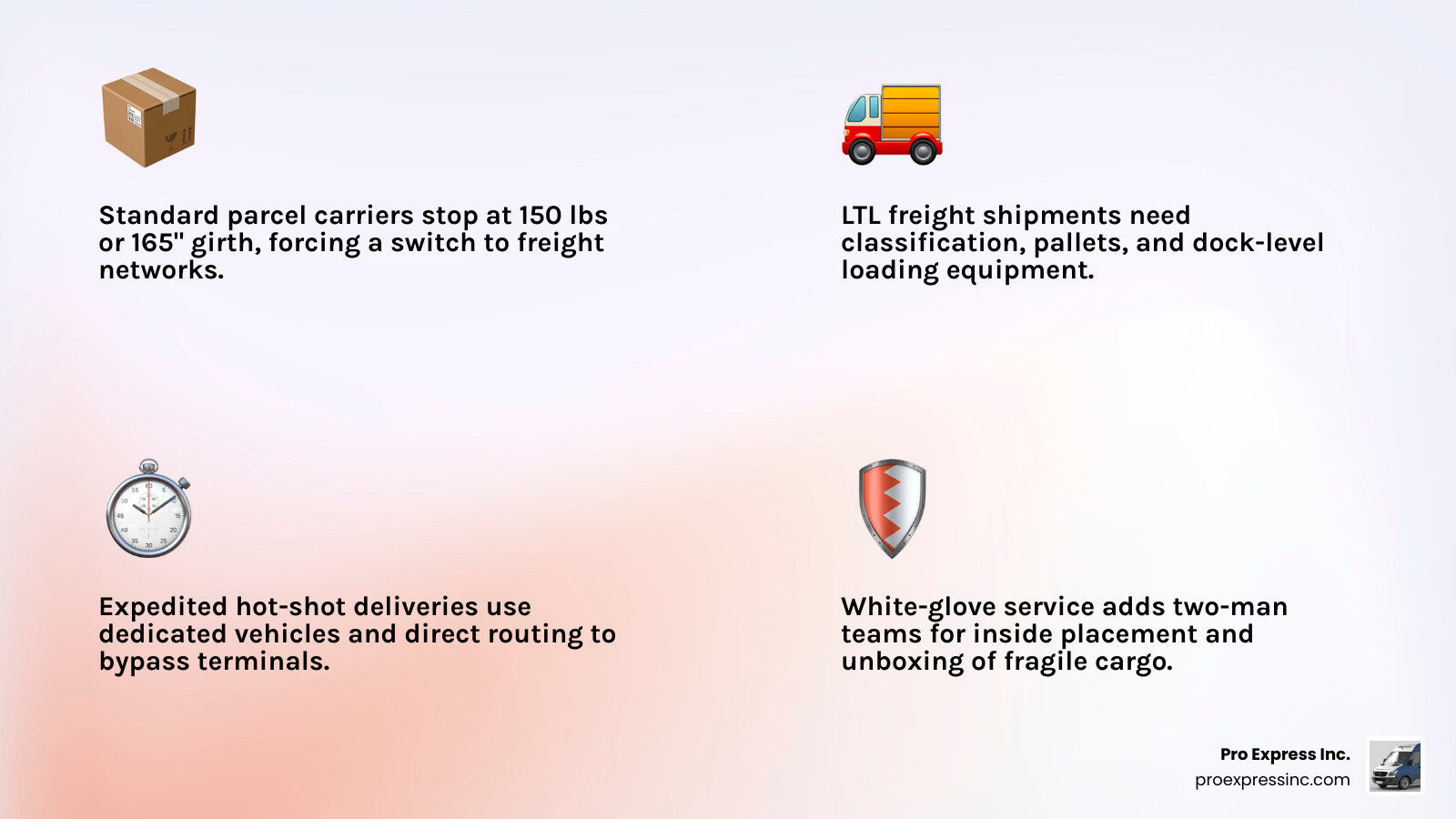
Large item courier terms to know:
Defining Oversized, Heavy, and Freight Shipments
To prevent operational bottlenecks, logistics teams must clearly distinguish between standard parcels, oversized items, and true freight. Standard delivery networks are optimized for automated sorting facilities. When an item exceeds standard weight limits or physical dimensions, it requires manual handling, specialized equipment, and custom routing.
According to standard industry definitions, any package exceeding 96 inches in length or 130 inches in combined length and girth incurs severe oversized surcharges. Once a package exceeds 150 pounds, or its combined length and girth surpasses 165 inches, it transitions entirely out of parcel networks and is classified as freight. You can read more about these precise limits in this guide to shipping oversized packages.
When shipping to unique domestic destinations like Alaska or Hawaii, these definitions become even more critical. Air cargo and ocean barge networks enforce strict physical dimensional limits due to the cargo holds of specific aircraft and ocean containers.
Standard Parcel vs. Oversized Freight
Standard parcel networks are designed for rapid, high-volume sorting. When a piece of cargo is too bulky or heavy, it can jam conveyor belts, damage other packages, or injure terminal staff.
| Shipping Category | Weight Threshold | Dimensional Threshold | Handling Method |
|---|---|---|---|
| Standard Parcel | Under 70 lbs | Under 108″ length | Automated sorting, single driver |
| Oversized Parcel | 70 to 150 lbs | 96″ to 108″ length, or up to 130″ length + girth | Manual sort, team lift, heavy labeling |
| Freight | Over 150 lbs | Over 165″ length + girth | Palletized, forklift, dock-to-dock |
If your cargo falls into the freight category, standard delivery vehicles cannot accommodate it. Attempting to force heavy industrial parts, large electronics, or manufacturing machinery into standard networks leads to immediate transit delays and administrative penalties.
When a Liftgate is Required for Loading
One of the most common oversights in oversized shipping is failing to account for how the cargo will physically enter and exit the transport vehicle. If your pickup or delivery location lacks a raised loading dock or a forklift, a standard box truck or semi-trailer cannot complete the job.
This is when a liftgate is required. A liftgate is a hydraulic platform installed on the rear of a truck that safely lowers heavy cargo from the bed of the truck to the ground. For shipments weighing over 150 pounds, relying on manual labor to lift cargo poses severe safety risks and can result in catastrophic product damage. Understanding When a Liftgate is Required for Delivery and How to Get One ensures your delivery site is prepared, preventing costly redelivery fees and transit delays.
Selecting the Right Large Item Courier for Time-Critical Freight
When production lines are down or critical medical equipment must reach a facility immediately, standard parcel networks are fundamentally unequipped to help. Selecting a specialized large item courier is the only way to guarantee speed, security, and precision.
Why a Specialized Large Item Courier Outperforms Standard Parcel Networks
Standard parcel networks operate on a “hub-and-spoke” model. Your package is picked up, taken to a local terminal, sorted, loaded onto a line-haul trailer, taken to a regional hub, sorted again, and eventually sent to a final delivery terminal. Every single touchpoint represents an opportunity for damage or delay. Heavy, bulky items are particularly vulnerable during automated sorting and consolidation.
A specialized courier operates on a direct-drive model. Your cargo is loaded onto a dedicated vehicle and driven straight to the destination without stops at intermediate sorting terminals. This eliminates handling risks and drastically reduces transit times. According to a standard carrier analysis, specialized handling is the single most effective way to eliminate damage in transit for high-value, heavy items.
Key Capabilities to Demand from Your Large Item Courier
When choosing a logistics partner for your most critical shipments, do not settle for standard tracking and rigid schedules. Your operations require a courier that offers:
- Real-Time Tracking: True visibility means knowing exactly where your truck is on the highway, not just receiving an automated email when a barcode is scanned at a terminal.
- 24/7 Dispatch and Support: Supply chain emergencies do not respect standard business hours. You need direct access to human dispatchers who can coordinate immediate solutions at midnight or on holiday weekends.
- Fleet Diversity: Your courier should match the vehicle to your cargo. A fleet consisting of sprinters, cargo vans, straight trucks with liftgates, and flatbeds ensures that you do not pay for empty space or risk cargo damage due to improper vehicle sizing.
To learn more about selecting a carrier that aligns with your operational demands, consult The Ultimate Guide to Choosing the Right Courier Service for Your Business Needs. For immediate assistance with time-sensitive transport, explore our dedicated Courier Service solutions.
Best Practices for Packaging and Securing Bulky Cargo
Even the most careful driver cannot protect poorly packaged cargo from the physical forces of transit. Proper packaging is your first line of defense against damage.
Securing Heavy Shipments on Pallets
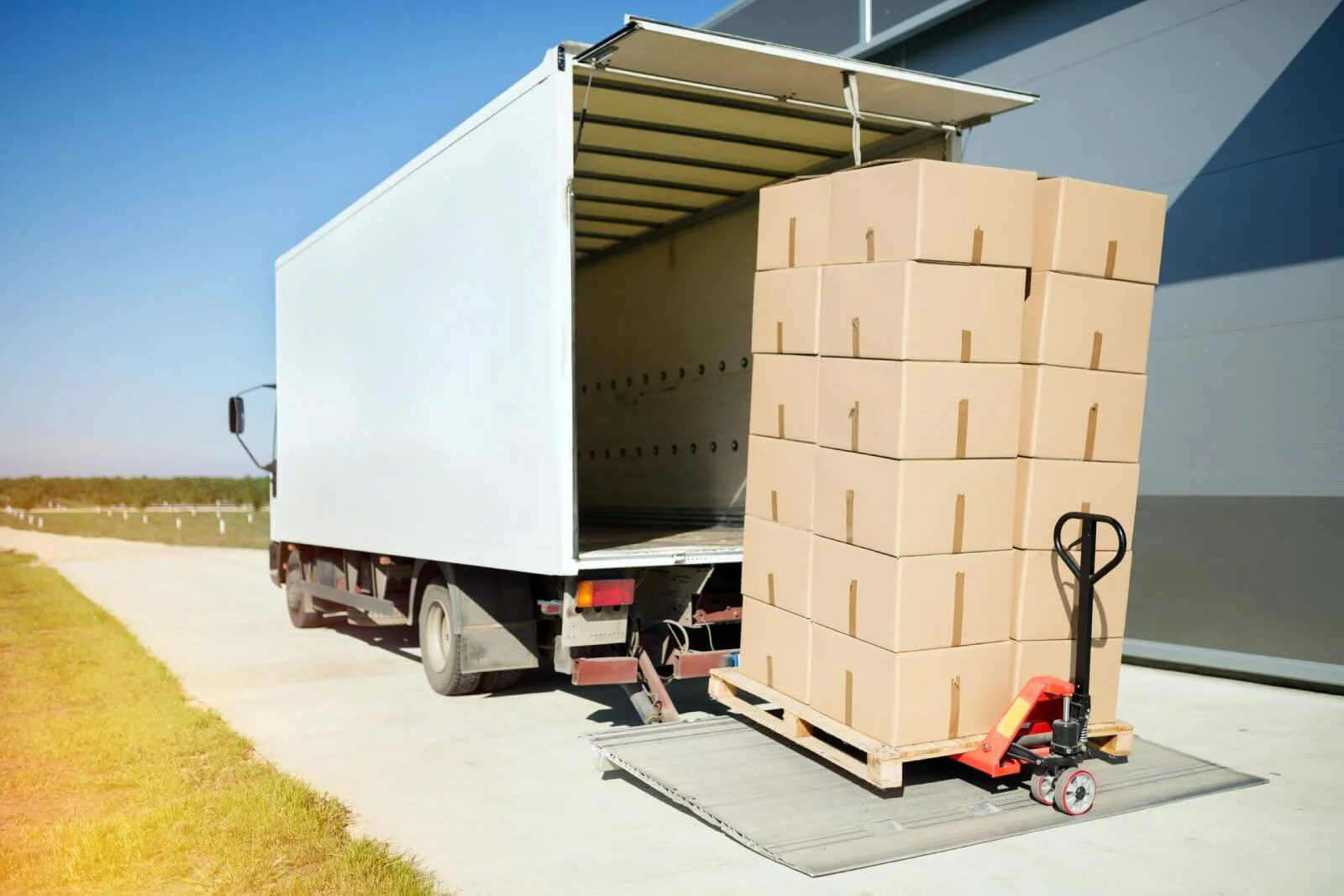
For heavy or oversized shipments, standard cardboard boxes are rarely sufficient. Palletization is the industry standard for securing heavy loads, allowing forklifts and pallet jacks to handle your cargo safely.
- Select the Right Pallet: Use a sturdy wooden or plastic pallet in excellent condition. Avoid pallets with broken boards or protruding nails. Ensure the pallet is rated to handle the exact weight of your cargo.
- Distribute Weight Evenly: Place the heaviest items at the bottom of the pallet to maintain a low center of gravity. Do not let cargo overhang the edges of the pallet, as this makes it highly susceptible to impact damage.
- Use Heavy-Duty Banding: Secure your cargo to the pallet using steel or heavy-duty polyester strapping. This prevents the load from shifting during acceleration, braking, and turning.
- Apply Industrial Shrink Wrap: Wrap the entire shipment tightly with multiple layers of high-gauge shrink wrap. Be sure to wrap around the base of the pallet itself to anchor the cargo securely to the platform.
Specialized Delivery Solutions: From Hot-Shot to White-Glove
Different shipments require different levels of service. A reputable large item courier offers customized solutions tailored to the specific urgency and sensitivity of your cargo.
Our Courier Delivery Services are designed to scale from rapid, direct-drive hot-shot deliveries to complex white-glove installations.
White-Glove and Two-Man Handling
For high-value medical devices, delicate laboratory instruments, or specialized commercial equipment, standard dock-to-dock delivery is not enough. These shipments require specialized care at both the pickup and delivery points.
White-glove service goes beyond the loading dock. It includes inside delivery, room-of-choice placement, unboxing, debris removal, and basic assembly. Because these items are heavy and complex, they require a coordinated team.
Our 2-man courier services ensure that two trained professionals handle your cargo, eliminating the risk of injury or property damage. For a complete breakdown of how these specialized services protect your supply chain, read Everything You Need to Know About White Glove Home Delivery.
Frequently Asked Questions About Oversized Shipping
What qualifies as an oversized shipment for expedited ground transport?
An oversized shipment is generally defined as any single package or piece of cargo that exceeds 150 pounds, or has a combined length and girth exceeding 130 inches. In standard ground transport, items exceeding 96 inches in length are also subject to oversized classification and require specialized vehicle routing.
How do hot-shot courier services handle urgent, large-item deliveries?
Hot-shot courier services bypass standard terminal-based shipping networks entirely. When you book a hot-shot delivery, a dedicated, sole-use vehicle is immediately dispatched to your pickup location. Your cargo is loaded, secured, and driven directly to the destination without any stops, consolidation, or terminal transfers. This direct-drive model ensures the fastest possible transit times and minimizes the risk of handling damage.
What is the difference between standard freight and white-glove courier services?
Standard freight delivery is a dock-to-dock service. The driver is responsible for transporting the palletized cargo from the shipper’s loading dock to the receiver’s loading dock.
White-glove courier service, on the other hand, provides complete, end-to-end handling. This includes bringing the cargo inside the building, navigating stairs and elevators, placing the item in its designated room, unpacking it, and removing all packaging materials. To understand how this service can protect your high-value assets, see Why Your Business Needs the White Glove Treatment for Shipping.
Conclusion
Managing oversized and heavy shipments does not have to be a source of operational downtime. When standard parcel networks fail to meet your deadlines or handle your cargo with the necessary care, Pro Express Inc. is ready to step in.
With nearly 20 years of logistics experience, more than 10,000 successful shipments delivered, and a 99% client satisfaction rate, we specialize in solving your most complex ground-expedited challenges. Whether you need an immediate hot-shot flatbed, a liftgate-equipped straight truck, or a dedicated two-man white-glove team, our US-wide operations and 24/7 support ensure your critical freight arrives on time, every time.
Don’t let shipping delays disrupt your operations. Request a Quote with Pro Express Inc. today and let our experts handle your oversized delivery needs.