
When “Tomorrow” Isn’t an Option: A Guide to Same Day Air Cargo
Same day air cargo is the fastest mode of freight transportation available — it moves critical shipments by air within hours, not days, using services like Next Flight Out (NFO), dedicated air charter, or on-board courier (OBC).
Here’s what you need to know at a glance:
| Service Type | Speed | Best For |
|---|---|---|
| Next Flight Out (NFO) | Hours (same day) | Ultra-urgent, smaller freight |
| Dedicated Air Charter | Same day to overnight | Large or specialized cargo |
| On-Board Courier (OBC) | Same day, door-to-door | High-value, hand-carry items |
| Next-Day Air Freight | By next morning | Less urgent, planned shipments |
| Expedited Ground (Hot Shot) | Same day (regional) | Heavy, oversized, or short-haul |
When a production line stops because a critical part is missing, or a hospital needs a medical device in time for a morning procedure, waiting until tomorrow means real financial and human consequences. An Aircraft on Ground (AOG) situation alone can cost an airline tens of thousands of dollars per hour.
For operations and logistics managers, the challenge isn’t just finding a carrier. It’s knowing which air cargo option fits your shipment, your timeline, and your risk tolerance — and having a trusted freight partner ready to coordinate it the moment a crisis hits.
With 17+ years of experience coordinating time-critical shipments and 6,000+ shipments arranged through a vetted carrier network, Pro Express Inc. has helped businesses navigate exactly these situations. This guide breaks down every major same day air cargo option so you can act fast and act right.
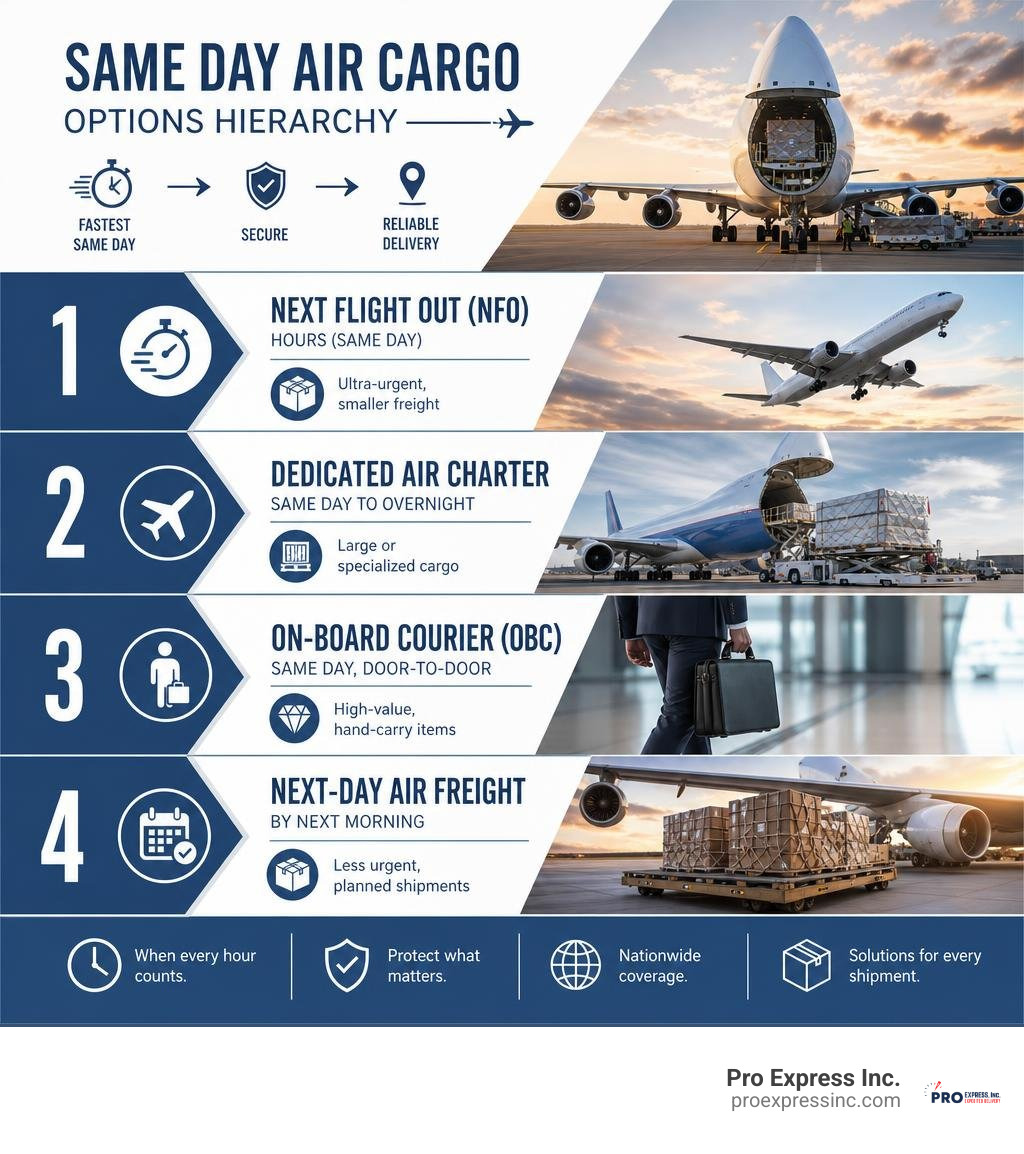
Same day air cargo terms made easy:
Understanding Same Day Air Cargo vs. Next-Day Air Freight
To effectively manage an emergency shipment, logistics professionals must understand the operational boundary lines between same day air cargo and next-day air freight. While both represent expedited logistics, their handling, scheduling, and priority tiers differ significantly.
Standard next-day air freight relies on structured, overnight cargo flight networks. Shipments are consolidated at local terminals, trucked to regional airport hubs, flown overnight, sorted at a central hub, and delivered the following morning. While reliable, this process is bound to fixed cutoff times and rigid routing schedules. If your shipment isn’t ready for the evening cutoff, it waits until the next night.
In contrast, same day air cargo bypasses the traditional consolidation process entirely. It is designed for ultra-time-sensitive situations where cargo must move immediately. This service operates outside of fixed schedules by tapping into commercial passenger flights, dedicated charters, or immediate hand-carry logistics.
Key differences include:
- Transit Speed: Same day cargo is on the move within hours of booking, often landing at the destination airport on the very same day. Next-day cargo is scheduled to land and deliver the following morning.
- Priority Handling: Same day shipments are granted the highest boarding priority. They are labeled as top-tier priority freight, meaning they are loaded first, bypass standard warehouse dwell times, and are the last to be bumped if a flight faces weight or capacity restrictions.
- Cargo Weight and Dimensions: Standard air cargo is highly suitable for shipments exceeding 150 pounds, whether palletized or non-palletized. However, same day options like Next Flight Out (NFO) must fit within the cargo holds of commercial passenger planes, whereas dedicated charters can accommodate heavy, oversized industrial machinery.
For a deeper dive into managing immediate ground-to-air handoffs, read our Same Day Delivery Service The 2026 Guide for Logistics Managers or explore the basics of overnight transit in our Next Day Delivery 101 resource.
Key Service Types for Same Day Air Cargo
When time is your greatest constraint, we help coordinate three primary methods to get your freight into the sky:
- Next Flight Out (NFO): This service places your cargo on the very next scheduled commercial passenger or cargo flight. Once we arrange for a carrier to pick up your freight, it is expedited directly to the airport, tendered to the airline with priority status, flown to the destination, and recovered at the cargo terminal for immediate final-mile delivery.
- Dedicated Air Charter: For massive payloads, highly sensitive materials, or remote destinations, we coordinate dedicated air charters. This involves securing an entire aircraft solely for your cargo. The flight schedule is tailored entirely to your timeline, and the plane flies directly to the target airport without intermediate stops.
- On-Board Courier (OBC): Also known as hand-carry service, OBC involves a dedicated courier physically accompanying your shipment as passenger baggage from pickup to final delivery. This is the ultimate risk-mitigation tool for high-value, lightweight, or highly sensitive items, ensuring an uninterrupted chain of custody.
To learn more about tailoring these rapid services to your supply chain, consult our Same-Day Courier Service Your 2026 Guide and see how we structure rapid-response logistics in The Need for Speed Top Rapid Response Courier Solutions.
Aircraft Selection Factors for Expedited Air Shipments
Selecting the correct aircraft is critical for ensuring your shipment arrives on time without operational delays. When arranging charters or choosing specific flight paths, several vital variables must be evaluated:
- Payload and Dimensions: The physical weight and size of your cargo dictate the class of aircraft required. Light twin-engine turboprops, such as the Cessna 406 Caravan II (carrying up to 3,000 pounds) or the Pilatus PC-12, are excellent for smaller, regional expedited runs. Mid-size cargo jets or heavy wide-body freighters are reserved for large palletized freight.
- Airport Runway Constraints: Larger cargo planes require long, paved runways and specialized ground-handling equipment (such as main-deck loaders). If your destination is a remote manufacturing plant near a regional airport, utilizing a smaller turboprop that can land on shorter runways allows the cargo to land closer to the final destination, bypassing busy major hubs.
- Range and Refueling: For cross-country same day missions, logistics coordinators must balance the range of the aircraft against immediate availability. In some urgent scenarios, choosing a smaller jet that requires a fast refueling stop is preferable if that aircraft is already on the tarmac and ready for immediate takeoff, compared to waiting hours to position a larger, non-stop jet.
Understanding these mechanics is key to avoiding logistical bottlenecks. For an in-depth look at managing air transit routes, see our guide on How to Master Next Day Air Shipping Without Breaking the Bank.
The End-to-End Process of an Expedited Air Shipment
Executing a successful same day air cargo shipment requires flawless execution across multiple handoff points. Because there is zero room for delay, every step must be planned and monitored in real time.
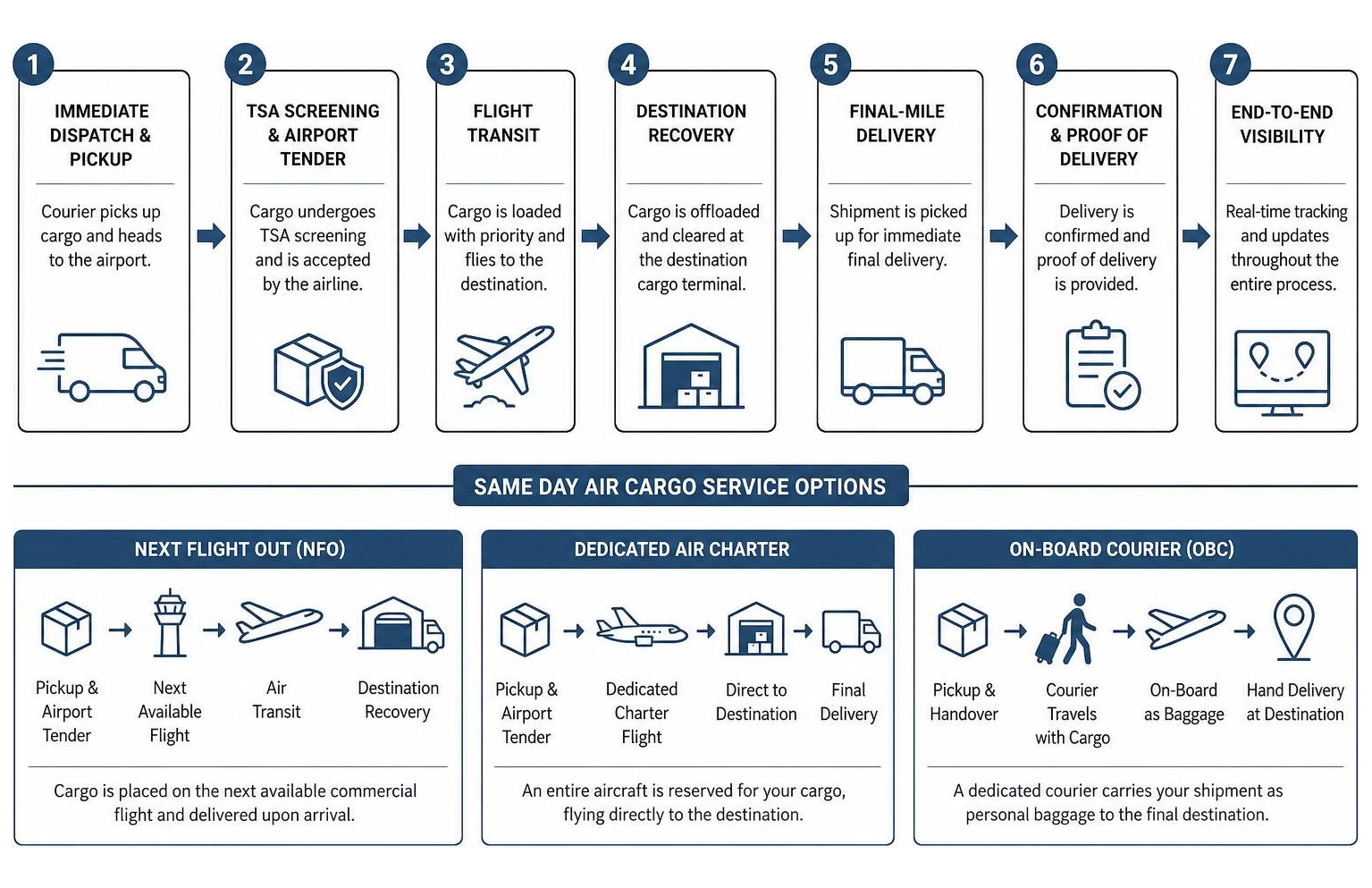
The journey of an expedited shipment follows a strict operational sequence:
- Immediate Dispatch & Pickup: The moment a crisis is reported, we arrange for a dedicated local courier (typically utilizing a sprinter van or straight truck) to pick up the freight. The goal is to have the cargo loaded and moving toward the airport within 60 to 120 minutes of booking.
- TSA Screening & Airport Tender: Upon arrival at the airport cargo terminal, the shipment must undergo mandatory TSA screening. Working with certified “Known Shippers” allows for faster processing through cargo acceptance windows, minimizing terminal dwell time.
- Flight Transit: The cargo is loaded onto the aircraft with priority boarding status. For commercial flights, it is placed in the lower hold; for dedicated charters, it is secured in the main cabin.
- Airport Recovery: Upon landing, the ground handling crew prioritizes the unloading of expedited cargo. The shipment is transferred to the cargo facility, where a waiting final-mile courier recovers it.
- Last-Mile Delivery: The courier transports the cargo directly to the receiving facility, utilizing specialized ground services such as liftgates or two-man delivery teams if required.
To understand the broader framework of these fast-moving operations, read The Complete Guide to Expedited Freight Services 2026 Guide and see how we rank rapid delivery options in The Best 24 Hour Courier Services Ranked for Speed and Price.
Route Engineering and Flight Coordination
Speed is built on control and intelligent routing. Route engineering is the practice of analyzing flight schedules, connection times, weather patterns, and airport congestion to build the most reliable path for your cargo.
Sometimes, the fastest path is not a direct flight. For instance, if a direct flight to your destination is delayed or isn’t scheduled to depart for several hours, a route engineering expert might route the cargo through an intermediate hub with immediate departure and high-frequency connections. This proactive planning reduces transit risk and ensures that cargo never sits idle at an airport terminal.
To explore how routing strategies keep critical shipments on track, check out our insights on Beating the Clock With Expert Time Sensitive Shipments.
Ground Support Integration
An air shipment is only as fast as its ground legs. If your cargo lands at 5:00 AM but sits on the tarmac for three hours because a pickup truck wasn’t coordinated, the speed of the flight is entirely wasted.
Seamless ground support integration involves aligning dedicated hot-shot ground transport at both the origin and destination airports. This requires real-time communication between flight dispatchers and ground couriers. Sprinter vans, box trucks, or flatbeds must be pre-positioned at the destination cargo terminal before the aircraft wheels touch the ground. Furthermore, utilizing specialized services such as liftgates or inside delivery ensures that once the cargo arrives at the facility, it can be unloaded and deployed immediately.
For a strategic overview of ground-to-air logistics, consult Expedited Ground Freight A Strategic Guide for Logistics Managers 2026 Guide and explore our dedicated Expedited Ground Services page.
Mission-Critical Industries Relying on Rapid Air Transit
While any business can benefit from expedited shipping, certain sectors operate under conditions where same day delivery is a operational necessity. For these industries, shipping delays do not merely represent an inconvenience; they can result in severe financial penalties or compromised safety.
To understand how expedited logistics acts as an essential safety net for these sectors, read Why Relying on Professional Expedite Services Is Your Businesss Safety Net.
Mitigating Manufacturing Downtime
Modern manufacturing facilities operate on just-in-time (JIT) inventory principles. While this keeps warehouse storage lean, it leaves assembly lines highly vulnerable to disruptions. If a critical robotic component or specialized tool breaks on an automotive assembly line, the entire plant can grind to a halt.
In these “line-down” scenarios, the financial impact is measured in tens of thousands of dollars per minute. Same day air cargo is utilized to source replacement parts from distant suppliers or sister plants and deliver them within hours, preventing a costly multi-day shutdown cascade.
To learn how we coordinate rapid freight solutions to keep assembly lines moving, read Why Businesses Need Reliable Expedited Services to Keep Operations Moving.
Life-Saving Medical and Pharmaceutical Transport
In the medical sector, logistics directly impacts patient outcomes. Hospitals, laboratories, and pharmaceutical companies rely on expedited air transit to move critical medical devices, temperature-sensitive biologics, and clinical trial materials.
Whether it is transporting an urgent medical implant for an upcoming surgery or delivering temperature-controlled vaccine batches across the country, these shipments require specialized handling. This includes utilizing active or passive temperature-monitoring systems, priority boarding to prevent exposure to extreme tarmac temperatures, and seamless handoffs to white glove couriers upon landing.
Global Same Day Logistics and Risk Mitigation
When same day shipments cross international borders, the logistical complexity increases exponentially. Managing time-critical international cargo requires a proactive strategy that addresses customs regulations, international flight connections, and strict custody chains.
For an expert perspective on international expedited transit, read Global Same Day Delivery: What It Really Takes… – Express OBC.
The Role of On-Board Couriers (OBC)
For high-value, highly sensitive, or extremely urgent international cargo, utilizing an On-Board Courier (OBC) is the most effective method to mitigate transit risk.
By bypassing standard cargo terminals, an OBC hand-carries the shipment through passenger check-in, security, and boarding. The cargo remains in the courier’s personal possession throughout the flight, eliminating the risk of it being misplaced in cargo sorting facilities or left behind on the tarmac. Upon landing, the courier personally guides the shipment through customs and delivers it directly to the recipient.
To understand the 24/7 nature of these dedicated courier services, read Your Package Never Sleeps and Neither Do These 24 Hour Couriers.
Navigating International Customs Without Delays
The single greatest bottleneck in international same day shipping is customs clearance. A minor documentation error or an incorrect commodity code can cause customs officials to hold a shipment for inspections, instantly defeating the purpose of expedited air transit.
To prevent these delays, logistics planners utilize specialized customs brokerage services to pre-clear shipments before the aircraft lands. This involves:
- Preparing comprehensive commercial invoices and packing lists well in advance.
- Verifying precise Harmonized System (HS) commodity codes.
- Utilizing temporary import frameworks (such as ATA Carnets) for items like specialized tools or demonstration equipment to bypass standard duty processing.
- Coordinating with customs brokers who maintain 24/7 communication channels with port authorities.
Comparing Air Cargo and Expedited Ground Solutions
When faced with an urgent shipping deadline, logistics managers must decide whether to send their cargo by air or utilize expedited ground transport. While air shipping offers unmatched speed over long distances, expedited ground services are often the optimal choice for regional shipments.
For a comprehensive comparison of expedited transit methods, refer to Expedited Shipping Your Complete 2026 Guide and The Ultimate Guide to Expedited Shipping.
When to Choose Ground Hot Shots Over Air
Expedited ground shipping, specifically utilizing exclusive hot-shot vehicles, is often the most reliable and efficient choice for shipments within a 400- to 600-mile radius.
Ground hot shots offer several distinct operational advantages:
- No Airport Dwell Times: Ground shipments bypass airport tender windows, TSA screening queues, and recovery delays. The vehicle is loaded at your facility and drives directly to the destination.
- Dedicated Vehicles: Your freight is the only cargo on the vehicle, eliminating the risk of damage or delays caused by co-loading.
- Oversized and Heavy Cargo: Ground transport can easily accommodate heavy machinery, odd-sized pallets, and industrial equipment that would not fit inside standard commercial aircraft cargo holds.
To learn more about when to leverage ground solutions, read Expedited Ground Shipping.
Critical Value-Added Services for Same Day Air Cargo
To ensure the safety and success of time-critical shipments, several value-added services should be integrated into your logistics plan:
- Real-Time GPS Tracking: Utilizing active GPS tracking devices placed inside the cargo provides continuous visibility into the shipment’s location, temperature, and orientation.
- Dangerous Goods (HAZMAT) Handling: Shipping hazardous materials via air requires strict adherence to IATA and DOT regulations, including specialized packaging, labeling, and documentation.
- White Glove & Inside Delivery: For sensitive medical equipment or high-value electronics, white glove services ensure that the cargo is not only delivered to the loading dock but is carefully unboxed, placed, and inspected inside the facility.
To discover how these services can optimize your supply chain, see How to Speed Up Your Cargo With Expedited Freight Delivery.
Frequently Asked Questions About Expedited Air Freight
What is the maximum weight for same day air cargo?
The maximum weight for same day air cargo depends entirely on the service type. For Next Flight Out (NFO) services utilizing commercial passenger flights, individual pieces are typically restricted to under 150 to 300 pounds, depending on the aircraft’s cargo door dimensions. However, if your cargo is palletized and shipped via a dedicated cargo charter, there are virtually no weight limits, provided the selected aircraft has the payload capacity to support it.
How does TSA screening affect expedited air transit times?
All cargo transported on commercial passenger aircraft must undergo mandatory TSA screening. To minimize screening delays, it is highly recommended to work with a logistics provider who can tender cargo as a “Known Shipper.” This status allows for expedited screening protocols, ensuring your freight passes through airport acceptance windows quickly and meets tight flight cutoff times.
Can hazardous materials be shipped via same day air?
Yes, but with strict limitations. Hazardous materials (HAZMAT) can be shipped via air cargo, but they are subject to rigorous IATA and DOT regulations. Many hazardous materials are strictly prohibited on passenger aircraft and must be routed exclusively on cargo-only flights or dedicated charters. Proper packaging, dangerous goods declarations, and certified handling are mandatory to avoid severe transit delays or legal penalties.
Conclusion
When your supply chain is on the line and “tomorrow” is simply too late, navigating the complex world of same day air cargo requires speed, precision, and an experienced logistics partner.
At Pro Express Inc., we bring 17+ years of experience as a trusted freight broker, specializing in arranging expedited ground and air solutions across the United States. By leveraging our deeply vetted network of carrier partners, we coordinate seamless, time-critical deliveries with a track record of 99% client satisfaction across more than 6,000 successfully coordinated shipments.
Whether you need to arrange an exclusive ground hot shot, coordinate a complex Next Flight Out air shipment, or secure white glove inside delivery for high-value cargo, we are here to act as your business’s ultimate safety net.
Don’t let a shipping failure halt your operations. Let our team of logistics experts engineer the perfect expedited solution for your business.
Request a Quote Today or Contact Us Today to discuss your urgent shipping needs with our 24/7 operations team.