The Real Impact of Getting Fragile Item Shipping Wrong
Fragile item shipping is one of the highest-risk operations in logistics — and the numbers prove it.
Quick answer: How to safely ship fragile items
- Wrap individually — use 3 inches of bubble wrap or foam around each item
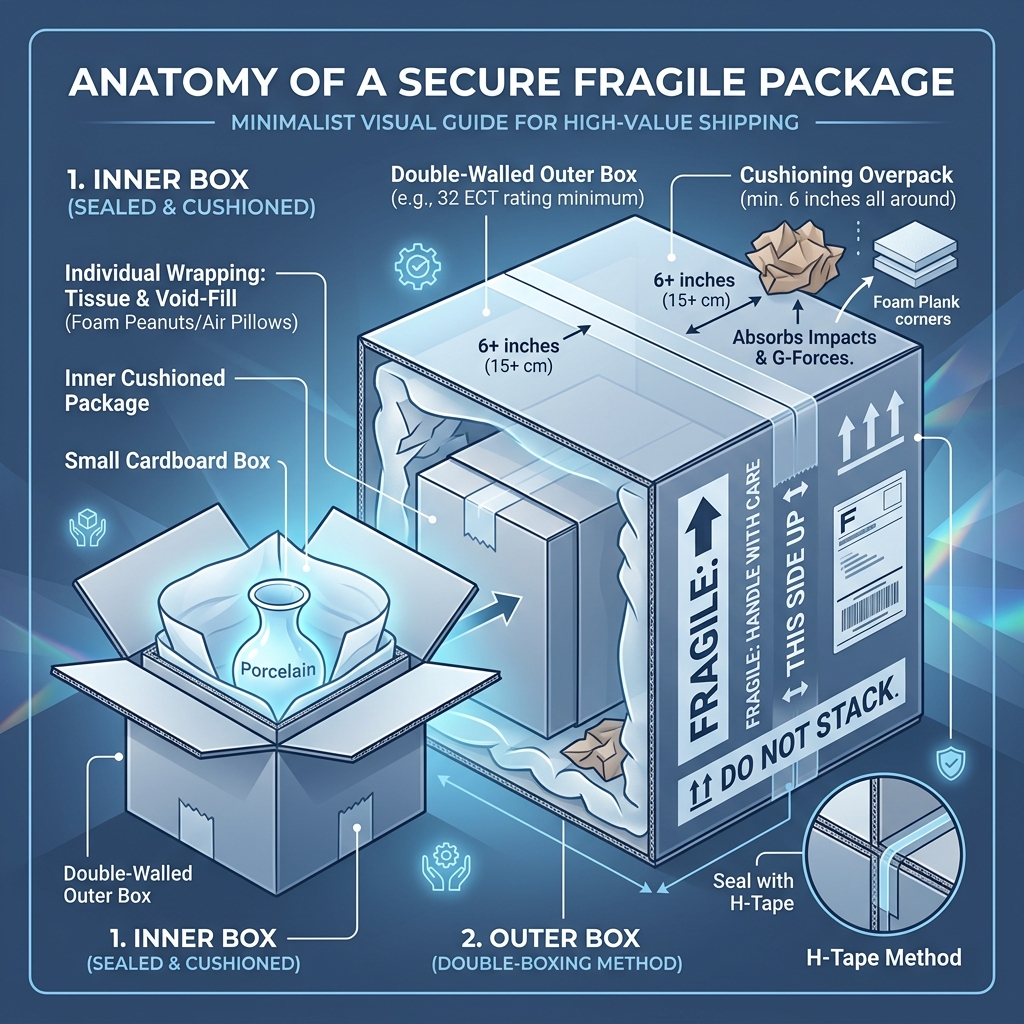
- Choose the right box — double-walled, 32 ECT rating minimum, 6 inches larger than the item
- Fill all voids — no movement means no damage; use foam peanuts or air pillows
- Seal with H-tape — run tape down the center seam and across both edges
- Label clearly — mark “Fragile” on multiple sides with orientation arrows
- Double-box high-value items — place the packed inner box inside a larger cushioned outer box
- Insure appropriately — document everything and cover at least the full replacement value
Shipping damage results in significant operational losses for U.S. businesses every year. About 11% of all goods arrive at distribution centers already damaged — and fragile items face far greater risk than standard freight.
The frustrating part? Up to 80% of those damage claims are caused by preventable packing mistakes.
The good news: proper packaging alone can reduce fragile item damage risk by up to 75%. That’s not a small margin. That’s the difference between a successful delivery and a disruptive claim, a lost client, and a missed deadline.
For logistics managers moving high-value, time-sensitive cargo across the US, how a fragile item is packed is just as critical as how fast it ships. A same-day delivery means nothing if the item arrives broken.
This guide walks you through exactly how to pack fragile items the right way — from materials to advanced techniques used by professionals handling irreplaceable cargo every day.
Essential Materials for High-Stakes Fragile Item Shipping
When we talk about fragile item shipping, the strength of your outer shell is your first line of defense. You wouldn’t send a high-value prototype in a cereal box, and you shouldn’t rely on standard single-wall cardboard for delicate freight.
The Foundation: Double-Walled Corrugated Boxes
For any shipment that is breakable or heavy, we recommend high-quality corrugated cardboard boxes with double or even triple walls. These provide 100% better crush resistance than standard boxes. Look for the manufacturer’s stamp on the bottom to check the 32 ECT (Edge Crush Test) rating. This is the industry standard for ensuring a box can withstand the stacking pressures found in a fast-moving logistics environment. If your item exceeds 50 pounds, step up to a 44 ECT or 48 ECT box to prevent the bottom from dropping out during a hot-shot delivery. For a neutral overview of corrugated strength ratings and construction, see corrugated fiberboard.
Industrial-Grade Cushioning
Crumpled newspaper might work for a gift to your cousin, but in B2B logistics, it’s a liability. Research shows that crumpled paper compresses and loses its protective qualities after just 48 hours of transit. Instead, use these professional-grade materials:
- Anti-static bubble wrap: This is non-negotiable for circuit boards, computers, and sensitive electronics. Regular bubble wrap can generate static electricity that fries internal circuitry before the box is even opened.
- Instapak foam bags: For glassware and ceramics, these are game-changers. They can reduce breakage rates by up to 90% compared to bubble wrap alone because they expand to create a custom-molded shield around the object.
- Polyethylene foam corner protectors: These should be at least 3 inches thick for electronics, capable of absorbing impacts of up to 100 pounds.
Sealing the Deal
Don’t settle for 1.5-inch “office” tape. Use 2-inch wide industrial packing tape (PVC or polypropylene). An extra half-inch of width doubles the surface contact area, ensuring your seams don’t burst under pressure.
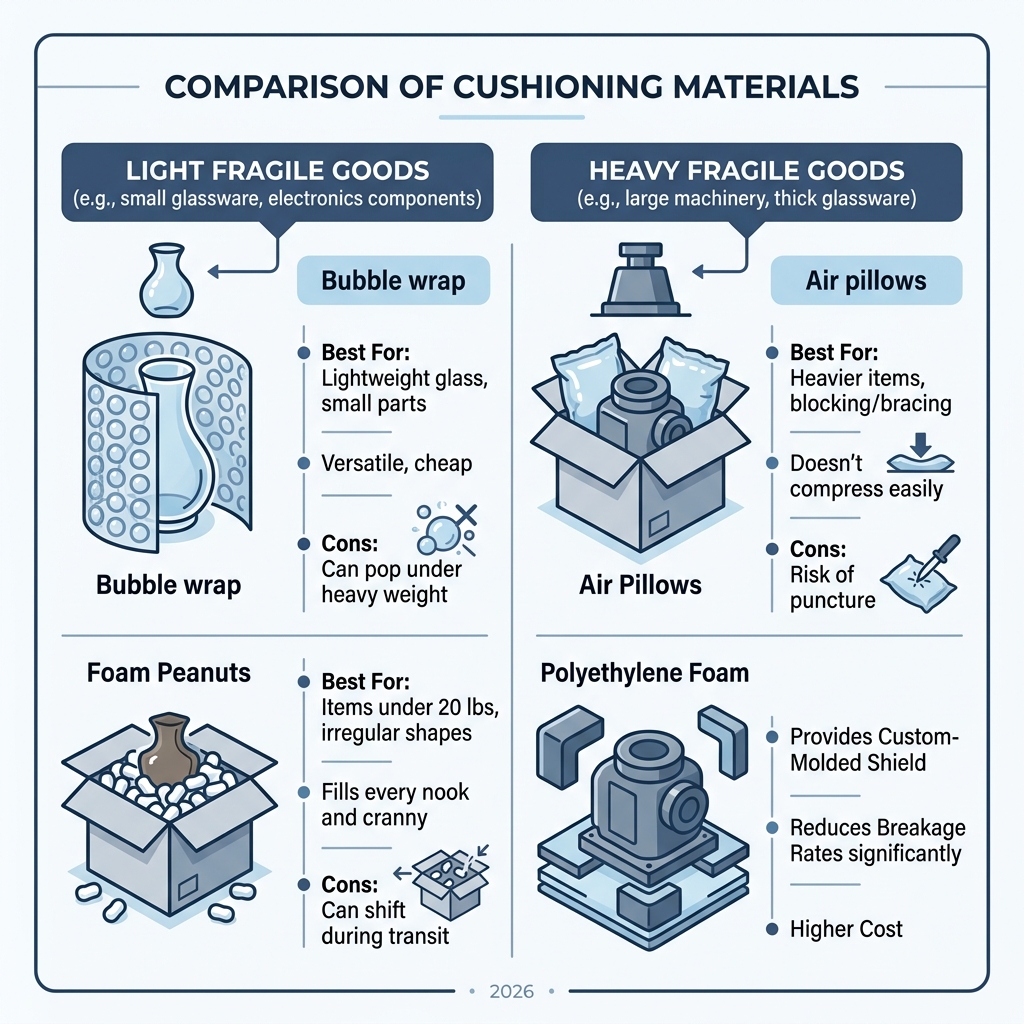
| Material | Best For | Pros | Cons |
|---|---|---|---|
| Bubble Wrap | Lightweight glass, small parts | Versatile, cheap | Can pop under heavy weight |
| Foam Peanuts | Items under 20 lbs, irregular shapes | Fills every nook and cranny | Can shift during transit |
| Air Pillows | Heavier items, blocking/bracing | Doesn’t compress easily | Risk of puncture |
| Instapak | High-value glass, heavy ceramics | 90% damage reduction | Requires activation/specialized application |
Step-by-Step Guide to Fragile Item Shipping Success
Proper fragile item shipping is an art form that requires a disciplined process. If you follow essential fragile package tips that prevent shipping damage, you significantly increase the odds of a perfect arrival.
1. The Individual Wrapping Rule
Never let two fragile items touch each other. Each piece must be wrapped individually in at least three layers of bubble wrap. For glass items, wrap them first in tissue paper to prevent the “bubbles” from leaving imprints on delicate finishes. Secure the wrapping with tape so it doesn’t unfurl inside the box.
2. The 3-Inch Cushioning Standard
Position your item in the dead center of the box. You need a minimum of 3 inches of cushioning on all six sides—top, bottom, and all four walls. This creates a “crumple zone” that absorbs the shock if the box is dropped or bumped during a next-day transit.
3. Void Filling and Immobilization
“Empty space” is the enemy of fragile item shipping. Fill every gap with foam peanuts or air pillows until the item is completely immobile. If you use packing peanuts, overfill the box by about 5-10% because they tend to settle during the vibrations of ground-expedited travel.
4. The H-Tape Sealing Method
This is the gold standard for secure shipping. Apply tape down the center seam of the box, then apply tape across the four edge seams to create the letter “H.” This reinforces the structural integrity of the box and prevents dust or moisture from entering. For boxes over 40 pounds, add perpendicular tape strips for extra security.
5. Internal Redundancy
Always place an extra address label inside the box on top of the cushioning. If the exterior label is somehow damaged or scraped off during high-speed sorting, the carrier can still identify the destination and complete the delivery.
For more detailed strategies on protecting your cargo, follow expert packing guides for high-value items.
Advanced Techniques: Double-Boxing and White Glove Handling
For high-value electronics, medical equipment, or irreplaceable antiques, standard packing isn’t enough. You need advanced engineering to ensure safety.
The Box-in-Box Method
This is the most effective way to ship extremely delicate items.
- Pack the item in an inner box with 3 inches of cushioning as described above.
- Select an outer box that is at least 6 inches larger in every dimension than the inner box.
- Place 3 inches of a different cushioning material (e.g., foam peanuts if the inner box used bubble wrap) at the bottom of the outer box.
- Center the inner box and fill the surrounding 3-inch gap tightly. This method distributes impact forces exponentially better than a single box.
Suspension Packing
For items like laboratory equipment or sensitive machinery, we use the suspension method. This involves securing the item to a plywood board with foam blocks, then suspending that board in the center of a larger box using bungee cords or specialized film. The item literally “floats,” protected from any external shocks.
White Glove and Custom Solutions
Sometimes, a box isn’t enough. For oversized artwork or heavy machinery, White Glove Services are essential. This involves custom-built wood crating, moisture barrier materials, and specialized handling by two-man teams. In Courier Delivery Services, these “high-touch” options ensure that even the most awkward or sensitive items arrive in pristine condition.
For industrial-grade protection, utilize custom fragile shipping services to build individualized crates for museum-quality pieces.
Critical Labeling and Handling Instructions for Fragile Item Shipping
You can pack an item perfectly, but if the handler doesn’t know which way is up, you’re still at risk. Proper labeling is about communication and visibility.
- Orientation Arrows: Use “This Side Up” labels on at least two opposite sides. This is critical for items like electronics or liquids that must remain upright.
- The “Largest Surface” Rule: Always place your shipping label on the largest surface of the box. Carriers are trained to keep the label facing up for scanning, which naturally encourages them to keep the package in its intended orientation.
- Automated Sorting Awareness: Understand that in modern logistics, packages move through highly automated equipment. While “Fragile” stickers are helpful for human handlers, they are often missed by machines. This is why internal packing is your primary defense.
- 24/7 Tracking and IoT: For high-stakes shipments, real-time visibility is a must. Modern Services often include IoT sensors that track not just location, but also tilt, temperature, and shock impacts.
For specialized carrier advice, consult with logistics professionals who handle high-stakes freight daily.
Frequently Asked Questions about Fragile Item Shipping
Do fragile stickers actually prevent damage during fragile item shipping?
To be honest, they provide limited protection. While they signal to human handlers to be careful, most packages are processed by automated belts and sorters that can’t read labels. Never use a “Fragile” sticker as a substitute for proper internal cushioning. Think of the sticker as a courtesy, but the packing as the actual insurance.
What is the recommended box size for fragile item shipping?
The “10-25% larger” rule is a good start, but for true fragile item shipping, we recommend the 6-inch clearance rule. Your box should be 6 inches larger than your item in every dimension (length, width, and height). This allows for 3 inches of uncompressed cushioning on every side. If the box is too small, the cushioning gets compressed and loses its ability to absorb shock.
How do I perform a professional shake test?
Before you apply the final H-tape seal, give the box a firm shake in every direction. If you hear anything moving or feel the weight shifting, you have failed the test. Open it back up and add more void fill. In a high-speed logistics environment, internal movement is the leading cause of breakage. The item must be completely immobilized.
Conclusion: Partnering for Reliable Expedited Logistics
At Pro Express Inc., we know that when you’re shipping fragile items, you’re not just moving a product—you’re moving your reputation. With nearly two decades of experience and over 6,000 successful shipments delivered, we understand the urgency and the precision required for high-stakes logistics.
Whether you need a hot-shot delivery across the country or a white glove setup for sensitive electronics, our US-wide operations and 24/7 customer support are designed to handle the pressure. We maintain a 99% client satisfaction rate because we treat every “fragile” label as a personal commitment to excellence.
Don’t leave your most important deliveries to chance or to carriers who don’t understand the nuances of expedited freight. When speed is a necessity and damage is not an option, you need a partner who moves as fast as you do without cutting corners.
Ready to ensure your critical cargo arrives intact and on time? Contact Us Today for a professional logistics solution tailored to your needs.