
Why Choosing the Right Ground Courier Service Can Make or Break Your Shipment
A reliable ground courier service is one of the most critical decisions a logistics or operations manager makes — especially when a deadline is on the line.
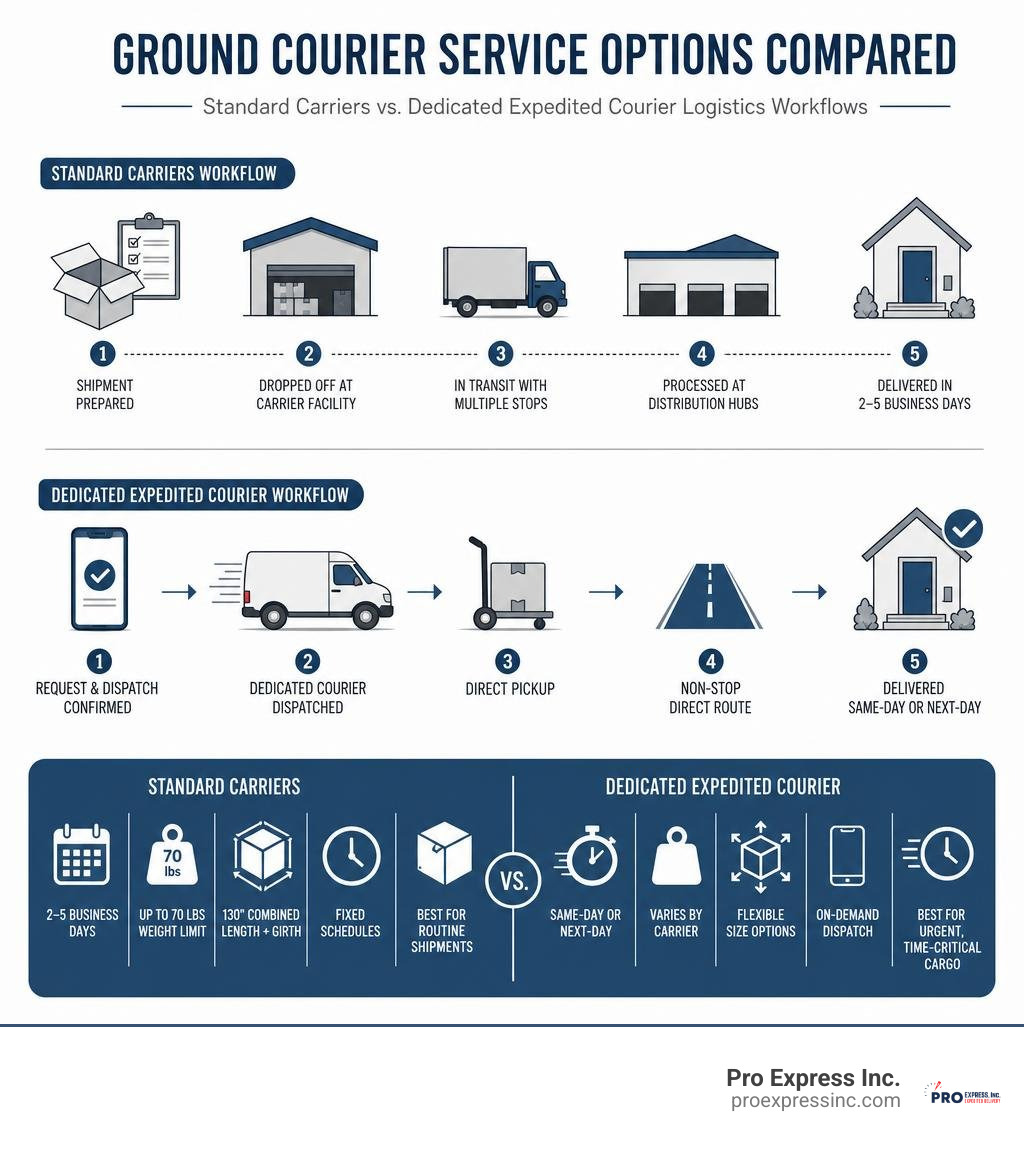
Here is a quick overview of what matters most when evaluating ground courier options:
| Factor | Standard Carriers | Dedicated Ground Courier |
|---|---|---|
| Delivery Speed | 2–5 business days | Same-day or next-day |
| Weight Limit | Up to 70 lbs | Varies by carrier |
| Max Size | 130″ combined length + girth | Flexible |
| Best For | Routine B2B shipments | Urgent, time-critical cargo |
| Flexibility | Fixed schedules | On-demand dispatch |
Standard ground carriers work well for predictable, non-urgent freight. But when your regular carrier fails mid-route or a production line is waiting on a critical part, standard options simply are not built for that pressure.
That is where dedicated ground courier coordination becomes essential.
Operations managers know this scenario well: a shipment gets delayed, a client deadline moves up, and suddenly the margin for error disappears. At Pro Express Inc., with nearly 20 years of freight brokerage experience and 10,000+ shipments coordinated, we connect businesses to a vetted carrier network built specifically for time-sensitive commercial freight.
This guide breaks down everything you need to know — from carrier standards and size limits to compliance requirements and specialized dispatch options.
Key ground courier service vocabulary:
Understanding Commercial Freight Standards and Ground Courier Service Solutions
Commercial freight logistics relies on strict operational benchmarks to maintain consistency across national supply chains. Standard ground networks operate on predictable, hub-and-spoke sorting processes designed for steady, high-volume throughput. Understanding how standard national networks operate helps logistics directors determine when a standard carrier is sufficient and when dedicated ground courier service coordination is required to protect critical operations.
When evaluating nationwide transit options, standard carrier guidelines establish baseline capabilities for everyday business shipments across the United States, including Alaska and Hawaii. However, fixed networks run on rigid schedule windows. If standard carrier web portals experience system downtime or permission errors during label generation, or if severe weather disrupts hub sorting, shipments can stall without real-time recourse.
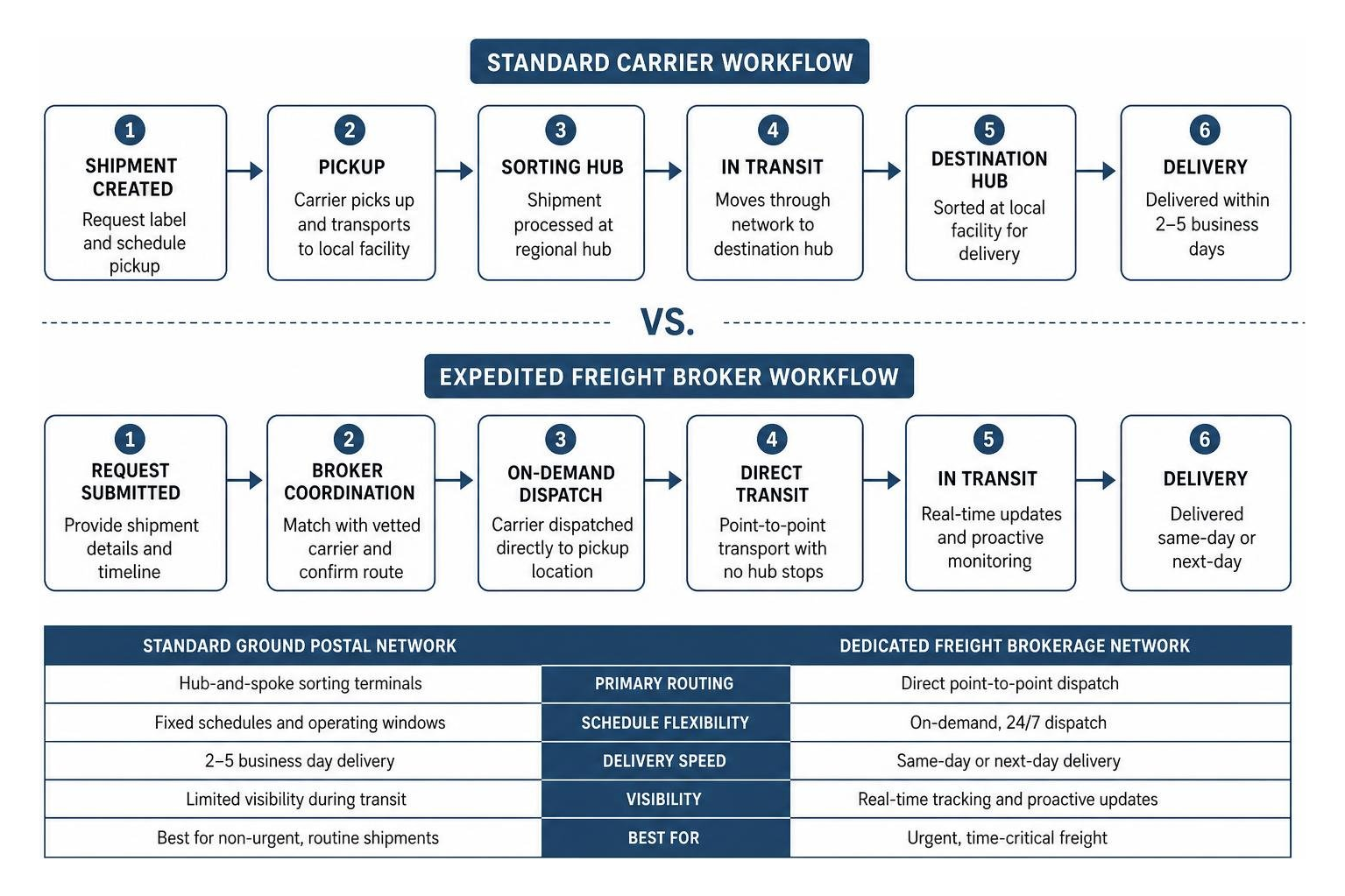
For time-critical cargo, relying on public sorting hubs introduces risk. Dedicated expedited ground arrangements bypass standard consolidation terminals, establishing direct point-to-point transit routes between commercial facilities.
| Logistics Requirement | Standard Ground Postal Network | Dedicated Freight Brokerage Network |
|---|---|---|
| Primary Routing | Hub-and-spoke sorting terminals | Direct point-to-point dispatch |
| Transit Reliability | Estimated 2–5 business days | Guaranteed time-critical pickup & drop-off |
| Handling Profile | Automated sorting conveyers | Dedicated vehicle routing with specialized care |
| Cargo Oversize Support | Strictly capped at standard thresholds | Customized equipment options (Liftgate, Hot Shot) |
| Exception Handling | Automated system ticketing | Dedicated 24/7 proactive dispatch monitoring |
Package Size, Weight, and Dimension Limits for Standard Ground Courier Service
Navigating physical thresholds is essential when prepping commercial goods for transport. Standard commercial parcel services enforce rigid physical boundaries:
- Maximum Package Weight: Standard public postal ground services cap individual parcel weight at 70 lbs.
- Maximum Combined Size: Total combined length and girth (Girth = 2 × width + 2 × height) must not exceed 130 inches.
- Freight Handling Thresholds: Oversized commercial items exceeding standard size and weight limits require specialized handling rather than standard sorting conveyor belts.
When cargo exceeds 70 lbs or 130 inches in combined dimensions, standard parcel services reject the shipment or impose strict operational handling restrictions. In contrast, arranging specialized Expedited Ground Services through a freight broker allows businesses to move palletized, heavy, or irregularly shaped machinery parts without fitting into standard cardboard packaging boxes.
Weight Tier Classifications and Commercial Shipping Options in Ground Courier Service
Within standard ground systems, commercial shipping classifications follow specific operational weight brackets:
- Standard Commercial Freight Tiers: Commercial items are categorized by whole-pound weight brackets to determine vehicle space and payload balance.
- Weight Rounding Standards: Weight calculations automatically round up to the next full unit (for instance, a commercial package weighing 8.3 lbs is calculated at the 9-lb tier).
For commercial operations managing larger freight loads, calculating exact volumetric space and payload capacity is vital. When standard carriers fall short due to dimensional constraints, working with a specialized freight brokerage ensures access to dedicated sprinter vans, straight trucks, or hot-shot trailers capable of transporting complex industrial payloads safely. Explore our comprehensive guide to Courier Service options to match your operational demand.
Navigating Ground Delivery Restrictions, Commercial Destinations, and Cargo Compliance
Transporting freight requires rigorous adherence to federal shipping guidelines and safety standards. Hazardous materials (HAZMAT), flammable liquids, lithium batteries, and regulated medical chemicals require specialized documentation, proper hazard labeling, and certified vehicle placarding before entering transit corridors. For official federal guidance on hazardous materials transportation requirements, shippers can review the U.S. Department of Transportation’s PHMSA hazardous materials safety resources.
Standard parcel ground shipping carries strict restrictions:
- Offshore Destinations: Deliveries heading to non-contiguous domestic regions such as Alaska, Hawaii, or offshore territories undergo extended transit schedules due to multimodal ground-to-sea transport.
- Military Shipping (APO/FPO/DPO): Shippers sending commercial supplies to domestic Military Post Offices qualify for domestic ground parameters but require specialized customs documentation and military mail clearance.
- Prohibited Cargo: Live animals, non-compliant hazardous materials, and improperly secured chemicals cannot enter standard ground transport systems.
If a standard online logistics portal experiences technical system outages or account permission errors during restricted item verification, shippers face severe dispatch delays. Freight brokers streamline compliance by pairing urgent cargo directly with vetted motor carriers fully certified to transport sensitive goods across all domestic jurisdictions.
Specialized Urgent Dispatch and Security Clearances
Urgent commercial shipments often involve high-security destinations such as commercial ports, naval shipyards, and international airport cargo zones. Standard delivery drivers typically lack the federal credentials needed to enter these restricted perimeters, causing severe delivery bottlenecks.
To navigate these secure zones smoothly, authorized transport operators hold critical federal credentials:
- TWIC (Transportation Worker Identification Credential): Required by the Transportation Security Administration (TSA) and U.S. Coast Guard for unescorted access to secure maritime facilities, port terminals, and commercial dock areas.
- TSA Authorization: Permits vetted drivers to execute rapid air-cargo pickups directly at airport tarmac facilities and secure freight hubs.
When secure facility access is mandatory for medical evidence, aerospace components, or marine replacement parts, coordinating dispatch with fully credentialed carriers eliminates gate rejections and guarantees uninterrupted transit. Detailed protocols for secure dispatch are covered in The Ultimate Guide to Courier Delivery Services.
Key Benefits of Business-to-Business Ground Freight Brokerage

When standard delivery channels encounter unexpected disruptions, business-to-business freight brokerage offers the speed, agility, and reliability necessary to keep commercial enterprises moving. Unlike traditional rigid parcel carriers, a trusted freight broker coordinates tailored logistics strategies designed around the exact requirements of your cargo.
Founded in 2007 by Peter Jałowiec, Pro Express Inc. has spent nearly 20 years building a vetted carrier network optimized for rapid commercial response. When a scheduled line haul fails or an emergency arises, freight brokers provide dedicated solutions including:
- Exclusive Hot Shots: Direct point-to-point dedicated vehicle routing, ensuring your time-critical shipment is the sole cargo on board, eliminating cross-dock delays and transit stops.
- White Glove Service: Specialized handling for sensitive high-value freight, complete with careful loading, blanket wrapping, and protective tiedowns.
- Two-Man Handling: Dual-driver teams for oversized cargo management or continuous non-stop long-haul transit to meet strict delivery windows.
- Liftgate Options: Hydraulic liftgate-equipped vehicles dispatching directly to job sites or commercial facilities lacking dedicated loading docks.
- Inside Delivery: Direct placement of heavy machinery, equipment, or components inside your office, plant, or facility floor rather than leaving cargo at a loading dock curb.
For more insights on optimizing local business logistics, review our Local Courier Services Guide.
Automotive, Medical, and Manufacturing Logistics
Time-critical ground courier brokerage provides vital operational support across specialized industrial sectors:
- Automotive Supply Chains: Modern automotive assembly operates on strict just-in-time (JIT) scheduling. A single delayed component can halt an entire production line. Dedicated hot-shot coordination ensures replacement tooling, stamping dies, or electronic modules arrive at assembly plants without delay.
- Medical and Pharmaceuticals: Transporting sensitive medical devices, laboratory equipment, or healthcare supplies demands strict chain-of-custody protocols and rapid dispatch.
- Manufacturing and Industrial Plants: When heavy production machinery breaks down, plant managers require immediate replacement valves, motors, or control panels shipped via expedited dedicated freight.
- Lighting Fixtures and Architectural Goods: Fragile, high-value commercial lighting systems and architectural installations require white glove loading and secure transport to prevent job site damage.
Discover how customized logistics strategies safeguard high-value supply lines by reading about our dedicated Expedited Ground Shipping capabilities.
Frequently Asked Questions About Ground Courier Logistics
What is the expected delivery timeframe for standard ground shipping vs expedited couriers?
Standard postal ground parcel services deliver within an estimated window of 2 to 5 business days for domestic shipments within the contiguous United States. However, transit schedules can extend significantly for shipments traveling to offshore domestic locations like Alaska or Hawaii. In contrast, an expedited ground courier service coordinated through a dedicated freight broker provides direct point-to-point transit, delivering urgent commercial shipments on a same-day or next-day basis depending on total route distance.
How do weight rounding rules affect package weight classification?
Standard carrier shipping rules require rounding fractional package weights up to the next full weight tier. For commercial cargo within standard thresholds, package weight calculations round up to whole-pound increments (for example, an 8.3 lb shipment is processed at the 9-lb weight tier). For heavy commercial freight exceeding standard parcel thresholds, freight brokers determine vehicle space and weight capacity using customized equipment, payload parameters, and specialized pallet configurations.
What certifications are required for secure airport and port cargo pickups?
Commercial drivers accessing secure transportation terminals must possess valid federal credentials. Key certifications include a Transportation Worker Identification Credential (TWIC) for unescorted access to secure sea ports and maritime docks, along with TSA authorization for entering airport air-cargo facilities. Choosing a freight broker that verifies carrier TWIC and TSA credentials ensures rapid, unhindered pickup at high-security facilities.
Conclusion: Selecting the Ideal Logistics Partner for Urgent Shipping

When critical production schedules are at risk or regular carriers fail to perform, having a dependable freight partner makes all the difference. At Pro Express Inc., we rely on nearly 20 years of freight brokerage experience and a proven track record of 10,000+ shipments coordinated with a 99% client satisfaction rate to keep business supply chains running smoothly nationwide.
We do not operate a rigid, one-size-fits-all route model. Instead, we act as your expert logistics coordinator, leveraging our thoroughly vetted carrier network to arrange fast, secure, direct ground transport tailored precisely to your operational requirements. Whether you require Exclusive Hot Shots, Liftgate access, or specialized White Glove service, our logistics team is ready to coordinate your critical shipments instantly.
Protect your supply chain against unexpected carrier failures and tight deadlines. Contact Us Today or request a customized dispatch plan to experience seamless, reliable commercial ground transport solutions.