
When Every Hour Counts: What to Know Before Hiring a 24/7 Express Logistics Provider
24/7 express logistics is the backbone of any supply chain that cannot afford delays. Whether you’re managing a medical supply run, preventing an assembly line shutdown, or recovering from a carrier failure, the right provider can mean the difference between a crisis resolved and a contract lost.
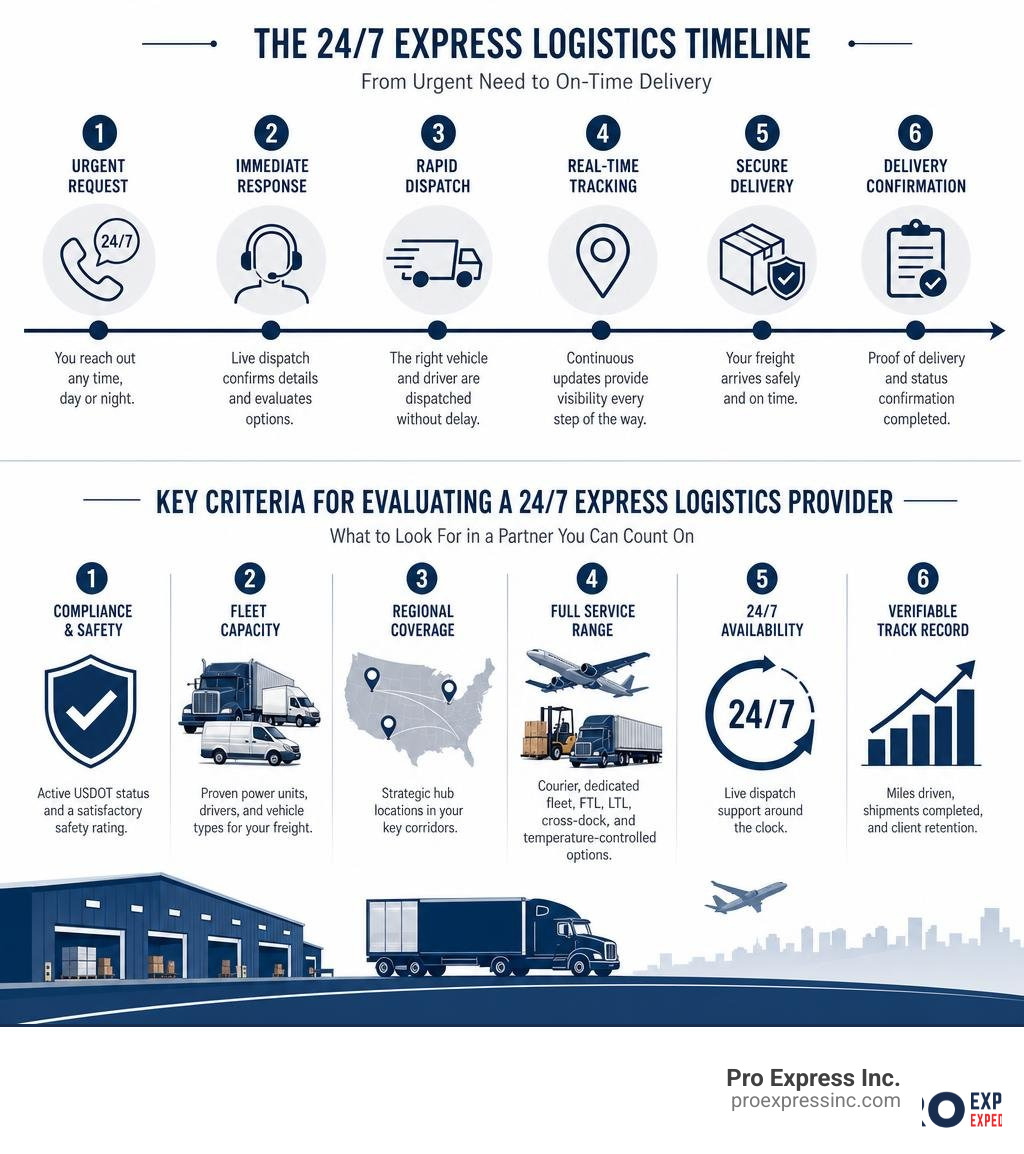
Quick Answer: What to Look for in a 24/7 Express Logistics Provider
- Active USDOT status and a satisfactory safety rating from FMCSA
- Proven fleet capacity — power units, drivers, and vehicle types suited to your freight
- Regional hub coverage with warehouse infrastructure in your key corridors
- Full service range — courier, dedicated fleet, FTL, LTL, cross-dock, and temperature-controlled options
- Genuine 24/7 availability — live dispatch support, not just a website claim
- Verifiable track record — miles driven, shipments completed, and client retention
This guide reviews the 24/7 express logistics landscape — including fleet data, safety records, service types, and real customer and employee experiences — so you can make a confident hiring decision.
The stakes are real. A single missed delivery can halt a production line, delay a hospital supply order, or cost a retail client their peak-season window. Operations managers don’t get second chances on time-critical freight. That’s why choosing a logistics partner with the infrastructure, compliance record, and round-the-clock support to back up their promises matters more than almost anything else in your vendor selection process.
Analyzing the Fleet and Footprint of 24/7 Express Logistics Operations

To understand how a top-tier 24/7 express logistics network operates, we must look at the physical infrastructure that keeps shipments moving. In the logistics sector, capacity and asset availability are the true measures of reliability. When standard carriers fail, expedited networks step in with dedicated fleets designed specifically to handle high-priority freight without intermediate handling.
A standard mid-sized carrier in this space typically maintains a highly active asset base. For instance, looking at industry-standard benchmarks for regional expedited networks, a representative mid-sized carrier operates 73 power units and employs 64 professional drivers. In a single year, a large carrier fleet can log millions of miles, delivering a high volume of goods to their destinations. These numbers illustrate the intense utilization required to keep supply chains fluid.
For businesses requiring rapid ground transport, choosing an asset-based provider ensures that vehicles are ready to deploy the moment an emergency arises. Our own experience at Pro Express Inc. confirms that a robust fleet footprint is essential for maintaining consistent transit times. To explore how we arrange dedicated vehicles through our carrier network for these demanding schedules, you can read more about our specialized Expedited Ground Shipping options.
The Core Services Offered by 24/7 Express Logistics Providers
Expedited logistics is not a one-size-fits-all service. It requires a diverse suite of transportation modes to match the specific urgency and volume of each shipment. Leading providers offer:
- On-Demand & Urgent Courier Services: Designed for small, highly critical items such as legal documents, medical specimens, or replacement parts that need to be delivered within hours.
- Dedicated Fleet Management: Outsource your transportation department entirely. This service provides exclusive-use vehicles and drivers, eliminating the administrative burden of maintenance, insurance, and compliance.
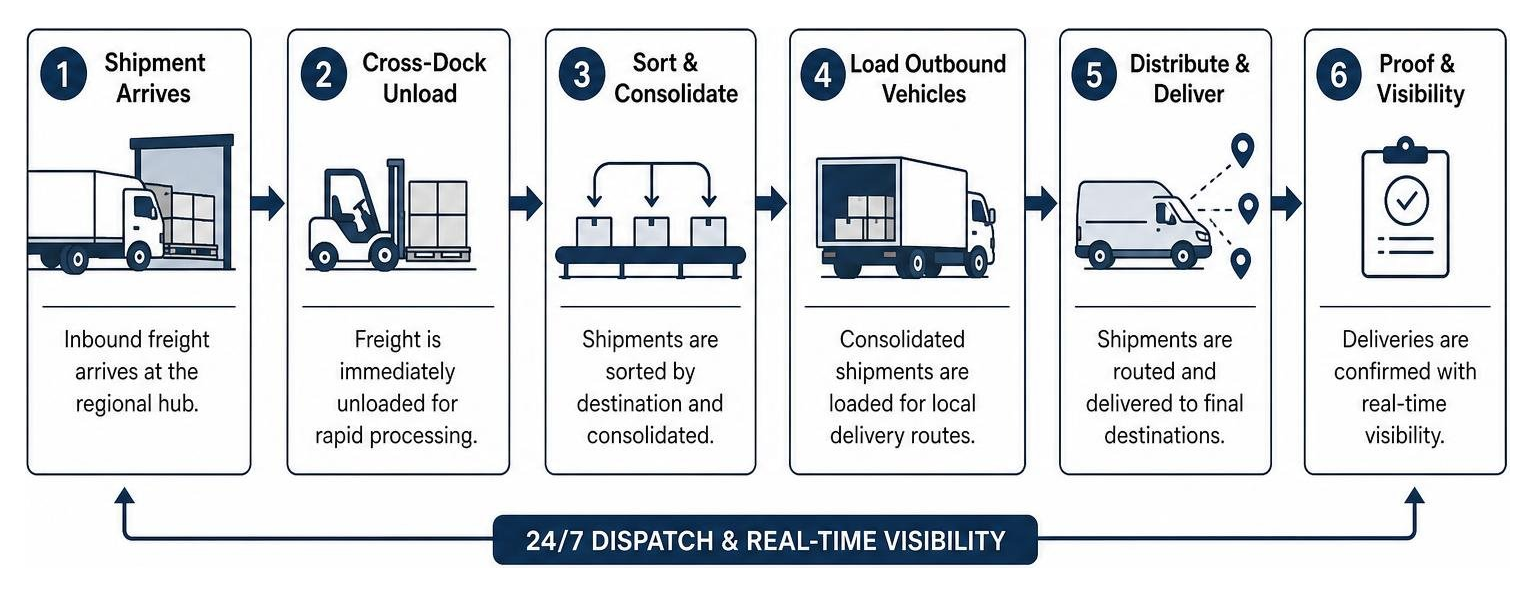
- Pool Distribution & Cross-Docking: A highly efficient method where truckload shipments are received at a central hub, sorted, and immediately loaded onto local delivery vehicles with minimal storage time.
- Full Truckload (FTL) & Less-Than-Truckload (LTL) Expedited Freight: Direct routing for larger shipments that cannot afford the delays associated with traditional hub-and-spoke distribution networks.
For a deeper dive into how these services integrate to protect your supply chain, see our comprehensive Expedited Shipping Services: The 2026 Guide and learn how to choose the right Freight Service for your operational requirements.
Regional Hubs and Transit Corridors
An express logistics network is only as strong as its physical footprint. To support rapid transit across the contiguous United States, carriers strategically position warehouse facilities near major metropolitan areas and shipping corridors.
A standard regional network often maintains over 200,000 square feet of warehouse space across key logistics hubs. These facilities serve as cross-docking terminals, consolidation points, and staging areas for final-mile delivery. In early 2026, leading Midwest networks expanded their footprints to include state-of-the-art facilities in emerging logistics centers like Des Moines, Iowa, further bridging the gap between major manufacturing hubs.
By positioning assets near major interstate junctions, carriers can support rapid dispatch times, often collecting freight shortly after an order is placed. This localized presence, backed by a nationwide network, ensures that even the most remote facilities can access critical Logistics Service support when every minute counts.
Safety, Compliance, and Fleet Performance

When shipping high-value or time-sensitive cargo, carrier compliance is not just a legal formality—it is a risk management necessity. A carrier’s safety record directly correlates with the likelihood of transit delays, cargo damage, and liability exposure.
To verify the legitimacy of any logistics provider, operations managers should consult official federal records. A reliable carrier must maintain an active registration status with the Federal Motor Carrier Safety Administration (FMCSA). You can verify carrier registration details and safety history directly through the Company Snapshot FMCSA SAFER portal.
Safety and Compliance Standards of 24/7 Express Logistics Networks
A thorough analysis of FMCSA safety data reveals the operational discipline of a carrier. Key metrics to evaluate include:
- Out-of-Service (OOS) Rates: These rates measure the percentage of inspections that result in a vehicle or driver being temporarily barred from operating due to safety violations. Top-tier expedited carriers consistently maintain driver out-of-service rates well below the national average (often around 4.5%), reflecting rigorous driver vetting and training.
- Vehicle Maintenance: Regular preventative maintenance keeps vehicle out-of-service rates low (typically below 19.3%), ensuring that trucks do not break down mid-transit during a critical delivery.
- Safety Ratings: Always partner with carriers that hold a “Satisfactory” safety rating, which is the highest designation awarded by the FMCSA.
Maintaining these standards across millions of driven miles requires a continuous commitment to safety, continuous driver education, and strict adherence to hours-of-service regulations. At Pro Express Inc., we prioritize these safety metrics when selecting carriers, so your freight arrives securely and without regulatory delays. Discover how our compliant network supports your business by visiting our Logistics Service page.
Industry Verticals and Specialized Cargo Handling
Different industries present unique logistical challenges. A professional 24/7 express logistics provider must possess the equipment and expertise to handle specialized cargo across diverse sectors:
- Medical and Healthcare: Transporting sensitive medical devices, pharmaceuticals, and laboratory specimens requires strict temperature control, sanitary environments, and certified courier drivers.
- Manufacturing and Just-In-Time (JIT) Production: Preventing factory shutdowns requires precise coordination, real-time tracking, and hot-shot shipping capabilities to deliver parts directly to assembly lines.
- Retail and High-Volume Distribution: Managing seasonal demand surges and inventory replenishment requires seamless pool distribution and cross-docking services.
- Hazardous Materials (Hazmat): Transporting chemical or industrial materials demands specialized driver certifications, compliant equipment, and strict adherence to safety protocols.
For shipments that require extra care, specialized handling, or inside delivery, choosing a partner with dedicated White Glove Services ensures that your high-value cargo is protected from the first mile to the last.
Employee and Customer Perspectives on Service Quality
Behind every successful delivery is a complex network of human coordination. The quality of a logistics provider’s service is deeply tied to its workplace culture and driver relations. When drivers are treated well and supported by professional dispatchers, they perform better on the road, resulting in safer transits and higher on-time delivery rates.
Driver Experiences and Workplace Culture
Employee feedback from major expedited carriers highlights the unique demands of the express logistics industry. Drivers frequently emphasize the importance of clear, direct communication with dispatchers, particularly when managing overnight routes or navigating long-distance runs.
Expedited driving is a high-stakes profession. Drivers often operate on tight schedules to meet critical deadlines. Carriers that foster a supportive, family-like atmosphere—providing clear route expectations and reliable equipment—tend to retain experienced drivers. This stability directly benefits shippers, as experienced drivers are more familiar with terminal procedures, security protocols, and specialized cargo handling. To understand the dedication required of round-the-clock delivery professionals, read our article on how Your Package Never Sleeps and Neither Do These 24-Hour Couriers.
Client Testimonials and Operational Reliability
For logistics decision-makers, customer testimonials offer valuable insight into a carrier’s real-world performance. When evaluating a partner for 24/7 express logistics, look for consistent praise in three main areas:
- Real-Time Visibility: Customers value advanced tracking systems that provide continuous updates, allowing them to monitor their shipments at any hour of the day or night.
- Proactive Communication: If an unavoidable delay occurs—such as severe weather or traffic congestion—a reliable carrier communicates immediately, offering alternative routing solutions.
- On-Time Performance: When a production line or critical project is on the line, there is no substitute for punctual delivery.
Partnering with a carrier that prioritizes these operational standards protects your business from the costly consequences of supply chain disruptions. Learn more about choosing a reliable partner in our Same Day Courier Service: Your 2026 Guide.
Frequently Asked Questions About Express Freight Operations
What is the difference between FTL and LTL shipping?
The primary differences between Full Truckload (FTL) and Less-Than-Truckload (LTL) shipping center on capacity utilization, transit speed, and cargo handling:
| Feature | Full Truckload (FTL) | Less-Than-Truckload (LTL) |
|---|---|---|
| Capacity | Dedicates an entire trailer to a single shipment. | Combines multiple shipments from different shippers in one trailer. |
| Transit Speed | Direct point-to-point transit with no intermediate stops. | Slower transit times due to multiple stops and terminal transfers. |
| Cargo Handling | Cargo is loaded once and remains secured until destination. | Cargo is handled frequently at regional cross-dock terminals. |
| Suitability | Best for large, high-value, or highly time-sensitive freight. | Best for smaller, non-urgent shipments that do not fill a trailer. |
For a complete breakdown of how to leverage these shipping methods for your business, check out our guide on Expedited Ground Shipping.
How do expedited ground services prevent supply chain disruptions?
Expedited ground services act as a safety net for modern supply chains. When a primary carrier fails to make a pickup, or when unexpected demand spikes deplete local inventory, standard shipping methods are simply too slow to resolve the issue.
By utilizing dedicated vehicles that bypass traditional hub-and-spoke distribution networks, expedited services provide direct, point-to-point transport. This rapid dispatch capability allows operations managers to resolve emergencies—such as transporting critical manufacturing components or medical supplies—before they escalate into costly shutdowns. Discover how to protect your operations from unexpected delays by reading about Beating the Clock with Expert Time Sensitive Shipments.
What specialized equipment is used for time-sensitive freight?
Expedited logistics carriers utilize a diverse fleet of specialized vehicles to match the weight, dimensions, and urgency of your cargo:
- Sprinter & Cargo Vans: Perfect for small, rapid deliveries weighing up to 3,000 pounds, offering maximum agility in congested metropolitan areas.
- Straight Trucks: Equipped to handle mid-sized freight (up to 12,000 pounds), often featuring liftgates for facilities without loading docks.
- Dry Vans (53-Foot): Standard trailers used for large-volume, time-critical full truckloads.
- Flatbeds: Specialized trailers designed for oversized, heavy machinery, or construction materials that require side-loading.
Matching the right vehicle to your cargo prevents unnecessary handling and ensures the fastest possible transit. Learn more about the vehicles we arrange in our guide to Hot Shot Delivery: Small Trucks for Big Deadlines.
Conclusion
When supply chain disruptions strike, you need a logistics partner that responds with speed, precision, and absolute reliability. At Pro Express Inc., we bring nearly two decades of dedicated experience to the expedited shipping industry. Our nationwide coordination across the contiguous United States helps ensure that your time-sensitive deliveries are covered, wherever they need to go.
With a proven track record of delivering over 10,000 high-priority shipments and maintaining a 99% client satisfaction rating, we specialize in:
- Same-Day and Next-Day Delivery for your most critical shipments
- Hot-Shot Shipping utilizing dedicated, exclusive-use vehicles
- White Glove Services for high-value, sensitive cargo
- 24/7 Live Customer Support so you always speak to a real person, day or night
Don’t let carrier failures or shipping delays compromise your business operations. Contact us today to discuss your logistics needs and secure a reliable partner for your supply chain.