
Why a Carrier Failure Backup Service Protects Client Relationships
A carrier failure backup service helps protect client relationships when an assigned ground carrier cannot complete a shipment. To prepare, identify alternate carriers before you need them, keep shipment details ready to share, and decide who will approve a replacement pickup and tell the client what has changed.
A breakdown or missed pickup is easier to manage when those decisions are already made. Pro Express Inc. is a freight broker that coordinates urgent ground shipments through a vetted carrier network 24/7.
The True Operational and Business Impact of Primary Carrier Disruptions
When an assigned freight carrier drops a load or breaks down on the highway, the consequences ripple across the entire supply chain. A single missed delivery window can trigger assembly line shutdowns, missed construction deadlines, or canceled medical procedures. In high-stakes manufacturing and automotive sectors, operations rely heavily on just-in-time delivery schedules where inventory arrives hours before installation.
The broader business impact of unplanned downtime is severe. According to research published by Gartner, enterprise downtime averages $5,600 per minute across critical business operations. When time-sensitive cargo is stranded, every minute of delay increases operational exposure. Utilizing expedited freight services provides an immediate buffer against these disruptions.
Primary transport disruptions also trigger severe cascading failures across interdependent supply networks. Studies on carrier outage vulnerabilities demonstrate how easily operational dependencies fail without redundant support. Furthermore, comprehensive research on freight transportation resilience from The National Academies highlights that organizations lacking predefined contingency logistics face significantly prolonged recovery times during regional or network disruptions.
Root Causes Behind Unplanned Ground Carrier Breakdowns
Ground transportation disruptions stem from several unpredictable factors:
- Mechanical Failures: Engine trouble, blown tires, and electrical faults can immobilize a truck without warning.
- Hours-of-Service Limitations: Drivers reaching maximum allowable driving hours under federal safety rules must stop, leaving loads stalled if relief drivers are unavailable.
- Severe Weather Delays: Sudden blizzards, flash floods, or high winds shut down major freight corridors across the lower 48 states.
- Terminal and Traffic Congestion: Bottlenecks at distribution hubs or severe interstate traffic gridlock can cause missed delivery appointments.
How Delivery Delays Erode B2B Customer Relationships
In B2B logistics, reliability forms the cornerstone of commercial partnerships. A primary carrier failure does not just stall freight; it damages credibility. When critical components fail to arrive on schedule, clients face their own operational downtime, leading to strict Service Level Agreement (SLA) chargebacks, damaged professional trust, and customer churn. Having a contingency plan ensures shipments stay on track even when primary providers encounter unexpected delays.
Why True Redundancy Requires Independent Freight and Telemetry Paths
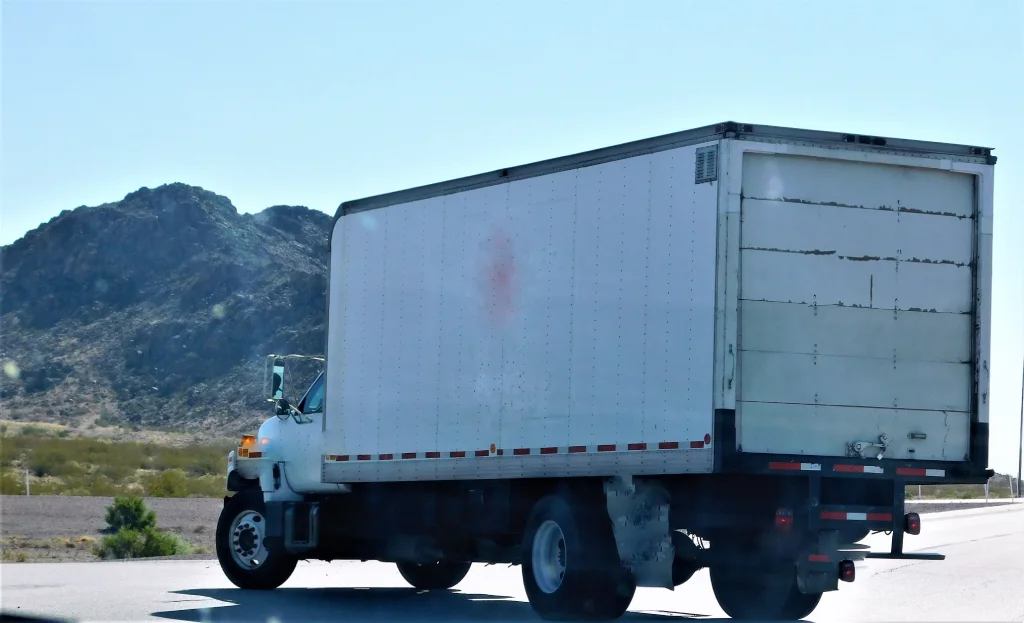
Many businesses mistakenly believe that contracting two different transport divisions under the same parent company provides complete redundancy. True resilience requires structural independence across both the physical transportation path and the digital systems used to track and manage shipments.
Understanding why relying on professional expedite services acts as a safety net begins with recognizing that a secondary carrier must operate completely detached from your primary carrier’s infrastructure, dispatch assets, and communication channels.
Uncovering Hidden Dependencies in Primary and Secondary Logistics
Redundancy often fails due to hidden shared dependencies:
- Shared Dispatch Portals: When primary and backup services rely on the same electronic data interchange (EDI) broker software or server clusters, a software outage paralyzes both options.
- Common Terminal Infrastructure: Utilizing two regional carriers that rely on the exact same cross-dock facility or parking yard creates a single point of physical failure.
- Shared Fleet Subcontracting: Many regional logistics companies outsource surplus capacity to the same pool of owner-operators, meaning a capacity crunch hits both providers simultaneously.
Aligning Recovery Time and Recovery Point Objectives in Freight Dispatch
In IT disaster recovery, Recovery Time Objective (RTO) measures how quickly an operation must be restored after a disruption, while Recovery Point Objective (RPO) dictates the maximum acceptable data loss. These same metrics apply directly to freight management. In logistics, RTO defines how quickly a replacement truck must be dispatched after a breakdown, while RPO defines the maximum acceptable gap in tracking and telematics visibility.
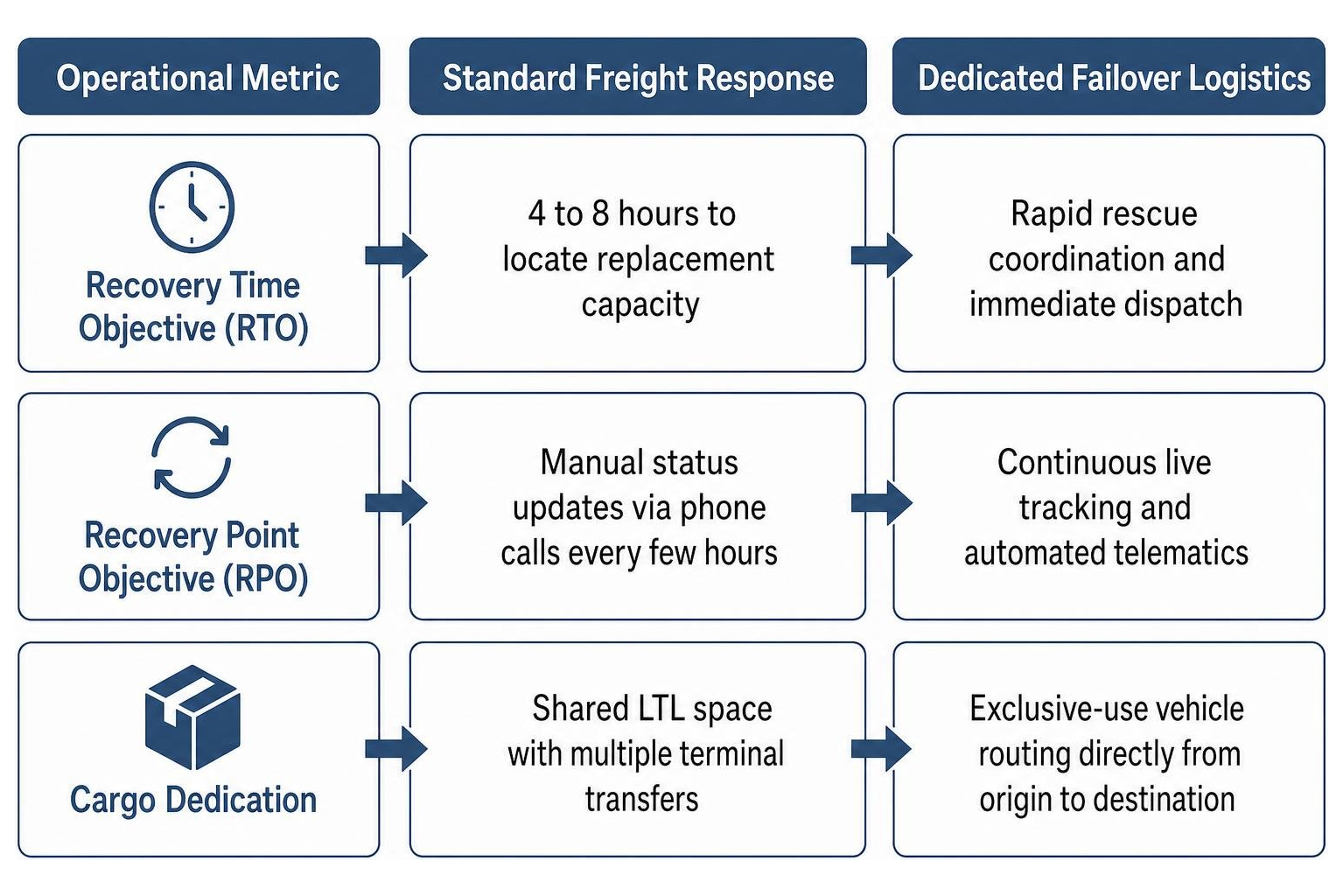
| Operational Metric | Standard Freight Response | Dedicated Failover Logistics |
|---|---|---|
| Recovery Time Objective (RTO) | 4 to 8 hours to locate replacement capacity | Rapid rescue coordination and immediate dispatch |
| Recovery Point Objective (RPO) | Manual status updates via phone calls every few hours | Continuous live tracking and automated telematics |
| Cargo Dedication | Shared LTL space with multiple terminal transfers | Exclusive-use vehicle routing directly from origin to destination |
| Communication Layer | Standard business hours helpdesk ticketing | 24/7 dedicated dispatch operations |
How a Carrier Failure Backup Service Protects Supply Chains and Client Trust
A dedicated backup service for carrier failure steps in the moment a primary logistics arrangement collapses. Instead of scrambling to find available capacity on open load boards during an emergency, businesses with a structured failover strategy activate pre-vetted recovery protocols immediately.
Working with carrier failure backup experts ensures your supply chain maintains continuous movement throughout the contiguous United States, safeguarding client relationships and preventing costly production stoppages.
Core Technical and Operational Pillars of a Carrier Failure Backup Service
A professional backup freight strategy relies on several essential components:
- 24/7 Live Monitoring and Coordination: Experienced freight brokers monitor transit milestones around the clock to detect delays before they escalate into missed deliveries.
- Vetted Carrier Diversity: Access to an extensive network of independent carriers across the lower 48 states ensures immediate capacity availability regardless of regional disruptions.
- Real-Time Telematics and Visibility: Implementing robust tracking systems aligned with wireless failover standards ensures constant telematics visibility even when primary network portals experience outages.
- Direct-Drive Contingency Routing: Freight is moved directly from pickup to delivery without unnecessary cross-docking or terminal handling.
Key Triggers for Activating a Carrier Failure Backup Service
Recognizing when to switch from your primary carrier to a backup service prevents small delays from turning into critical failures:
- Missed Pickup Windows: When an assigned carrier fails to arrive within the scheduled window and cannot provide an immediate estimated time of arrival.
- En-Route Mechanical Breakdowns: If an in-transit truck experiences equipment failure and the primary carrier cannot provide an immediate replacement vehicle.
- Sudden Capacity Cancellations: When a primary carrier cancels a load right before dispatch due to equipment shortages or driver availability issues.
- Escalated Delivery Timelines: When a client suddenly accelerates a production schedule, requiring standard freight to be converted into an immediate hot-shot ground delivery.
Step-by-Step Guide to Establishing a Reliable Freight Redundancy Plan
Building a resilient freight backup plan requires proactive preparation before an emergency occurs.
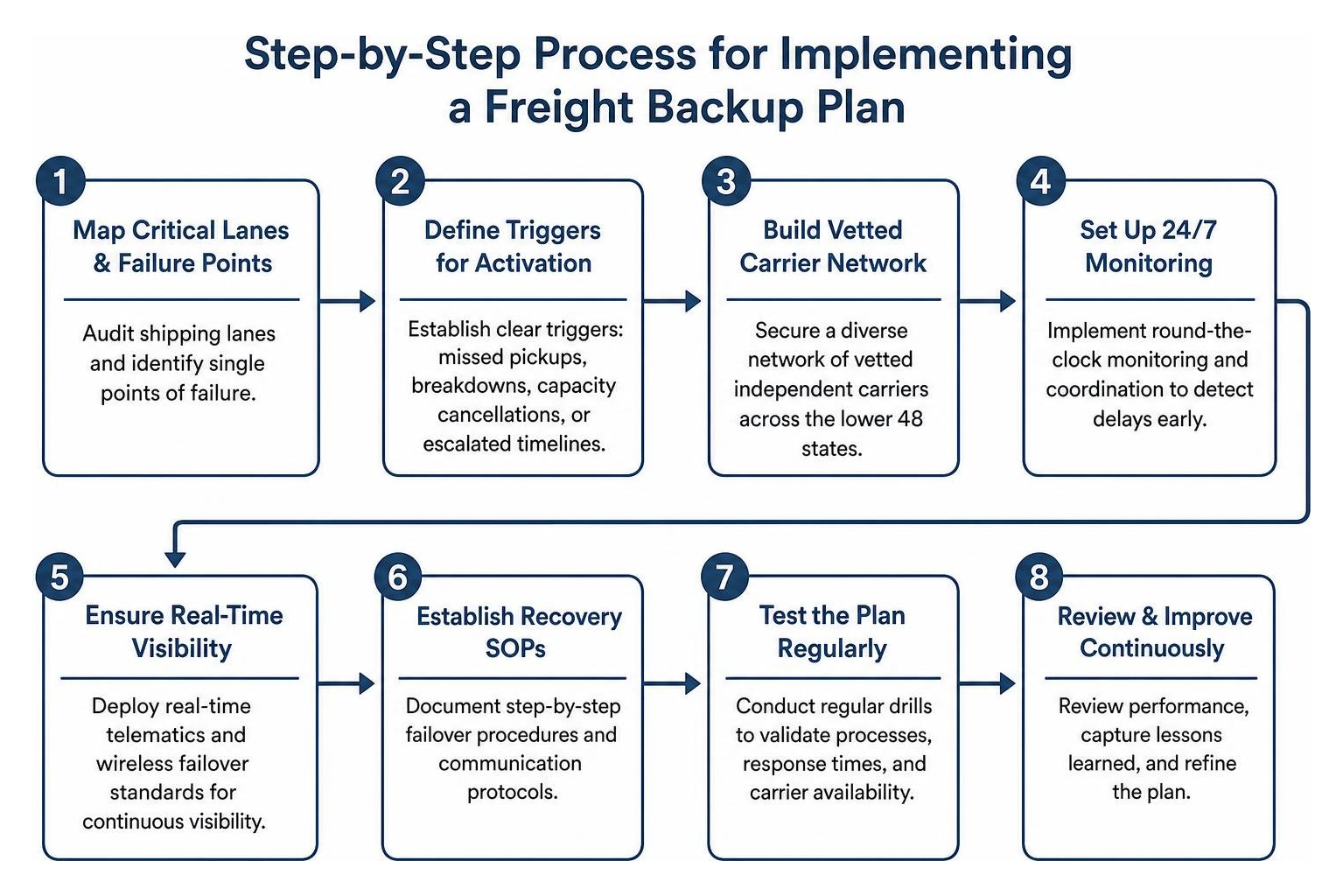
By partnering with specialists in exclusive hot shots, businesses can establish clear Standard Operating Procedures (SOPs) that keep cargo moving seamlessly.
Step 1: Map Critical Ground Freight Lanes and Single Points of Failure
Begin by conducting a comprehensive audit of all regular shipping lanes across your supply chain:
- Identify time-sensitive lanes that serve critical assembly plants, medical facilities, or construction job sites.
- Document high-risk corridors prone to severe weather or heavy seasonal congestion.
- List all single-source carrier dependencies across your primary routes.
Step 2: Establish Dedicated On-Demand Expedited Transport Protocols
Create standard protocols for urgent shipments that require immediate intervention:
- Pre-authorize dispatch workflows so operations managers can activate backup freight services without administrative delays.
- Define equipment requirements (e.g., cargo vans, sprinter vans, straight trucks, or 53-foot dry vans) for different cargo categories.
- Integrate rapid response courier solutions for mission-critical parts, production line components, and specialized equipment.
Step 3: Conduct Regular Failover Drills and Service Audits
A contingency plan is only as reliable as its execution. Regular testing ensures smooth operations during real emergencies:
- Conduct Mock Failover Drills: Run tabletop simulations where a primary carrier experiences a breakdown, testing your team’s ability to provide load specifications and coordinate an alternate carrier.
- Audit Carrier Network Credentials: Ensure all partner carriers maintain clean safety ratings, valid operating authorities, and active commercial insurance policies.
- Test Emergency Contact Chains: Verify that 24/7 contact information for operations managers, dispatchers, and receiving docks is accurate and accessible.
Frequently Asked Questions About Carrier Failure Backup Services
What is a carrier failure backup service in freight logistics?
A carrier failure backup service is a contingency logistics arrangement where a freight broker rapidly coordinates alternative ground transportation when a primary carrier breaks down, misses a pickup, or cancels capacity. This service ensures cargo is picked up and delivered on schedule using exclusive-use vehicles without terminal transfers.
How quickly should a backup ground carrier deploy after a primary failure?
An effective backup service activates recovery protocols immediately upon notification, searching its vetted network to match the shipment with an available vehicle in the region. Rapid coordination ensures freight is secured and en route across the contiguous United States as quickly as possible.
How do businesses test their freight failover procedures before an emergency?
Businesses test failover procedures by conducting simulated carrier failure drills and auditing emergency communication channels. Teams verify that shipment dimensions, weight data, and facility access requirements are readily available for immediate handoff to a backup broker. These regular simulations help identify workflow bottlenecks before an actual breakdown occurs.
Conclusion
When primary ground carriers encounter unforeseen disruptions, having a dependable contingency plan is what separates resilient supply chains from costly operational shutdowns. Pro Express Inc. is an expedited freight brokerage based in Oak Brook, Illinois, with nearly 20 years of experience coordinating urgent, time-sensitive ground freight since 2007. Having managed over 10,000 delivered shipments with a 99% client satisfaction rate and long-term clients returning for over 13 years, we connect businesses with a trusted carrier network for rapid-response ground transport 24/7 across the contiguous United States.