
Why Warehouses Choose Expedited LTL Ground Delivery
For a time-sensitive shipment of a few pallets, expedited LTL ground delivery uses a dedicated cargo van, sprinter van, or box truck to travel directly from pickup to delivery. That direct move offers a faster alternative to standard LTL by avoiding waits within a shared multi-stop network.
When a regular pickup falls through or a delivery appointment is at risk, the best option depends on the route, freight size, and deadline. Pro Express Inc. coordinates urgent ground shipments through a vetted carrier network across the contiguous United States.
Key Differences: Expedited LTL Ground Delivery vs. Standard Freight Networks
Understanding how cargo moves across modern supply chains requires looking under the hood of standard freight infrastructure. Standard ground freight relies on systematic consolidation, while expedited solutions prioritize velocity and minimal handling. Choosing between them often dictates whether production lines stay active or face unexpected downtime.
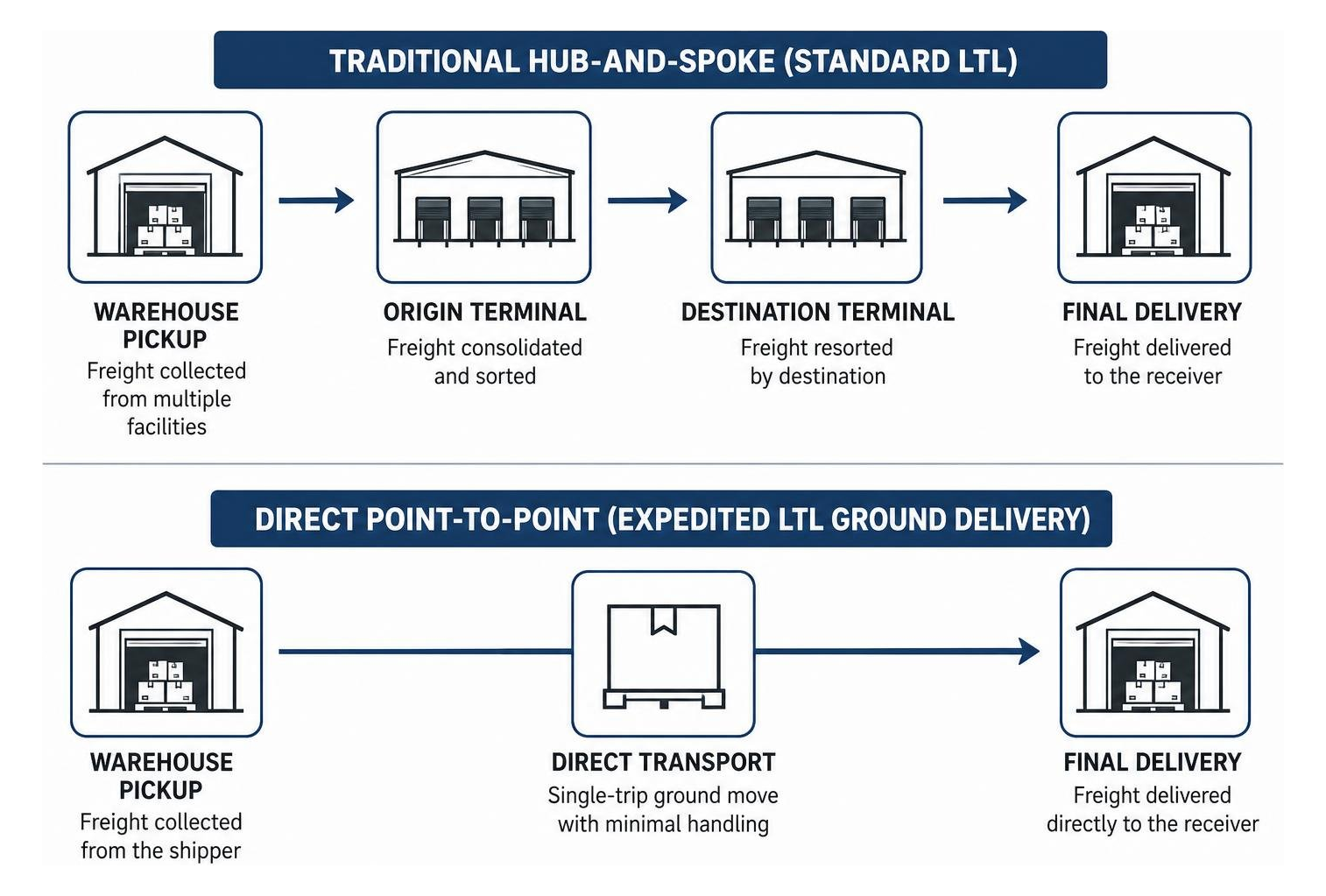
When selecting expedited ground shipping, shippers trade standard multi-stop sorting processes for optimized transit paths designed to protect delivery schedules across the contiguous United States.
Traditional Hub-and-Spoke Mechanics
In traditional less-than-truckload (LTL) shipping, freight moves through a tiered hub-and-spoke network. A local pickup driver collects pallets from multiple facilities and brings them to an originating regional terminal.
At this breakbulk facility, warehouse teams unload the cargo, sort it by geographic destination, and consolidate it with shipments from dozens of other companies.
From there, the consolidated freight moves to an intermediate or destination hub. The cargo is unloaded again, staged, sorted, and finally loaded onto an outbound delivery vehicle for the final mile.
While this model maximizes network capacity, every terminal transfer introduces potential dwell time, scheduling variance, and additional forklift touchpoints that increase cargo handling risks.
Why Direct Routing Powers Expedited LTL Ground Delivery
A dedicated cargo van, sprinter van, or box truck can take a small pallet shipment straight from the shipper to the receiving location. This expedited option avoids the repeated sorting and intermediate stops commonly associated with standard LTL networks.
By deploying time-critical pallet transit solutions, freight moves along continuous transit corridors. When transit requirements demand uninterrupted driving over long distances across the lower 48 states, carriers utilize team drivers to keep the vehicle in motion while adhering strictly to federal rest regulations.
This direct approach eliminates cross-dock congestion, sharply reduces handling touchpoints, and creates a streamlined path from origin dock to receiving bay.
Comparing Standard LTL and a Dedicated Van or Box Truck
Evaluating your shipment against core operational criteria helps determine the ideal mode for your timeline and cargo profile:
| Freight Factor | Standard LTL | Dedicated Van or Box Truck |
|---|---|---|
| Typical Pallet Range | 1 to 6 pallets | A cargo or sprinter van can carry up to about 3 pallets; a box truck can carry up to about 12 standard pallets |
| Standard Weight Range | 150 to 15,000 lbs | A cargo or sprinter van can carry around 3,200 lbs; a box truck can carry around 10,000 lbs |
| Network Mechanics | Multi-terminal hub-and-spoke | Direct point-to-point routing |
| Handling Touchpoints | Multiple cross-dock transfers | Minimal to zero intermediate handling |
| Transit Velocity | Standard estimated transit days | Accelerated, direct highway transit |
| Vehicle Use | Shared, consolidated cargo space | Dedicated cargo van or box truck, your freight only |
| Dock Scheduling | Standard open-window delivery | Strict, appointment-compliant windows |
Top Reasons Modern Warehouses Choose Expedited LTL Solutions
Modern fulfillment hubs and manufacturing operations operate under strict just-in-time constraints. Holding excess inventory carries high carrying burdens, while missing critical components can idle an entire assembly plant. National supply chain data shared through the Freight Logistics Optimization Works program by the U.S. Department of Transportation underscores the importance of operational predictability and container-level visibility across domestic freight channels.
When supply chain disruptions strike, utilizing urgent logistics freight services allows operations managers to stabilize inventory flow without waiting on a shared multi-stop network.
Eliminating Multi-Terminal Freight Re-Handling
Every time a forklift lifts, moves, and sets down a pallet inside a crowded breakbulk facility, the potential for cargo damage increases. Fragile packaging, sensitive electronics, precision industrial parts, and lighting assemblies are especially vulnerable to rough handling during frequent cross-dock transfers.
By coordinating dedicated direct ground transport, cargo remains firmly secured inside a single vehicle from pickup to delivery. Eliminating intermediate terminal sorting protects freight integrity, preserves custom packaging, and ensures that sensitive equipment arrives in ready-to-use condition.
Meeting Precise Delivery Appointment Windows
Major retail distribution hubs, automotive manufacturing plants, and tier-one supply facilities enforce strict Must-Arrive-By Dates (MABD) and tight delivery appointment windows. Failing to hit these scheduled slots can trigger severe operational chargebacks or force drivers to reschedule days in the future.
Standard LTL networks operate on estimated transit schedules where local terminal backlogs can easily delay final-mile delivery. Expedited LTL ground delivery bypasses these regional backlogs, providing the operational control necessary to align precisely with assigned dock schedules and maintain vendor compliance metrics.
Flexible Handling with Specialized Accessorial Equipment
Not every delivery destination features a standard 48-inch elevated loading dock. Construction jobsites, regional clinics, retail strip centers, and urban facilities frequently require specialized equipment to offload heavy palletized goods safely.
Expedited LTL ground solutions accommodate customized accessorial requirements seamlessly:
- Hydraulic Liftgate Service: Enables ground-level offloading when facilities lack loading docks or yard ramps.
- Inside Delivery: Coordinates driver assistance to bring freight past the threshold and into facility staging rooms.
- Two-Man Service: Provides additional personnel for heavy, cumbersome, or delicate items requiring careful physical positioning.
- Non-Dock Commercial Staging: Ensures safe delivery to non-traditional industrial and commercial sites across the contiguous United States.
Best Practices for Preparing and Tracking Urgent Pallet Freight
Speed in transit begins with proper preparation on the warehouse floor. Even the fastest direct carrier cannot compensate for poorly palletized freight or missing shipping documentation that stalls freight at an inspection checkpoint.

Implementing thorough prep protocols and utilizing real-time freight tracking ensures smooth handoffs and complete visibility from dock to dock.
Essential Steps to Prepare Freight for Expedited LTL Ground Delivery
Follow these practical steps to prepare time-critical freight for swift, secure highway transport:
- Select High-Grade Pallets: Use sturdy, undamaged wooden or plastic pallets rated to support your cargo’s exact weight without deflection.
- Distribute Weight Evenly: Place heavier items at the bottom center of the pallet to maintain a low center of gravity and prevent tipping during transit.
- Avoid Overhang: Ensure all cartons and containers sit completely within the pallet perimeter to prevent impact damage along vehicle walls.
- Apply Protective Corner Boards: Place rigid corner and edge protectors along vertical edges to increase stacking strength and prevent strapping from crushing boxes.
- Stretch-Wrap and Band Securely: Wrap cargo with heavy-gauge stretch film, overlapping layers by 50%, and tie the film directly into the pallet base. Apply heavy-duty poly or steel strapping for dense industrial machinery.
- Verify Dimensions and Weight: Record accurate length, width, height, and gross weight to ensure precise vehicle assignment and avoid transit re-weigh delays.
- Ensure Clear, Redundant Labeling: Place large, clear shipping labels on all four sides of the pallet, including consignee address, contact numbers, and special handling notices.
- Provide Accurate Bill of Lading (BOL): Complete the BOL thoroughly, detailing piece counts, NMFC freight classifications where applicable, declared values, and necessary accessorials.
Continuous Visibility and Milestones Monitoring
Modern logistics managers cannot afford to wonder where critical freight is located while assembly teams wait on site. Modern tracking capabilities provide end-to-end transparency throughout the entire transit lifecycle.
Carriers utilize integrated GPS telematics, electronic logging devices (ELDs), and automated geofencing to relay milestone updates as vehicles pass regional checkpoints. Shippers track cargo movements using assigned PRO numbers or BOL identifiers, receiving electronic proof of delivery (POD) with digital timestamps and signatures as soon as the consignee offloads the freight.
Frequently Asked Questions About Expedited LTL Ground Delivery
What vehicle sizes are used for expedited pallet shipments?
For a larger pallet shipment, a box truck can typically carry up to about 12 standard pallets and around 10,000 pounds. For smaller urgent loads, a cargo van or sprinter van can typically carry up to about 3 pallets and around 3,200 pounds.
How much transit time is typically saved compared to standard LTL?
Expedited LTL ground delivery typically saves one to three business days compared to standard LTL shipping by bypassing regional sorting terminals and breakbulk hubs. On long-haul interstate routes across the lower 48 states, deploying continuous direct routing or team drivers maintains vehicle movement to accelerate final arrival.
What freight information is required to track an expedited LTL shipment?
To track an expedited shipment effectively, shippers need the unique PRO tracking number, the Bill of Lading (BOL) number, or the booking reference number. Having the origin and destination postal codes alongside these identifiers allows logistics coordinators to provide continuous real-time milestone updates.
Conclusion
For warehouses, manufacturers, and distributors with urgent pallet freight, a dedicated vehicle provides a direct alternative to standard LTL. Keeping the shipment in a cargo van, sprinter van, or box truck from pickup through delivery reduces handling steps and avoids delays associated with shared multi-stop routing.
At Pro Express, Inc., we leverage nearly 20 years of freight brokerage experience and a vetted carrier network to coordinate reliable, time-critical transportation across the lower 48 states. Whether your operation requires immediate point-to-point transport, specialized liftgate handling, or exclusive hot-shot solutions, our coordination team is available 24/7 to keep your critical shipments moving safely.
Ready to optimize your urgent ground freight logistics? Contact Us Today to coordinate your next time-critical shipment.