
When Your Regular Carrier Fails and the Clock Is Already Running
Same-day freight delivery is the coordination of urgent, time-critical shipments — typically palletized cargo, industrial equipment, or specialty goods — that must be picked up and delivered within the same business day, often within hours of booking.
Who arranges it: Specialized freight brokers coordinate these shipments through vetted networks of hot-shot carriers, expedited couriers, and regional transport partners — no single asset-based carrier can cover every lane or cargo type on short notice.
What it covers:
- Industrial and manufacturing parts
- Medical and pharmaceutical supplies
- Automotive components
- Heavy or oversized freight requiring liftgate or two-man delivery
When you need it: When a carrier fails, a production line is at risk, or a client deadline cannot move.
When a critical shipment doesn’t show — and your regular carrier isn’t picking up — every hour of delay has a direct cost. A stalled production line. A missed client commitment. A medical facility waiting on supplies it cannot operate without.
This is the reality that operations and logistics managers face when standard freight networks fall short. The margin for error is zero, and the pressure to find a reliable solution right now is immense.
That’s exactly where a seasoned freight broker becomes essential. With 17+ years of experience coordinating urgent shipments across the U.S., Pro Express Inc. has built its reputation on being the partner that answers the phone when it matters most — and delivers.
This guide covers everything you need to know: how to find the right same-day freight partner, how to structure your logistics for speed, and how to measure whether your urgent freight program is actually working.
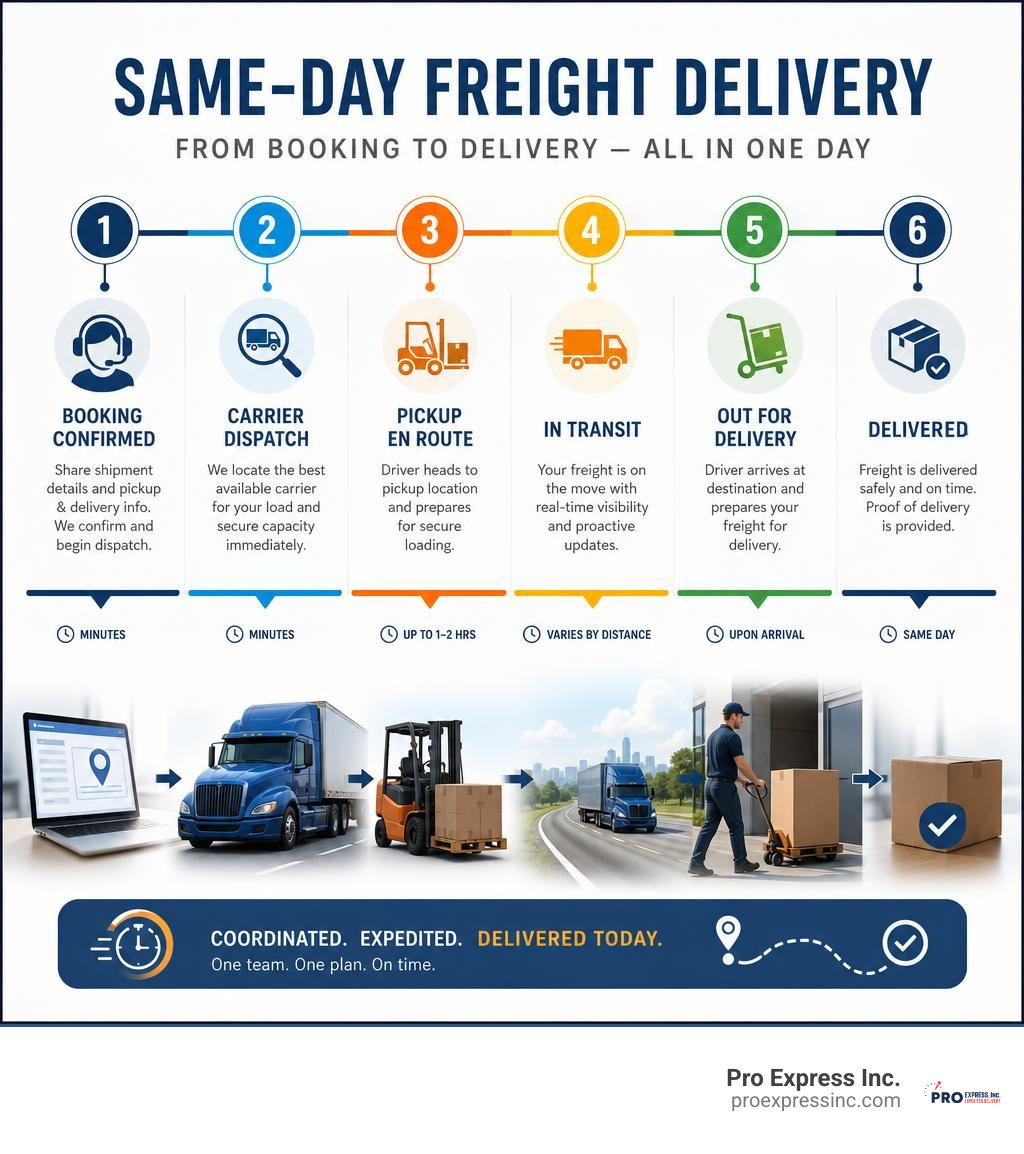
Same-day freight delivery basics:
The Strategic Imperative of Same-Day Freight Delivery in 2026
In 2026, delivery speed is no longer just a premium operational option; it is a critical driver of business retention and conversion. For mid-market merchants and B2B suppliers alike, failing to offer rapid fulfillment can result in significant missed opportunities.
Data shows that 34% of abandoned shopping carts are abandoned primarily due to slow delivery speeds. This issue becomes even more acute for specific product categories. For businesses dealing in home goods, beauty, and pet care, the percentage of abandoned carts citing delivery speed climbs past 40%.
When B2B buyers or high-value clients experience slow transit times, they do not simply wait; they seek out alternative suppliers who can guarantee faster turnarounds. Implementing an expedited logistics strategy is an effective way to recover this potentially lost business.
Merchants who reframe rapid shipping options as a tool for revenue recovery typically see an 18–22% lift in conversion rates on product pages that display a same-day badge. To understand how these faster transit models function at a high level, you can explore The Ultimate Guide to Expedited Shipping.
When a same-day shipping program generates a 20% conversion lift on eligible items, the incremental margin gained often offsets the operational shipping premiums within 60 days of launch. Providing these fast delivery options helps secure sales that would otherwise go to competitors. For an in-depth look at how urgent shipping can optimize your overall supply chain, refer to Expedited Freight Meaning and Why Your Logistics Need a Turbo Boost.
The Business Impact of Delayed Industrial Shipments
While cart abandonment is a major issue for e-commerce, delayed industrial shipments can cause even more severe operational disruptions. In sectors like automotive manufacturing, aerospace, medical technology, and heavy industrial production, a single missing component can halt an entire operation.
Consider the consequences of a manufacturing plant shutdown. If a critical assembly line lacks a specific part, production stops, workers stand idle, and backlogs accumulate. In the medical and pharmaceutical sectors, delays in receiving specialized equipment or sensitive chemical reagents can directly impact patient care and compromise clinical trials.
When these critical bottlenecks occur, standard LTL (Less-Than-Truckload) transit is simply not fast enough. Businesses require a dedicated logistical response that prioritizes speed, security, and direct routing. To learn more about how operations managers handle these high-stakes scenarios, see Same-Day Delivery Service The 2026 Guide for Logistics Managers.
Selecting the Right Partners for Urgent Logistics
To successfully execute same-day freight delivery, you must partner with logistics specialists who understand the urgency of your operations. This is not a service that can be managed by standard parcel carriers or traditional freight networks that rely on rigid hub-and-spoke sorting systems.
Instead, urgent logistics requires a flexible approach. This is typically managed through:
- Vetted Carrier Networks: A wide pool of pre-screened transport professionals who are ready to deploy at a moment’s notice.
- Dedicated Hot-Shot Transport: Utilizing smaller, highly maneuverable vehicles (such as sprinter vans or straight trucks) that bypass standard freight terminals and drive directly to the destination.
- Specialized Handling Services: Solutions that include liftgate equipment, two-man delivery crews, and white-glove inside delivery to ensure heavy or delicate cargo is handled safely.
For a comprehensive overview of how to choose the right courier partner for your immediate logistics needs, read Same-Day Courier Service Your 2026 Guide. If you need to understand the structural differences between standard shipping and high-speed freight brokerage, refer to Expedited Freight Services Reliable Solutions for Urgent Logistics.
Evaluating Broker Networks vs. Asset-Based Carriers
When arranging urgent shipping, logistics managers must choose between working directly with an asset-based carrier or partnering with a professional freight broker.
An asset-based carrier is limited by the physical size and geographic location of its fleet. If their trucks in your region are fully booked, or if a vehicle experiences a mechanical breakdown, your shipment will be delayed.
In contrast, a freight broker operates by coordinating shipments through a vast, vetted network of independent transport partners. This model offers several key operational advantages:
- Capacity Flexibility: Brokers can source the exact vehicle type you need—whether it is a cargo van, a flatbed, or a dry van with a liftgate—even during peak shipping seasons.
- Nationwide Reach: Because brokers are not tied to a single regional terminal network, they can coordinate shipments across different states and major metropolitan areas simultaneously.
- Operational Resilience: If a primary carrier encounters an issue, a broker can quickly reassign the load to another vetted provider in their network, keeping your shipment on schedule.
To learn more about how broker networks maintain high service levels, see The Complete Guide to Expedited Freight Services 2026 Guide.
Decentralized Inventory and Operational Infrastructure

To consistently meet same-day delivery timelines, you must minimize the physical distance between your inventory and your customers. Trying to fulfill same-day orders from a single, centralized national warehouse is structurally impossible for most regions.
Fortunately, you do not need to own or lease a massive network of physical warehouses to achieve this. By partnering with decentralized third-party logistics (3PL) providers, you can position your inventory closer to major demand centers. This strategy allows you to utilize regional staging nodes to fulfill urgent orders quickly. For a detailed look at how to set up this type of operational framework, see How to Launch a Same-Day Delivery Operation Without a Warehouse – Online Store News.
How to Position Inventory for Same-Day Freight Delivery Without a Warehouse
Implementing a decentralized inventory model requires a data-driven approach. Instead of distributing your entire catalog across multiple regional nodes, you should focus on your most popular products.
We recommend using a streamlined, four-step strategy to position your inventory effectively:
- Analyze Geographic Order Density: Pull your order history reports from the last 90 days to identify your highest-density customer zip code clusters.
- Apply the 80/20 SKU Rule: Identify the top 20% of your SKUs that generate 80% of your overall demand. These are the high-velocity products that should be prioritized for regional staging.
- Stage Inventory at Satellite Nodes: Position only these top-performing SKUs at regional 3PL nodes near your high-density customer clusters. Staging your top 20 SKUs in your highest-density order zip clusters typically unlocks same-day eligibility for 60–70% of your total shipment volume.
- Establish Geo-Based Shipping Rules: Configure your order management system to automatically route orders to the nearest regional node. This ensures that same-day shipping options are only displayed to customers located within the delivery zone of that specific node.
By keeping your long-tail, slow-moving SKUs in a centralized warehouse and regionalizing your high-demand items, you can offer rapid delivery options without incurring excessive inventory carrying costs. For more information on optimizing your inventory distribution, see Expedited Shipping Your Complete 2026 Guide.
Executing Same-Day Logistics at Scale
Running a successful same-day shipping program requires a reliable technology stack. Your systems must connect your storefront, your inventory management software, and your shipping partners in real time.
To manage this workflow efficiently, your technology stack should include:
- An Order Management System (OMS): This system should automatically route orders to the correct fulfillment node based on real-time inventory availability and customer location.
- Real-Time Tracking and Last-Mile Visibility: This provides continuous updates on the status of your shipments, allowing your customer service team to monitor deliveries and proactively address any transit issues.
- Estimated Delivery Date (EDD) Displays: Showing clear, dynamic delivery promises on your product pages helps set accurate expectations and encourages buyers to complete their purchases.
To learn more about the technology and operational strategies required to manage urgent shipments, read Expedited Ground Freight A Strategic Guide for Logistics Managers 2026 Guide.
Establishing Safe Cutoff Times for Same-Day Freight Delivery
One of the most critical aspects of managing a same-day shipping program is setting an operationally safe cutoff time. If you promise same-day delivery for an order placed too late in the day, your warehouse team and transport partners will not have enough time to pick, pack, and ship the cargo before the daily shipping windows close.
To prevent service level agreement (SLA) breaches, you must build a reliable buffer into your daily schedule:
- Map Your Pick-and-Pack Times: Determine exactly how long it takes your warehouse team to process, palletize, and prepare an urgent shipment for pickup once the order is received.
- Identify Carrier Pickup Windows: Work with your logistics partners to establish the latest possible time a vehicle can depart your facility and still guarantee same-day delivery.
- Apply a Sacred Operational Buffer: Set your customer-facing storefront cutoff time 30 to 45 minutes earlier than your actual warehouse fulfillment cutoff. This buffer gives your team a critical window to handle unexpected delays, verify order details, and ensure the cargo is ready when the transport vehicle arrives.
Establishing these clear operational boundaries helps protect your team from unrealistic deadlines and ensures consistent delivery performance. For more insights on coordinating urgent pickups, refer to Instant Freight Quote On Demand Shipping.
Key Performance Metrics for Same-Day Freight Programs
To ensure your same-day shipping program is performing well, you must track key performance indicators (KPIs) regularly. Relying on general feedback is not enough; you need hard data to verify that your logistics network is operating efficiently.
We recommend focusing on three primary metrics:
- SLA Compliance Rate: This measures the percentage of shipments delivered within your promised timeframe. We recommend aiming for an SLA Compliance Rate of 94%+ at launch, and 97%+ as your operations mature over the first 90 days. Any compliance rate below 90% indicates operational issues that can damage customer trust.
- Same-Day Attach Rate: This tracks the percentage of total customers who choose the same-day shipping option when it is presented to them. Monitoring this metric helps you understand customer demand and assess the value of your rapid shipping program.
- Net Margin Per Same-Day Order: Track the overall profitability of orders shipped via same-day delivery. This calculation should account for the increased order conversion rates and any adjustments in inventory handling costs.
By monitoring these metrics, you can make informed decisions to optimize your logistics and ensure your shipping program supports your business goals. For guidance on evaluating your shipping performance and coordinating expedited freight, see How to Get an Accurate Expedited Freight Quote 2026 Guide.
Frequently Asked Questions about Same-Day Freight
What types of cargo qualify for same-day freight delivery?
Same-day freight delivery is designed for high-priority cargo that requires immediate transport. This typically includes palletized industrial freight, manufacturing components, automotive assemblies, medical devices, and sensitive aerospace parts. Because these shipments are time-critical, they are moved using dedicated vehicles rather than being consolidated into standard, multi-stop LTL networks.
How do freight brokers coordinate same-day shipments without owning trucks?
Freight brokers use specialized logistics platforms and deep industry relationships to connect shippers with a vetted network of independent carriers. When an urgent shipment is requested, the broker matches the load with an available hot-shot carrier or expedited owner-operator located near the pickup point. This model allows brokers to secure the right vehicle for your specific cargo quickly and efficiently, providing nationwide coverage without the limitations of a single physical fleet.
What is the target SLA compliance rate for urgent freight?
For high-priority shipments, we recommend aiming for an SLA compliance rate of at least 94% at the launch of your program, with a target of 97% or higher as your operations mature. Consistent delivery performance is essential for maintaining client trust and ensuring that critical supply chains remain undisrupted.
Conclusion
When your supply chain faces unexpected disruptions, you need a logistics partner you can rely on. Pro Express Inc. has spent over 17 years coordinating urgent, time-sensitive shipments across the United States. Founded in 2007 by Peter Jałowiec, we have coordinated over 6,000 shipments with a 99% client satisfaction rating.
We specialize in arranging a wide range of expedited shipping services, including:
- Exclusive Hot Shots: Direct, non-stop transport for your most urgent cargo.
- White-Glove & Inside Delivery: Careful handling and precise placement of sensitive equipment.
- Two-Man & Liftgate Services: Safe loading and unloading for heavy or oversized freight.
Whether you are shipping automotive parts, medical supplies, manufacturing equipment, or lighting fixtures, we have the experience and the carrier network to get your cargo delivered safely and on time.
When your regular carrier fails and the clock is ticking, do not leave your logistics to chance. Contact us today to coordinate your next shipment.