
What Does Expedited Shipping Mean — and Why It Matters in Commercial Logistics
What does expedited shipping mean? In short: it is any shipping method that moves a shipment faster than standard transit — using priority handling, direct routing, and fewer stops to compress delivery windows.
| Shipping Type | Typical Transit Time | Key Characteristic |
|---|---|---|
| Standard Ground | 3–7 business days | Multiple transit hubs, regular routing |
| Expedited | 1–3 business days | Priority handling, reduced stops |
| Express / Overnight | Next day or 1–2 days | Premium carrier tier, time-definite |
| Same-Day / Hot-Shot | Same day | Dedicated vehicle, immediate dispatch |
For a B2B operations or logistics manager, the definition goes deeper than a checkout label. When a regular carrier fails, a production line goes down, or a critical medical shipment is stuck — expedited shipping is the difference between a recoverable situation and a missed deadline.
The stakes are real. The global logistics market exceeded $9 trillion USD in 2022 and is projected to reach $14.37 trillion by 2028, driven in large part by the growing demand for faster, more reliable freight movement. At the same time, 62% of shoppers — and far more B2B buyers — now expect delivery in under three business days as a baseline.
Yet “expedited shipping” is one of the most misunderstood terms in logistics. It means different things depending on whether you’re talking about a retail parcel carrier, a freight broker, or a dedicated hot-shot service coordinating an exclusive-use vehicle across state lines.
This guide cuts through the confusion — explaining what expedited shipping actually means at the commercial freight level, how it differs from express, same-day, and hot-shot services, and how operations leaders can use it as a strategic tool when speed and reliability cannot be compromised.
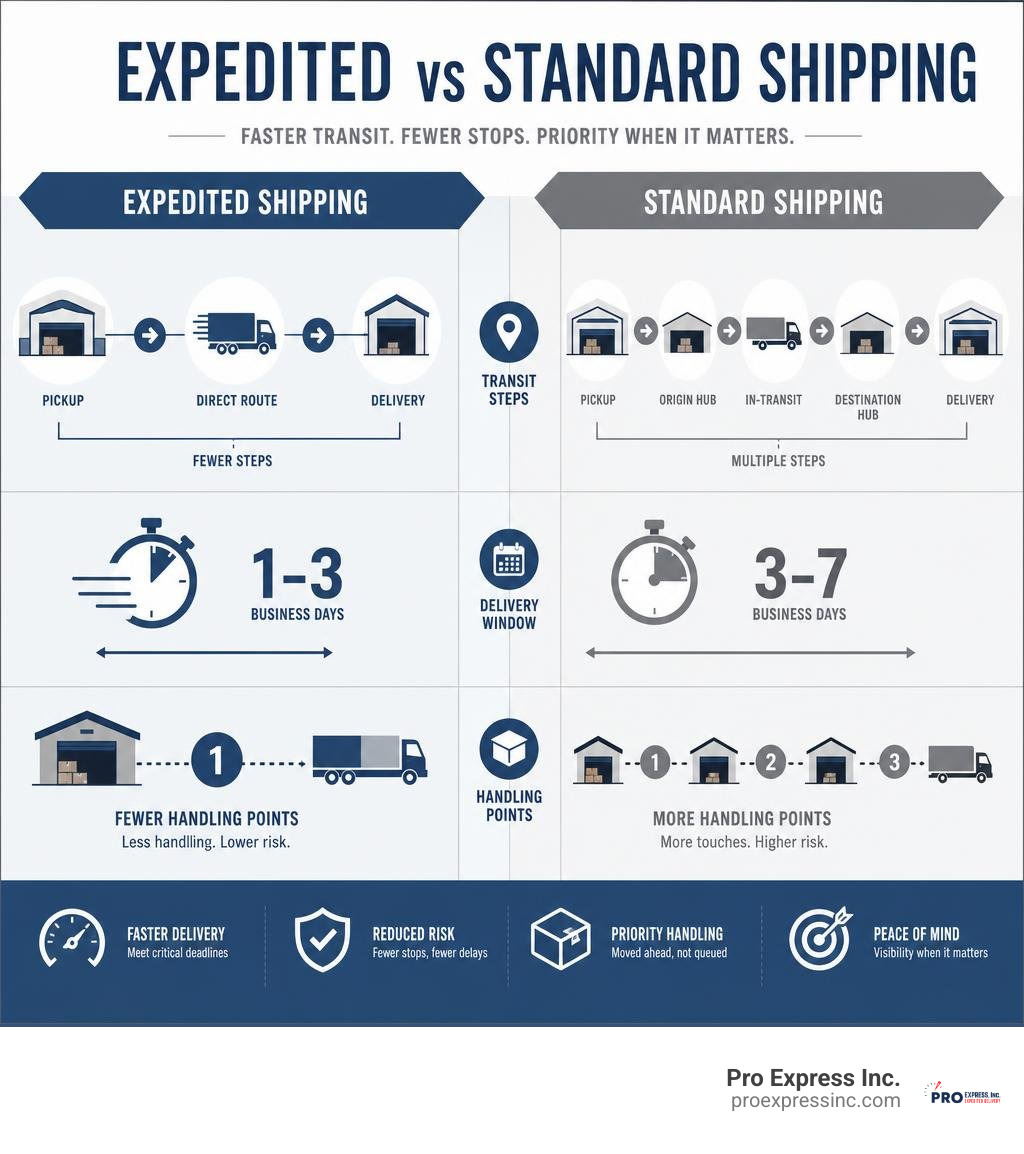
Quick what does expedited shipping mean definitions:
What Does Expedited Shipping Mean in Commercial Logistics?
When asking what does expedited shipping mean within commercial logistics, the answer centers on relative speed and operational prioritization. In plain terms, expedited shipping represents any cargo movement systematically engineered to travel faster than standard baseline transit schedules.
Unlike standard freight — which relies on scheduled hub-and-spoke consolidation networks — expedited shipments bypass routine delays. From the moment dispatch occurs, cargo moves under priority status. Depending on the distance and mode required, this acceleration is achieved through dedicated routing, exclusive-use vehicles, continuous driving teams, or immediate carrier dispatch. To explore deeper foundational definitions, review What is Expedited Shipping? The 2026 Guide and this Overview of Expedited Shipping Definition.
In commercial freight operations, expediting is not merely a marketing term; it is an active risk-management strategy designed to keep supply chains fluid and predictable.
What Does Expedited Shipping Mean for Supply Chain Operations?
For supply chain executives and plant managers, expedited shipping functions as an operational safety valve. Modern lean manufacturing relies on tight inventory cycles, where holding vast amounts of safety stock is minimized. However, when unexpected spikes in demand occur or supplier dispatches are delayed, standard transit schedules create severe operational friction.
Expedited ground freight restores balance across critical operations by supporting:
- Urgent Inventory Replenishment: Fast-tracking raw materials or essential parts directly to distribution centers or plant floors to avoid stockouts.
- Line-Down Risk Mitigation: Coordinating rapid cargo dispatch when an active manufacturing plant risks shutting down due to missing components.
- Downtime Prevention: Transporting replacement machinery, industrial valves, or specialized electronic control units directly to field engineers without waiting for standard LTL (Less-Than-Truckload) consolidation schedules.
What Does Expedited Shipping Mean Compared to Standard Ground Transit?
To understand how expedited shipping achieves faster arrivals, it helps to examine the operational differences between standard ground logistics and expedited freight movement.
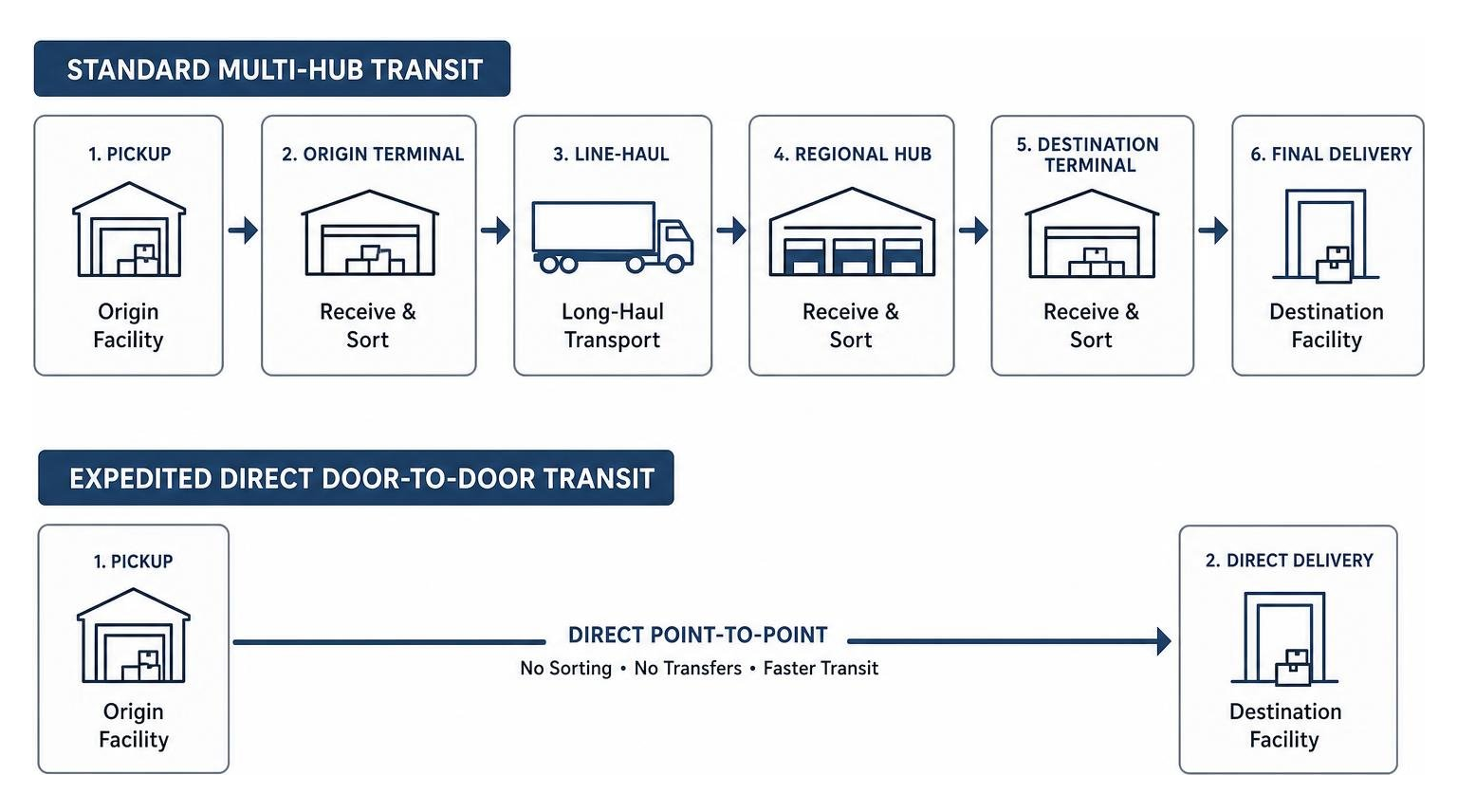
Standard ground transit relies on network efficiency through cargo consolidation. A typical standard shipment is picked up, brought to a local origin terminal, sorted, loaded onto a line-haul trailer, moved to a regional distribution hub, sorted again, and finally transferred to a last-mile delivery route. Each touchpoint introduces waiting periods, handling stages, and potential transfer delays.
In contrast, expedited shipping strips away unnecessary handling steps:
- Direct Point-to-Point Routing: Cargo moves directly from the loading dock at origin straight to the destination facility, eliminating sorting terminals.
- Minimal Handoffs: Fewer transfer points dramatically lower the potential for cargo damage, misrouting, or administrative delays.
- Dedicated Resource Allocation: Vehicles are assigned specifically to move urgent freight without waiting to build full consolidated trailer loads.
Comparing Expedited, Express, Same-Day, and Hot-Shot Services
Logistics terminology can easily overlap, creating confusion when choosing the appropriate service level for time-critical shipments. Understanding the distinct differences between expedited freight, parcel express, same-day delivery, and hot-shot shipping ensures operations leaders match the right service to their exact timeline constraints.
| Logistics Tier | Typical Delivery Window | Primary Vehicle / Mode | Ideal Freight Type | Service Level Highlights |
|---|---|---|---|---|
| Standard Freight | 3–7 Business Days | LTL / FTL Semi-Trucks | Non-urgent bulk cargo | Multi-hub consolidation, scheduled routing |
| Expedited Freight | 1–3 Business Days | Dedicated Vans / Straight Trucks | High-priority commercial cargo | Direct transit, reduced intermediate stops |
| Express Parcel | 1–2 Business Days | Parcel Air / Ground Networks | Small packages under 150 lbs | Time-definite morning or end-of-day delivery |
| Same-Day Logistics | Same Day (Within Hours) | Direct Couriers / Vans | Local emergency shipments | Immediate pickup and direct local drop-off |
| Exclusive Hot-Shot | Same Day or Next Day | Cargo Vans, Sprinters, Flatbeds | Critical industrial freight | Dedicated vehicle assigned exclusively to cargo |
Dedicated Hot-Shot Delivery vs. Standard Express Parcel
While standard express parcel networks excel at moving smaller, uniform packages through automated sorting systems, heavy industrial freight requires a different approach. Standard express services enforce strict weight and dimension limits (typically topping out around 70 to 150 pounds per package) and adhere to rigid daily pickup cutoffs.
Dedicated hot-shot delivery, on the other hand, provides exclusive-use vehicles tailored for oversized, heavy, or specialized freight. When a hot-shot load is arranged, a vehicle — such as a Sprinter van, straight truck, or flatbed — is dispatched directly to the shipper’s facility.
The cargo occupies the entire vehicle, meaning there are zero co-loaded shipments, zero intermediate hub stops, and zero unnecessary delays. For comprehensive insights into ground freight solutions, read our guide on Expedited Ground Freight Faster Shipping Solutions for Your Business Needs.
Time-Critical Same-Day and Next-Day Logistics Solutions
When timelines collapse to hours rather than days, time-critical same-day and next-day logistics services become vital. These specialized solutions rely on rapid dispatch workflows:
- Immediate Dispatch Execution: Upon order confirmation, direct pickup is scheduled without waiting for routine end-of-day carrier sweeps.
- Direct Point-to-Point Transit: The dedicated transport vehicle drives straight to the receiver facility, bypassing cross-dock facilities entirely.
- Last-Mile Execution Control: On-demand tracking and verified chain-of-custody protocols ensure recipient verification at the point of delivery.
Learn more about managing critical deadlines in our detailed analysis of Same Day Delivery Service The 2026 Guide for Logistics Managers.
Operational Mechanics of Expedited Freight Delivery
How exactly does an expedited shipment move so much faster than a standard one? The secret lies in backend operational orchestration.
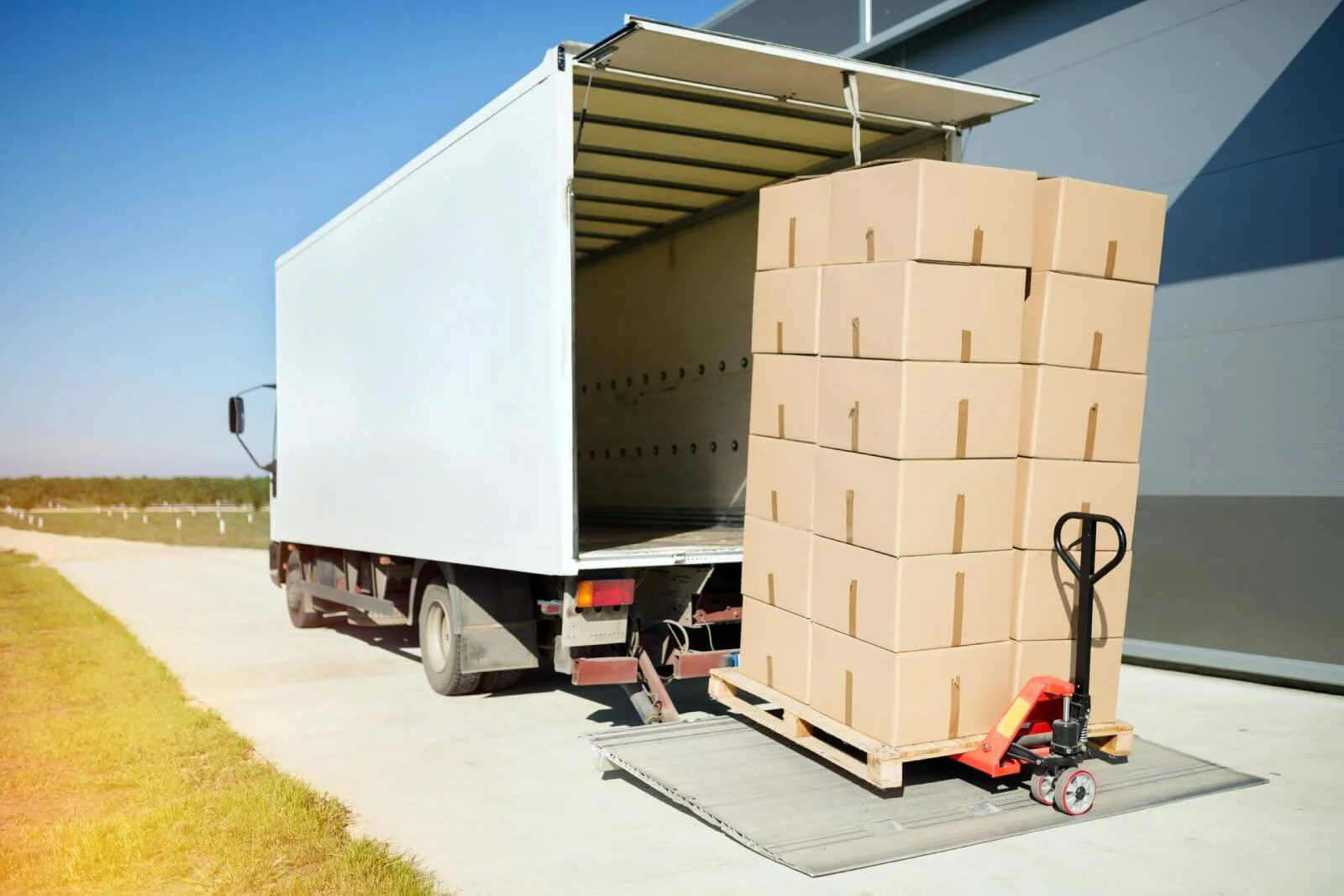
When an expedited freight order is placed, logistics coordinators immediately trigger priority handling workflows:
- Warehouse Prioritization: Dock staff stage and load the cargo ahead of routine shipping queues to align with strict departure windows.
- Vetted Carrier Matching: As a specialized freight broker with nearly 20 years of experience since our founding in 2007 by Peter Jałowiec, we tap into our vetted carrier network to locate available equipment positioned closest to the pickup location.
- Route Optimization: Dispatchers analyze traffic patterns, weather advisories, and transit corridors to chart the fastest, safest ground routes across North America.
- Continuous Transit Monitoring: Proactive tracking systems monitor progress from origin pickup straight through to final delivery, ensuring total visibility.
For additional carrier-specific timing metrics and service standards, review Detailed Carrier Service Timelines.
Specialized Handling: White Glove, Liftgate, and Two-Man Delivery
Fast transit is only valuable if cargo arrives unharmed and is handled safely at destination. Specialized cargo often requires enhanced physical handling services at delivery points:
- Liftgate Services: Essential for delivery locations lacking dedicated loading docks, allowing heavy freight to be safely lowered from trailer level to ground level.
- Two-Man Delivery Teams: Required for heavy, unwieldy, or high-value items where safe maneuverability requires coordinated manual effort.
- White Glove & Inside Delivery: Complete end-to-end handling where vetted delivery teams bring cargo directly inside the facility, unpack equipment, position it in designated work areas, and clear away packaging materials.
Key Industry Use Cases: Automotive, Medical, and Manufacturing
Different commercial sectors depend on expedited logistics to uphold operational integrity:
- Automotive: Just-In-Time (JIT) assembly lines require precise component deliveries. A delay of a single bracket or wiring harness can stall an entire plant floor.
- Medical & Pharmaceutical: Temperature-sensitive medical devices, laboratory equipment, and urgent pharmaceutical supplies require rapid transit under strict chain-of-custody controls.
- Manufacturing & Industrial: Heavy production machinery, replacement hydraulic pumps, and critical electrical components require direct transport to keep operations running smoothly.
- Lighting Fixtures & Architectural Equipment: Fragile, high-value commercial lighting assemblies intended for job site construction deadlines require specialized handling to prevent breakage and project delays.
Strategic Benefits and Risk Mitigation for Operations Leaders
Beyond pure speed, coordinating expedited freight provides strategic risk-management advantages for supply chain decision-makers.

When standard logistics channels experience disruptions — such as weather bottlenecks, driver shortages, or carrier tender rejections — having a trusted freight broker standing by ensures seamless operational continuity.
Preventing Critical Downtime and Missed Deadlines
In commercial operations, time directly impacts operational continuity. A missed delivery deadline can result in contract penalties, idle labor forces, or lost client trust.
By leveraging dedicated hot-shot and expedited ground freight, operations managers can rapidly resolve supply chain exceptions. When a primary carrier drops a tender or delays a routine shipment, coordinating emergency dispatch through a vetted carrier network immediately restores project timelines and preserves strict Service Level Agreements (SLAs).
Enhancing Cargo Security and Reducing Handoff Risks
Cargo damage and loss occur most frequently during intermediate handling stages — such as forklifts transferring pallets across busy cross-dock terminals.
Because expedited ground freight emphasizes direct transport with minimal handling, the risk of cargo damage is dramatically reduced. Cargo is loaded at the origin dock, secured in place, and remains untouched until the vehicle arrives at the destination dock. This minimal-touch workflow provides maximum security for high-value, sensitive, or fragile commercial shipments.
Frequently Asked Questions About Expedited Shipping
How fast is expedited ground freight compared to standard shipping?
Standard ground shipping typically requires 3 to 7 business days, relying on consolidated LTL networks that route packages through multiple regional sorting terminals. Expedited ground freight compresses transit times down to 1 to 3 business days — or even same-day for regional hot-shot deliveries — by using direct point-to-point routing and dedicated vehicles without intermediate terminal stops.
What happens when a primary carrier fails an urgent delivery?
When a primary carrier fails to show up, drops a tender, or delays a critical shipment, an experienced freight broker steps in to provide recovery dispatch. By tapping into a nationwide network of pre-vetted carriers, a broker can quickly assign an exclusive hot-shot vehicle or dedicated sprinter van to pick up the stranded cargo and drive it straight to its final destination.
What types of freight require dedicated expedited handling?
Dedicated expedited handling is ideal for time-sensitive, high-value, fragile, or oversized commercial cargo. Key examples include critical automotive assembly line parts, medical devices, emergency manufacturing replacement machinery, architectural lighting assemblies, and sensitive industrial control components that cannot tolerate multiple terminal handoffs.
Conclusion: Securing Reliable Expedited Shipping Solutions
Understanding what does expedited shipping mean empowers supply chain and operations leaders to make confident logistics decisions when timelines are under pressure. Far more than a generic fast option, expedited freight is a targeted operational strategy built on priority handling, direct transit, and uncompromised execution.
At Pro Express, Inc., we have spent nearly 20 years building a reputation as a trusted nationwide freight broker specializing in expedited ground shipping — including same-day, next-day, and exclusive hot-shot deliveries across the United States and North America. Founded in 2007 by Peter Jałowiec, our company connects businesses with a rigorously vetted carrier network designed to move urgent, time-sensitive cargo fast and safely.
Whether your shipment calls for Exclusive Hot Shots, White Glove service, Liftgate capability, Two-Man handling, or Inside Delivery, our team has coordinated over 10,000 shipments with a 99% client satisfaction rate. When your primary carrier fails or an urgent production deadline is at risk, you can rely on our expertise to keep your business moving forward.
Ready to secure fast, reliable delivery for your urgent freight? Request Freight Brokerage Services from Pro Express Inc. today and discover how our dedicated carrier network can protect your supply chain operations.