
How to Find the Right 3PL Provider in the United States
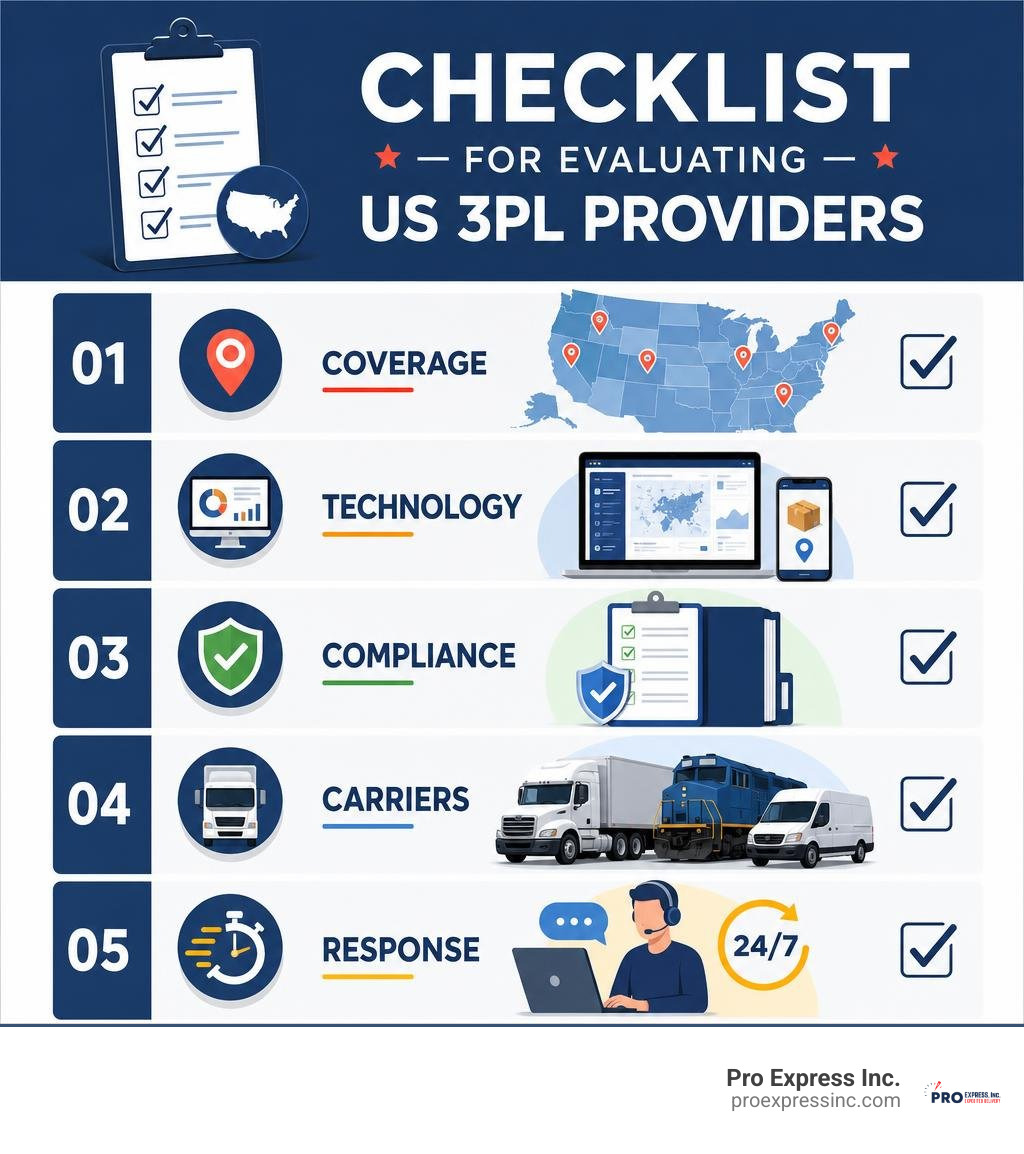
A strong 3PL United States partner should match your freight and fulfillment needs with the right warehouse locations, technology, compliance capabilities, and dependable carrier capacity. Start by checking whether the provider can support your shipment type, service level, geographic reach, and required response time – especially when a missed pickup or failed carrier puts a B2B deadline at risk.
For urgent freight, look beyond warehouse space and national coverage. Confirm that the provider or freight broker can coordinate expedited service through a vetted carrier network, provide clear shipment visibility, and respond quickly when exceptions happen.
The U.S. is the world’s largest 3PL market, with more than 2,600 providers listed across all 50 states. That gives manufacturers, distributors, and medical suppliers many choices – and makes careful evaluation essential.
At Pro Express Inc., we bring nearly 20 years of freight-brokerage experience to critical shipments. We arrange and coordinate delivery through vetted carriers when regular transportation plans fail and reliable execution matters most.
3pl united states terms made easy:
Core Services Offered by a 3PL United States Partner
Third-party logistics providers serve as the backbone of domestic commerce, managing the end-to-end movement, storage, and fulfillment of goods. The scale of this sector is immense: according to A&A’s Top 50 US Third-Party Logistics Providers (3PLs) List, the top 10 U.S.-based logistics entities generated over $257 billion in gross logistics revenue in 2025.
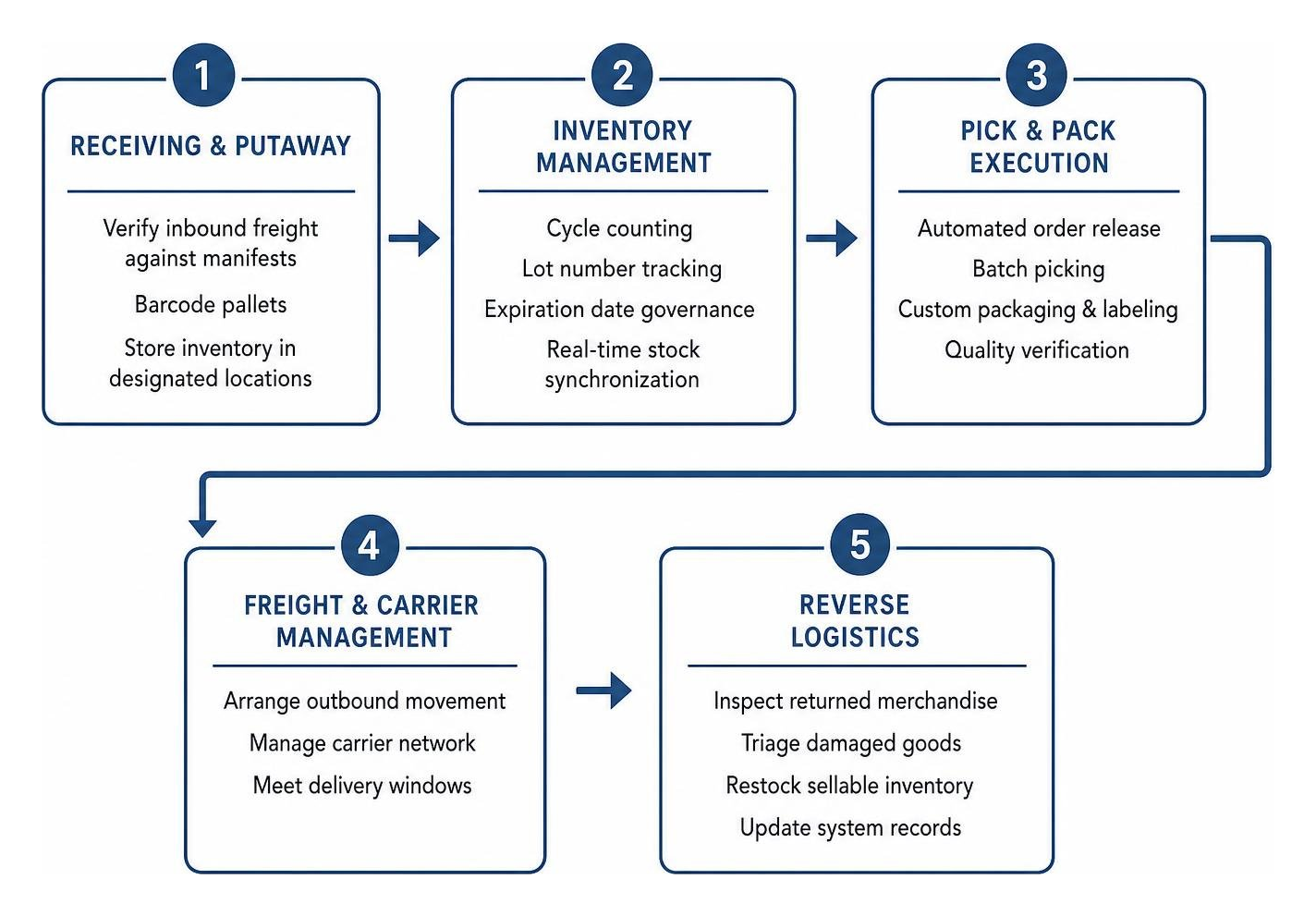
To keep supply chains moving seamlessly, an integrated Logistics Service handles multiple critical touchpoints under a unified strategy:
- Receiving and Putaway: Verifying inbound freight against manifests, barcoding pallets, and transferring inventory to designated storage bins.
- Inventory Management: Continuous cycle counting, lot number tracking, expiration date governance, and real-time stock synchronization.
- Pick and Pack Execution: Automated order release, batch picking, custom packaging, labeling, and quality verification.
- Freight and Carrier Management: Arranging outbound movement through a dependable Transportation Service to meet tight delivery windows.
- Reverse Logistics: Inspecting returned merchandise, triaging damaged goods, restocking sellable inventory, and updating system records immediately.
Warehousing, Distribution, and Inventory Control
Modern distribution centers are precision engines designed to maximize SKU velocity. High-performing facilities maintain strict dock-to-stock timelines—often within 24 to 48 hours—ensuring that inventory is checked, scanned, and made available for order release without operational stalls.
For high-turnover operations, cross-docking allows inbound shipments to be unloaded, sorted, and reloaded onto outbound line-hauls with minimal storage time. When paired with high-capacity pallet racking and specialized climate-controlled zones, a versatile Freight Service ensures sensitive materials—from delicate electronics to temperature-critical pharmaceuticals—remain intact throughout the storage lifecycle.
Specialized Transportation and Expedited Solutions in 3PL United States Networks
Standard distribution models often struggle when unexpected disruptions strike, such as assembly line halts, urgent hospital equipment requirements, or high-stakes retail rollouts. In these scenarios, businesses require dedicated, time-critical transportation capabilities.

When standard transit schedules fail to meet firm operational deadlines, enterprise shippers depend on high-touch transportation options:
- Urgent Manufacturing Shipments: Supporting B2B Shipping For Manufacturers Distributors to prevent severe factory downtime and ensure uninterrupted assembly lines.
- Time-Critical Ground Transit: Coordinating dedicated Expedited Ground Shipping to bypass intermediate terminals and ship directly from dock to facility.
- Delicate Handling & Final Placement: Arranging premium White Glove Services for sensitive equipment, including inside delivery, uncrating, room-of-choice positioning, and complete packaging debris removal.
- Direct Urgent Dispatch: Coordinating Exclusive Hot Shots where a dedicated vehicle is dispatched exclusively for your high-priority shipment to support on-time arrival.
Key Evaluation Criteria for Selecting American Logistics Providers
Selecting a logistics partner requires looking beyond surface-level facility footprints. A partner’s true value lies in execution reliability, operational discipline, and communication during critical exceptions. Understanding Why Selecting The Right Freight Company Defines Your Success is essential when vetting providers across platforms like Find a 3PL in the United States — Warehousing & Fulfillment.
When assessing candidate facilities and freight coordinators, evaluate these operational benchmarks:
- Carrier Network Vetting: The rigor applied to carrier screening, including active operating authority verification, safety ratings, cargo insurance minimums, and historical on-time performance.
- Order Accuracy and SLA Commitments: Track record for dock-to-stock turnaround, pick-and-pack precision (targeting 99.8%+ accuracy), and same-day shipping cutoffs (typically 1:00 PM to 5:00 PM local facility time).
- Exception Management and Live Support: Direct access to experienced dispatch teams capable of resolving shipment delays, damaged freight claims, or unexpected reroutes immediately.
- Capacity Scalability: The operational flexibility to handle massive peak volume surges without sacrificing accuracy or delivery speed.
Technology Stack and Omnichannel System Integrations
An enterprise logistics network must be supported by an integrated software ecosystem. Modern supply chains rely on Warehouse Management Systems (WMS) and Transportation Management Systems (TMS) that communicate seamlessly with enterprise resource planning (ERP) platforms and digital marketplaces.
Critical technical capabilities to confirm include:
- Automated EDI & RESTful APIs: Instant, two-way data exchange for purchase orders, advance shipping notices (ASNs), shipment status updates, and inventory levels.
- Real-Time Inventory Visibility: Live visibility into cycle counts, allocated stock, safety stock levels, and order stages across every storage node.
- Dynamic Order Routing: Smart logic that routes incoming orders to the optimal fulfillment facility based on stock availability and geographic proximity to the destination.
- High-Touch Coordination: Seamless handoffs for complex E Commerce Fulfillment Last Mile Shipping workflows requiring strict barcode verification.
Strategic Multi-Node Fulfillment and Transit Speed
Relying on a single centralized warehouse often leaves coastal markets subject to extended transit times. By distributing inventory across a multi-node network—combining bi-coastal facilities with central hubs—enterprises can reach the vast majority of the population via rapid ground transit.
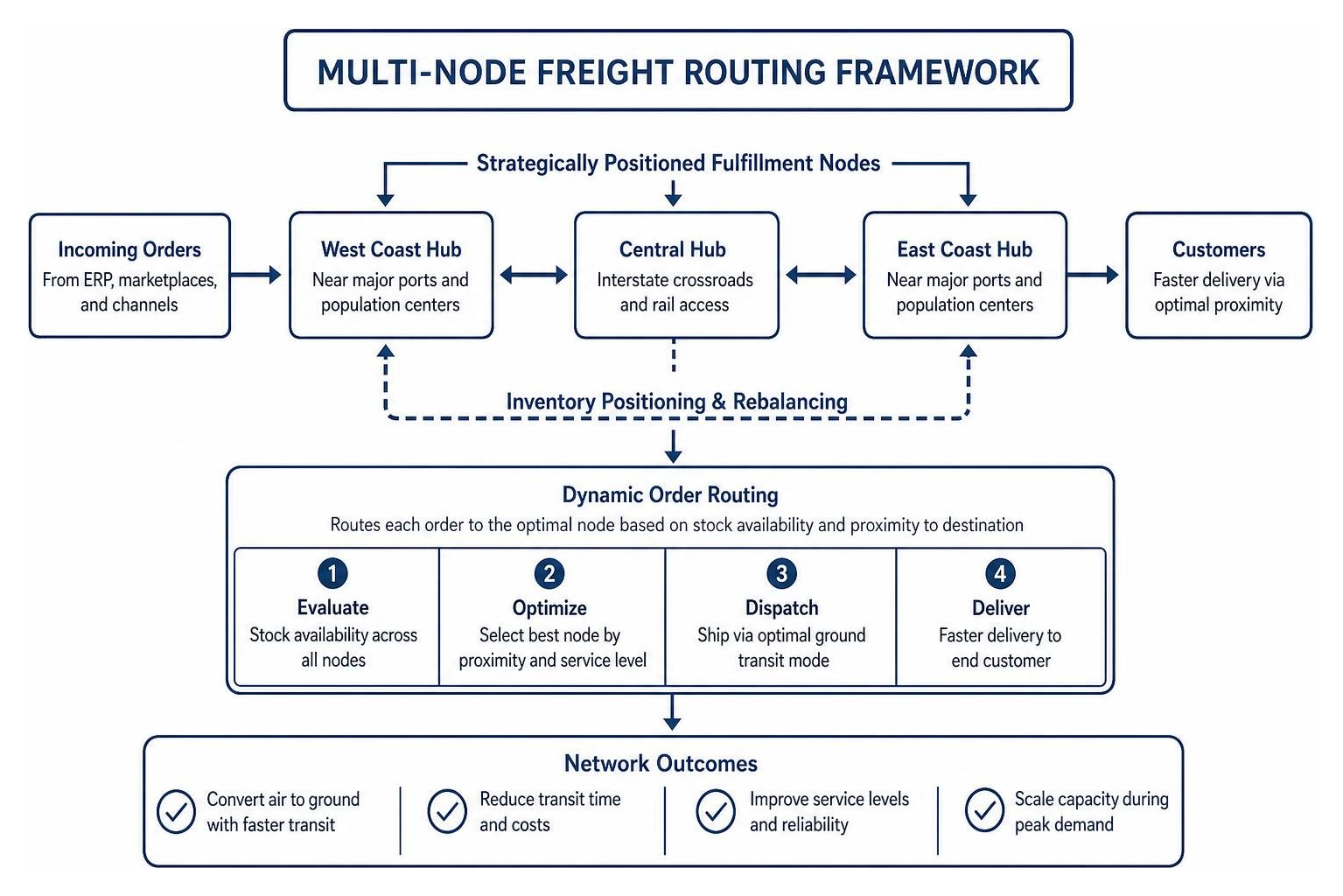
Strategically positioned inventory enables shippers to convert multi-day air shipments into standard surface transit, coordinating with The Complete Guide To FTL Ground Freight Delivery Services to reposition full truckloads between regional hubs efficiently.
Major Strategic Logistics Hubs Across the Nation
The efficiency of a nationwide distribution network depends heavily on geographic placement. Logistics hubs develop around critical infrastructure, including major container ports, extensive rail intermodal ramps, interstate crossroads, and cargo airport hubs.

Navigating Compliance Capabilities in 3PL United States Operations
For organizations sourcing international components or finished goods, port-adjacent logistics hubs provide vital import support. Containerized cargo entering gateway terminals like the Port of Los Angeles, Long Beach, New York/New Jersey, or Savannah requires rapid drayage and prompt clearance coordination by the importer’s licensed customs broker to avoid operational demurrage and detention delays.
Key compliance capabilities to evaluate in a 3PL include:
- Licensed Customs Brokerage: For importers working with specialized 3PLs, Automated Commercial Environment (ACE) portal integration, accurate Harmonized Tariff Schedule (HTS) classifications, and Importer Security Filings (ISF).
- Foreign Trade Zone (FTZ) Utilization: Storing and processing imported cargo within FTZ-designated facilities to manage compliance requirements until goods enter domestic commerce.
- Domestic Ground Freight: Managing inland freight moving between ports, distribution centers, and end customers across the contiguous United States.
- Clear Chain-of-Custody Tracking: Streamlining documentation by Finding A US Based Freight Forwarder Without The Logistics Headache who understands port transloading and domestic line-haul connections.
Avoiding Critical Pitfalls in Enterprise Logistics Partnerships
Outsourcing fulfillment and transportation introduces operational interdependencies. Recognizing and mitigating common supply chain pitfalls early protects delivery execution and brand reputation.
Watch out for these frequent operational oversights:
- Vague Service Level Agreements (SLAs): Contracts that fail to define specific dock-to-stock timelines, cut-off hours, order accuracy minimums, and non-performance penalties.
- Mismanaged Inventory Visibility: Lack of real-time cycle counting leading to ghost inventory, unexpected stockouts, and delayed backorder fulfillment.
- Rigid Carrier Routing Rules: Over-reliance on a single carrier model that fails when capacity tightens or severe weather disrupts regional hubs.
- Inadequate Emergency Protocols: Absence of clear escalation pathways when critical freight must be arranged immediately outside of standard shipping windows.
- Unvetted Freight Brokerage Sourcing: Partnering with intermediaries that lack strict safety standards, insurance verification, and carrier screening. Refer to Broker Me This How To Choose The Best Freight Brokerage Companies In USA to establish rigorous vetting criteria.
Frequently Asked Questions About US Third-Party Logistics
How does inventory storage in a 3PL affect sales tax nexus across states?
Storing physical inventory inside a third-party logistics warehouse establishes a “physical nexus” in that state. Under U.S. state tax laws, having tangible property (such as inventory held for sale) within state borders obligates your business to register for a sales tax permit, collect sales tax on taxable transactions delivered to customers in that state, and remit those taxes accordingly.
When adopting a multi-node fulfillment strategy across states like California, Texas, Illinois, and New Jersey, you must track stock movements and maintain compliance with each state’s tax department.
What is the delivery speed difference between single-hub and multi-node fulfillment?
A single, centrally located warehouse (such as in Indianapolis or Columbus) can reach roughly 60% to 70% of the continental U.S. population within 2 to 3 days via standard ground transport. However, reaching opposite coasts from a single hub often requires 4 to 5 transit days.
By contrast, a distributed two-node or three-node model (such as pairing Southern California, Texas, and Pennsylvania) enables 1-to-2-day ground delivery coverage for over 90% to 95% of the population, reducing reliance on dedicated air services.
When should a growing enterprise transition to specialized freight brokerage?
Enterprises should transition to specialized freight brokerage when shipping volumes exceed standard parcel capabilities, when critical freight deadlines cannot risk regular network delays, or when high-value goods require specialized handling like liftgate or two-man teams.
Understanding What Is A Freight Broker The 2026 Guide helps clarify how an experienced broker acts as an agile logistics partner, coordinating dedicated capacity through a thoroughly vetted carrier network to resolve complex freight challenges.
Conclusion
Building an efficient, resilient logistics operation requires aligning your storage nodes, technology integrations, and carrier networks with experienced execution. While traditional third-party warehousing provides the physical framework for inventory management, the true test of your supply chain occurs when unexpected disruptions, tight delivery windows, or high-value shipments require immediate, coordinated action.
Founded in 2007 by Peter Jałowiec, Pro Express, Inc. brings nearly 20 years of specialized freight-brokerage experience to critical, time-sensitive freight. We arrange and coordinate expedited ground transportation nationwide through our rigorously vetted carrier network, specializing in exclusive hot shots, white glove handling, liftgate service, two-man delivery, and inside placement.
When standard shipping networks encounter delays and critical business deadlines are on the line, our experienced dispatch team coordinates the reliable capacity your business needs. Explore our comprehensive freight coordination Services to keep your critical supply chain operations moving without delay.