
Find an Emergency Backup Freight Carrier Before the Deadline Slips
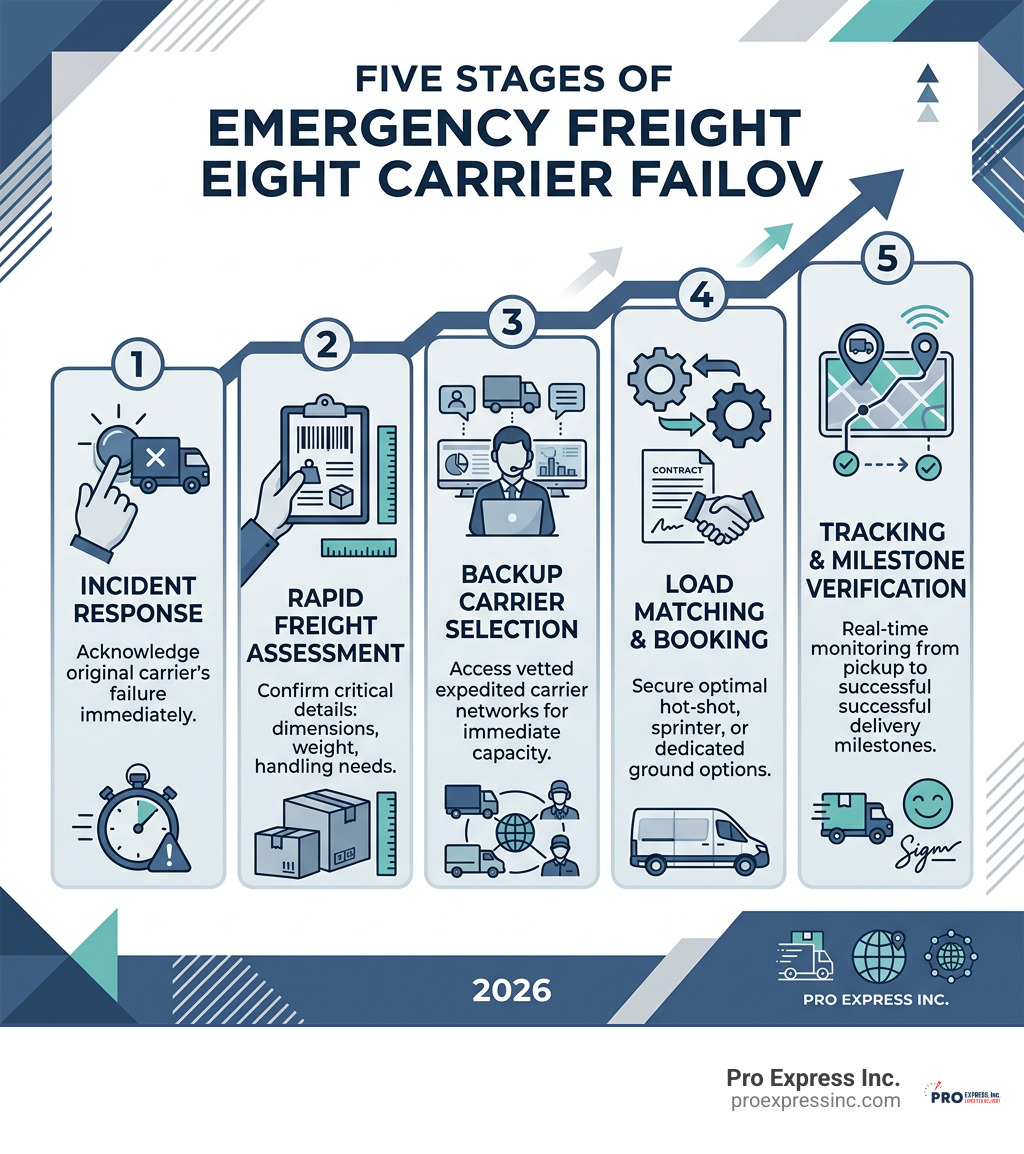
When a regular carrier fails, act fast: confirm the shipment details, set the latest acceptable delivery time, and contact a freight broker with access to a vetted expedited carrier network. Carrier failure backup experts can quickly match the load to available hot-shot, sprinter, or dedicated ground capacity, then verify pickup, tracking, handling needs, and delivery milestones.
A useful emergency request includes:
- Pickup and delivery locations, plus the exact ready time.
- Freight weight, dimensions, pallet count, and handling requirements.
- The deadline that protects your customer, production line, or patient-care operation.
- Any special needs, such as liftgate service, temperature control, secure handling, or two-person delivery.
A contact list alone is not a recovery plan. During a regional disruption, capacity can disappear quickly, and a backup carrier may face the same route, weather, or availability problem as the original provider.
For nearly 20 years, Pro Express Inc. has helped businesses coordinate urgent delivery through a vetted carrier network when regular transportation plans break down. The goal is simple: establish a workable recovery path, keep stakeholders informed, and move critical freight with verified milestones.
Carrier failure backup experts helpful reading:
- FTL Ground Freight Delivery
- Same Day Delivery Freight Carriers
- Fragile Freight Transport Specialists
The Hidden Points of Failure in Urgent Ground Logistics
Supply chains are delicate networks where a single broken link can stop manufacturing plants, delay clinical trials, or leave retail shelves bare. The primary vulnerability in modern ground logistics is single-carrier dependency. When an organization relies on one primary carrier without an active, tested failover plan, any disruption creates immediate operational gridlock.
Logistics disruptions stem from several primary vulnerabilities:
- Mechanical Equipment Breakdowns: Engine failures, reefer malfunctions, and blown tires frequently strand critical freight mid-transit.
- Capacity Bottlenecks: Unexpected freight volume surges exhaust regional fleets during peak quarters.
- Driver Shortages and Hours of Service (HOS) Exhaustion: Stricter compliance rules limit driver availability when unexpected delays happen.
- Severe Weather and Infrastructure Blockages: Flooding, ice storms, and road closures can block major transit corridors.
- Terminal and Yard Congestion: Freight can sit untouched inside congested transfer facilities when cross-dock workers face backlogs.
Government agencies and modern supply chain leaders recognize that relying on a single network is an unacceptable operational risk. In fact, many agencies should add carrier and network redundancy to disaster recovery planning to avoid total operational paralysis when primary logistics providers stumble.
| Failure Category | Single-Carrier Vulnerability | Diversified Broker Network Failover |
|---|---|---|
| Mechanical Breakdown | Load stays stranded until the carrier sends a replacement unit | Immediate cross-docking and dispatch via a secondary vetted carrier |
| Regional Weather Events | Carrier routes through single local terminals that may be closed | Immediate rerouting via alternate transit lanes and hubs |
| Surge Capacity Deficits | Freight is delayed due to fixed fleet size constraints | On-demand access to thousands of independent freight providers |
| Visibility Loss | Manual phone updates with delayed incident escalation | Continuous GPS tracking with automated milestone checkpoints |
Critical Vulnerabilities in Primary Freight Routing
The most damaging failures occur on isolated freight lanes where primary carriers lack local terminal density. When a load stalls on an unmonitored lane, missing tracking visibility leaves logistics managers in the dark for hours.
Unvetted sub-haulers represent another hidden risk. When primary carriers overextend their capacity, they may broker loads to secondary drivers without verifying compliance, insurance minimums, or safety records. By beating the clock with expert time-sensitive shipments, professional freight brokers eliminate these blind spots through rigorous carrier vetting, proactive milestone management, and dedicated capacity matching.
The Difference Between a Contact List and an Actionable Recovery Plan
Many logistics teams rely on a spreadsheet of emergency phone numbers as their contingency plan. However, a static contact list is merely a collection of names, not an actionable failover strategy.
An actionable freight recovery plan requires:
- Real-Time Capacity Verification: Live visibility into available equipment rather than calling numbers sequentially during an emergency.
- Standardized Response Times: Established benchmarks that require replacement carriers to accept and dispatch within minutes.
- Documented Standard Operating Procedures (SOPs): Clear runbooks specifying who authorizes expedited movement, confirms freight specifications, and monitors recovery milestones.
- Pre-Audited Compliance: Carrier safety records, active operating authority, and adequate cargo insurance verified before disruptions occur.
Why Partnering with Carrier Failure Backup Experts Protects Critical Supply Chains
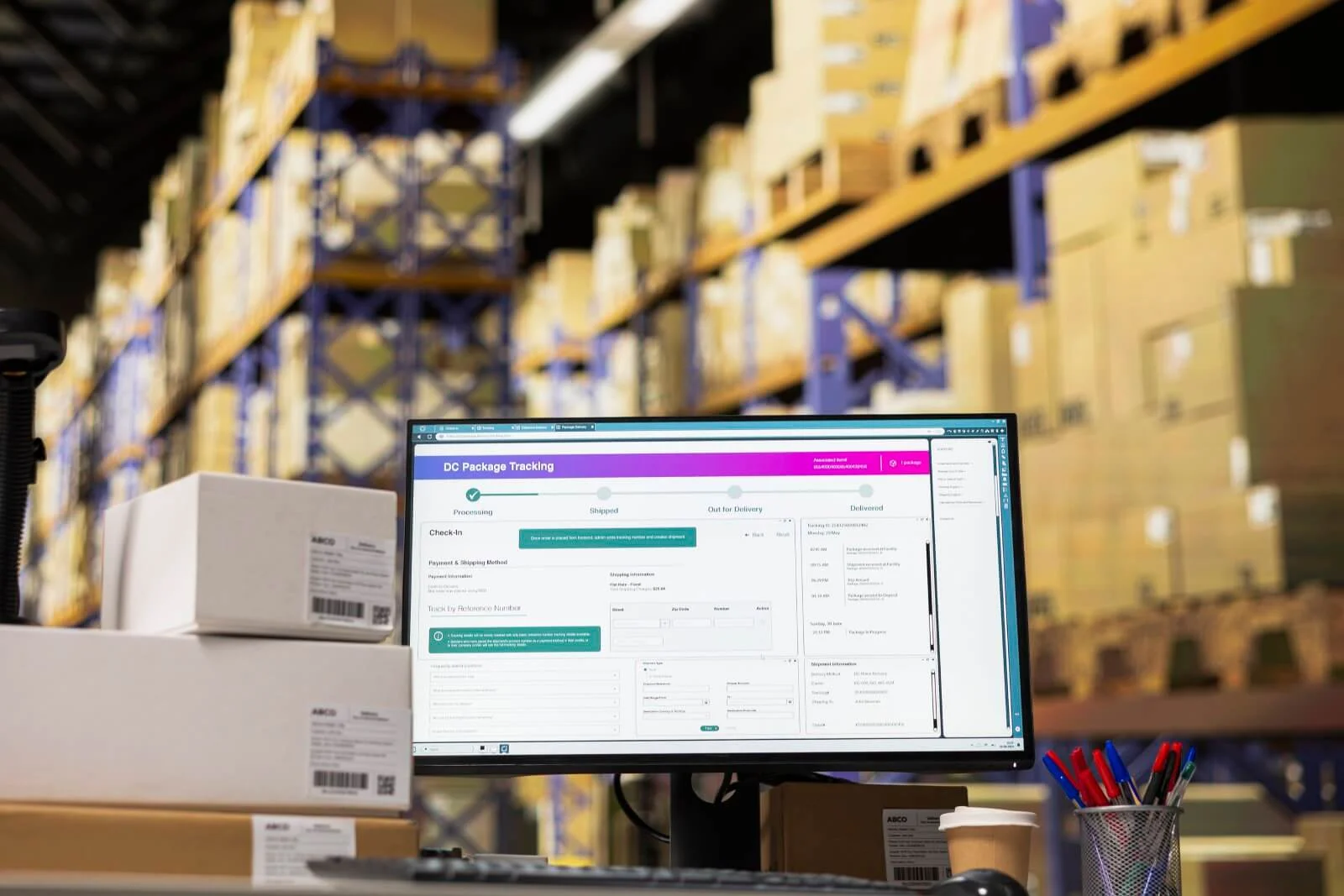
When an urgent load goes off track, freight brokers step in to manage the recovery process. Professional freight brokers maintain continuous oversight across thousands of vetted independent carriers, providing immediate access to specialized equipment and dedicated lanes across the contiguous United States.
By choosing the best expedited freight companies for your business, you replace single points of failure with a resilient logistics network ready to step in whenever primary carriers fail.
Insights from Carrier Failure Backup Experts on Rapid Freight Recovery
Specialized freight brokers prevent severe operational downtime through rapid carrier reassignment. In high-stakes manufacturing environments, an automotive assembly line stoppage can cause significant operational disruption within hours.
When a standard LTL carrier misses a scheduled pickup or breaks down en route, freight brokers arrange dedicated hot-shot or sprinter van transport to intercept and rescue the freight. Our team arranges same-day delivery service to maintain delivery windows for automotive components, medical supplies, and precision industrial machinery.
Key Questions Carrier Failure Backup Experts Ask During a Disruption
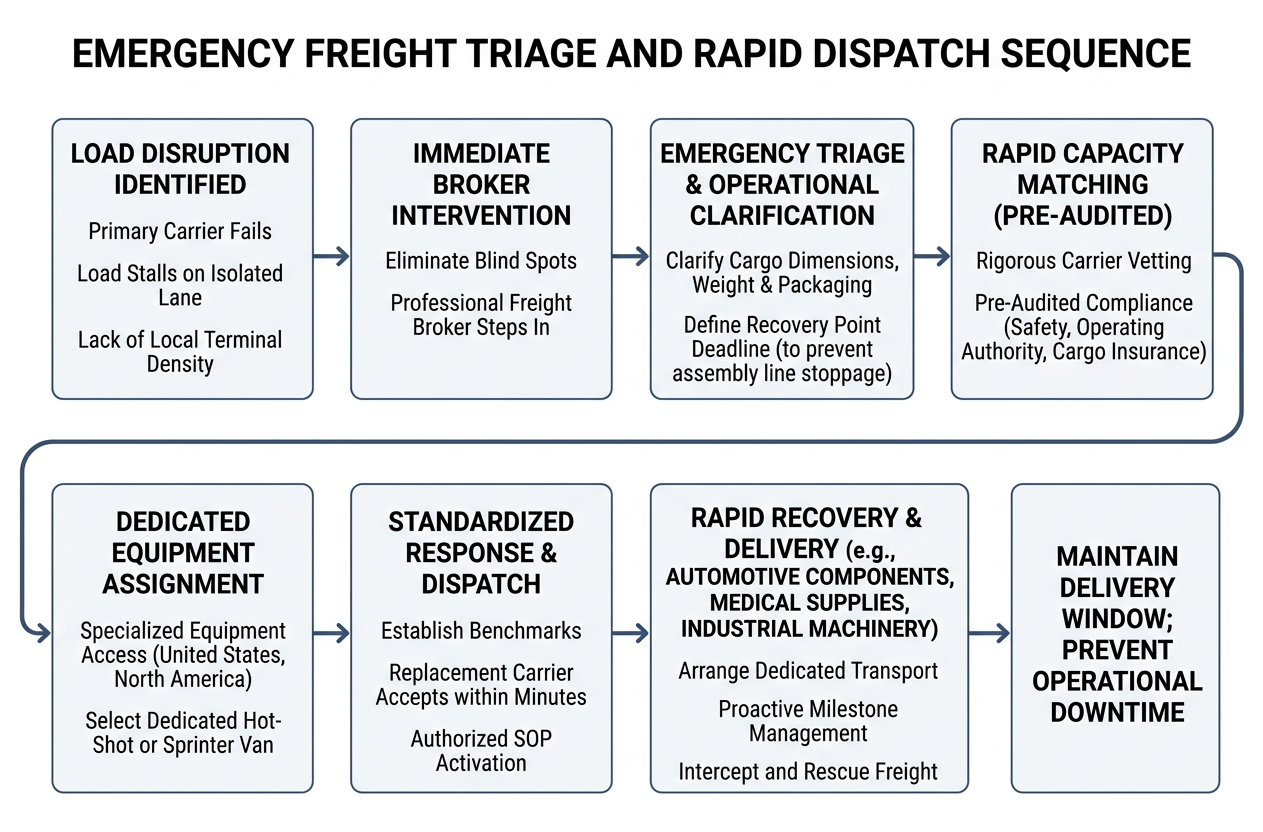
When coordinating an emergency freight intervention, brokers clarify operational details to ensure the recovery vehicle matches the cargo’s exact needs:
- What are the precise cargo dimensions, weights, and packaging types? Verifying whether the freight is crated, palletized, or loose prevents equipment mismatches.
- What is the firm Recovery Point Deadline? Defining the exact minute the shipment must arrive to prevent assembly line stoppages or cancelled medical procedures.
- Are specialized accessorials required? Confirming requirements for liftgate equipment, pallet jacks, inside delivery, or two-person handling teams.
- What are the physical facility constraints at both ends? Checking for low loading docks, residential zoning restrictions, or construction sites lacking standard freight bays.
Step-by-Step Strategy to Secure Emergency Backup Freight Solutions

When standard transit plans fail, having a structured recovery process helps supply chain managers secure alternative transportation without delay. Partnering with professional freight broker services for urgent B2B shipping gives businesses the structure and carrier access needed to maintain logistics continuity.
Step 1: Establish Strict Recovery Time Objectives (RTO) for Freight
Borrowing a core principle from enterprise disaster recovery, businesses must establish clear Recovery Time Objectives (RTO) for physical shipments. Your logistics RTO is the maximum allowable window between a carrier failure and when a backup transport option takes control of the load.
To set effective logistics recovery benchmarks:
- Quantify Production Downtime Tolerances: Calculate the exact hourly financial and operational impact of missing components.
- Define Time-to-Dispatch Targets: Establish internal rules requiring emergency freight broker dispatch within 15 to 30 minutes of a missed primary pickup.
- Create an Escalation Roster: Ensure plant managers, shipping clerks, and procurement leads have direct authorization to initiate backup carrier brokerage without bureaucratic delays.
Step 2: Ensure True Carrier and Route Diversity
True logistics resilience requires path diversity. If your primary freight provider and your backup plan rely on the same regional terminals or carrier alliances, both will fail when a regional disruption strikes.
Carrier failure backup experts design redundant freight strategies by:
- Separating Carrier Modes: Pairing traditional Less-Than-Truckload (LTL) linehauls with dedicated point-to-point hot-shot capacity.
- Bypassing Congested Hubs: Routing urgent shipments directly between pickup and delivery locations via dedicated sprinters rather than hub-and-spoke sorting centers.
- Accessing Multi-Carrier Networks: Leveraging a freight brokerage that coordinates across thousands of independent owner-operators and small fleets nationwide.
Step 3: Integrate 24/7 Tracking and Real-Time Milestone Verification
A recovery plan is only as reliable as its visibility tools. Once an emergency load is in transit, automated tracking systems must provide real-time updates from pickup to final delivery.
Essential tracking protocols include:
- Live GPS Geofencing: Automated notifications when the transport vehicle arrives at, departs from, and reaches key checkpoints along the route.
- Proactive Exception Management: Continuous route monitoring to spot weather delays, road closures, or mechanical anomalies before they affect the final deadline.
- Direct Digital Proof of Delivery (POD): Instant confirmation with timestamped signatures and delivery photos provided upon drop-off.
Frequently Asked Questions About Carrier Failure Solutions
How quickly can an emergency backup carrier be dispatched after a primary failure?
When coordinated through an experienced freight broker, emergency backup vehicles—such as dedicated sprinter vans, straight trucks, or hot-shot flatbeds—can often be dispatched within 15 to 45 minutes of load confirmation. Brokers tap into real-time capacity networks nationwide, identifying available drivers positioned near the stranded freight to minimize recovery delays.
What specialized handling options exist for urgent cargo recovery?
Emergency freight brokerages arrange a comprehensive suite of specialized accessorial services to accommodate sensitive cargo:
- White Glove Service: Complete unpackaging, careful indoor placement, and debris removal for high-value industrial or medical machinery.
- Liftgate and Pallet Jack Equipment: Essential for delivery locations lacking dedicated loading docks.
- Two-Man Delivery Teams: Required for heavy, oversized cargo or continuous, non-stop transit runs over long distances.
- Inside Delivery: Safe transport of delicate electronics or lighting fixtures directly into office suites, hospitals, or manufacturing facilities.
Why do DIY backup carrier lists fail during severe regional disruptions?
Static internal contact lists fail during regional crises because local capacity saturates quickly. Independent carriers on a standard contact sheet may already be fully booked, facing driver hour restrictions, or contending with the same regional delays affecting your primary carrier. A freight brokerage bypasses these limits by coordinating across a wide, nationwide network of pre-vetted carriers to locate available, compliant equipment instantly.
Conclusion
Operational resilience is defined by how effectively an organization responds when primary logistics fail. Relying on single-carrier relationships or unvetted backup lists leaves supply chains vulnerable to mechanical breakdowns, severe weather disruptions, and capacity bottlenecks.
Working with experienced freight brokers gives your business the agility, visibility, and network reach needed to resolve shipping emergencies swiftly. With nearly 20 years of freight brokerage experience, Pro Express Inc. has coordinated more than 10,000 successful shipments across the contiguous United States.
Founded in 2007 by Peter Jałowiec, we broker expedited ground freight solutions through a rigorously vetted carrier network, maintaining a 99% client satisfaction rate across the automotive, medical, manufacturing, and commercial lighting sectors. When critical deadlines are on the line and your primary transportation fails, rely on our specialized freight brokerage services to secure reliable, dedicated transport and keep your operations moving forward.