
When Every Hour Counts: What You Need to Know About Next Day Delivery
Next day delivery is possible — but in B2B freight, the real question isn’t just about speed. It’s about which service gets your critical cargo there on time, intact, and with full visibility.
Here are the fastest ways to get next-day freight delivery in the US:
| Service Type | Best For | Transit Time |
|---|---|---|
| Dedicated ground (under 1,000 miles) | Heavy freight, urgent parts | Next business day |
| Expedited air freight (over 1,000 miles) | Long-haul, time-critical loads | Next business day |
| Sprinter van / hot-shot | Smaller urgent loads | Same day or next day |
| Straight truck (dedicated) | Mid-size freight, no transfers | Next business day |
For logistics managers, a missed delivery isn’t just an inconvenience — it can shut down an assembly line, delay a project, or damage a client relationship.
Standard carriers often fall short when deadlines are tight. Hub-and-spoke networks, shared loads, and rigid cut-off times are built for volume, not urgency.
That’s where expedited freight specialists change the equation. Dedicated vehicles, direct routing, and 24/7 dispatch support mean your shipment doesn’t wait in a queue — it moves the moment it’s ready.
Pro Express Inc. has been solving exactly these problems for nearly 20 years, with more than 10,000 shipments delivered and a 99% client satisfaction rate across the US.
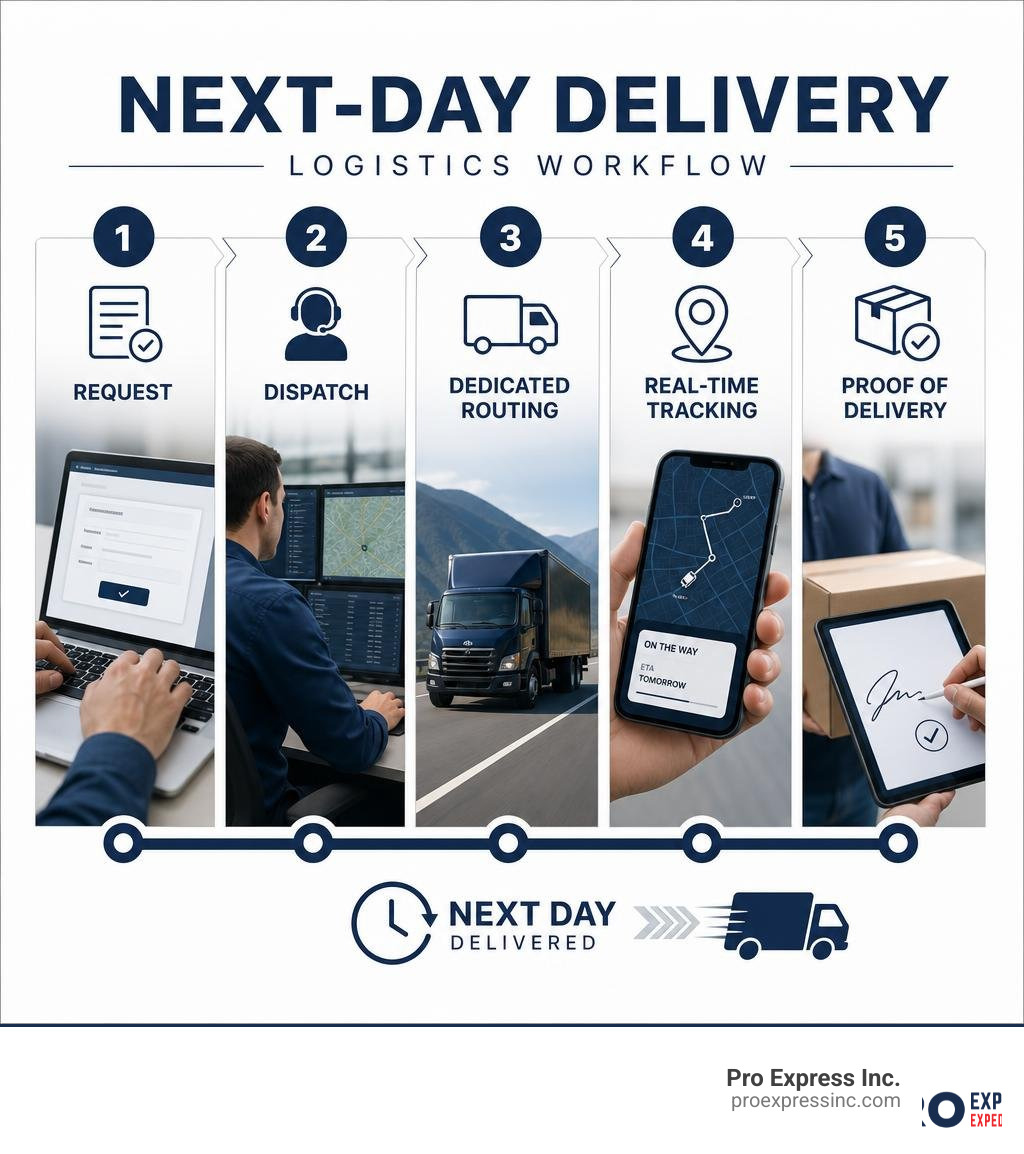
Basic next day delivery vocab:
The Mechanics of Next-Day Delivery in B2B Logistics

Understanding how next-day freight moves across North America requires looking past standard carrier operations. In traditional freight networks, a shipment is picked up, taken to a local service center, sorted, loaded onto a line-haul trailer, sent to a regional hub, sorted again, and finally dispatched for delivery. This hub-and-spoke model is highly efficient for non-urgent shipments, but it introduces multiple points of failure and significant transit delays.
In high-urgency B2B logistics, the mechanics of achieving next day delivery rely heavily on bypassing these congested transfer points altogether. True expedited shipping uses point-to-point routing. When a shipment is booked, a dedicated vehicle is dispatched directly to the shipper’s dock. The cargo is loaded, secured, and driven straight to the destination without any intermediate hub transfers.
To master this process, logistics professionals rely on foundational frameworks. You can read more about these operational basics in our comprehensive overview of Next Day Delivery 101.
By eliminating the terminal handling steps, the risk of cargo damage drops to near zero, and transit times are cut in half. This direct-routing methodology is supported by three core pillars:
- Intelligent Route Optimization: Utilizing advanced mapping and real-time traffic data to avoid active construction zones, weather disruptions, and metropolitan congestion.
- Carrier Network Integration: Relying on a vast, vetted fleet of sprinter vans, straight trucks, and team-driver dry vans positioned strategically across major US shipping corridors.
- Dedicated Dispatch Operations: Ensuring that once a load is in transit, it is monitored continuously by a professional dispatch team capable of making real-time adjustments.
Streamlining Operations with Next-Day Delivery
For modern manufacturing and distribution facilities, inventory management strategies have shifted from “just-in-case” stockpiling to just-in-time (JIT) replenishment. While JIT operations significantly reduce onsite storage requirements, they also leave businesses highly vulnerable to supply chain disruptions. A single missing component can halt an entire assembly line, creating idle labor, missed production targets, and delayed order fulfillment.
Integrating reliable next-day logistics into your operational planning acts as a critical safety net. When an unexpected inventory shortage occurs, having an expedited partner ready to move parts overnight keeps production schedules on track. To discover how businesses successfully manage these high-pressure scenarios, consult Next Day Shipping: A Guide for People Who Needed It Yesterday.
Beyond emergency mitigation, consistent next-day transit capabilities allow operations managers to streamline their daily workflows. Instead of holding buffer stock for critical operations, businesses can confidently coordinate shipments to arrive exactly when they are needed on the factory floor, maximizing floor space and improving overall operational efficiency.
Maximizing Efficiency with Next-Day Delivery Networks
Achieving maximum efficiency in overnight transit requires a highly coordinated network of regional hubs, direct-routing protocols, and flexible fleet capacities. For shipments traveling under 1,000 miles, ground-expedited transportation is often the fastest and most reliable option. Ground transport eliminates the airport transfer bottlenecks, TSA screening delays, and weather-related flight groundings that can plague air freight.
To make ground expedited work at this scale, logistics partners must possess deep fleet capacity, including sprinter vans for palletized freight, straight trucks for mid-sized loads, and full-sized dry vans for high-volume shipments. For a detailed breakdown of how ground networks outperform standard freight, explore Expedited Ground Freight: Faster Shipping Solutions for Your Business Needs.
Direct routing ensures that your cargo remains on a single dedicated vehicle from pickup to delivery. This eliminates the physical handling at terminals, which is where the vast majority of freight damage and loss occurs in standard shipping networks.
Ground Expedited vs. Standard Shipping: Choosing the Right Service
When selecting a transportation method for time-sensitive cargo, logistics decision-makers must weigh the trade-offs between standard transit networks and ground-expedited services. Making the wrong choice can lead to missed delivery windows, production downtime, and frustrated clients.
Below is a direct comparison of how ground-expedited services stack up against standard shipping capabilities in North America:
| Operational Feature | Ground Expedited | Standard Shipping |
|---|---|---|
| Transit Time | Guaranteed next business day (or exact time-definite windows) | Estimated 1 to 7 business days depending on distance |
| Handling Processes | None; cargo stays on the same dedicated vehicle from dock to dock | Multiple transfers at regional sortation hubs and terminals |
| Vehicle Allocation | Dedicated vehicle reserved exclusively for your shipment | Co-mingled with freight from hundreds of other shippers |
| Tracking Resolution | Continuous, real-time satellite tracking with instant updates | Milestone-based scans at terminal arrival and departure points |
| Customer Support | 24/7/365 dedicated dispatch with a single point of contact | Standard business hours call centers with automated phone trees |
| Risk of Damage/Loss | Extremely low due to zero intermediate handling | Moderate due to frequent cross-docking and forklift transfers |
Choosing standard shipping makes sense when transit times are flexible and a delay will not disrupt operations. However, when a shipment is critical to business continuity, ground expedited is the only viable option. Utilizing dedicated vehicles means the entire transit schedule is customized around your facility’s operational hours, bypassing the rigid pickup cut-off times imposed by standard LTL (Less-Than-Truckload) carriers.
To fully understand how these transit capabilities integrate into your overall supply chain strategy, read our detailed guide on Expedited Ground Shipping.
Critical Factors in High-Urgency Freight Shipping
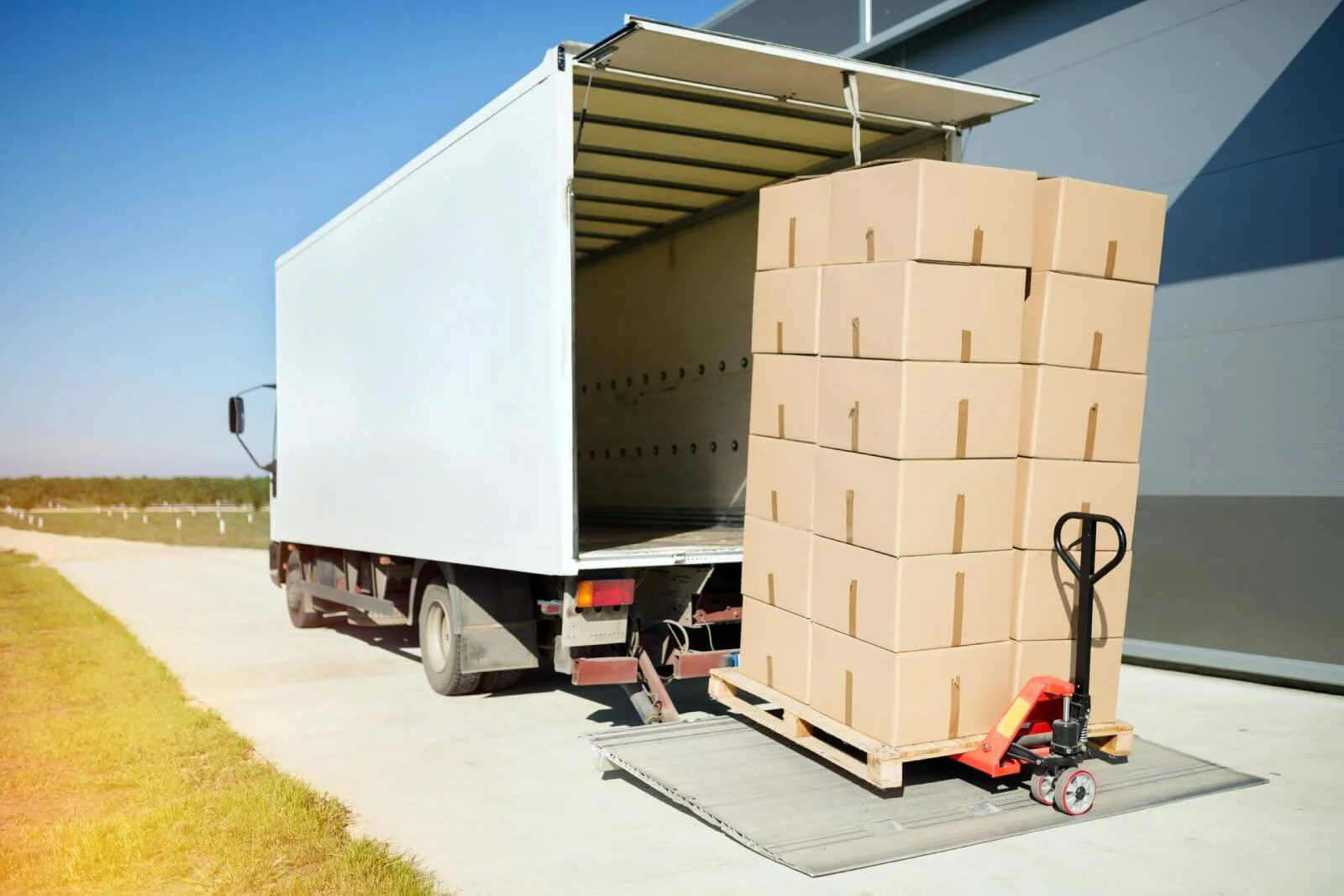
High-urgency freight shipping requires meticulous attention to detail at every stage of the journey. When a delivery window is narrow, there is no margin for error. Managing these shipments successfully involves prioritizing several key operational factors:
- Uncompromising Cargo Security: High-value or time-sensitive freight must be secured properly inside the vehicle using heavy-duty logistics straps, load bars, and protective padding. Because expedited shipments do not undergo terminal cross-docking, the freight remains undisturbed and secure throughout the entire transit.
- Real-Time Satellite Tracking: Modern expedited shipping relies on continuous visibility. Fleet vehicles equipped with GPS tracking allow logistics managers to monitor the exact location of their cargo in real time, providing precise Estimated Times of Arrival (ETAs) to receiving docks.
- Dedicated Dispatch and 24/7 Support: Supply chains never sleep, and shipping emergencies rarely happen during standard business hours. True high-urgency logistics providers maintain 24/7/365 dispatch teams to handle immediate quote requests, coordinate night pickups, and actively manage active shipments.
For operations managers looking to build a robust, failure-resistant logistics strategy, understanding these critical factors is essential. You can access deep industry insights and best practices in The Ultimate Guide to Expedited Shipping.
Frequently Asked Questions about Expedited Shipping
What is the difference between same-day and next-day freight?
The primary difference lies in the urgency of dispatch and the distance of transit. Same-day service involves immediate pickup and direct delivery within the same business day, typically using a dedicated same-day courier or a hot-shot vehicle for regional routes. Next-day transit, on the other hand, allows for overnight travel, making it suitable for longer distances (often up to 1,000 miles by ground). Both services utilize dedicated transport to bypass traditional shipping hubs, ensuring maximum reliability. For a comprehensive comparison of these urgent transit options, see our Same Day Delivery Service: The 2026 Guide for Logistics Managers.
How do weight and size limits affect expedited ground transport?
In expedited ground transport, cargo dimensions and weight dictate the type of vehicle required for the run. Sprinter vans are ideal for smaller, palletized loads under 2,000 lbs, offering excellent speed and maneuverability through urban areas. Mid-sized shipments up to 10,000 lbs typically require straight trucks, which frequently feature liftgates for locations without loading docks. For oversized or exceptionally heavy freight, full-sized tractor-trailers or specialized flatbeds are utilized. Matching the cargo precisely to the correct vehicle size ensures optimal transit efficiency and prevents unnecessary handling.
What tracking and security features are standard for urgent shipments?
Standard security and tracking features for urgent expedited freight include continuous satellite GPS tracking, proactive geofencing alerts, and instant digital Proof of Delivery (POD) sent within minutes of arrival. High-security shipments may also utilize advanced cargo sensors that monitor trailer door status, temperature, and shock-impact levels, ensuring absolute transparency and peace of mind from dock to dock.
Conclusion
When your supply chain faces critical deadlines, relying on standard shipping networks is a risk your business cannot afford. Securing reliable, high-urgency logistics is about partnering with an experienced specialist who understands that speed, precision, and communication are non-negotiable.
Pro Express Inc. brings nearly two decades of dedicated ground-expedited experience to every shipment. With US-wide operations (including specialized routing capabilities for Alaska and Hawaii), a 99% client satisfaction rate, and over 10,000 successfully delivered shipments, we are the trusted partner logistics managers turn to when failure is not an option. Our 24/7/365 customer support team is always standing by to keep your operations moving forward.
For more details on our full suite of expedited ground, hot-shot, and white-glove services, visit Pro Express Inc. Expedited Services. Ready to secure your next critical delivery? Request a Quote today.