
Choose Oversized Shipment Ground Specialists Before the Load Is Ready
Choose oversized shipment ground specialists that verify the cargo’s exact dimensions and weight, match the trailer to the load, secure permits, check the route, schedule escorts, and confirm final-site unloading before dispatch. For an urgent industrial move, ask for one accountable contact, real-time status updates, and a written plan for access, cranes, forklifts, and delivery appointments.
This matters because heavy haul freight leaves little room for recovery. A load that is too wide, tall, long, or heavy for standard road rules can be delayed at a state line, rerouted around a low bridge, or held when the jobsite cannot unload it safely.
For operations teams managing equipment failures, shutdowns, or tight project windows, the right provider is not simply finding a truck. It is managing the full move from load review through safe, on-time delivery. Pro Express Inc. brings nearly 20 years of freight brokerage experience to coordinating time-sensitive freight moves when reliability matters most.
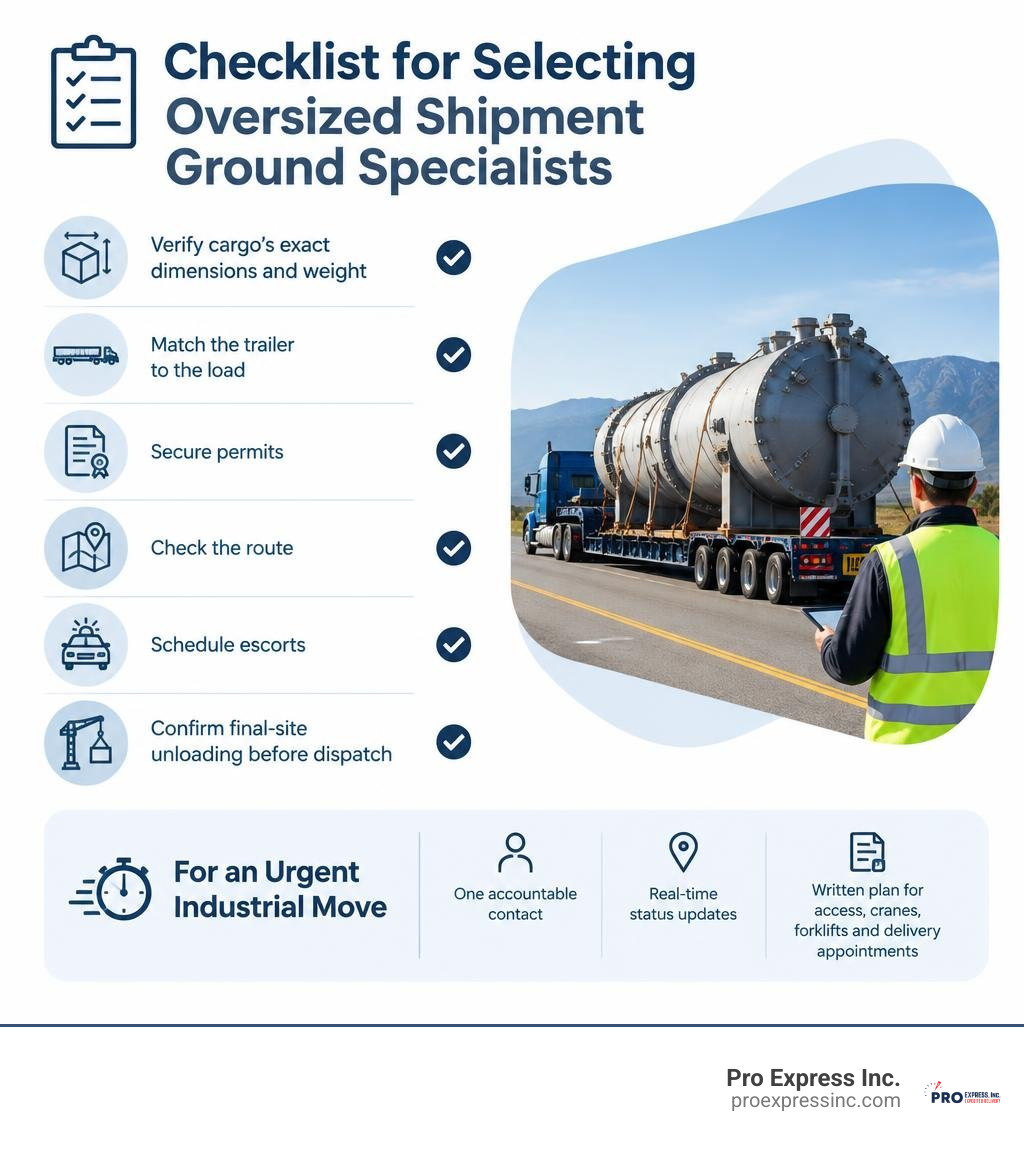
Oversized shipment ground specialists vocabulary:
Introduction
When an essential production line halts or a remote facility faces an emergency outage, the pressure on logistics managers surges instantly. Studies indicate that 87% of catastrophic equipment failures occur without advance warning, requiring immediate intervention to prevent compounding operational downtime. Standard transportation channels simply cannot accommodate critical, massive components under extreme time constraints.
Moving over-dimensional project cargo requires end-to-end precision across every stage of the journey. Whether orchestrating the delivery of replacement turbines, high-capacity transformers, or heavy industrial machinery, an uncoordinated move risks severe transit halts, physical hazards, and missed operational milestones.
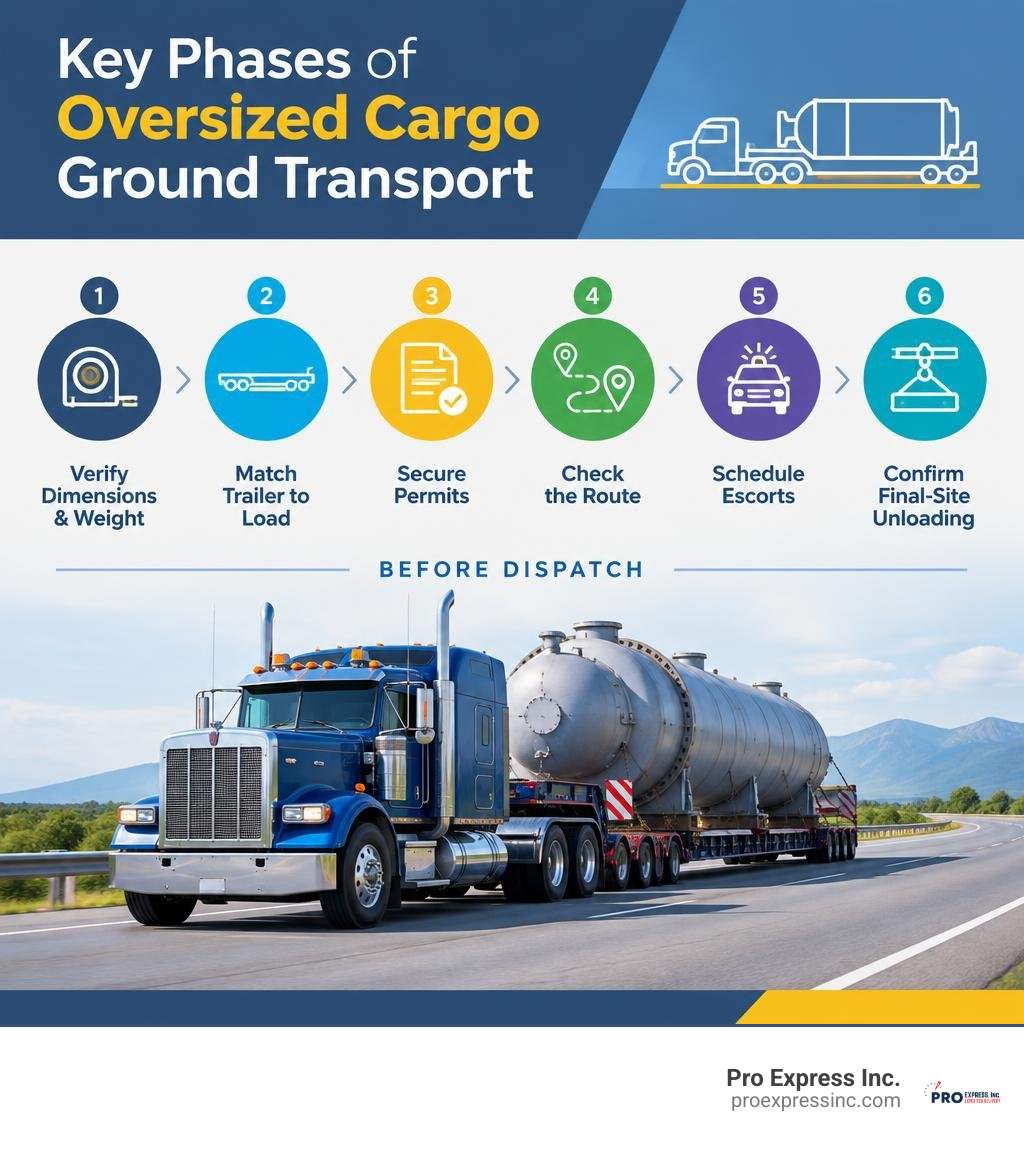
Navigating these challenges requires partnering with seasoned freight brokers who coordinate reliable capacity, secure jurisdictional approvals, and maintain transparent communication. When standard carrier networks fail during critical disruptions, structured project freight logistics keep vital facilities operational.
Understanding Heavy Haul Freight and Legal Dimension Thresholds
A shipment is legally classified as oversized or heavy haul when its physical measurements or gross weight exceed standard federal highway limits. Under United States federal guidelines, standard freight parameters allow for a maximum width of 8.5 feet (102 inches), a maximum height of 13.5 to 14 feet (depending on regional infrastructure), a trailer length of 48 to 53 feet, and a maximum gross vehicle weight (GVW) of 80,000 pounds across standard five-axle configurations.
When a load surpasses any of these baseline thresholds, it falls under strict Department of Transportation (DOT) over-dimensional freight regulations:
- Width Thresholds: Any cargo wider than 8.5 feet requires specialized state permits. Shipments exceeding 12 feet often mandate dedicated pilot escort vehicles to warn oncoming traffic and ensure lane integrity.
- Height Thresholds: Cargo exceeding 13.6 to 14 feet requires precise vertical clearance verification to prevent collisions with overpasses, utility lines, and overhead sign structures.
- Weight Thresholds: A gross vehicle weight surpassing 80,000 pounds demands specialized multi-axle configurations to distribute weight evenly across roadway surfaces and bridges.
- Length Parameters: Structural cargo, industrial piping, and wind energy components exceeding standard trailer lengths require specialized extendable trailers, rear steerable dollies, and advance travel route authorizations.
Because individual states maintain autonomous permitting regulations and travel restrictions, moving over-dimensional equipment across state lines introduces complex jurisdictional compliance layers. When project deadlines are immediate, operations teams benefit from strategies for moving construction freight quickly and aligning with nationwide freight networks capable of handling multifaceted cargo profiles.
Essential Capabilities of Oversized Shipment Ground Specialists
Executing an oversized ground shipment requires comprehensive pre-dispatch engineering and rigorous logistical planning. Experienced freight specialists do not simply book a trailer; they conduct exhaustive technical evaluations to identify and resolve transit risks before the freight ever departs the loading facility.
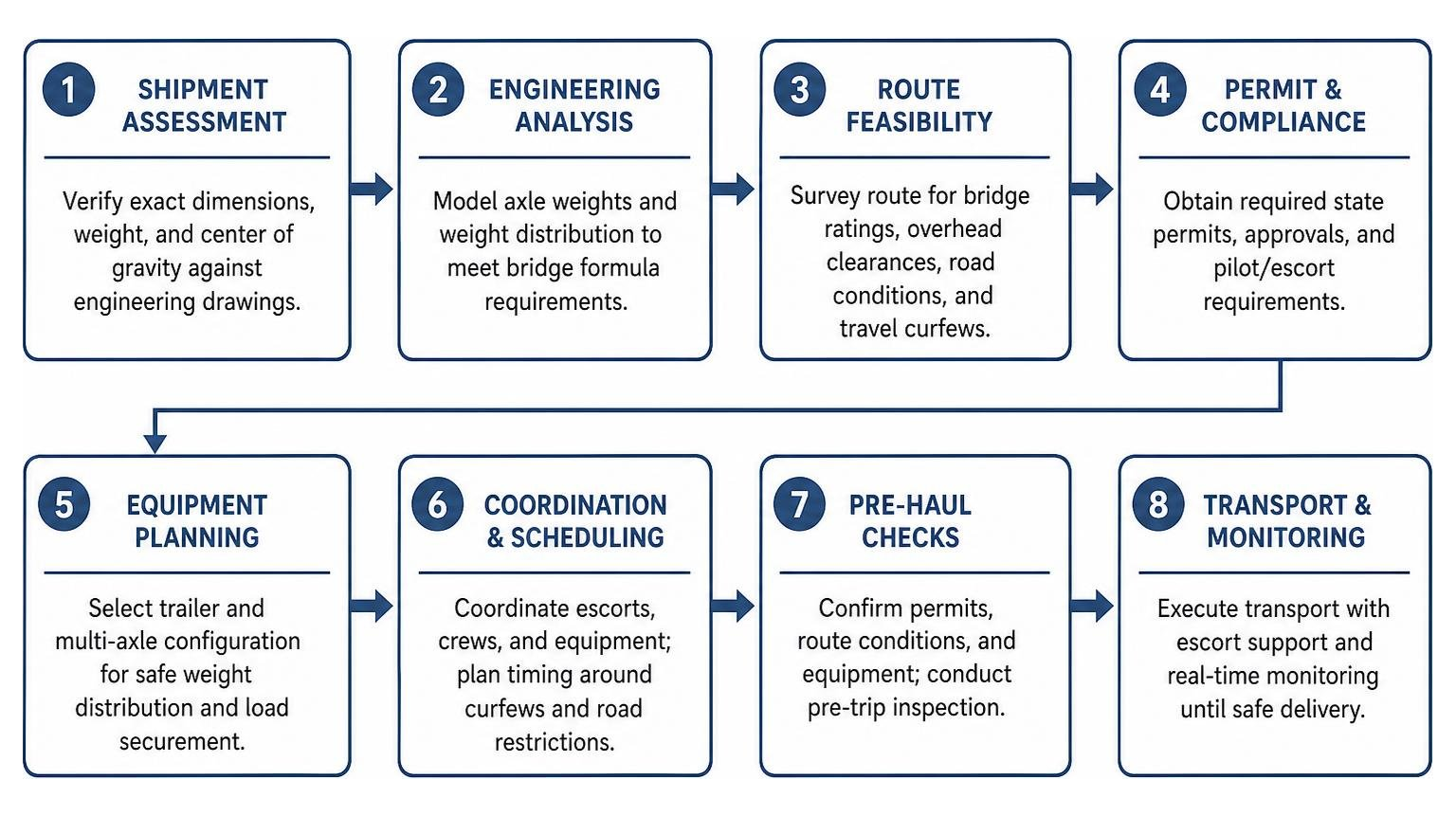
This pre-shipment planning workflow includes several critical engineering controls:
- Physical Dimension and Weight Verification: Exact measurements, including crating, protruding lifting lugs, and true center of gravity, are verified against engineering schematics.
- Axle Weight and Weight Distribution Modeling: Logistics coordinators calculate weight per axle line to ensure compliance with bridge formula laws across every transit jurisdiction.
- Route Feasibility Surveys: Physical route surveys verify bridge load ratings, overhead utility clearances, construction choke points, tight turning radiuses, and municipal travel curfews.
- Jurisdictional Permitting and Escort Coordination: State, county, and municipal transit permits are secured alongside civilian pilot cars or law enforcement escorts where mandated by law.
Specialized Equipment Used by Oversized Shipment Ground Specialists
Selecting the correct specialized trailing equipment protects both the cargo structure and public road infrastructure. Vetted carrier networks utilize distinct open-deck and heavy-haul trailer platforms tailored to specific dimensional profiles:
| Trailer Type | Deck Height | Max Cargo Height | Ideal Cargo Profile |
|---|---|---|---|
| Standard Flatbed | ~5 feet | Up to 8.5 feet | Heavy crated industrial machinery, structural steel, pipe bundles |
| Single / Double Step Deck | ~3.5 feet | Up to 10 feet | Mid-height manufacturing equipment, agricultural tractors, skid units |
| Lowboy (Fixed Gooseneck) | 18 to 24 inches | Up to 11.5 feet | Heavy construction machinery, tracked excavators, mining components |
| Removable Gooseneck (RGN) | 12 to 24 inches | Up to 12 feet | Drive-on rolling stock, tall industrial vessels, heavy equipment |
| Multi-Axle / Dual-Lane Transporters | Variable | 12+ feet (engineered) | Massive transformers, power generation rotors, heavy nuclear vessels |
Removable Gooseneck (RGN) and lowboy trailers are essential for tall, heavy loads because their sunken well designs lower the overall center of gravity while maximizing vertical clearance beneath overhead obstacles. For ultra-heavy loads, multi-axle trailers distribute hundreds of thousands of pounds across dozens of individual tire lines to meet bridge weight limits.
How Oversized Shipment Ground Specialists Manage Permits and Route Planning
Securing state and municipal permits is a precise administrative process. A single missing or inaccurate state permit can ground an over-dimensional shipment for 24 to 72 hours at a state boundary, leading to severe project downtime and operational disruptions.
Oversized freight specialists eliminate mid-journey delays by acquiring all necessary municipal, county, and state permits before dispatch. Route planning accounts for:
- State-Specific Travel Windows: Many jurisdictions prohibit over-dimensional freight movement during morning and evening rush hours, over major holiday weekends, or between sunset and sunrise.
- Overhead Obstruction Verification: Physical high-pole escort vehicles travel ahead of ultra-tall loads to confirm overhead clearance beneath utility wires and bridges.
- Bridge Clearance and Weight Restrictions: Route plotting avoids restricted bridges, navigating around aging infrastructure via pre-cleared corridors.
- Civilian Escort and Law Enforcement Scheduling: Timed handoffs between state-line escort teams prevent transit interruptions.
Logistics teams seeking operational peace of mind rely on proactive management for shipping big stuff without excessive stress across complex regulatory environments.
Critical Steps to Prevent Major Delays and Route Hazards
Managing heavy haul shipments demands absolute attention to cargo integrity and site-level logistics. Hidden project risks frequently arise not from transit conditions, but from inadequate physical preparation or site coordination:
- Structural Packaging and Engineered Lifting Points: Heavy machinery must feature clearly labeled, engineered lift and tie-down points. Substandard crating or missing lashing points can cause port or jobsite loading refusals, resulting in substantial delays.
- Accurate Dimensional Reporting: Omitting exterior accessories, mirror assemblies, or packaging skids from initial measurements alters permit accuracy, risking severe roadside enforcement actions or vehicle impoundment.
- Jobsite Rigging and Crane Unloading Coordination: Heavy cargo requires dedicated offloading assets. Without advance coordination, delivery vehicles face extended on-site dwell times while waiting for mobile cranes or heavy-capacity forklifts.
To maintain efficient supply chains, operations teams implement clear protocols for managing oversized parcel delivery alongside comprehensive heavy freight movement. For broader context on regulatory frameworks, the Federal Motor Carrier Safety Administration provides guidance on commercial vehicle size and weight standards.
Key Criteria for Evaluating and Selecting a Heavy Haul Ground Provider
Choosing a dependable freight broker to manage over-dimensional transport requires evaluating core operational competencies:
- Rigorous Carrier Vetting: Verify that the brokerage works exclusively with safety-rated carrier partners holding active DOT authorities, substantial cargo insurance coverage, and clean safety performance records.
- Dedicated Single Point of Contact: Operations managers need direct communication with a single logistics coordinator available 24/7/365, avoiding call-center runarounds during critical transit stages.
- Real-Time GPS Tracking and Milestone Reporting: Direct visibility allows destination teams to mobilize rigging crews and plant technicians precisely when the transport arrives.
- Specialized Handling Services: Ensure the provider can coordinate white glove logistics, liftgate support, and specialized two-man handling teams for destination offloading challenges.
- Urgent Time-Critical Execution: When production lines stop, the ability to coordinate expedited ground freight through dedicated hot-shot and direct transport capacity is essential.
Frequently Asked Questions About Oversized Ground Freight
What legal dimensions define an oversized load in the United States?
In the United States, a shipment is legally considered oversized when it exceeds standard commercial limits: a width greater than 8.5 feet (102 inches), a height exceeding 13.5 to 14 feet, a trailer cargo length beyond 48 to 53 feet, or a total gross vehicle weight surpassing 80,000 pounds. Exceeding any single parameter requires specialized jurisdictional permits and equipment.
How far in advance should an oversized ground move be scheduled?
Standard oversized shipments requiring routine state permits should ideally be booked 3 to 7 business days in advance to allow for permit procurement, equipment positioning, and route planning. Superloads, ultra-heavy moves, or shipments requiring physical route surveys and utility line lifts may require 2 to 4 weeks of advance preparation.
How do logistics specialists handle final jobsite delivery challenges?
Specialists conduct advance site feasibility checks to evaluate gate clearance, internal turning radiuses, ground stability, and overhead line obstructions. They coordinate delivery windows directly with destination rigging personnel, mobile crane operators, and heavy forklift teams to ensure safe offloading without on-site congestion.
Conclusion
Over-dimensional and heavy haul transportation requires precise logistical engineering, regulatory expertise, and dependable carrier coordination. When unexpected equipment breakdowns threaten production schedules, partnering with an experienced freight broker ensures your mission-critical cargo moves smoothly from origin to destination.
Pro Express Inc. provides the freight brokerage expertise required for complex ground transport challenges. With nearly 20 years of freight brokerage experience, over 10,000 shipments coordinated, and a 99% client satisfaction rate, our team connects you to a dependable, vetted carrier network for all your time-sensitive and heavy freight requirements across North America.
Ensure your heavy cargo arrives safely and on schedule. Connect with our logistics specialists today to coordinate your next shipment through our dedicated freight services. Contact Us Today to get your freight moving without delay.