
What Is Expedited Shipping for Critical Freight?
Expedited shipping is a priority delivery method that moves freight faster than standard service. For B2B shipments, it usually means arranging dedicated, direct transportation with fewer stops, faster dispatch, and close tracking from pickup through delivery.
When a regular carrier misses a pickup, a production line needs a critical part, or a customer deadline is at risk, expedited freight can help keep the shipment moving. Depending on the lane and urgency, service may be same-day, next-day, or delivered within a tightly defined transit window.
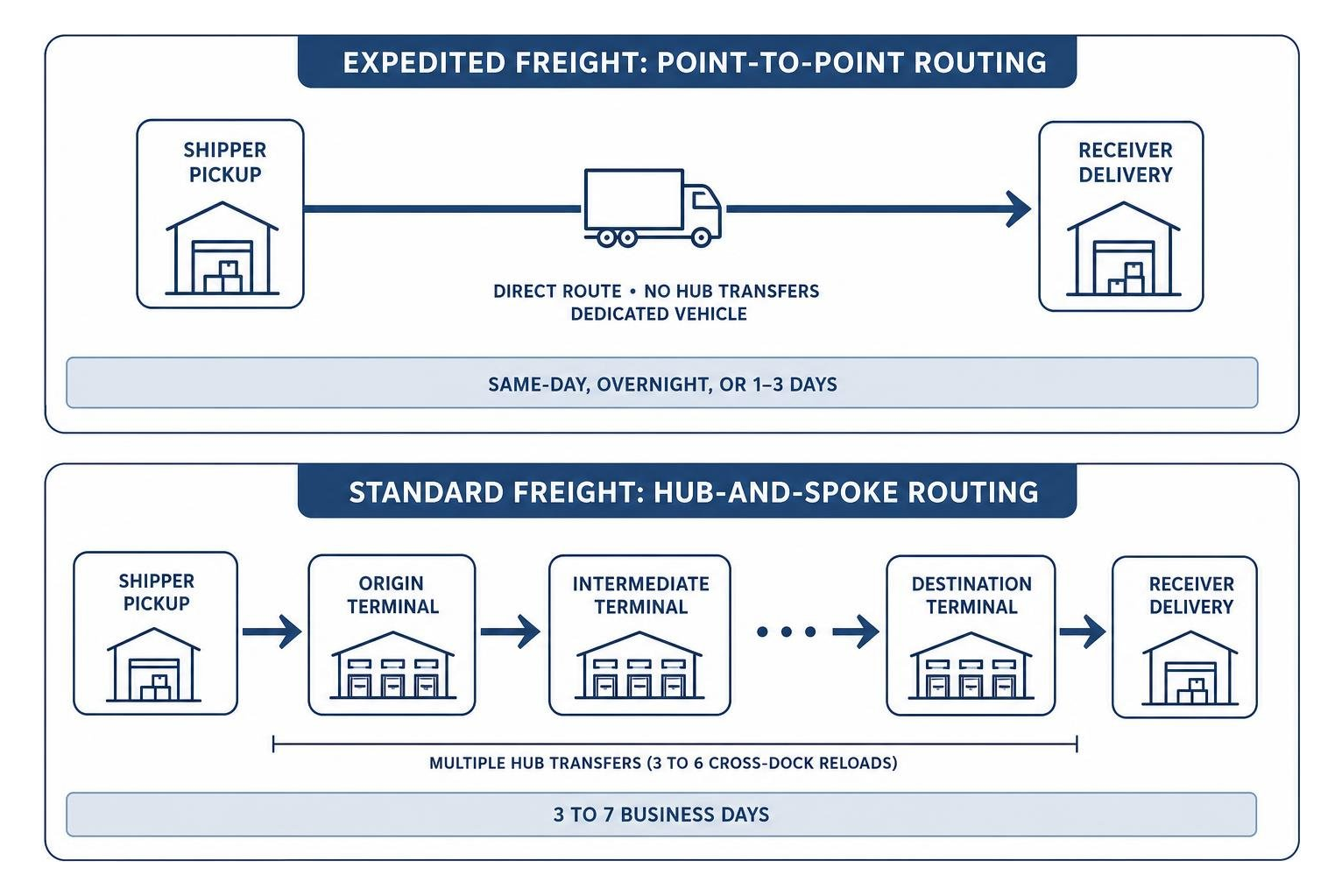
Unlike standard freight, which may move through terminals and cross-docks with several handoffs, expedited shipping is built to reduce delays and cargo touchpoints. That can improve visibility and help protect sensitive, high-value, or time-critical freight.
For nearly 20 years, Pro Express Inc. has arranged urgent freight transportation through a vetted carrier network. It is the kind of support operations teams need when normal shipping plans fail and timing cannot slip.
Relevant articles related to what is an expedited shipping:
Core Logistics: What Is an Expedited Shipping Solution?
In enterprise transportation, understanding the core logistics behind what is an expedited shipping solution starts with recognizing that conventional freight models are structured for bulk consolidation rather than raw velocity. For industrial supply chains, expedited freight represents an operational upgrade designed to bypass typical distribution bottlenecks.
As explored in The Ultimate Guide to Expedited Shipping, expedited logistics prioritizes individual shipments from the moment a load tender is accepted. Instead of waiting for a consolidated trailer to fill across an entire geographic territory, an expedited freight arrangement coordinates direct pickup and immediate dispatch. This model replaces traditional multi-facility handling with dedicated routing, accelerating transit times across regional and interstate corridors.

| Transit Feature | Standard Freight Transit | Expedited Dedicated Transport |
|---|---|---|
| Routing Structure | Multi-terminal hub-and-spoke | Direct point-to-point |
| Intermediate Handling | 3 to 6 cross-dock reloads | Zero hub transfers (exclusive use) |
| Transit Duration | 3 to 7 business days | Same-day, overnight, or 1–3 days |
| Driver Configuration | Single driver with mandatory rests | Dedicated solo or continuous team drivers |
| Tracking Visibility | Periodic facility scan updates | Continuous real-time GPS milestone tracking |
| Cargo Safety Profile | Higher touchpoints and damage risk | Maximum chain-of-custody security |
Defining What Is an Expedited Shipping Timeline in Freight Logistics
A standard freight timeline depends on consolidated linehauls and terminal sorting shifts. In contrast, expedited logistics operates around precise delivery milestones established by your operational requirements. When supply chains demand accelerated turnarounds, expedited ground shipping arrangements ensure freight moves immediately upon loading.
Depending on mileage, origin, and destination, expedited timelines generally include:
- Same-Day Dispatch & Delivery: Urgent regional freight moving across 50 to 350 miles within hours of dispatch.
- Overnight / Next-Day Delivery: Critical components traveling hundreds of miles through coordinated overnight transport to arrive before morning operational shifts.
- Dedicated Time-Definite Windows: Cross-country or long-haul routes coordinated with tightly monitored delivery appointments to satisfy demanding enterprise service level agreements (SLAs).
Expedited Freight vs. Standard Multi-Stop Ground Transit
Standard less-than-truckload (LTL) networks rely on a hub-and-spoke architecture. Pallets move from local pickup units to break-bulk terminals, undergoing multiple offloading, staging, and reloading cycles. Each intermediate dock adds hours—or days—of dwell time, increasing the risk of missed connections and freight damage.
As detailed in our analysis of Expedited Freight Meaning and Why Your Logistics Need a Turbo Boost, expedited freight eliminates the terminal network entirely. Dedicated vehicles pick up freight directly at the shipper’s dock and drive directly to the receiving facility without intermediate cross-dock transfers. According to supply chain transit timing research, eliminating these freight touchpoints bridges the operational gap between multi-day transit windows and time-critical delivery schedules.
How Expedited Freight Delivery Works to Accelerate Supply Chains
Executing rapid logistics requires a disciplined workflow that coordinates timing, equipment availability, and non-stop operational execution. Professional freight brokerages maintain the responsive communication channels and carrier visibility needed to organize seamless point-to-point transit.

Operational Mechanics: What Is an Expedited Shipping Network Workflow?
Coordinating an expedited freight movement involves a specialized, multi-step process engineered to eliminate administrative and operational delays. As outlined in The Complete Guide to Expedited Freight Services 2026 Guide, the operational workflow follows a structured sequence:
- Rapid Requirement Assessment: Analyzing cargo specifications, dimensional requirements, accessorial needs (such as liftgates), and strict delivery deadlines.
- Carrier Sourcing and Matching: Sourcing an exclusive-use vehicle—ranging from cargo vans and sprinter vans to box trucks—from a vetted network of qualified carriers.
- Priority Dispatch Coordination: Confirming immediate driver dispatch to the pickup facility to prevent staging delays.
- Real-Time GPS Tracking & Milestones: Continuously monitoring cargo movement through active tracking milestones, keeping dispatchers and receiving managers updated.
- Direct Destination Hand-Off: Completing prompt, secure delivery at the receiver’s dock or designated drop-off point with immediate proof-of-delivery (POD) confirmation.
Dedicated Team Drivers and Direct Point-to-Point Routing
For long-haul freight lanes exceeding normal single-driver driving limits, expedited freight logistics relies on dedicated team drivers. Long-distance ground transit can face delays when a single driver must take mandatory rest breaks to comply with Hours of Service (HOS) regulations.
By assigning team drivers who alternate driving shifts, freight stays in continuous motion along highway corridors. As explored in Expedited Ground Freight A Strategic Guide for Logistics Managers 2026 Guide, team-driver routing allows cargo to travel across the contiguous United States—including long-haul coast-to-coast lanes—in a fraction of standard transit time. Reviewing industry standards on expedited delivery underscores that non-stop direct transport remains the most dependable method for meeting non-negotiable delivery windows.
Critical Benefits of Expedited Freight for Enterprise Operations
When standard transit channels experience disruptions or unexpected surges, expedited freight services provide the operational velocity necessary to maintain business continuity.
Preventing Manufacturing Downtime and Assembly Stoppages
In industrial manufacturing, timing is everything. A single delayed component can stall an entire assembly plant, causing cascading scheduling failures and idle labor across production shifts.
Expedited freight serves as an emergency lifeline when tier-1 automotive suppliers, industrial fabricators, or equipment manufacturers face unexpected inventory shortages. Coordinating an exclusive hot-shot delivery ensures urgent tooling, replacement valves, or custom fasteners arrive at the plant floor before a shutdown occurs, protecting operational uptime and fulfilling critical customer commitments.
Minimizing Cargo Touchpoints and Freight Damage Risks
Every time a forklift offloads, stages, and reloads a pallet at an intermediate freight terminal, the potential for cargo damage increases. Fragile, high-value, or sensitive commercial products are particularly vulnerable inside multi-stop LTL consolidation networks.
Expedited shipping utilizes exclusive-use vehicles, meaning the freight is loaded once at the origin facility, secured inside the vehicle, and untouched until arrival. This sealed chain of custody delivers key operational benefits:
- Touchpoint Reduction: Zero intermediate terminal handling or dock transfers.
- Cargo Integrity: Freight remains strapped and secured in the same configuration throughout its journey.
- Enhanced Security: Dedicated routing minimizes exposure to loss, tampering, or misrouting in shared transit facilities.
Industry-Specific Applications for Time-Sensitive Freight
High-stakes industries depend on expedited freight solutions to handle mission-critical, high-value, and sensitive commercial cargo across the United States.
Automotive and Industrial Just-in-Time Replenishment
Automotive assembly facilities and heavy equipment manufacturers operate lean Just-in-Time (JIT) production schedules. When a stamping press breaks down or an assembly line exhausts critical sub-assemblies, waiting days for standard delivery is not an option. Expedited hot-shot arrangements deliver replacement robotics, custom stamping dies, and raw materials directly to the factory gate on demand.
Medical and Pharmaceutical Chain of Custody Logistics
The healthcare and medical manufacturing sectors operate under stringent regulatory and operational requirements. As highlighted in our guide to Medical Pharmaceutical Expedited Shipping, time-sensitive healthcare logistics includes:
- Diagnostic and Imaging Equipment: Transporting sensitive components for MRI, CT, and X-ray systems directly to hospitals and clinical labs.
- Surgical Tools and Implants: Arranging rapid point-to-point transport for custom orthopedic devices and specialized surgical kits.
- Laboratory Supplies: Coordinating uninterrupted delivery for diagnostic reagents and essential testing equipment.
Specialized White-Glove and Two-Man Delivery Requirements
Not all commercial deliveries end at an open, raised loading dock. High-value equipment, architectural lighting fixtures, and laboratory machinery often require specialized handling at their final destinations.
Through The Speed and the Splendor of Expedited White Glove Shipping, logistics managers can coordinate specialized accessorial solutions:
- Liftgate Delivery: Providing hydraulic liftgate equipment when delivering to facilities or commercial job sites without a dedicated loading bay.
- Inside Delivery and Placement: Coordinating careful movement of heavy or sensitive items beyond the building threshold and into specific operational rooms.
- Two-Man Delivery Teams: Arranging dual-specialist teams to safely maneuver heavy, awkward, or high-value equipment through corridors, elevators, and cleanrooms.
Frequently Asked Questions About Expedited Freight
How fast does an expedited freight shipment arrive compared to standard freight?
Standard ground freight typically takes between 3 to 7 business days, as shipments transit through multiple regional consolidation terminals. Expedited freight moves directly from the pickup dock to the final destination without intermediate stops. Depending on total lane distance, expedited delivery can arrive same-day (for routes under 350 miles), next-day, or within 1 to 3 business days for long-haul national routes utilizing dedicated team drivers.
What types of specialized handling services are available for expedited cargo?
Expedited freight arrangements can accommodate a comprehensive range of specialized accessorial services tailored to destination needs. These include dedicated white-glove delivery, hydraulic liftgate service, two-man delivery teams, inside placement, direct job-site delivery, and specialized equipment configurations designed to transport sensitive or non-standard cargo securely.
How do direct point-to-point routes safeguard fragile or mission-critical freight?
In standard LTL networks, cargo is frequently transferred between trailers at multiple cross-dock facilities, dramatically increasing the risk of forklift strikes, improper restacking, and transit vibration. Direct point-to-point routing places your cargo inside an exclusive vehicle where it remains untouched and undisturbed from origin to destination. This closed chain of custody preserves package integrity and prevents freight damage.
Conclusion
When supply chain disruptions strike, manufacturing deadlines loom, or regular carriers fail to meet critical schedules, businesses require a logistics partner that acts with speed and reliability. Understanding how expedited shipping works enables enterprise operations managers to deploy fast, dedicated ground solutions that protect project timelines, maintain production uptime, and fulfill demanding client commitments.
Founded in 2007 by Peter Jałowiec, Pro Express Inc. brings nearly 20 years of specialized freight brokerage experience to every urgent shipment. Having coordinated over 10,000 time-critical shipments with a 99% client satisfaction track record, we connect businesses across the contiguous United States with a thoroughly vetted carrier network. Whether your operation requires exclusive hot-shots, liftgate equipment, two-man delivery, or specialized inside placement, our dedicated team coordinates non-stop logistics that keep your business moving forward.
Explore our comprehensive freight services today to discover how our vetted network and experienced brokerage team deliver rapid, dependable freight solutions when timing matters most.