
When a Shipment Can’t Wait: What You Need to Know About Medical Courier Companies
Medical courier companies are a specialized category of logistics providers built for one purpose: moving time-critical, sensitive healthcare materials safely and on time — every time.
If your regular carrier just failed you, a specimen is sitting at a pickup point, or a hospital client is waiting on a critical delivery, here is what you need to know right now:
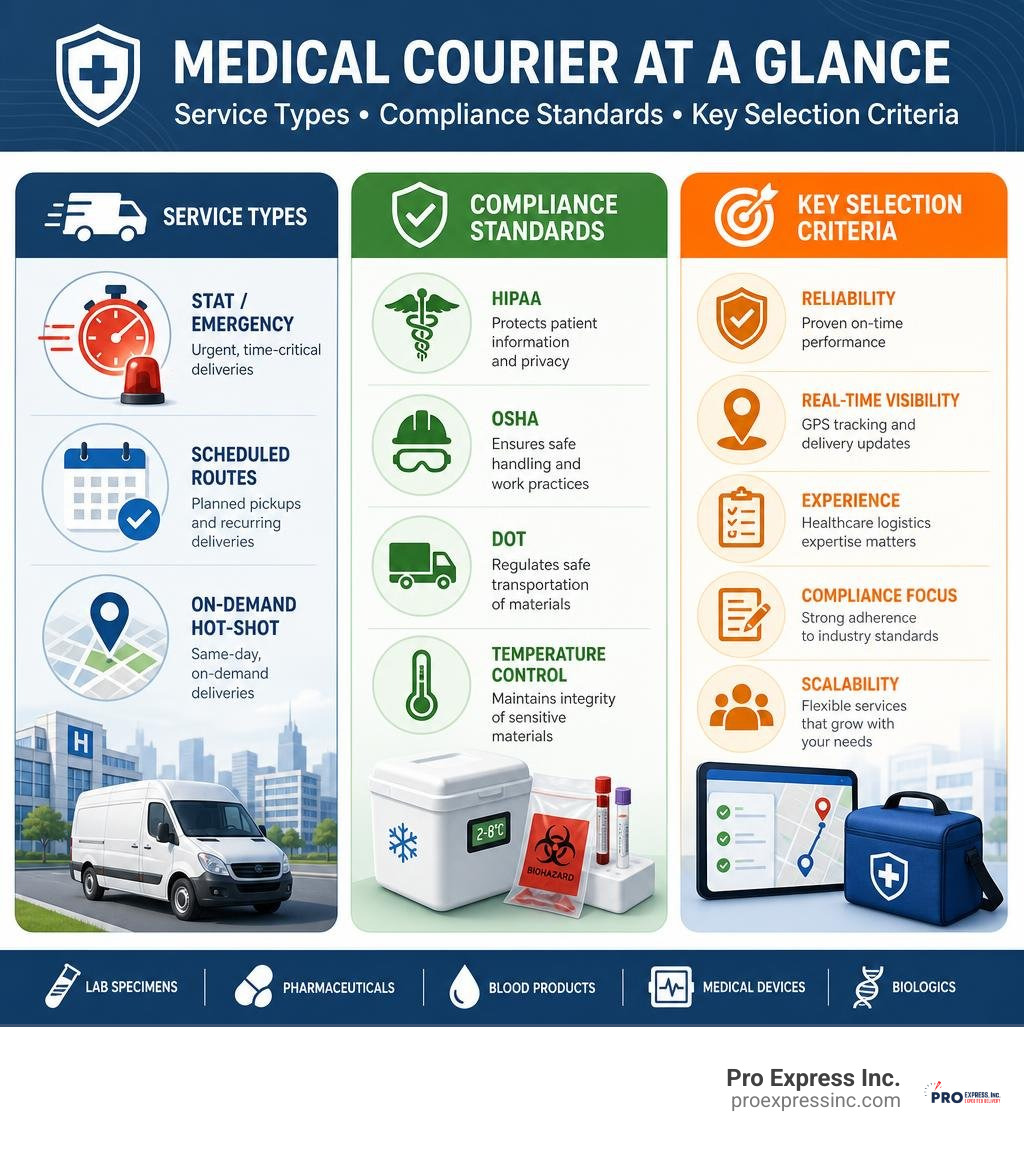
What medical courier companies do — at a glance:
- Transport time-sensitive materials — lab specimens, pharmaceuticals, medical devices, blood products, and biologics
- Operate under strict compliance — HIPAA, OSHA, DOT, and temperature-control standards
- Offer multiple service levels — STAT/emergency, scheduled routes, and on-demand hot-shot delivery
- Provide real-time tracking — GPS visibility, chain of custody documentation, and delivery confirmation
- Serve healthcare organizations — hospitals, independent labs, long-term care pharmacies, and research institutions
This is not standard freight. A missed or mishandled medical delivery can affect a patient’s diagnosis, delay a treatment, or compromise an irreplaceable specimen.
The stakes are real. According to a 2026 American Nurse Survey, 83% of nurses reported that medical couriers play a critical role in healthcare delivery — and courier failures are on the rise.
For operations and logistics managers in healthcare supply chains, choosing the right medical courier partner is one of the most consequential vendor decisions you will make.
This guide walks you through exactly how to evaluate and select the best medical courier companies for your needs — from compliance requirements and service types to technology standards and what to look for in a carrier network.
Related content about medical courier companies:
What Defines Specialized Medical Courier Companies?
Standard courier services are built to move paperwork, office supplies, or retail inventory. To a standard courier, a package is just a cardboard box. To specialized medical courier companies, a package represents a patient’s diagnosis, a life-saving therapy, or an irreplaceable biological sample.
The primary differentiator lies in the absolute preservation of specimen integrity and unwavering regulatory compliance. If a standard delivery is delayed by an hour, a business faces minor inconvenience. If a medical delivery of transplant tissue or a time-sensitive blood biopsy is delayed, the clinical consequences can be devastating.
Unlike general freight providers, specialized medical logistics networks utilize advanced climate-control systems, certified spill-response equipment, and highly trained personnel who understand the clinical urgency of what they are transporting. When standard transport options cannot guarantee the speed or environmental precision required, healthcare organizations rely on Expedited Ground Shipping to bridge the gap.
Whether coordinating deliveries from a local clinic to a regional laboratory or arranging critical transport across the contiguous United States, specialized logistics providers focus entirely on minimizing transit times while maintaining a secure chain of custody.
Critical Compliance and Handling Standards in Healthcare Logistics
Operating within the medical space requires strict adherence to federal and state regulations. When we arrange Medical Pharmaceutical Expedited Shipping, we confirm the shipment’s handling requirements before a carrier is booked. Key compliance benchmarks in healthcare logistics include:
- HIPAA Compliance: The Health Insurance Portability and Accountability Act protects patient privacy. Medical couriers frequently transport patient records, labeled specimens, and personalized prescriptions. Any breach of this data can lead to severe legal and financial penalties. Carriers must handle all shipments in a manner that prevents unauthorized access to protected health information (PHI).
- OSHA Regulations: The Occupational Safety and Health Administration mandates strict protocols for handling bloodborne pathogens and biohazardous materials. Couriers must carry specialized spill kits, use puncture-resistant secondary packaging, and know exactly how to manage an accidental exposure or spill.
- Precise Temperature Control: Biologics, vaccines, and specimens require specific thermal environments to remain viable. Healthcare logistics relies on three primary temperature ranges:
- Ambient (15°C to 25°C) for general pharmaceuticals and certain tissue samples.
- Refrigerated (2°C to 8°C) for vaccines, blood products, and most clinical specimens.
- Frozen (-20°C to -80°C) using dry ice or liquid nitrogen for specialized biological materials and genomic samples.
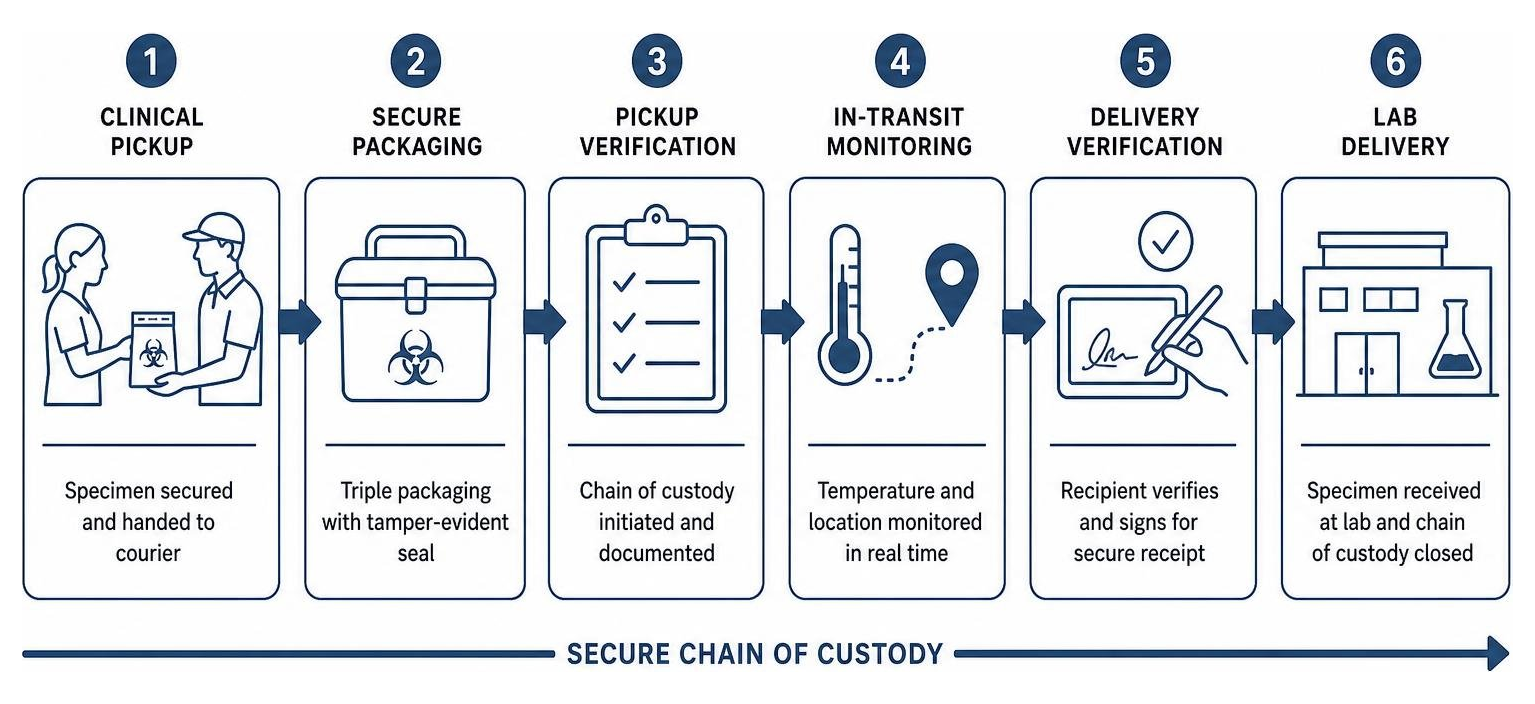
- Auditable Chain of Custody: A continuous, documented paper and digital trail must accompany every shipment. This record details exactly who had physical possession of the material from the moment of pickup to the final signature at delivery, leaving no room for error or loss.
Training Requirements for Medical Courier Networks
To safely navigate these compliance standards, drivers within a medical courier network must complete comprehensive, ongoing training. General delivery drivers do not possess the certifications required to enter a clinical environment or handle biological materials.
Essential training protocols include:
- Bloodborne Pathogen Training: Standardized under OSHA 29 CFR 1910.1030, this training ensures drivers understand the risks associated with transporting infectious substances and how to protect themselves and the public.
- DOT Hazardous Materials Regulations: DOT 49 CFR 171-180 governs the packaging, labeling, and transport of hazardous diagnostic specimens and clinical waste, which need a carrier authorized for hazardous materials. Pro Express does not arrange hazardous-materials shipments.
- Vetted and Certified Drivers: Leading logistics networks rely on hand-selected, verified professionals who undergo thorough background checks, drug screenings, and regular compliance audits.
By coordinating transport through a highly vetted carrier network, as detailed in our Expedited Shipping Services The 2026 Guide, we reduce the risk of unvetted drivers handling your critical healthcare cargo.
Key Services: STAT, Scheduled, and On-Demand Routing
Healthcare operations operate on varying timelines. To accommodate these diverse needs, medical courier companies typically offer three primary service levels, each designed to balance urgency, routing efficiency, and handling precision.
For logistics managers overseeing complex networks, implementing the right service mix is essential. Our guide on Same Day Delivery Service The 2026 Guide For Logistics Managers outlines how expedited routing can be integrated to keep healthcare facilities running smoothly.
| Service Type | Typical Response / Transit Time | Best Used For | Key Handling Requirements |
|---|---|---|---|
| STAT / Emergency | Immediate dispatch; direct route; usually under 60-120 minutes | Organ transplants, emergency blood products, life-saving therapies, urgent biopsies | Dedicated hot-shot transport, real-time tracking, immediate delivery verification |
| Scheduled / Routed | Predetermined daily or weekly pickup/delivery windows | Routine lab specimens, daily pharmacy replenishments, medical records, laundry/linen | Consistency, barcode scanning at every stop, predictable temperature control |
| On-Demand / Urgent | Same-day dispatch; flexible scheduling | Last-minute medical equipment requests, unexpected clinic supply shortages, non-emergency specimens | Rapid booking, immediate carrier availability, flexible vehicle sizing |
How Medical Courier Partners Handle STAT and Emergency Requests
When a clinical situation escalates, there is no time for routing delays or multi-stop consolidations. STAT and emergency medical requests require a dedicated, direct-to-destination approach.
For example, when a hospital needs to transport a time-critical specimen or an organ for transplant, the dispatch process must be instantaneous. In these high-pressure scenarios, logistics managers rely on hot-shot shipping to bypass standard hub-and-spoke delays. A dedicated vehicle is assigned exclusively to that shipment, moving it directly from the pickup point to the receiving facility without intermediate stops.
To understand how to manage these high-priority, round-the-clock logistics challenges, consult The 24 Hour Shipping Service Survival Guide, which details the operational frameworks required to keep critical supply chains moving 24/7/365.
Technology and Tracking Tools for Real-Time Visibility
In modern healthcare logistics, visibility is not a luxury — it is a compliance requirement. Leading medical courier companies leverage advanced technology suites to provide complete transparency throughout the shipping lifecycle.

Key technological tools used to secure sensitive medical shipments include:
- Real-Time GPS Tracking: Logistics managers can monitor the exact location of their shipments at any second, allowing for precise delivery window forecasting and immediate intervention if traffic or weather disruptions occur.
- Environmental Condition Monitoring: For highly sensitive biologics, advanced sensor-enabled packaging tracks temperature, humidity, and shock in real time. If a container’s temperature begins to drift outside of the validated 2°C to 8°C range, automatic alerts are sent to a centralized control tower, allowing the courier to take corrective action before the shipment is compromised.
- Centralized Control Towers: A dedicated, 24/7/365 monitoring team oversees all active shipments. This centralized approach ensures that any route deviation, delay, or environmental warning is addressed immediately.
- Digital Chain of Custody & Verification: Paper manifests are prone to loss and human error. Modern medical logistics utilizes digital barcode scanning at every transition point, backed by electronic signatures and photographic proof of delivery.
By utilizing these cutting-edge digital tools, we help businesses transition away from traditional, opaque shipping methods. As explained in our breakdown of Expedited Freight Meaning And Why Your Logistics Need A Turbo Boost, real-time visibility and proactive monitoring turn logistics from an operational headache into a strategic asset.
Key Considerations When Selecting a Healthcare Logistics Partner
Choosing a medical logistics partner is a decision that directly impacts patient outcomes and clinical operations. A single failure can lead to lost specimens, compromised trials, or delayed surgeries.
When evaluating potential partners, operations and logistics decision-makers should focus on these critical factors:
- Exemplary Reliability & Track Record: Look for established networks with a proven history of success. For example, premier medical delivery specialists like Your Medical Courier Service and Medical-Only Delivery | MCI have spent decades perfecting specimen transport, demonstrating how a specialized focus leads to near-perfect delivery records.
- Comprehensive Carrier Vetting: Ensure your partner has a rigorous screening process for every carrier in their network. Drivers must be fully certified in HIPAA, OSHA, and cold-chain protocols.
- True Nationwide & Multi-State Coverage: Healthcare networks are expanding rapidly, often requiring seamless logistics across state lines. Your partner must be able to arrange reliable transport across the contiguous United States, including hard-to-reach rural regions, with a unified, nationwide solution across the lower 48 states.
- Dedicated Support & Contingency Planning: When a primary carrier fails or an unexpected supply chain disruption occurs, you need immediate access to live, professional dispatchers. A trusted partner does not rely on automated phone trees; they provide 24/7/365 live support to coordinate backup transport on a moment’s notice.
- Specialized Regional Coverage: A broker with a broad carrier network can match local, on-demand capacity to each lane, helping keep your cold chain unbroken from coast to coast.
Frequently Asked Questions About Medical Logistics
What is the difference between a standard courier and a medical courier?
Standard couriers transport general commodities with minimal handling requirements. Medical courier companies specialize exclusively in healthcare logistics. Their networks utilize drivers trained in HIPAA and OSHA, carry biohazard spill kits, and use validated temperature-controlled containers to transport sensitive biological materials, pharmaceuticals, and medical devices. For highly specialized requirements, organizations often turn to dedicated Medical Courier Services to ensure absolute compliance.
How do couriers maintain the cold chain for sensitive specimens?
The cold chain is maintained through a combination of active and passive temperature-control technologies. This includes vacuum-insulated panels, phase-change materials, dry ice, and specialized mobile refrigeration units. Real-time digital sensors monitor internal temperatures throughout transit, sending immediate alerts if any fluctuations occur.
What happens if a medical shipment is delayed or lost?
A professional medical logistics partner utilizes proactive contingency planning. If a delay occurs due to mechanical issues or extreme weather, the centralized control tower immediately flags the shipment. Because we operate as a freight broker with access to a massive, vetted carrier network, we can rapidly coordinate backup transport, such as an exclusive hot-shot vehicle, to intercept and complete the delivery before specimen viability is compromised.
Conclusion: Partnering with Pro Express Inc. for Your Critical Medical Logistics
When lives and clinical trial results are on the line, you cannot afford to rely on unverified carriers or generic logistics providers. You need a trusted partner who treats your urgent shipments with the speed, respect, and precision they require.
At Pro Express Inc., we bring nearly 20 years of experience as a premier freight brokerage specializing in expedited ground shipping. Founded in 2007, we have built a reputation for coordinating urgent, time-sensitive cargo safely and efficiently across the contiguous United States.
We don’t believe in a one-size-fits-all approach. By leveraging our deeply vetted carrier network, we arrange tailored transport solutions designed to meet your exact compliance and timing needs. Whether you require Exclusive Hot Shots, White Glove handling, Two-Man teams, Liftgate assistance, or Inside Delivery, we have the expertise to coordinate your most critical medical and pharmaceutical shipments.
With a track record of coordinating thousands of successful shipments and maintaining a 99% client satisfaction rating, we are the partner healthcare operations and logistics managers trust when their primary carriers fail or deadlines are at risk.
Don’t leave your sensitive healthcare shipments to chance. Let us coordinate your next time-critical delivery with the speed and reliability your patients deserve.
Contact Us Today to speak with our expedited logistics experts, or Request a Quote to secure your critical medical shipment now.