
Why a Fast Last Mile Courier Matters for Critical Shipments
A last mile courier handles the final leg of a shipment: moving freight from a local terminal, warehouse, airport, or distribution hub to the receiving business. For urgent B2B freight, success depends on three things:
- Fast coordination after the shipment is released or a regular carrier fails.
- Clear status updates throughout the trip.
- Verified proof of delivery at the commercial destination.
This final leg is where deadlines can be won or lost. A delayed machine part, medical supply, retail fixture, or time-sensitive pallet may be only a short distance from its destination, yet still require careful scheduling, the right equipment, and reliable handoff documentation.
Pro Express Inc. has spent nearly 20 years arranging time-critical freight through a vetted carrier network. When a shipment is stalled, a delivery appointment is at risk, or a customer needs urgent final-leg support, our role is to coordinate the right delivery solution and keep the process moving.
A modern last-mile operation also needs visibility. Real-time updates, delivery-window communication, and digital proof of delivery help operations teams act before a minor delay becomes a missed deadline.
Must-know last mile courier terms:
Understanding the Critical Role of a Last Mile Courier in Modern Logistics
The final leg of commercial distribution demands exceptional transit velocity and strict adherence to service-level agreements. When enterprise freight arrives at a metropolitan airport cargo terminal or a regional sorting hub, the journey is far from complete. The last mile represents the most operationally demanding stage of the entire supply chain. In fact, logistics data indicates that the final leg accounts for approximately 41% to 53% of overall fulfillment complexity, making rapid execution at this junction essential for maintaining operational momentum.
In modern industrial supply chains, an urgent last mile courier bridges the gap between bulk freight arrival and point-of-use deployment. Whether an automotive plant faces line-down conditions awaiting custom stampings or a healthcare facility requires specialized diagnostic parts before a scheduled surgical procedure, standard multi-day freight schedules introduce unacceptable risks. By brokering direct, dedicated transit, we ensure that time-critical cargo bypasses intermediate handling and moves immediately toward its destination via expedited ground shipping.
Carrier Classification Models and Fleet Capabilities
Selecting the proper transportation mode requires aligning vehicle dimensions, loading configurations, and speed requirements with the specific freight profile. While standardized networks operate on rigid multi-stop schedules, specialized B2B courier coordination utilizes dedicated vehicles arranged specifically for the cargo at hand.
| Logistics Model | Dispatch Velocity | Vehicle Capacity & Types | Handling Protocols | Primary Use Case |
|---|---|---|---|---|
| Standard Freight Networks | Scheduled hub transfers (24–72+ hours) | Semi-trailers, multi-stop dry vans | Standard cross-dock sortation, high touchpoints | Non-urgent stock replenishment, bulk inventory |
| Regional Linehaul Hubs | Fixed daily routes (Next-day sorting) | Box trucks, regional linehaul units | Multi-carrier transfers, sorting conveyers | Zone-based commercial shipments |
| Dedicated B2B Courier Dispatch | Immediate on-demand dispatch (Direct-drive) | Sprinter vans, cargo vans, straight trucks | Point-to-point, zero transfers, exclusive vehicle use | Mission-critical components, emergency line-down parts |
By arranging dedicated equipment such as high-roof cargo vans, extended sprinters, and 26-foot straight trucks equipped with hydraulic liftgates, we match cargo dimensions and facility unloading conditions precisely to vetted, professional carriers across the contiguous United States.
B2B vs. B2C Service Requirements for an Urgent Last Mile Courier
Commercial final-mile freight differs significantly from residential doorstep package delivery. Consumer deliveries typically prioritize wide delivery windows and basic porch drop-offs. In contrast, commercial facilities demand strict security clearances, dock appointments, certified equipment, and exact receiving protocols.
In mission-critical sectors like manufacturing, precision machinery parts must arrive directly at designated receiving bays without delay. Delivering specialized industrial components requires tailored B2B shipping for manufacturers & distributors, ensuring that freight arrives on schedule, uncompromised, and fully documented.
Step-by-Step Delivery Workflow from Hub Dispatch to Doorstep
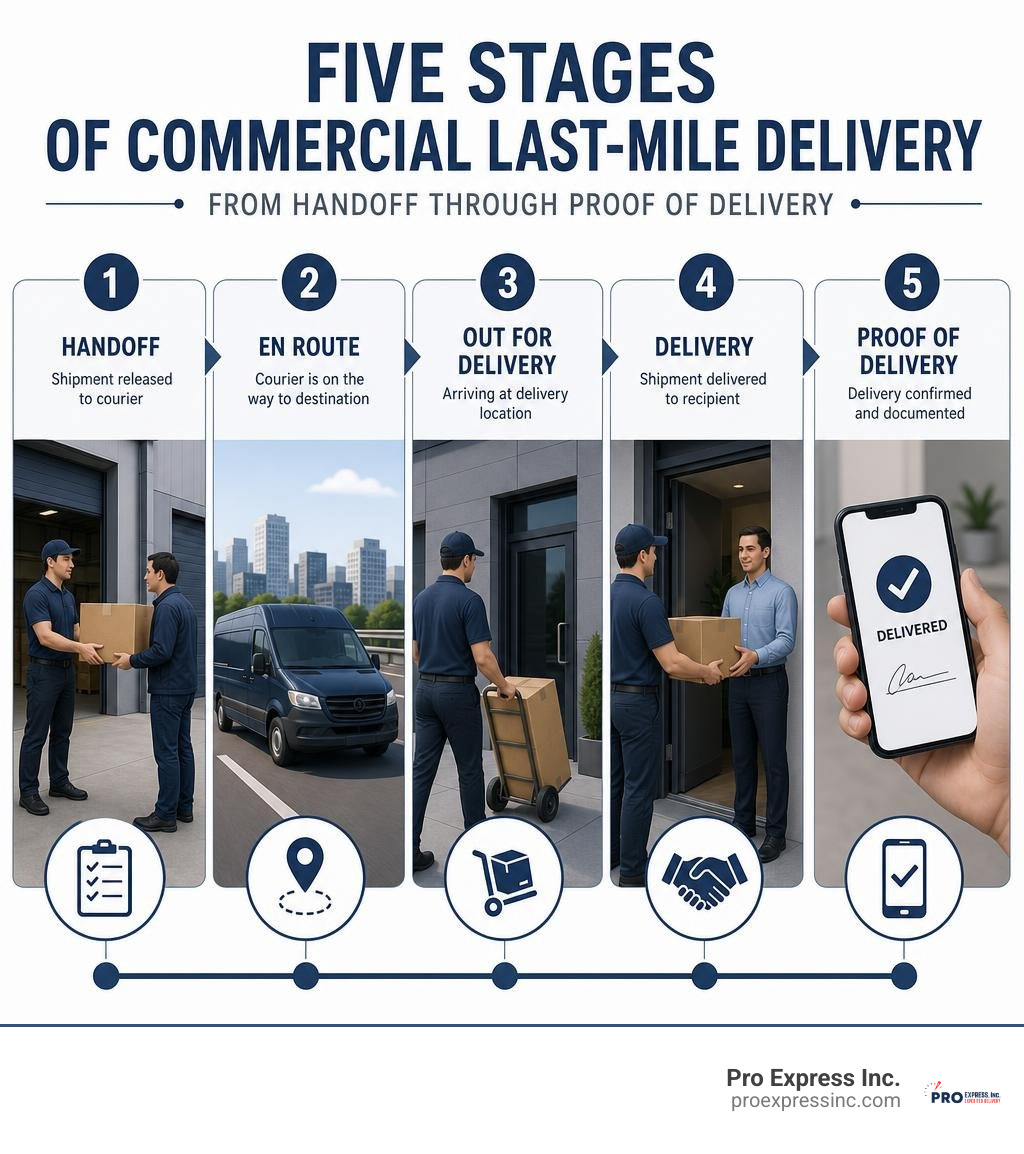
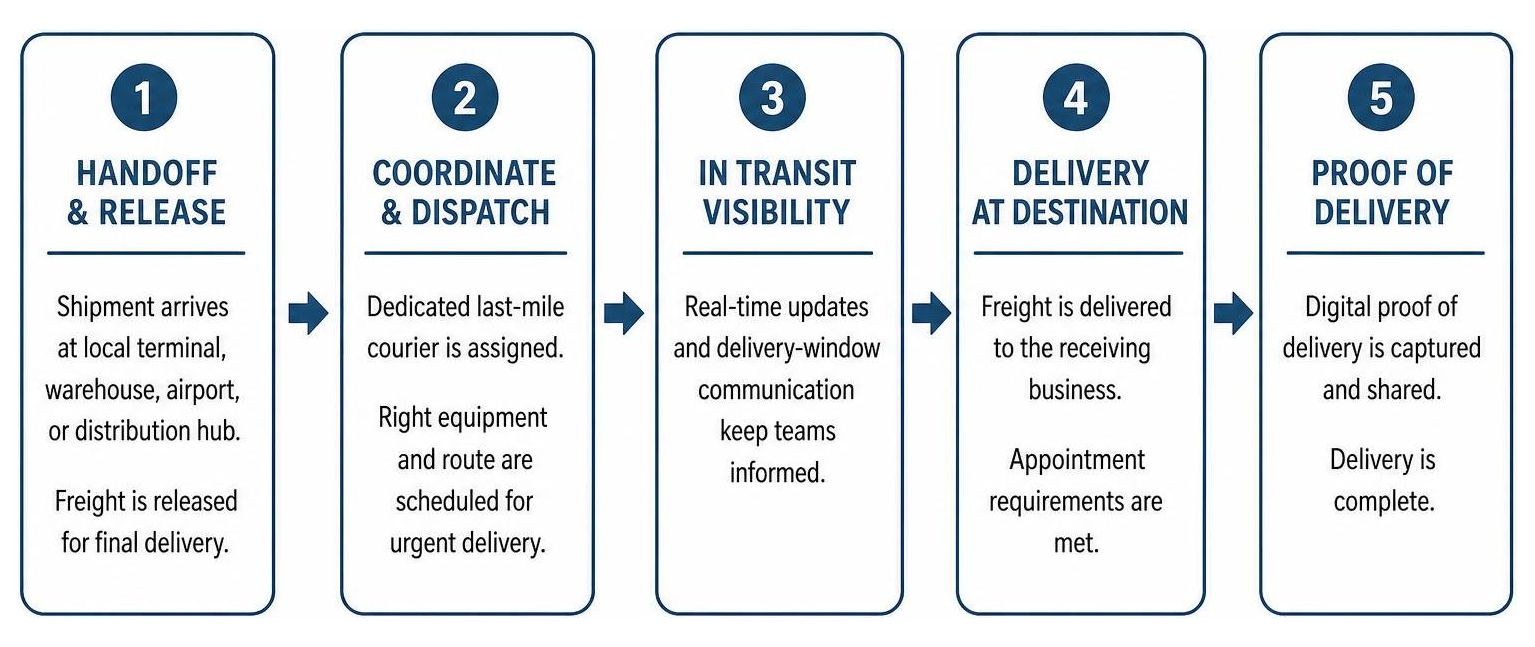
Coordinating reliable final-leg transportation involves a structured five-stage workflow designed to eliminate delays, prevent damage, and maintain transparency:
- Manifest Intake and Freight Verification: Upon notification of released cargo at an airport terminal, warehouse, or production facility, shipment dimensions, weight, and delivery constraints are verified.
- Dedicated Carrier Sourcing and Dispatch: A vetted carrier with appropriate vehicle capacity (sprinter van, straight truck, or specialized equipment) is assigned for immediate pickup.
- Secure Cargo Loading and Transit Monitoring: Cargo is secured using dedicated strapping and padding, initiating point-to-point transit without intermediate sorting stops.
- Site Access and On-Site Execution: The carrier navigates commercial facility checkpoints, maneuvering to receiving bays or designated entry points.
- Electronic Proof of Delivery and Status Synchronization: Digital signatures, timestamped photography, and receiving confirmations are logged instantly to close the chain of custody.
When manufacturing facilities face tight production schedules, utilizing an arranged same-day delivery service ensures that freight moves uninterrupted from the release point directly to the facility floor.
Real-Time Chain of Custody and Proof of Delivery

High-value commercial freight requires an unbroken chain of custody. When sensitive medical diagnostic machinery, aerospace components, or architectural lighting fixtures are in transit, passive milestone tracking is insufficient.
Modern freight brokerage relies on active status monitoring. Every handoff is verified through electronic proof of delivery (e-POD), capturing recipient names, digital signatures, exact GPS coordinates, and timestamped photography. This structured documentation confirms that delicate cargo is delivered in proper condition to authorized personnel, preventing disputes and verifying service completion.
Automated Notification Workflows and Status Tracking
Proactive communication is essential for managing receiving crews, staging areas, and equipment docks. Industry data shows that implementing integrated tracking workflows can decrease status inquiry friction by up to 70%, allowing operations personnel to focus on core tasks.
By coordinating with carriers utilizing modern digital infrastructure—such as an advanced Delivery Management System | FixLastMile—our freight coordinators maintain continuous visibility over transit milestones. Automated milestone alerts notify facility managers when the delivery vehicle departs the origin hub, enters the local geofence, and arrives on site, ensuring receiving teams are prepared for offloading.
Overcoming Visibility Gaps and Delivery Delays with Modern Technology
Inefficient carrier handoffs and tracking blind spots present significant operational challenges in US supply chains. Research indicates that logistics friction and uncoordinated transfers account for between 13% and 19% of supply chain inefficiencies—representing substantial operational waste across domestic transportation networks.
When freight is transferred between multiple regional networks, visibility is frequently lost, leading to missed delivery appointments and disruptive facility downtime. Coordinating dedicated, non-stop ground transport resolves these primary operational bottlenecks:
- Elimination of Cross-Dock Bottlenecks: Direct-drive transport eliminates sorting terminals where shipments risk misplacement or handling damage.
- Dynamic Real-Time Routing: Professional dispatch systems account for traffic congestion, road construction, and weather disruptions, recalculating routes to reduce out-of-route mileage by up to 35%.
- Seamless Communication Channels: Automated dispatch links provide real-time updates directly to facility managers, removing guesswork.
- Mitigation of Industry Delays: Direct transport prevents the cascading delays common in hub-and-spoke networks during peak seasonal surges.
How Modern Dispatch Technology Empowers the Last Mile Courier
Modern dispatch technology equips logistics coordinators with predictive tools to anticipate transit disruptions before they affect delivery schedules. AI-driven route optimization and geofenced milestone triggers allow dispatchers to bypass urban congestion and route drivers along optimal commercial corridors.
Furthermore, dynamic routing software has been shown to reduce vehicle idle times and decrease road fleet carbon emissions by up to 25%. When unexpected congestion occurs, intelligent dispatch systems immediately reroute dedicated vehicles, preserving critical delivery timelines for time-sensitive commercial shipments.
Specialized Handling for Critical and High-Value Commercial Freight

Standard curb drop-offs are inadequate for oversized, delicate, or high-value commercial cargo. Industrial manufacturing equipment, commercial architectural lighting, and sensitive medical technologies require specialized handling configurations and tailored vehicle capabilities.
When standard freight transit exposes cargo to excessive handling risks, arranging exclusive hot shots secures dedicated vehicle use. The cargo remains securely on a single truck from initial pickup to final destination, eliminating intermediate handling entirely.
White-Glove and Multi-Man Transport Protocols
Delicate electronic instruments, sterile healthcare components, and luxury architectural fixtures require meticulous handling beyond standard dock delivery. Our network coordination includes specialized white glove services designed for sensitive commercial freight:
- Two-Man Delivery Teams: Professional two-person crews equipped to maneuver heavy, delicate, or non-conveyable items through facility access ways safely.
- Inside Delivery and Placement: Transporting cargo past the loading dock directly into cleanrooms, production floors, laboratories, or administrative staging suites.
- De-crating and Debris Removal: Carefully unpacking machinery, verifying external condition, and removing all pallets, strapping, and protective wrap from the facility.
- Pre-Staging and Positioning: Positioning crated components precisely where installation teams require them for immediate assembly.
Heavyweight Freight and Mechanical Unloading Solutions
Many commercial delivery locations—such as active construction sites, suburban clinics, retail developments, and older manufacturing plants—lack elevated loading docks or forklifts. Delivering heavy palletized freight to these facilities requires specialized mechanical equipment.
To ensure safe, ground-level unloading without site delays, we arrange straight trucks and dry vans equipped with commercial hydraulic tailgates. As detailed in our guide where liftgate delivery explained outlines mechanical offloading protocols, deploying liftgate-equipped vehicles allows drivers to lower palletized cargo weighing up to several thousand pounds safely to the pavement or staging pad, preventing property damage and personal injury.
Frequently Asked Questions About Last-Mile Operations
How fast can an urgent commercial last-mile delivery be dispatched and completed?
Dispatch timelines depend on origin location and vehicle configuration, but urgent commercial pickups are typically arranged within 60 to 90 minutes of order confirmation. Because our network utilizes dedicated vehicles traveling directly to the destination without intermediate hub sorting, transit is completed as fast as road conditions safely permit.
What is the difference between standard parcel delivery and dedicated courier transport?
Standard parcel and LTL freight networks rely on hub-and-spoke distribution, meaning your cargo is co-loaded with hundreds of other shipments, unloaded at intermediate sorting terminals, and routed across multiple regional hubs. Dedicated courier transport assigns an exclusive vehicle solely to your cargo, traveling directly from pickup to delivery with zero transfers and complete chain-of-custody security.
How do specialized handling options like liftgates and inside delivery work for commercial sites?
When a commercial destination lacks an elevated loading dock or forklift, a liftgate-equipped truck uses a hydraulic platform to lower heavy freight from truck-bed height to ground level. If inside delivery is specified, the delivery crew uses specialized equipment like pallet jacks and stair-climbers to maneuver the cargo beyond the threshold and into the designated room, laboratory, or production floor.
Conclusion: Coordinating Fast and Reliable Final-Leg Logistics
When critical supply chains face unexpected disruptions, production deadlines loom, or primary logistics providers fail to deliver, businesses need a dependable partner to coordinate urgent ground solutions. For nearly 20 years, Pro Express Inc. has served as a trusted freight broker, orchestrating time-critical, same-day, and hot-shot freight across the contiguous United States.
Having successfully coordinated over 10,000 expedited shipments with a 99% client satisfaction track record, our team understands that speed, communication, and execution are paramount. Through our rigorously vetted carrier network, we arrange the dedicated vehicles, hydraulic liftgates, two-man crews, and inside handling protocols required to protect your critical deadlines.
When time is running out and standard carriers cannot meet your schedule, rely on our experienced team to coordinate your time-sensitive courier delivery services and keep your business moving forward.