
When Your Supply Chain Can’t Wait: What Expedited Freight Delivery Actually Means
Expedited freight delivery is a transportation service designed to move time-critical cargo faster than standard shipping — using dedicated vehicles, direct routing, and often team drivers to hit tight deadlines that normal freight simply can’t meet.
Quick answer for logistics managers:
- What it is: Priority shipping using dedicated trucks, vans, or air freight with no terminal transfers or shared stops
- How fast: Same-day delivery for regional lanes, next-day or 2-3 days coast-to-coast (vs. 4-5 days standard)
- Who uses it: Automotive, healthcare, aerospace, retail, and manufacturing operations facing urgent or unplanned shipping needs
- Key advantage: Your freight moves on your schedule — not the carrier’s consolidation schedule
- When to use it: Manufacturing line-down events, carrier failures, missed pickups, high-value cargo, or any shipment where a delay has a direct business cost
Every logistics manager knows the feeling. A critical part doesn’t show up. A carrier fails. A production line is hours away from shutting down. Standard freight won’t cut it.
That’s exactly the problem expedited freight solves.
Unlike conventional LTL or FTL shipping — where your cargo shares space, makes multiple stops, and moves on a carrier’s timetable — expedited freight assigns a dedicated vehicle to your load and sends it directly from origin to destination. No cross-docking. No waiting. No surprises.
With nearly 20 years of experience and 10,000+ shipments delivered, Pro Express Inc. has been the trusted partner for operations teams across the US when the clock is running and a missed delivery is not an option.
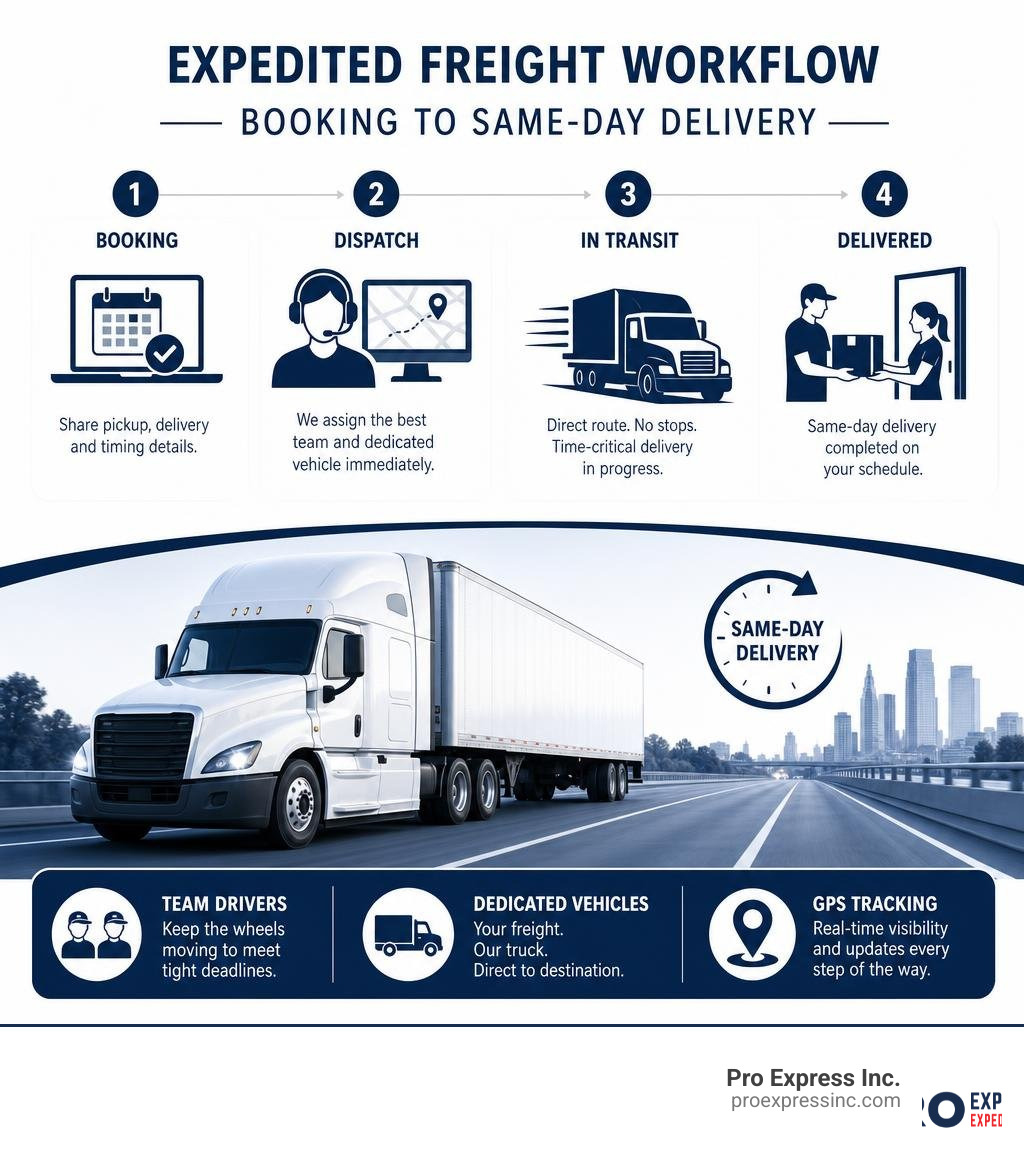
Expedited freight delivery vocab explained:
What is Expedited Freight Delivery and How Does It Work?
To truly understand how expedited freight delivery keeps supply chains moving, we must look at how it bypasses the traditional bottlenecks of standard transportation. Standard shipping is designed for volume consolidation. Carriers group multiple shipments from different businesses into a single trailer, routing them through a network of regional hubs and distribution terminals. While this is highly structured, it introduces significant delays and handling points.
When you opt for expedited ground shipping, the entire operational model shifts from consolidation to speed and direct execution. The moment you book a critical shipment, we bypass the standard terminal network entirely. Your cargo is loaded onto a dedicated vehicle that is committed solely to your shipment. This vehicle travels directly from your pickup location to the final destination without stopping to load or unload other cargo.
This direct-routing model is the most reliable way to eliminate transit uncertainty. By utilizing dedicated capacity, we ensure that your freight is not subject to the delays of other shippers’ cargo, missed hub connections, or terminal backlogs. Whether your cargo is moving across state lines or traversing long-haul corridors, this streamlined workflow guarantees that the focus remains entirely on your timeline.
To explore how these rapid solutions can be tailored to your specific logistics requirements, you can read more about Expedited Ground Freight: Faster Shipping Solutions for Your Business Needs.
The Mechanics of Expedited Freight Delivery
The true engine behind long-haul expedited transportation is the strategic deployment of team drivers. Under federal safety regulations, a single commercial driver is strictly limited in the number of hours they can operate a vehicle before they must take a mandatory rest break. This regulatory pause typically caps a single driver’s progress at approximately 500 miles per day.
By contrast, expedited team drivers work in pairs, alternating shifts behind the wheel. While one driver rests in the sleeper berth, the other keeps the truck in continuous motion. This operational synergy allows the vehicle to cover approximately 1,000 miles per day—nearly double the distance of a standard single-driver truckload.
Through this continuous movement, coast-to-coast deliveries that normally require four to five days are compressed into just two to three days. This is particularly vital for critical lanes connecting remote manufacturing hubs or reaching distant markets like Alaska or Hawaii. For shipments destined for the Pacific Northwest or the far north, utilizing specialized services such as Expedited Freight Shipping Alaska | Urgent & Time-Critical or Expedited Freight Anchorage | ExpeditedFreightAnchorage.com ensures that even remote locations receive uninterrupted, rapid service.
Key Differences from Standard Freight Shipping
When comparing expedited services to standard shipping methods, the differences in handling and security are stark. In a standard Less-Than-Truckload (LTL) network, a single piece of freight may be loaded, unloaded, and transferred between different trailers four or five times before reaching its final destination. Each transfer represents a point of vulnerability where cargo can be damaged, misrouted, or lost.
Expedited shipping minimizes these touchpoints. Because the cargo is placed on a dedicated vehicle at the origin and remains untouched until delivery, the risk of physical damage is virtually eliminated. This single-handling model is a cornerstone of expedited freight meaning, which prioritizes security alongside transit speed.
Furthermore, standard shipping operates on estimated delivery windows, whereas expedited logistics features guaranteed delivery times, often down to a specific hour. This level of precision allows operations managers to coordinate labor, prepare receiving docks, and keep downstream processes running smoothly.
Critical Scenarios: When to Choose Expedited Shipping
Logistics decision-makers must constantly balance operational urgency with resource allocation. While standard transport is suitable for routine inventory replenishment, certain high-stakes business scenarios demand the absolute speed of expedited services. Recognizing these triggers early can mean the difference between a minor operational hiccup and a multi-million-dollar disruption.
When a standard carrier fails to make a scheduled pickup, or when a sudden spike in demand leaves your shelves empty, waiting for the next standard transit window is not an option. In these moments, switching to a high-priority service is the most effective way of beating the clock with expert time-sensitive shipments.
Preventing Manufacturing Line-Down Emergencies
In modern manufacturing, particularly within the automotive and aerospace sectors, just-in-time (JIT) inventory models are the standard. While JIT minimizes warehouse storage requirements, it leaves very little margin for error. A single missing component—whether it is a specialized fastener, an electronic sensor, or an engine part—can cause an entire assembly line to grind to a halt.
The consequences of a manufacturing line shutdown are severe. Idle labor costs accumulate by the minute, production schedules slip, and contractual penalties from downstream buyers can mount rapidly. In these line-down situations, expedited transportation is utilized as an emergency recovery tool. Getting that critical part delivered via a dedicated sprinter van or an urgent air charter is a necessary step to resume production and protect key business relationships.
High-Value Cargo and Strict Delivery Windows
Certain types of cargo require an elevated level of security and precision that standard shipping networks simply cannot provide. High-value electronics, sensitive aerospace assemblies, and critical medical devices must be transported under strict supervision.
For example, the healthcare sector relies heavily on medical & pharmaceutical expedited shipping to transport life-saving equipment, temperature-sensitive pharmaceuticals, and urgent clinical trial materials. These shipments often require specialized climate control, continuous monitoring, and delivery directly to a specific hospital ward or laboratory.
Similarly, transporting trade show exhibits or high-profile product launch materials requires strict adherence to rigid delivery windows. If trade show materials arrive even a few hours late, the entire event investment is lost. Utilizing dedicated expedited carriers ensures that these high-value, highly sensitive shipments arrive exactly when promised, completely bypassing the risks of standard hub networks. This holds true even for offshore destinations, where coordinating with specialized providers like Expedited Freight Honolulu | ExpeditedFreightHonolulu.com or leveraging a dedicated Hawaii Freight Transport and Shipping Company is essential to meet narrow delivery windows.
Equipment and Vehicle Options for Urgent Shipments
To execute rapid logistics successfully, a carrier must match the specific cargo profile with the right vehicle. Using a vehicle that is too large can lead to unnecessary resource consumption, while a vehicle that is too small cannot accommodate the physical dimensions of the freight.
Our ground-expedited services rely on a versatile fleet designed to handle everything from a single critical pallet to a full truckload of high-priority inventory. To understand the capabilities of each option, consider the following equipment breakdown:
| Vehicle Type | Maximum Weight Capacity | Average Pallet Capacity | Ideal Use Case |
|---|---|---|---|
| Cargo / Sprinter Van | Up to 2,500 – 3,500 lbs | 2 – 3 Standard Skids | Small parts, urgent medical devices, local hot-shots |
| Straight Truck (Box Truck) | Up to 8,000 – 12,000 lbs | 10 – 12 Standard Skids | Mid-sized manufacturing shipments, trade show exhibits |
| Dry Van (Tractor-Trailer) | Up to 45,000 lbs | 26 Standard Skids | High-volume inventory recovery, long-haul team driving |
| Flatbed Truck | Up to 45,000 lbs | Variable (Oversized) | Industrial machinery, construction equipment, oilfield parts |
By maintaining a diverse range of equipment, we can deploy the exact vehicle needed for your urgent cargo, ensuring maximum transport efficiency and absolute safety. You can learn more about how we structure these specialized resources by visiting our expedited ground services page.
Ground Expedited Vehicles
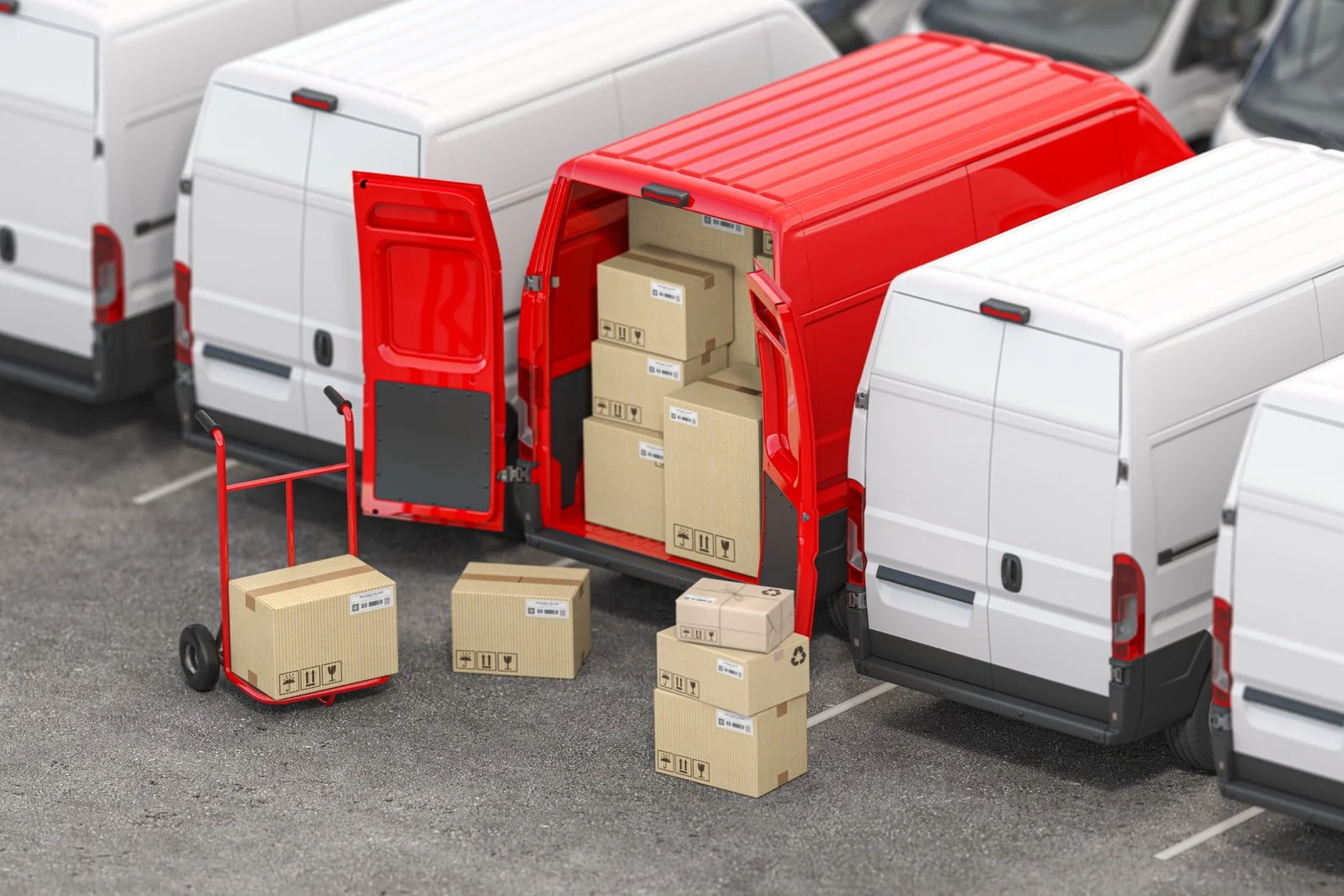
For regional and mid-distance lanes, sprinter vans and straight trucks are the workhorses of expedited logistics. Sprinter vans are highly agile, capable of navigating congested urban areas and tight loading docks with ease. They are ideal for rapid, door-to-door deliveries of smaller cargo.
For larger loads, straight trucks equipped with liftgates allow us to service locations that do not have dedicated loading docks. This is highly valuable for final-mile deliveries to retail stores, medical facilities, or construction sites. Additionally, we can deploy two-man crews for white-glove handling, ensuring that heavy or sensitive equipment is safely unloaded, placed, and unpacked according to your exact specifications.
Hot-Shot Trucking and Dedicated Solutions
Hot-shot trucking is a highly specialized form of expedited shipping that typically utilizes Class 3-5 trucks (such as heavy-duty pickups) pulling flatbed trailers. This method is widely used for transporting urgent, oversized, or irregularly shaped cargo—such as industrial valves, construction materials, or agricultural machinery—that must be loaded and unloaded from the side or top of the trailer.
Whether you need a hot-shot flatbed for an industrial site or a dedicated sprinter van for an overnight delivery, having access to a flexible fleet ensures that your operations never miss a beat. For a deeper dive into how these vehicles are managed across nationwide networks, read The Ultimate Guide to Expedited Shipping.
Best Practices for Selecting an Expedited Carrier
When your supply chain is facing a crisis, you cannot afford to partner with an unverified carrier. The expedited logistics space is highly fragmented; in fact, approximately 91.7% of U.S. motor carriers operate six or fewer trucks, and 97.3% operate fewer than 20 trucks. This means that many providers are small, regional operators who may lack the technology, capacity, or 24/7 infrastructure required to manage high-stakes, long-distance emergencies.
To ensure your critical cargo is protected, you must partner with an experienced provider that possesses a proven track record, nationwide reach, and robust communication systems.
Ensuring Reliable Expedited Freight Delivery
A reliable expedited partner must offer more than just trucks; they must deliver peace of mind. When evaluating a carrier, look for a proven history of high on-time performance and deep industry experience. Pro Express Inc. brings nearly two decades of logistics expertise, backed by a 99% client satisfaction rating and a history of more than 10,000 successfully delivered shipments.
Nationwide coverage is equally critical. Your carrier must be capable of seamlessly managing shipments across the entire North American continent, including specialized lanes servicing Alaska, Hawaii, and cross-border lanes. This ensures that no matter where your disruption occurs, you have a single, reliable point of contact to handle the recovery from start to finish.
Key Questions to Ask Your Logistics Partner
Before tendering a critical shipment, ask your logistics provider these essential questions to verify their capabilities:
- Do I have direct access to a dispatcher 24/7/365? During a 3 AM shipping emergency, you should not be routed to an automated voicemail or a generic offshore call center. You need immediate, direct contact with an expert coordinator who can make real-time decisions.
- How do you monitor shipment security and location? Reliable carriers utilize advanced satellite tracking and real-time GPS monitoring to provide constant visibility. This level of oversight ensures that high-value cargo is safeguarded against theft and delay throughout its journey.
- What is your contingency plan if a vehicle experiences a breakdown? A true expedited expert always has a backup plan, maintaining access to a broad network of vetted recovery vehicles to transfer cargo and keep the shipment moving without delay.
To learn more about the operational advantages of continuous, round-the-clock visibility, check out our guide on Tracking Your Package at 3 AM and Other Expedited Service Perks.
Frequently Asked Questions About Expedited Shipping
How fast can an expedited shipment be delivered?
Delivery speed depends on distance, but expedited shipping is designed for maximum velocity. For regional shipments (under 300 to 400 miles), same-day delivery is standard. For long-haul transits, team-driver vehicles can remain in continuous motion, covering up to 1,000 miles per day. This enables coast-to-coast deliveries in just two to three days, compared to the four to five days required for standard truckload shipping.
What is the difference between hot-shot trucking and expedited freight?
While both services focus on urgent deliveries, they utilize different equipment and serve different cargo profiles. Hot-shot trucking typically refers to urgent shipments moved on flatbed trailers or medium-duty trucks, often servicing the oil, gas, agriculture, and construction industries. Expedited freight is a broader category that encompasses all time-critical transport, utilizing sprinter vans, straight trucks, and full 53-foot dry vans for a wide variety of industries.
Can expedited shipments be tracked in real time?
Yes. Unlike standard freight, which may only update when passing through physical terminals, expedited shipments utilize continuous GPS tracking. Shippers receive real-time location updates, automated status alerts, and 24/7 support, ensuring complete visibility from the moment of pickup to the final signature. For additional details on how to get started with time-critical logistics, you can consult resources like Expedited Freight Shipping: What It Is, How It Works, and How to Get … or browse the general industry network at Expedited Freight | ExpeditedFreight.com .
Conclusion
When your standard supply chain channels fail, or when critical deadlines put your business relationships at risk, you need a logistics partner that operates with the same level of urgency that you do. Expedited freight delivery is not just an alternative shipping method; it is an essential business continuity tool that protects your production schedules, secures your high-value cargo, and ensures you keep your promises to your customers.
At Pro Express Inc., we have spent nearly 20 years refining our ground-expedited services. With a track record of over 10,000 shipments delivered and a 99% client satisfaction rating, we provide the US-wide coverage, 24/7 live dispatch support, and specialized equipment your operations demand.
Don’t let a shipping delay disrupt your business operations. Contact our logistics specialists to experience the speed, security, and reliability of dedicated expedited transport.