
When “Fast” Means Nothing Without Visibility
Expedited freight services tracking is the real-time monitoring of time-critical shipments as they move from pickup to final delivery — typically through GPS-equipped vehicles, live carrier updates, and dedicated support contacts available around the clock.
If you’re a logistics manager looking for expedited freight tracking portals and tools, here’s a quick-reference overview:
| Tracking Method | What It Does | Best For |
|---|---|---|
| GPS vehicle tracking | Live location updates every 60 seconds | Ground expedited, sprinter vans, straight trucks |
| Satellite tracking | Coverage in remote or low-signal areas | Hot-shot, oil & gas, long-haul lanes |
| Carrier portal login | Status, ETA, and event history in one dashboard | Day-to-day shipment monitoring |
| API/EDI integration | Automated updates pushed to your own system | Operations teams, ERP-connected workflows |
| Dedicated point of contact | Direct human updates 24/7/365 | Urgent or high-stakes freight moves |
Here’s the problem every operations manager knows too well: a shipment is marked expedited, but there’s no way to confirm where it actually is. The carrier goes quiet. Your production line is waiting. And “fast” suddenly means nothing.
Same-day and next-day shipping demand has surged — next-day volumes alone have grown by 58% over the past five years, with same-day up by 164%. That kind of pressure leaves zero room for blind spots in your supply chain.
Real-time visibility isn’t a nice-to-have for time-critical freight. It’s the entire point. Without it, you’re not managing a shipment — you’re just hoping.
Pro Express Inc. has spent nearly 20 years solving exactly this problem for B2B logistics teams across the US, delivering 10,000+ shipments with a 99% client satisfaction rate — because knowing where your cargo is, at every moment, is what separates a reliable partner from another missed deadline.
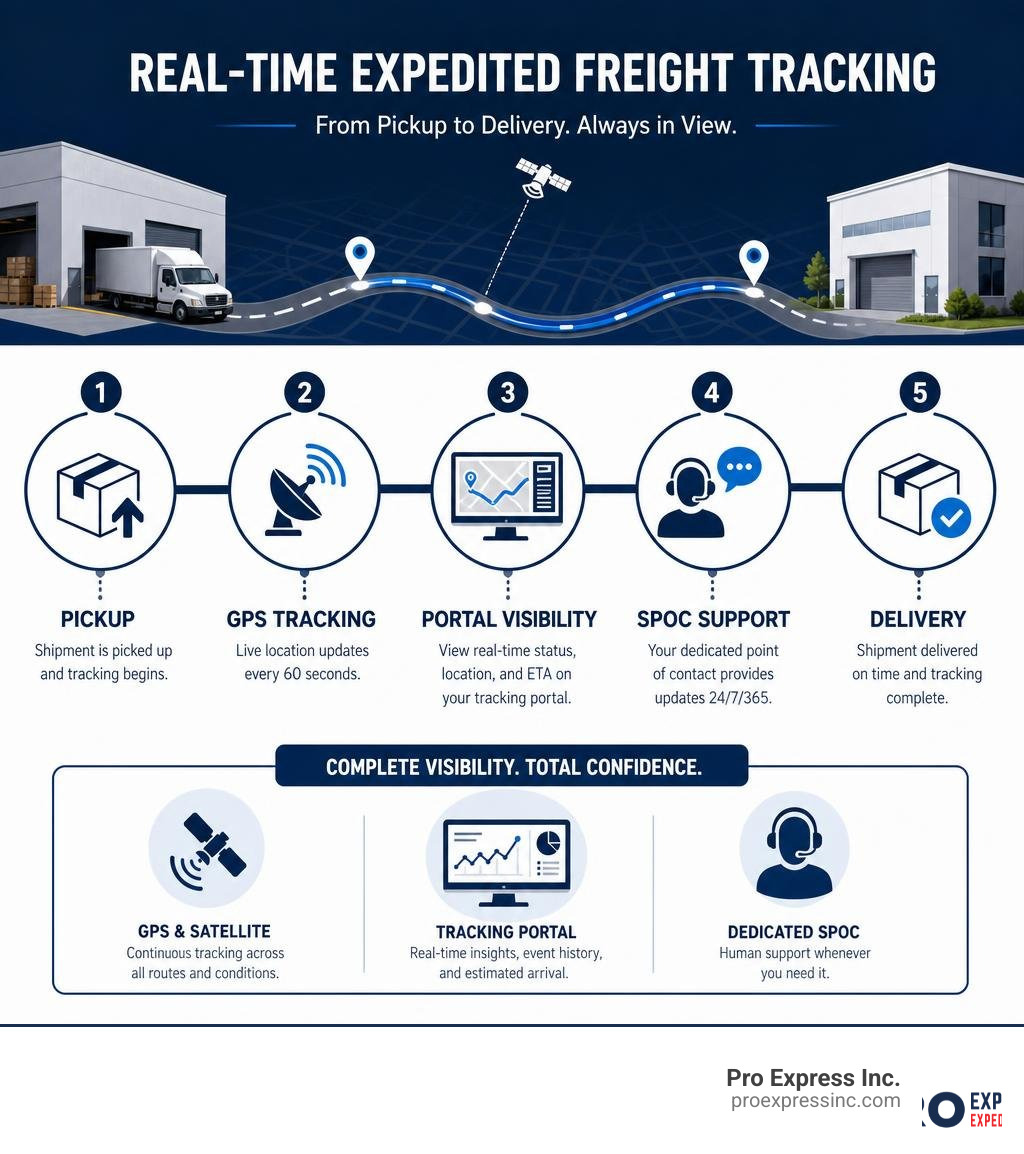
Understanding Expedited Freight Services Tracking and How It Works
To understand why specialized tracking is so critical, we must first look at how standard freight tracking operates. In a traditional less-than-truckload (LTL) or truckload setup, tracking is often transactional and retroactive. A truck rolls into a regional terminal, a barcode is scanned, and your online portal updates to show the cargo has arrived at a transit hub. If that truck gets stuck in traffic, experiences a mechanical failure, or sits in a yard for twelve hours, you rarely find out until the delivery window has already passed.
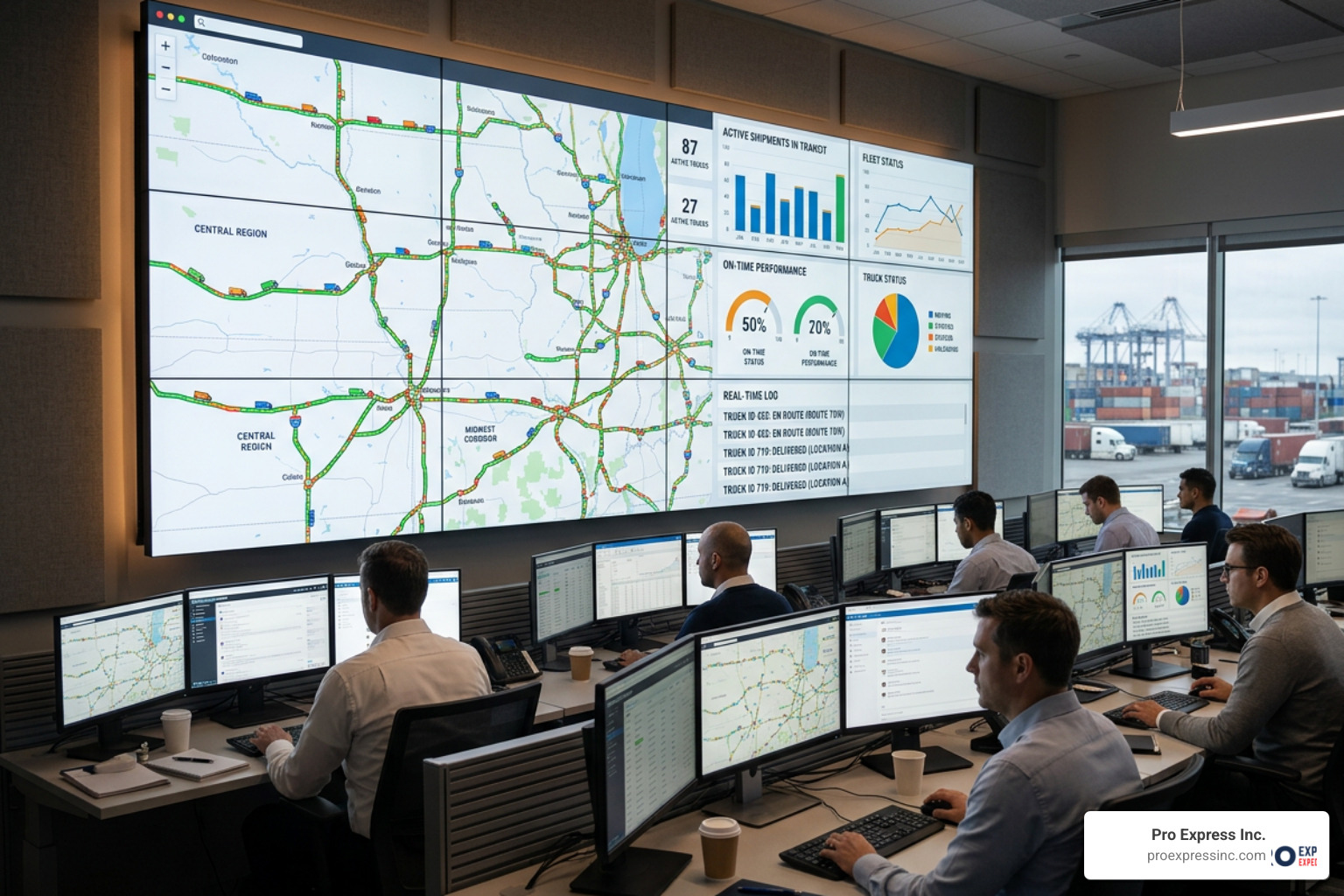
With expedited freight services tracking, the paradigm shifts entirely. Because time-critical shipments cannot afford delays, the tracking infrastructure is designed around continuous, active monitoring. Instead of waiting for terminal scans, logistics managers receive continuous updates directly from the vehicle carrying their goods.
This high-performance tracking relies on three core operational pillars:
- Dedicated Vehicles: Unlike standard freight, which is consolidated and transferred between multiple trucks and hubs, expedited shipments utilize exclusive-use vehicles. Your cargo goes onto one vehicle at the origin and stays on that exact vehicle until it reaches its destination. This eliminates the “black box” period associated with terminal transfers.
- Direct Routing: Because the vehicle has a single mission, it travels directly from point A to point B. The tracking system monitors this specific path, comparing actual progress against optimized routing models to identify any potential bottlenecks before they cause a delay.
- Active GPS Telemetry: Modern expedited fleets are equipped with hardware that transmits geographic coordinates, speed, and heading at frequent intervals. This ensures that logistics planners and shippers have access to the exact physical location of their freight at any hour of the day or night.
Having access to this continuous stream of information is particularly valuable when managing high-stakes shipments. Whether you are coordinating a critical run at midnight or checking on a shipment’s progress before a morning production shift, having a reliable system in place makes all the difference. For a deeper look at the peace of mind this level of visibility provides, read our guide on Tracking Your Package at 3 AM and Other Expedited Service Perks.
When managing time-critical logistics, knowing the exact status of your freight helps you coordinate labor, manage warehouse space, and keep your customers informed. Having access to real-time tracking data allows operations teams to organize shipment events, monitor estimated arrival times, and respond immediately to exception alerts.
Core Technologies Powering Time-Critical Shipment Visibility
Achieving true, uninterrupted visibility across North America requires a sophisticated stack of hardware and software. When a shipment must cross several states overnight, standard cellular tracking is rarely sufficient. Expedited logistics providers utilize an array of advanced technologies to keep shippers connected to their cargo.
How GPS and Satellite Systems Enable Expedited Freight Services Tracking
At the foundation of expedited tracking is global positioning system (GPS) technology combined with satellite communication. While cellular tracking is highly effective in major metropolitan corridors, it can drop off in remote regions, mountain passes, or during severe weather events.
By integrating satellite-backed telemetry, expedited carriers ensure that cargo location updates are transmitted every 60 seconds, regardless of cellular network availability. This continuous data stream creates a highly accurate “breadcrumb trail” on interactive tracking maps.
For long-haul lanes, this technology is vital when utilizing team drivers. Team drivers are pairs of certified operators who alternate driving shifts, allowing the vehicle to remain in motion around the clock without violating federal hours-of-service regulations. With satellite-enabled tracking, logistics managers can monitor the vehicle’s continuous progress in real-time, verifying that the truck is moving safely and efficiently toward its destination even while one driver rests.
API and EDI Integrations for Automated Expedited Freight Services Tracking
While tracking portals are excellent for manual checks, enterprise operations require automated, system-to-system communication. This is achieved through Application Programming Interfaces (APIs) and Electronic Data Interchange (EDI).
Instead of requiring your dispatchers or logistics coordinators to log into external websites, API integrations push real-time milestone updates directly into your company’s Enterprise Resource Planning (ERP) or Transportation Management System (TMS). When a milestone is reached—such as a vehicle crossing a custom geofence near your facility—your internal systems are updated automatically, triggering receiving dock preparations or automated notifications to your customer.
For technical teams looking to build direct tracking integrations, modern logistics platforms structure exact-match queries to retrieve comprehensive status, events, and carrier details using a single customer reference number.
Furthermore, these integrated systems utilize standard tracking structures to ensure consistency across different platforms. Shippers looking to understand how enterprise-level tracking systems manage multi-entity orders, container events, and milestone timelines can rely on robust API frameworks that map critical milestones from dispatch to final sign-off.
How Real-Time Visibility Solves Critical Supply Chain Pain Points
In the B2B world, shipping delays are rarely just inconvenient—they are operationally disruptive. When a critical component fails to arrive on time, the consequences ripple across entire organizations.
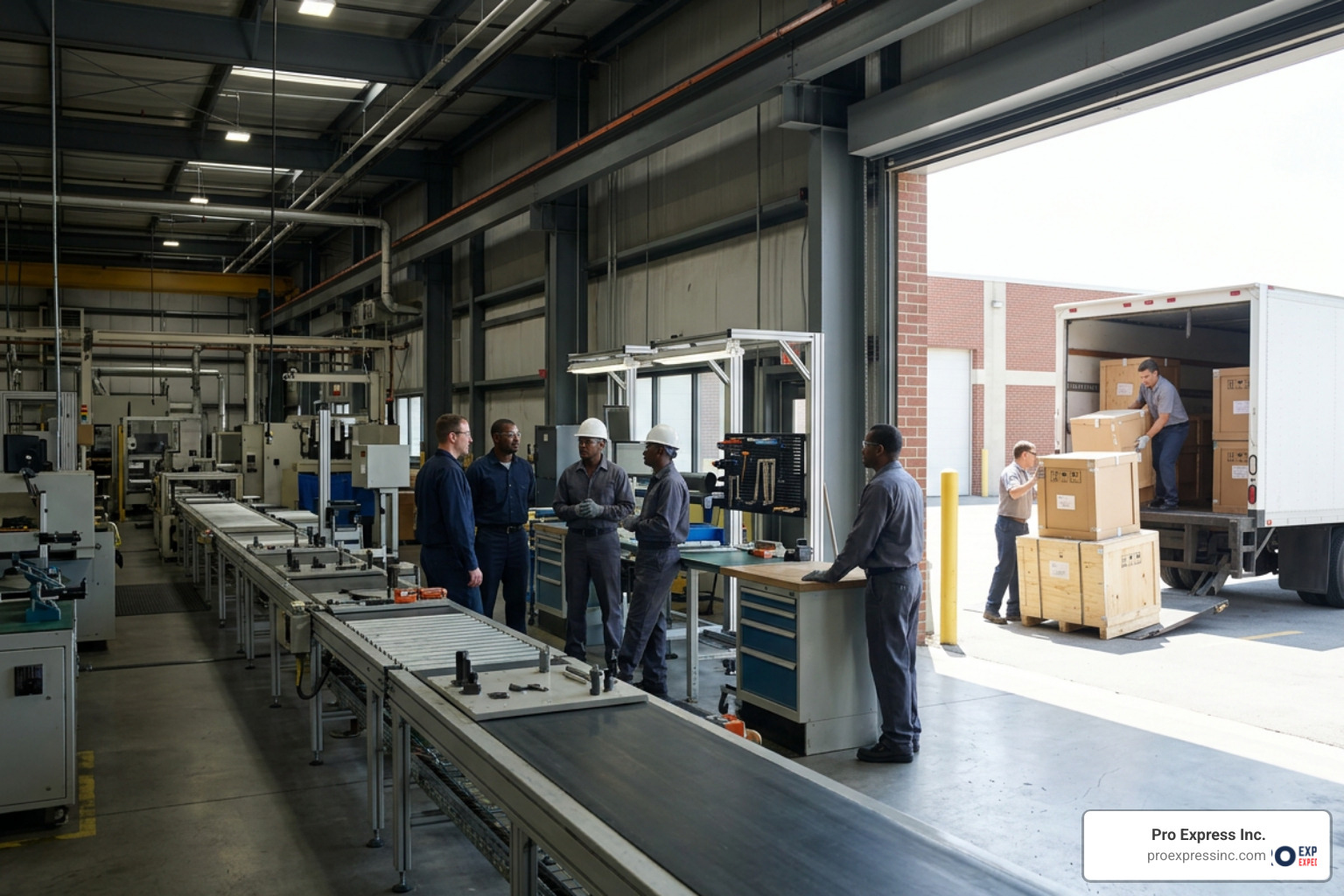
Consider a manufacturing facility experiencing a “line-down” event. If a specialized sensor or hydraulic pump fails, an entire assembly line can grind to a halt, idling dozens of workers and delaying finished product shipments to customers. In these high-pressure scenarios, standard shipping is simply not an option. You can learn more about the strategic role of rapid logistics in our article on Expedited Freight Meaning and Why Your Logistics Need a Turbo Boost.
Real-time visibility directly addresses these operational vulnerabilities by transforming how businesses handle logistics exceptions:
- Mitigating Carrier Failures: If a standard carrier fails to show up or misses a critical transit window, real-time tracking alerts you instantly, allowing you to deploy an expedited hot-shot vehicle to recover the freight before the delay escalates.
- Precise Warehouse Coordination: Instead of having receiving crews wait around for a truck with an uncertain arrival time, warehouse managers can monitor the live GPS feed to schedule labor precisely when the truck is 30 minutes away.
- Proactive Problem Solving: If a tracking system flags a delay due to an unexpected road closure or severe weather, logistics coordinators can immediately reroute the vehicle or adjust production schedules, rather than discovering the delay after the delivery window has closed.
- Building Customer Trust: When you can provide your clients with a secure, real-time tracking link showing the exact location of their urgent order, you eliminate anxiety and build long-term operational trust.
To illustrate the operational differences, consider how standard tracking compares to expedited tracking across key metrics:
| Operational Metric | Standard Freight Tracking | Expedited Freight Tracking |
|---|---|---|
| Update Frequency | Hours or days (only at terminal scans) | Minutes (continuous GPS/satellite updates) |
| Data Accuracy | Estimated based on historical averages | Predictive based on real-time traffic, weather, and HOS |
| Cargo Handling | High (multiple transfers, cross-docking) | Minimal to none (loaded once, delivered directly) |
| Communication | Automated email alerts or call centers | Dedicated single point of contact (SPOC) |
| Geofencing | Rarely available | Standard (automated alerts upon arrival/departure) |
Tracking Across Different Urgent Transportation Modes
Not all expedited shipments travel the same way. Depending on the size, weight, and urgency of the cargo, different transportation modes are deployed. A robust tracking system must adapt to each of these modes seamlessly.
- Sprinter Vans: Perfect for smaller, palletized loads or loose cargo up to 3,000 pounds. These agile vehicles are frequently used for rapid local and regional deliveries. Tracking systems monitor these vans closely as they navigate congested urban environments, providing precise arrival times down to the minute.
- Straight Trucks: Designed for mid-sized shipments up to 13,000 pounds that require dedicated space. Straight trucks are ideal for regional manufacturing runs, and their tracking systems often include sensor integration to monitor cargo security throughout the journey.
- Hot-Shot Trucking: Utilizing heavy-duty pickup trucks with specialized trailers, hot-shot shipping is the go-to choice for heavy, oversized, or awkwardly shaped machinery components, particularly in the construction, agricultural, and energy sectors. Tracking hot-shot loads requires specialized routing software to account for weight restrictions and travel regulations.
- Air Charter: For the most urgent, long-distance shipments, chartering a dedicated aircraft bypasses ground transit times entirely. Air charter tracking monitors flight plans, runway departures, and tarmac transfers, ensuring seamless coordination with ground couriers at both ends of the flight.
Regardless of the vehicle selected, the core principle remains the same: the shipment travels in an exclusive-use vehicle with direct routing. To explore how different ground options can be tailored to your operational needs, read our comprehensive guide on Expedited Ground Freight: Faster Shipping Solutions for Your Business Needs.
To gain a broader perspective on how these services fit into your overall logistics strategy, you can review our resources on Expedited Shipping: Your Complete 2026 Guide and explore the various service levels detailed in Expedited Shipping Services: The 2026 Guide.
For those who want an all-in-one manual on managing time-sensitive cargo, The Ultimate Guide to Expedited Shipping provides actionable checklists and operational best practices. Once you are ready to book, you can quickly secure dedicated capacity by requesting an Instant Freight Quote on Demand Shipping.
When selecting a logistics partner, it is important to ensure their network can support your geographic requirements. Whether you are shipping within the contiguous United States, coordinating a critical delivery to the Pacific Northwest, or managing urgent lanes in remote areas, a reliable carrier must maintain robust coverage even in challenging environments.
For shippers evaluating nationwide capacity, consulting industry resources like the Expedited Carriers Guide 2024 – Inbound Logistics can help you understand standard carrier capabilities and how leading networks structure their fleets, tracking portals, and support teams to meet tight deadlines.
Frequently Asked Questions About Expedited Tracking
What is the difference between delayed and late status in expedited tracking?
In professional expedited tracking systems, these two terms represent different operational stages:
- Delayed: This status indicates that a shipment has fallen behind its planned transit schedule—for example, due to an unexpected traffic bottleneck, weather event, or a slight delay during the pickup window. However, a “delayed” status does not necessarily mean the final delivery window will be missed. It serves as an early alert for dispatchers to optimize the remaining route or coordinate with drivers to get the shipment back on track.
- Late: This status is applied when a shipment is actively en route but has officially surpassed its scheduled delivery time.
How do team drivers affect tracking and delivery timelines?
Team drivers are critical for long-haul expedited ground transit. Under federal safety regulations, a single driver must stop and rest after a set number of driving hours. On a cross-country run, these mandatory rest periods can add days to the delivery timeline.
By pairing two drivers on a single vehicle, one driver can sleep in the onboard berth while the other keeps the truck moving. This allows the vehicle to remain in continuous motion around the clock. From a tracking perspective, you will see your cargo moving continuously across the map without the long, static pauses associated with single-driver rest cycles.
What should B2B shippers look for in an expedited tracking portal?
When evaluating an expedited carrier’s tracking capabilities, look for these essential features:
- Real-Time Map Visibility: A live, interactive map showing the vehicle’s actual location, not just a list of text-based terminal updates.
- Proactive Alerts: The ability to configure automated text or email notifications for key milestones, such as when a vehicle is within 50 miles of your facility.
- Single Point of Contact (SPOC): A direct line to a dedicated logistics specialist who is actively monitoring your shipment, allowing you to bypass automated phone trees or generic customer service queues.
- Document Access: Immediate digital access to critical paperwork, including the Bill of Lading (BOL) and real-time digital Proof of Delivery (POD) signatures.
Conclusion
In the world of B2B logistics, speed is only half the equation. Without real-time visibility, even the fastest transportation modes can leave your operations vulnerable to uncertainty, missed deadlines, and miscoordinated labor. Implementing a robust expedited freight services tracking strategy ensures that you maintain complete control over your supply chain, protect your production schedules, and build lasting trust with your clients.
At Pro Express Inc., we combine nearly two decades of logistics expertise with advanced tracking technology to deliver absolute reliability. With nearly 20 years of experience, over 10,000 successfully delivered shipments, and a 99% client satisfaction rate, we specialize in providing fast, secure ground-expedited shipping—including same-day, next-day, hot-shot, and white glove services—across the United States. Supported by our 24/7/365 customer service team, we ensure you never have to wonder about the status of your critical cargo.
Don’t let carrier failures or blind spots disrupt your operations. Contact our logistics specialists today to secure dedicated capacity and experience the peace of mind that comes with complete cargo visibility.