
Why a Vetted Carrier Network Nationwide Matters When Freight Cannot Wait
A vetted carrier network nationwide gives shippers and brokers faster access to qualified freight capacity when a regular carrier falls through. The practical test is simple: work with a freight broker that confirms active operating authority, insurance, safety and compliance history, equipment fit, and carrier performance – then continues to monitor those details after dispatch.
For an urgent B2B shipment, this process helps reduce the risk of an unauthorized pickup, coverage gap, missed deadline, or carrier that cannot handle the load. It also makes it easier to match a shipment with the right capacity for its route, handling needs, and delivery window.
A standard carrier list may only show who is available. A vetted network adds proof that the carrier is legitimate, properly covered, and suitable for the shipment. Modern vetting can also combine digital records with live location data and physical verification, creating a stronger chain of custody from pickup through delivery.
For nearly 20 years, Pro Express Inc. has arranged and coordinated time-critical freight through qualified carrier relationships. When a critical shipment is stuck or a delivery deadline is at risk, reliable verification matters as much as fast dispatch.
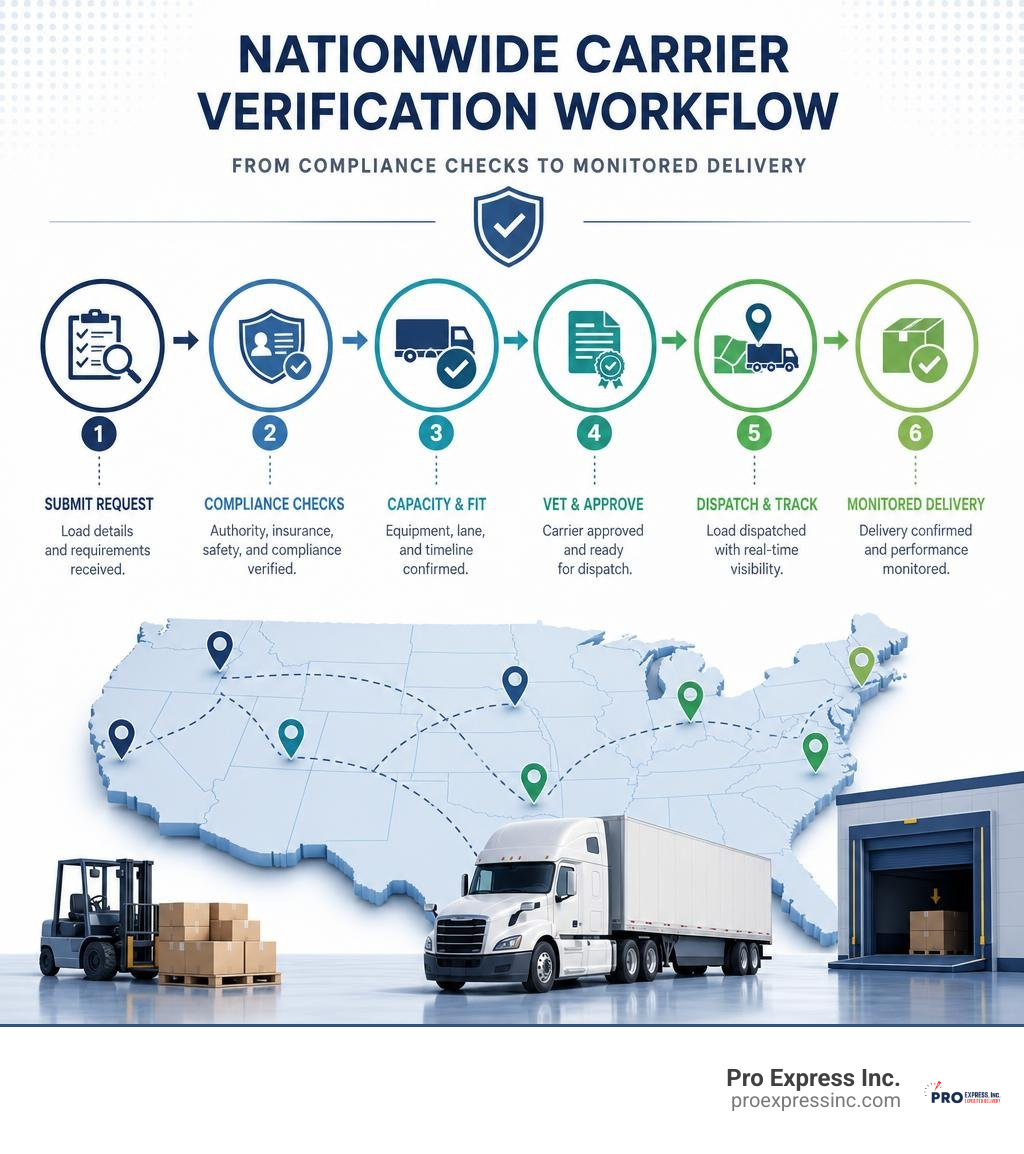
Vetted carrier network nationwide terms simplified:
5 Core Pillars of a Vetted Carrier Network Nationwide
Managing high-stakes B2B shipments demands strict discipline. Handing over mission-critical freight to an unknown entity can feel daunting, but a systematic vetting framework removes uncertainty from the equation.
Stringent Safety, RMIS Risk Scoring, and Insurance Thresholds
The foundation of any reputable network is an unbending standard for safety, compliance, and insurance coverage. When businesses seek to find reliable shipping companies, they need absolute confidence that motor carriers possess active Department of Transportation (DOT) operating authority and a pristine Federal Motor Carrier Safety Administration (FMCSA) safety profile.
At Pro Express Inc., we rely on comprehensive Risk Management Information Systems (RMIS) to evaluate carrier safety histories, out-of-service violations, crash metrics, and carrier longevity. We require carriers operating across arranged lanes to meet non-negotiable insurance thresholds:
- A minimum of $100,000 in cargo liability coverage to safeguard freight against damage or loss.
- At least $1,000,000 in active auto liability coverage to ensure complete financial and legal protection during transit.
- Proof of active, unblemished operating authorities verified directly against federal licensing databases.
Maintaining Compliance Across a Vetted Carrier Network Nationwide
Carrier compliance is not a one-time stamp of approval; it is an ongoing, real-time discipline. A carrier that meets every standard during initial onboarding could experience an insurance cancellation or safety downgrade weeks later.
Maintaining network integrity requires automated compliance alerts and continuous record reviews. Modern freight broker services utilize integrated tracking systems that flag:
- Certificate of Insurance (COI) expiration dates well in advance.
- Sudden changes in DOT safety ratings, inspections, or out-of-service percentages.
- Key Performance Indicator (KPI) metrics, including on-time pickup and delivery rates, tracking consistency, and responsiveness.
When a carrier experiences an authority lapse or fails to meet our performance thresholds, automated safeguards immediately pause their assignment capability until compliance is completely restored.
Advanced Security: Integrating Physical Ground Truth and Digital Authentication
Freight security today must defend against increasingly sophisticated threats, including identity theft, fraudulent carrier profiles, and unauthorized double brokering.

How a Vetted Carrier Network Nationwide Prevents Cargo Fraud and Theft
Strategic cargo theft often involves digital manipulation—such as compromised carrier emails, fraudulent dispatchers, or spoofed documentation designed to misdirect high-value goods. Mitigating these risks requires pairing digital verification with physical ground truth.
Modern security workflows authenticate carrier identity at multiple checkpoints before freight is loaded:
- Direct Dispatch Validation: Verifying that communication originates from authenticated carrier domains rather than lookalike email addresses.
- Double-Brokering Safeguards: Cross-referencing carrier tax IDs, banking information, and authorized equipment counts to verify that the booked entity is the entity physically hauling the load.
- Dockside Identity Matching: Equipping facility staff with verified driver credentials, truck license numbers, and carrier operating numbers prior to gate entry.
Driver-Level Verification and Sensor-Based Asset Tracking
Carrier vetting has evolved beyond corporate-level documentation to driver-level physical verification. Across major shipping lanes, advanced roadside optical sensors and optical ground-truth networks capture millions of truck images daily. This data verifies that a specific tractor and trailer combination is physically present on the scheduled route.
When arranging time-critical logistics for manufacturing or automotive sectors, this physical-to-digital link provides clear chain-of-custody verification:
- Roadside Sensor Cross-Referencing: Validates that the carrier assigned to the load is operating on the planned transit corridor.
- Rapid Recovery Protocols: In the rare event of transit discrepancies or equipment theft, sensor data gives recovery teams precise geographic coordinates, enabling swift coordination with local authorities.
- Driver Validation: Prevents unauthorized drivers from picking up time-sensitive freight by verifying physical identification against dispatch credentials at the loading dock.
Technological Infrastructure Supporting Modern Carrier Vetting
Seamless nationwide logistics relies on advanced data integration. Digital systems eliminate manual bottlenecks, ensuring that vetted capacity is ready for rapid dispatch.
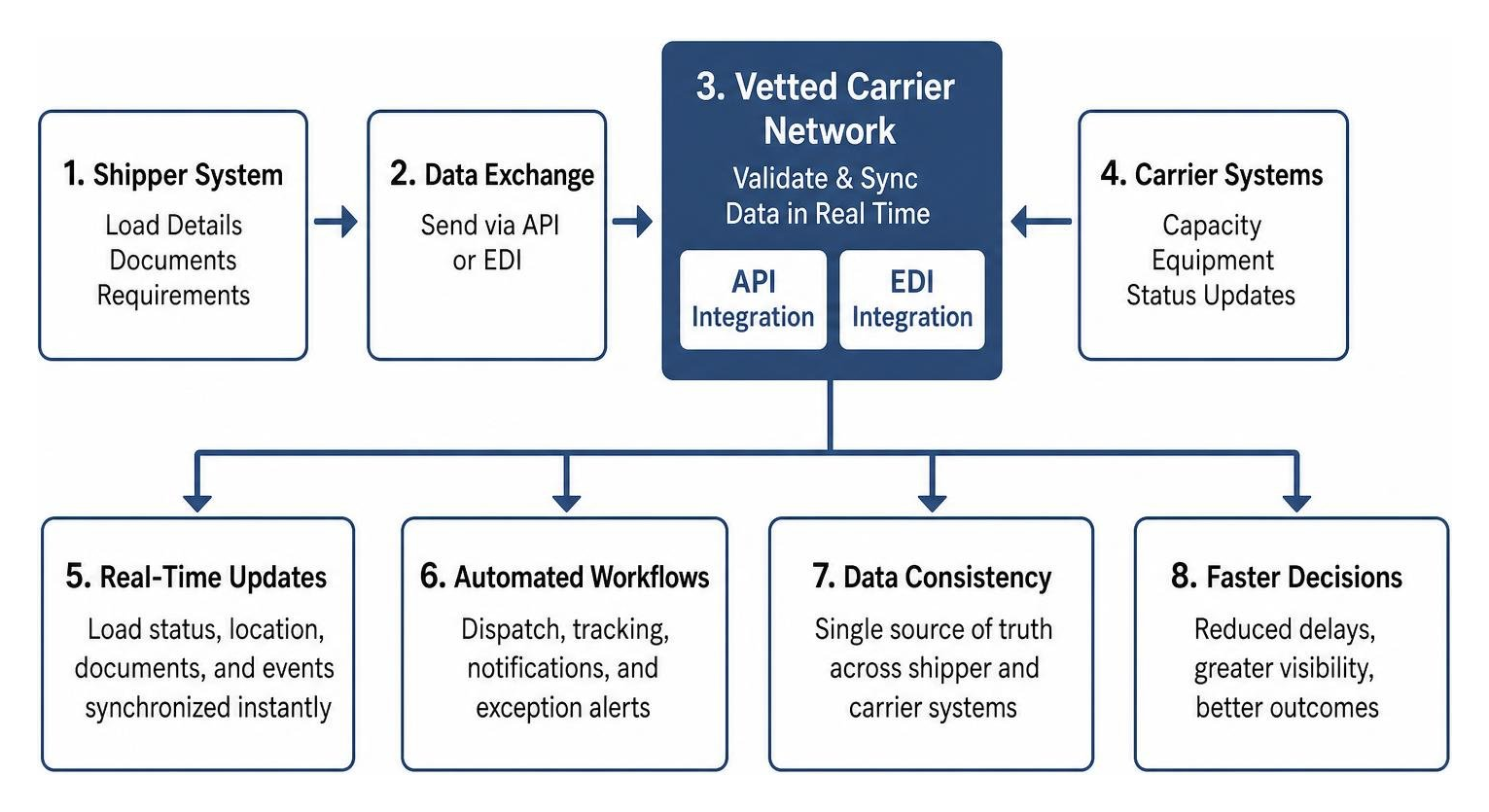
Real-Time API and EDI Data Synchronization
When coordinating critical B2B freight, manual phone calls and paperwork introduce delays that supply chains cannot afford. Shippers evaluating options for choosing the best expedited freight companies benefit significantly from networks powered by direct Application Programming Interface (API) and Electronic Data Interchange (EDI) connectivity.
Our brokerage operations integrate these technologies to provide:
- Instant Automated Status Updates: Automated EDI 214 status messages that deliver live shipment milestones from origin dock to final delivery.
- Seamless Dispatch Workflows: Instant electronic tendering to pre-vetted carriers, cutting onboarding delays down to minutes for time-sensitive freight.
- Unified Visibility: Centralized data feeds that keep supply chain managers informed without repetitive manual check calls.
Automated Dimensioning and Specialized Equipment Verification
Specialized cargo demands specialized equipment. Whether arranging an urgent run for lighting fixtures or sensitive medical machinery, verifying that a carrier’s equipment matches the load profile is essential to prevent transit delays and freight reclassification issues.
- Dimensionalizer Technology: Modern freight facilities utilize automated dimensionalizers to calculate precise length, width, height, and weight profiles, ensuring measurement accuracy and eliminating freight classification disputes.
- Specialized Capability Verification: Our network validation protocols confirm equipment requirements in advance, including functional liftgates, air-ride suspension, pallet jacks, and dedicated sprinter or straight truck dimensions.
- White Glove & Two-Man Handling: Pre-clearing drivers and crews for specialized handling, inside delivery, and secure placement requirements.
Full Truckload vs. LTL Vetting Protocols for B2B Freight
Carrier vetting must adapt to the distinct operational realities of Full Truckload (FTL) and Less-Than-Truckload (LTL) shipping.
| Vetting Criteria | Full Truckload (FTL) Protocols | Less-Than-Truckload (LTL) Protocols |
|---|---|---|
| Capacity Type | Dedicated single-vehicle space | Shared terminal and trailer capacity |
| Tracking Verification | Point-to-point GPS and optical sensor verification | Terminal-to-terminal scans, PRO number milestones, and EDI/API updates |
| Insurance Requirements | High liability thresholds ($100k+ cargo / $1M auto) per power unit | Comprehensive corporate cargo liability across terminal networks |
| Equipment Checks | Dedicated dry van, flatbed, reefer, or hot-shot verification | Terminal dimensionalizers, liftgate fleets, and hub-and-spoke handling equipment |
| Security Risk Profile | Direct point-to-point transit; zero handling between docks | Multiple consolidation points; requires strict handling and cross-dock security |
Capacity Requirements and Handling Protocol Differences
Dedicated FTL and hot-shot movements require a vetting emphasis on point-to-point driver integrity, continuous GPS tracking, and single-truck mechanical reliability. Because the cargo stays on one vehicle from dock to destination, transit risk is contained within that specific equipment and crew.
In contrast, LTL freight moves through complex hub-and-spoke networks. Shippers leveraging trusted regional and North American LTL delivery networks rely on standardized terminal handling protocols, dimensionalizer accuracy, and rigorous cross-dock security to prevent misplaced pallets and transit damage.
Scaling Nationwide Coverage to Cross-Border and Global Logistics
A robust domestic network also serves as a vital bridge to broader North American and international shipping channels. Enterprise freight platforms, such as nShift’s Global Carrier Network, demonstrate how standardized vetting and API connectivity can link domestic ground transportation with cross-border operations in Canada and Mexico, as well as specialized ocean lanes.
Whether coordinating expedited mainland freight or arranging specialized transport across regional corridors, maintaining consistent vetting standards ensures cargo integrity across every mile.
Operational Benefits of Partnering with Verified Freight Brokers
When supply chains face critical deadlines, working with experienced freight brokerage companies in USA provides immediate operational resilience.

Urgent B2B Shipping Reliability and Asset Protection
When an automotive assembly plant faces an imminent line-down situation or a hospital urgently requires critical diagnostic parts, standard freight options can fall short. Partnering with a dedicated freight broker connected to a nationwide vetted carrier network delivers concrete advantages:
- Rapid Recovery from Carrier Failures: When a primary carrier cancels at the last minute, an extensive vetted network allows brokers to secure qualified, pre-screened replacement capacity within minutes.
- Protection of High-Value Assets: Stringent background checks and continuous tracking drastically reduce the risk of cargo damage, lost pallets, and fraudulent redirection.
- Consistent On-Time Performance: Pre-qualifying carriers based on historical performance ensures that urgent shipments are handled by operators with proven track records on specific geographic lanes.
- Specialized Service Execution: From exclusive hot-shot deliveries and liftgate deliveries to two-man inside delivery, pre-vetted carrier capabilities guarantee seamless end-to-end execution.
Frequently Asked Questions About Nationwide Carrier Vetting
What criteria define an authenticated carrier network?
An authenticated carrier network consists of motor carriers that have passed rigorous screening before dispatch. Key criteria include active DOT and FMCSA operating authority, a clean safety rating, verifiable business operating history, RMIS risk scoring, and verified insurance policies (minimum $100,000 cargo liability and $1,000,000 auto liability).
How does real-time ground truth verification stop freight fraud?
Ground truth verification uses physical checkpoints—such as dockside vehicle imaging, driver credential matching, and roadside optical sensor data—to confirm that the authorized carrier and driver are physically transporting the load. This prevents digital identity theft, spoofed dispatch communications, and unauthorized double brokering.
Why is continuous carrier monitoring necessary after initial onboarding?
A carrier’s compliance status can change rapidly due to insurance cancellations, safety rating downgrades, or DOT authority revocations. Continuous automated monitoring tracks insurance renewals, safety infractions, and active authority status in real time, ensuring that only fully compliant carriers receive freight assignments.
Conclusion
A nationwide vetted carrier network provides the operational backbone modern businesses need to keep critical supply chains moving without interruption. By combining rigorous RMIS screening, high insurance thresholds, and advanced real-time tracking, freight brokers deliver the certainty and rapid response required when delivery deadlines are non-negotiable.
For nearly 20 years, Pro Express Inc. has served as a trusted freight broker, successfully coordinating over 10,000 critical shipments with a 99% satisfaction rate. When regular freight arrangements fall through or urgent shipments demand immediate execution, our team connects your business with dependable, pre-screened capacity across North America.
To secure qualified capacity for your next urgent B2B shipment, explore our nationwide expedited freight services and keep your freight moving forward with confidence.