
What Tailgate Delivery Means for Your Freight
The meaning of tailgate delivery depends on the carrier. It may mean freight is brought to the back of the truck for you to unload, or that a hydraulic liftgate lowers it to the ground. It does not automatically include moving freight inside, so confirm the unloading point before booking.
If your receiver has no dock or forklift, request liftgate service and confirm who will move the freight once it reaches the ground.
Explore more about tailgate delivery meaning:
Clarifying the Tailgate Delivery Meaning in Modern Freight
In commercial logistics, clarity prevents operational bottlenecks. When a transport carrier references a tailgate delivery, shippers must understand the exact scope of service being executed at the destination. While moving freight between industrial warehouses with elevated loading bays is straightforward, delivering to facilities that lack built-in infrastructure introduces operational friction.
Understanding the operational boundary of dockless transport helps logistics managers avoid surprise accessorial adjustments, missed delivery deadlines, or freight being stranded on a truck bed.
Tailgate Delivery Meaning and Core Equipment Functions
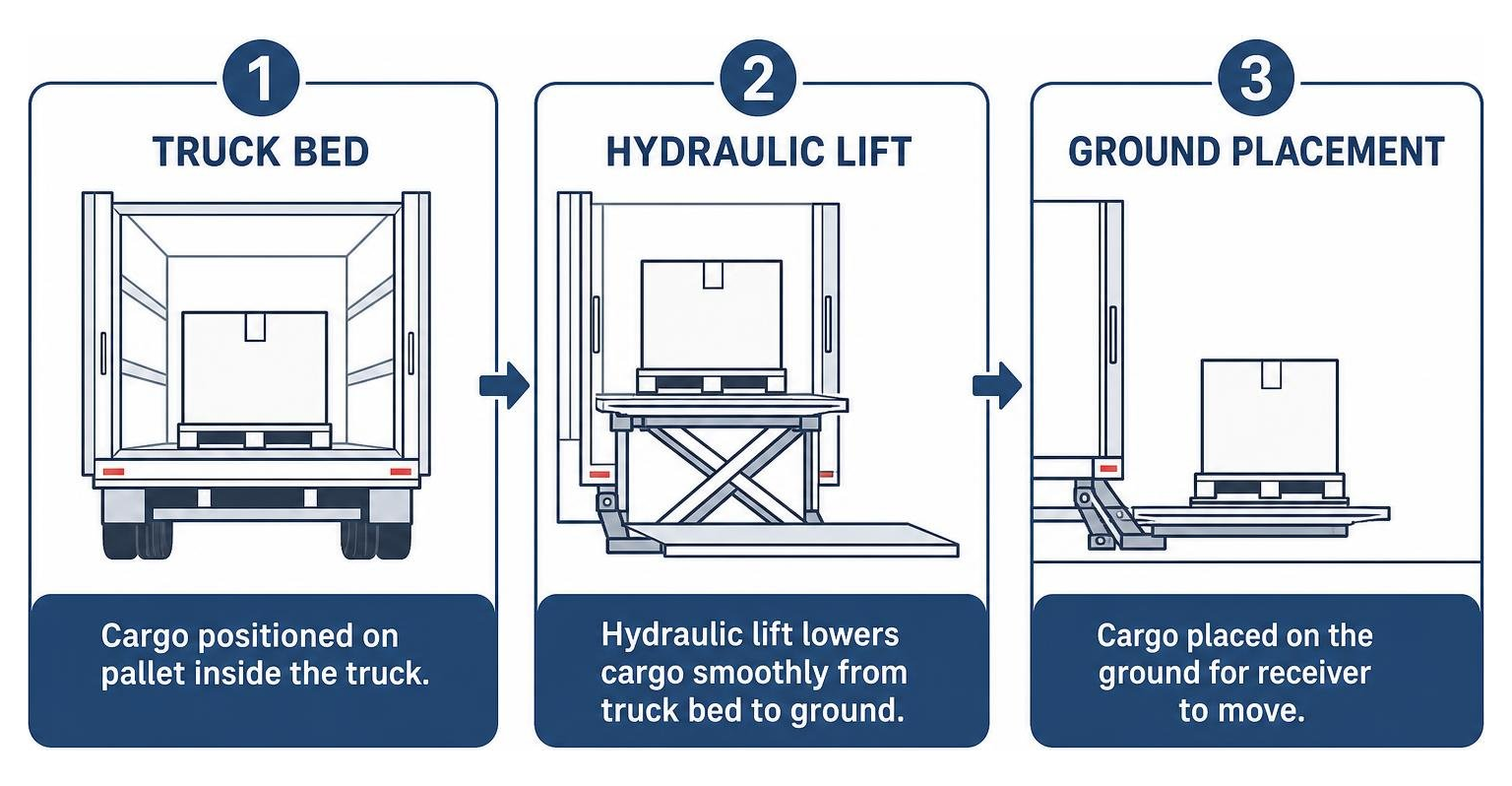
At its core, a tailgate or liftgate delivery utilizes a mechanical, hydraulic platform mounted to the rear frame of a straight truck or box truck. The platform folds flat against the vehicle during transit and deploys horizontally when unloading begins. Using a manual or electric pallet jack, cargo is positioned onto the platform from inside the truck body, and the hydraulic assembly lowers the load smoothly down to street or pavement level.
For shippers navigating final-mile requirements, having liftgate delivery explained highlights how mechanical unloading keeps cargo intact. The driver assists in lowering the cargo to the ground, where the receiver assumes responsibility for moving the shipment onto their property.
Key Distinctions: Tailgate vs. Liftgate Terminology
While industry professionals across different regions use varying terms, “tailgate delivery” and “liftgate delivery” typically refer to the same physical unloading mechanism:
- United States Freight Standards: “Liftgate” is the primary commercial term used by domestic carriers and freight brokers.
- International and Regional Variations: Shippers in international markets often refer to this mechanical system as a “tail-lift” or “tailgate.”
- Operational Distinction: In traditional dock-to-dock shipping, a strict “tailgate delivery” occasionally meant the carrier simply moved freight to the rear edge of the truck bed, requiring the consignee to lift it off. In modern logistics, booking tailgate service almost universally implies a mechanical hydraulic lowering platform.
When and Why Shippers Need Tailgate Delivery Services
Transporting heavy commercial cargo without an elevated loading dock requires specialized planning. When arranging palletized ground freight, determining when a liftgate is required for delivery ensures that the assigned carrier arrives equipped to complete the job without manual lifting hazards.
Physical Site Constraints and Dockless Facilities
A significant percentage of commercial delivery points throughout the contiguous United States operate without dedicated material handling docks or on-site forklifts. Tailgate delivery becomes critical when delivering to:
- Commercial Retail Storefronts: Strip malls, downtown commercial districts, and urban centers rarely feature elevated loading docks or staging yards.
- Manufacturing Facilities Without Bays: Secondary assembly plants or smaller fabrication shops often receive crated machinery through standard roll-up ground doors.
- Active Construction Sites: Developing job sites rely on ground-level unloading before internal elevators or permanent receiving areas exist.
- Medical Clinics and Laboratories: Specialized facilities receiving diagnostic machines or lab supplies operate in office parks lacking industrial infrastructure.
Cargo Weight and Dimensional Limits
Workplace safety standards strictly regulate manual freight handling. According to the Occupational Safety and Health Administration (OSHA), manual handling of excessively heavy items creates severe ergonomic hazards and worker injury risks. In commercial freight practices, individual packages exceeding 150 lbs (68 kg) or palletized assemblies require mechanical equipment for unloading.
Standard hydraulic platforms accommodate standard 48” x 40” or 48” x 48” pallets, with maximum freight dimensions typically capped around 72” L x 48” W x 82” H. Standard commercial tailgate capacities range from 1,300 to 1,500 lbs on medium-duty straight trucks, with heavy-duty platforms reaching higher thresholds. Freight that exceeds these physical footprints requires alternative offloading plans.
Step-by-Step Mechanics of a Tailgate Freight Delivery

Executing a ground-level delivery requires clear communication between the freight broker, the carrier, and the consignee. When managing time-sensitive shipments, adhering to established safety procedures prevents damage and physical injury during ground transfer.
Preparing the Delivery Location and Access Route
Before the carrier arrives, the receiving site must be prepared for a heavy commercial vehicle:
- Pavement Surface and Leveling: The vehicle must park on level, paved concrete or asphalt. Hydraulic lifts cannot deploy safely on steep inclines, loose gravel, mud, or soft ground.
- Vehicle Clearance: Standard straight trucks and box trucks require substantial vertical and horizontal clearance, free from low-hanging tree branches, overhead wires, and narrow alley blockades.
- Staging Area Clearances: Ensure the path behind the truck is unobstructed so the driver can deploy the platform and roll the pallet clear of the mechanism.
For a practical demonstration of ground-level freight handoffs, review this video guide on how to accept a tailgate delivery.
Receiving, Inspection, and Damage Protocols
The consignee must actively inspect the shipment the moment it reaches the pavement. As outlined by the Federal Motor Carrier Safety Administration (FMCSA), the delivery receipt and Bill of Lading (BOL) serve as legal contracts recording the physical handoff of property.
Reviewing standard freight shipment delivery procedures ensures your warehouse team executes proper documentation at the time of delivery.
Comparing Delivery Service Levels: Tailgate, Inside, and White Glove
Choosing the correct final-mile service prevents operational surprises. Shippers must differentiate between standard curbside drops, threshold delivery, and specialized placement.
| Delivery Service Level | Unloading Method | Drop-off Boundary | Equipment Provided | Best Used For |
|---|---|---|---|---|
| Tailgate / Liftgate | Hydraulic rear platform | Ground level at curbside or parking lot | Hydraulic platform & pallet jack | Standard pallets, crates, dockless commercial sites |
| Threshold / Inside | Hydraulic lift + manual transport | Inside the first dry entryway or roll-up door | Liftgate, pallet jack, hand trucks | Weather-sensitive goods, warehouse floor drops |
| White Glove / Two-Man | Specialized lift & multi-person crew | Room of choice, uncrating, debris removal | Full rigging, ramps, padded dollies | High-value medical, lab gear, commercial displays |
Threshold, Room-of-Choice, and Inside Placement
Tailgate service concludes once the freight rests flat on the ground outside the vehicle. If the cargo must cross the building threshold, shippers must request inside accessorial services in advance.
Reviewing inside delivery tracking explains how carriers handle transitions beyond the parking lot. For broader service breakdowns, read Inside Delivery Explained: A Guide for Shippers in 2026 | EuroSaleOnline.com.
Unpacking the Tailgate Delivery Meaning for Commercial Locations
Commercial facilities regularly receive critical components under strict timelines. Coordinating expedited ground freight services through a trusted brokerage pairs time-critical line-haul transit with dockless delivery execution across the lower 48 states.
When planning dock-free transport for specialized cargo, logistics managers can also explore Tailgate Delivery – Speed Post for further perspective on ground-level freight coordination.
Avoiding Tailgate Delivery Failures and Site Exceptions
Delivery failures disrupt production schedules and create unwanted delays. In dockless logistics, identifying access bottlenecks before dispatch ensures the carrier network executes the delivery smoothly.
Managing Overweight or Exceeded Freight Dimensions
When crated machinery or industrial skids exceed 1,500 lbs or surpass standard platform dimensions (such as freight exceeding 72” in length or 48” in width), standard tailgate platforms cannot safely handle the load. Attempting to lower freight beyond these limits on a standard platform risks tipping, cargo damage, and operator injury.
In these situations, logistics managers should consider a dedicated full box truck load or confirm that forklift offloading is available at the destination.
Consignee Attendance and Delivery Sign-Off Requirements
Because freight left unattended in a commercial parking lot creates significant liability and weather exposure, carriers require an authorized consignee representative on site. The receiving team must:
- Confirm accurate site contact numbers during shipment booking.
- Maintain open phone lines for driver arrival notices.
- Be physically present to direct ground placement and execute the Bill of Lading sign-off.
Frequently Asked Questions About Tailgate Delivery
Do I need to be present during a tailgate delivery?
Yes, an authorized representative must be on site to inspect the shipment, direct the ground placement, and sign the Bill of Lading. Commercial carriers will not leave heavy palletized freight unattended in parking lots or loading zones without explicit written authorization and a physical sign-off.
What happens if my freight exceeds the tailgate limits?
If a shipment exceeds standard hydraulic weight capacities (typically 1,300 to 1,500 lbs) or platform dimensions, it cannot be lowered safely using a standard liftgate. In these cases, the shipment must be repackaged into smaller handling units, routed through a local freight terminal, or unloaded using an on-site forklift or specialized rigging equipment.
Is tailgate delivery a ground-level delivery?
Yes, tailgate delivery means the carrier uses a mechanical hydraulic lift to transfer freight from the truck bed down to the ground level. The standard scope of service ends once the freight is placed safely on the pavement or curbside adjacent to the vehicle.
What should I do if freight arrives damaged during a tailgate delivery?
Inspect the cargo thoroughly before signing the delivery receipt. Note any visible damage, crushed packaging, or broken bands directly on the Bill of Lading, take clear photographs of the cargo while it is still at ground level, and notify your freight brokerage coordinator immediately to initiate a formal claim.
Conclusion
Understanding the meaning of tailgate delivery is essential for planning efficient, dockless freight movements across the contiguous United States. By verifying site access, checking cargo weights against platform limits, and confirming whether inside delivery is required, logistics managers can prevent transit exceptions and keep commercial supply chains operating smoothly.
Pro Express, Inc. has coordinated time-sensitive ground freight since 2007, delivering over 10,000 shipments with 99% client satisfaction through our vetted carrier network. Whether your shipment requires dedicated hot-shot transit, specialized liftgate coordination, or multi-man inside handling, our operations team coordinates shipments 24/7 across the lower 48 states. Explore our comprehensive freight logistics services to streamline your ground transport operations.