
Why Facility Managers Rely on Liftgate Delivery Service Pros
Liftgate delivery service pros help facility managers receive heavy freight when a site has no loading dock or forklift. A trained carrier driver uses a truck-mounted platform to lower the load to ground level, reducing the need for manual handling. Before booking, confirm the freight’s size and weight and whether the site has space to unload it.
For urgent ground shipments, Pro Express Inc. coordinates liftgate-equipped carriers through its vetted network. Sharing site limits early helps the carrier arrive with the right equipment and an unloading plan.
Quick liftgate delivery service pros definitions:
Understanding Liftgate Mechanics and Hydraulic Specifications
A liftgate is an electro-hydraulic or mechanical platform installed at the rear of a commercial box truck, straight truck, or trailer. Its primary function is bridging the vertical gap between the elevated truck bed—typically 48 to 52 inches above the pavement—and the ground. When receiving facilities lack dedicated dock bays or ground-level material handling machinery, this mechanical lift acts as an on-demand loading dock. Shippers often review a comprehensive guide to liftgate freight handling to understand how these platforms safely move heavy pallets without physical strain.
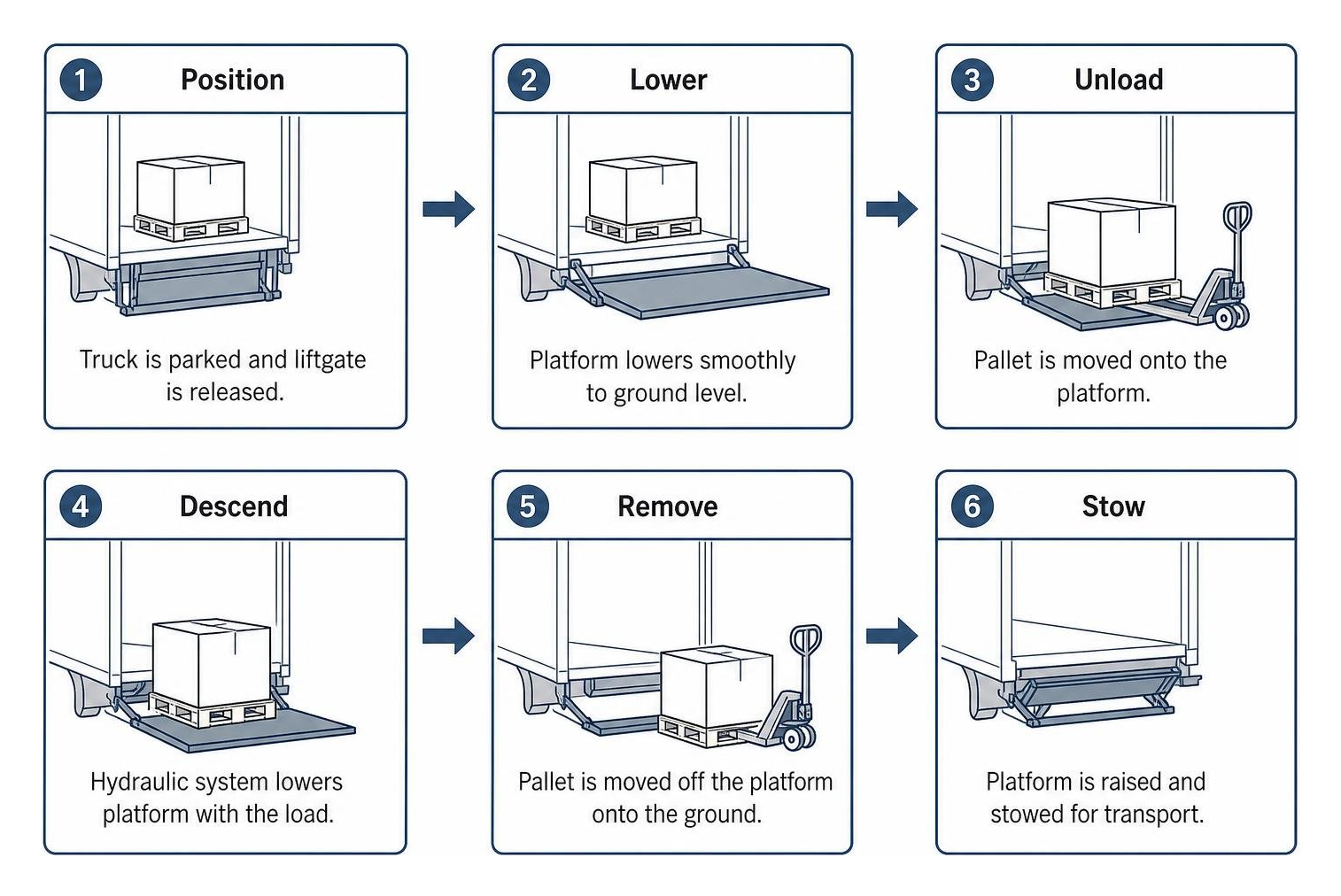
The underlying mechanics rely on a closed hydraulic system. A direct-current (DC) electric motor powers a hydraulic pump, drawing fluid from an onboard reservoir and directing it under pressure through reinforced steel-braided lines into heavy-duty hydraulic cylinders. When pressurized, the cylinder rods extend or retract to manipulate mechanical linkages, maintaining a level platform as cargo moves between heights. For plant operators and site managers, understanding liftgate delivery requirements ensures that arriving freight matches the mechanical capabilities of the dispatched vehicle.
Weight Capacity Limits and Platform Ratings
Liftgate platforms vary in size and load capacity. Standard commercial units generally offer usable platform dimensions around 72 inches long by 48 inches wide, designed to support standard 48×48-inch or 48×40-inch GMA pallets. Light-to-medium-duty tuckaway and cantilever styles commonly provide lifting capacities between 1,300 and 1,500 pounds.
Heavy industrial shipments, such as crated machine tools or fully loaded distribution pallets, demand specialized column lifts or rail-type gates. Manufacturers design these heavy-duty column lifts to travel vertically along fixed outer steel tracks, supporting cargo ratings between 3,500 and 6,600 pounds. Exceeding these engineering ratings risks mechanical failure, valve blowouts, or platform tilting.
| Liftgate Category | Platform Dimensions (Typical) | Working Capacity | Ideal Application |
|---|---|---|---|
| Standard Tuckaway | 72″ L x 48″ W | 1,300 – 1,500 lbs | Commercial freight, retail boxes, palletized cartons |
| Cantilever / Rail-Style | 72″–84″ L x 50″–60″ W | 2,000 – 3,000 lbs | Industrial parts, manufacturing components |
| Heavy-Duty Column Lift | 80″–90″ L x 60″–82″ W | 3,500 – 6,600 lbs | Heavy industrial equipment, crated machinery |
Hydraulic vs Mechanical Operation
Hydraulic lift systems dominate modern expedited ground freight because of their smooth operation and safety features. Pressure-compensated lowering valves control descent speeds, preventing rapid drops even under maximum loads. Built-in mechanical velocity fuses lock hydraulic fluid inside the cylinders if an external hose suffers sudden pressure loss, stopping the platform immediately.
Mechanical and electric drive systems provide consistent leveling across uneven ground. Operators utilize torsion springs and power-leveling switches to adjust the approach angle, ensuring pallet jacks roll on and off without bottoming out or tipping delicate loads.
Operational Benefits of Hiring Liftgate Delivery Service Pros
Coordinating deliveries through experienced professionals protects personnel, prevents equipment damage, and maintains operational uptime. When managing high-stakes shipments, pairing ground-level mechanical lowering with specialized inside delivery handling helps ensure that cargo transitions from the truck bed past the facility threshold into its designated staging area.

How Liftgate Delivery Service Pros Prevent Freight Damage
Drop damage and severe shock loads often occur when facilities attempt manual unloads or employ makeshift ramps. Mechanical liftgates maintain a stable horizontal plane throughout the descent cycle. Eliminating sudden drops preserves internal electronics, calibration settings, and fragile casing. For high-value commodities such as precision medical devices or commercial lighting fixtures, combining liftgate services with white glove logistics support provides padded handling, strapping, and smooth ground positioning.
How Liftgate Delivery Service Pros Handle Difficult Access Points
Industrial complexes, suburban commercial hubs, and research parks frequently feature tight turning radiuses, low overhangs, and limited dock access. Full 53-foot tractor-trailers cannot maneuver into these spaces. Arranging specialized box trucks equipped with hydraulic lifts enables carriers to access tight receiving aprons. When shippers need seamless ground-level coordination, arranging specialized freight service through a knowledgeable broker keeps freight moving without site bottlenecks.
Critical Scenarios Requiring Liftgate Equipment
Facility managers must assess receiving infrastructure before dispatching heavy loads. When sites lack permanent dock bays or operational forklifts, specifying liftgate service is essential. Identifying these operational constraints early through identifying when liftgate equipment is required avoids delivery rejections and disruptive site delays.
Industrial loading rules emphasize strict protocols for moving freight between docks and truck beds. The Occupational Safety and Health Administration (OSHA) outlines detailed loading and unloading safety standards for powered industrial trucks and transport equipment to prevent tip-overs and loading dock accidents.
Managing Dockless Facilities and Construction Sites
Active building sites, retail storefronts, decentralized utility substations, and temporary research facilities operate without fixed loading docks. At these locations, shipments must be set directly onto asphalt or concrete pads. Professional carrier drivers utilize pallet jacks to reposition the cargo onto the lowered platform, descend smoothly, and wheel the shipment directly to the designated laydown area or exterior doorway.
Overcoming Manual Handling and Safety Thresholds
The National Institute for Occupational Safety and Health (NIOSH) sets a safe upper lifting limit of 51 pounds for a single worker under ideal physical conditions. Freight industry guidelines recommend mechanical intervention whenever individual cargo items exceed 150 pounds. Manual unloading of crated cargo, steel assemblies, or production components exposes facility personnel and drivers to musculoskeletal injuries. Deploying hydraulic equipment mitigates workplace hazards. In high-stakes manufacturing situations where replacement parts must arrive rapidly to prevent assembly stoppages, pairing mechanical unloading with dedicated expedited freight transport coordination maintains safety while restoring plant operations.
Vetting and Selecting Dedicated Ground Freight Providers
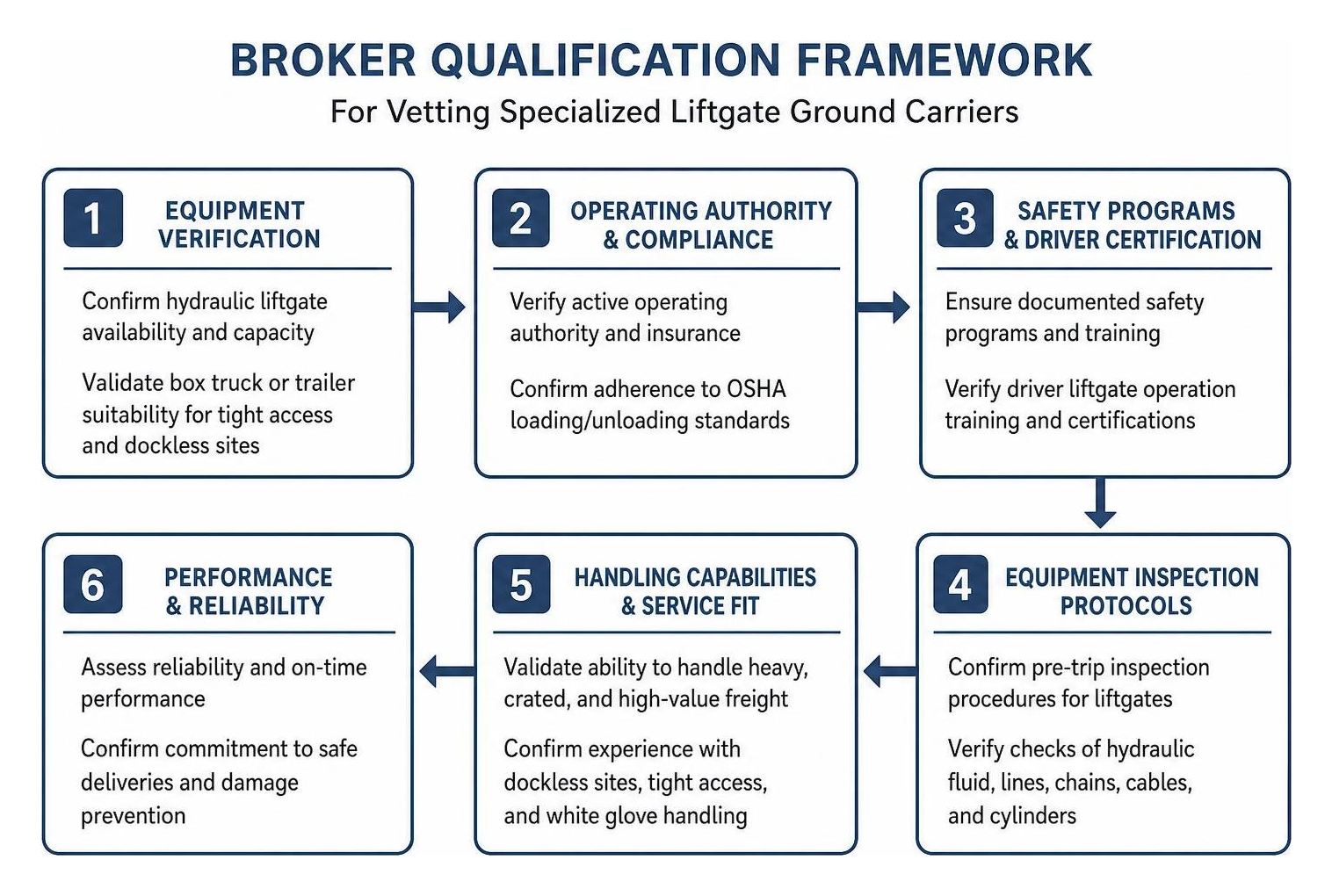
Sourcing the right carrier requires verifying equipment specifications, operating authority, and professional qualifications. Shippers benefit from selecting qualified liftgate service partners who understand the technical demands of heavy freight transport.
Safety Standards and Driver Certification
Qualified carriers enforce comprehensive pre-trip inspections covering:
- Hydraulic fluid levels and line integrity
- Platform chain, cable, and cylinder condition
- Functionality of dual-control operation switches and emergency stop systems
- Mechanical ground latch locks and platform extension integrity
- Safe cargo securement using e-track strapping and wheel chocks on the platform
Carriers must train drivers to evaluate ground slope and surface conditions before deployment, as uneven or cracked pavement creates serious tipping hazards during platform descent.
Integration with Time-Critical Delivery Services
When critical components fail on a manufacturing line, standard transit schedules are insufficient. Facility directors require rapid dispatch with dedicated, direct-drive ground routing. We coordinate critical shipments across the contiguous United States, matching precise load dimensions with properly equipped liftgate straight trucks and vans. For comprehensive logistics operations across the lower 48 states, businesses rely on our full suite of specialized ground delivery services to manage critical schedules without service interruptions.
Frequently Asked Questions About Liftgate Delivery
What weight threshold requires a hydraulic liftgate?
Mechanical lift assistance is recommended whenever an individual freight piece exceeds 150 pounds and the delivery site lacks a dedicated loading dock or forklift. Ergonomic standards outlined by NIOSH identify manual lifting over 51 pounds as hazardous to personnel. Utilizing a hydraulic liftgate ensures compliance with industrial safety practices for heavy cargo.
What happens if freight arrives at a dockless site without a liftgate?
If cargo arrives on a standard dry van without a liftgate and the receiving site cannot provide a forklift, the driver cannot safely unload the freight. The carrier must return the shipment to the regional terminal, re-dispatch it on a liftgate-equipped vehicle, and reschedule the appointment, introducing transit delays. Specifying equipment requirements during initial booking prevents these disruptions.
How does standard liftgate delivery differ from inside delivery?
Standard liftgate service covers lowering the shipment from the truck bed to ground level at curbside or the facility driveway. Inside delivery involves moving the unloaded freight beyond the exterior door threshold, navigating entryways, hallways, or ground-floor staging rooms using specialized handling tools like pallet jacks or dollies.
Conclusion
Securing dependable ground transportation requires working with logistics experts who understand critical freight demands. At Pro Express Inc., we bring nearly 20 years of experience as an expedited freight broker, operating from our headquarters in Oak Brook, Illinois. Since 2007, we have coordinated over 10,000 delivered shipments with a 99% client satisfaction rate, serving facility managers and industrial clients returning for over 13 years across the contiguous United States.
Whether your shipments involve mission-critical automotive assemblies, sensitive pharmaceutical freight, or delicate lighting hardware, our vetted carrier network delivers direct-drive execution. For time-critical ground transportation requiring specialized equipment, explore our exclusive hot-shot ground freight solutions.
Contact Us Today to schedule your next dedicated shipment.