
Request Residential Liftgate Delivery Before Scheduling
To arrange residential liftgate delivery, tell your freight broker when booking that the destination is a home without a loading dock or forklift. Share the shipment’s weight and dimensions, any street or driveway limits, and the receiver’s contact details so the carrier can plan the right equipment before scheduling delivery.
A liftgate lowers freight to ground level; it does not include moving it into a garage or home. Pro Express Inc. coordinates delivery requirements with its trusted carrier network for ground shipments across the contiguous United States.
Simple residential liftgate delivery word guide:
Understanding Residential Liftgate Delivery and Why It Is Required
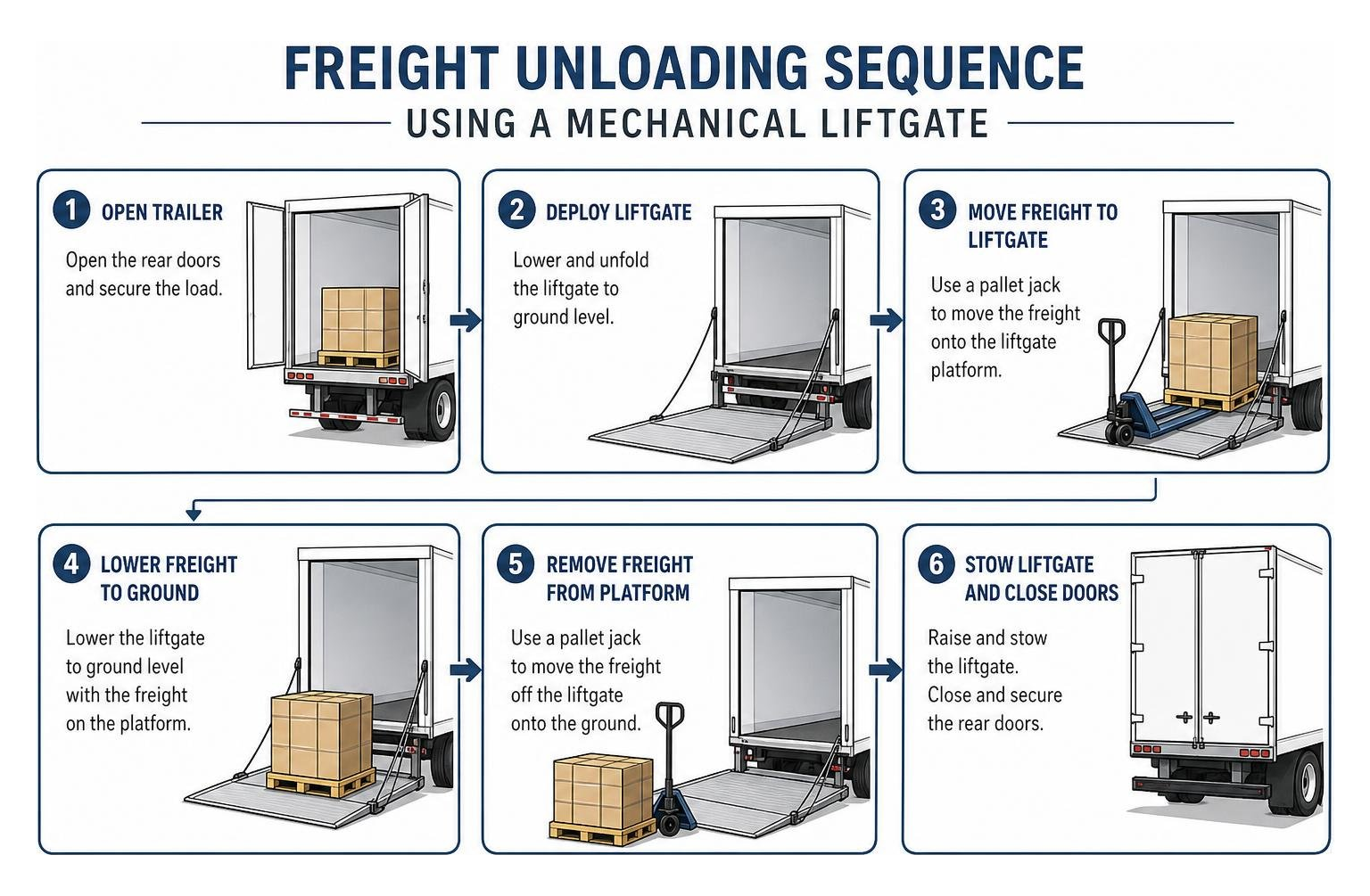
Commercial shipping relies heavily on standard infrastructure such as raised loading docks, yard ramps, and forklifts. Standard semi-trailers position cargo beds roughly four to five feet off the asphalt. When a delivery site lacks a raised dock or heavy machinery to extract freight, safely getting cargo off the trailer bed becomes physically impossible without specialized mechanical assistance.
A liftgate is an electric-hydraulic platform permanently mounted to the rear frame of a truck or box trailer. It operates as an exterior freight elevator, raising or lowering pallets, crates, and oversized freight between the trailer floor and ground level. Understanding liftgate freight requirements is essential for operations managers and logistics planners moving industrial materials, medical systems, or commercial fixtures to non-dock destinations.
Freight carriers treat liftgate handling as an accessorial requirement because it alters equipment routing and driver labor. Under general freight definitions outlined in industry standards such as the Uniform Rules Tariff No. 200, accessorials must be identified prior to transit to ensure carrier safety and compliance. When your destination has no dock, a liftgate bridges the gap between the vehicle platform and the pavement.
When Freight Carriers Classify a Delivery Location as Residential
In commercial logistics, carrier classifications depend on operational access rather than municipal tax zoning alone. Freight carriers classify a location as residential if the property includes private living quarters or if commercial vehicle maneuvering is constrained by residential traffic patterns.
Locations that trigger residential or limited-access classifications include:
- Single-family suburban houses, townhomes, and private rural residences
- Multi-family apartment complexes and condominium communities
- Small home-based businesses, workshops, or studios operating in neighborhood zones
- Farms, ranches, and estates accessed via private driveways or unpaved lanes
- Schools, daycares, churches, and community centers situated within residential subdivisions
If a carrier’s tractor-trailer cannot access a standard loading dock or must navigate passenger vehicle parking, dead-end streets, low power lines, or weight-restricted residential roads, the shipment is classified under residential guidelines.
Liftgate vs Inside Delivery vs Standard Curbside Service
Logistics coordinators often mix up the boundaries between curbside drops, mechanical liftgate drops, and interior transport. Clear communication prevents misaligned expectations on delivery day.
| Service Level | Delivery Boundary | Equipment Provided | Receiver Responsibility |
|---|---|---|---|
| Standard Curbside (Tailgate) | Back of the trailer bed | None (Driver opens rear doors) | Receiver unloads cargo from the elevated trailer bed |
| Liftgate Delivery | Ground level at the curb or driveway apron | Hydraulic liftgate and manual pallet jack | Receiver moves cargo from the curb into their structure |
| Inside Delivery | First dry threshold (garage, foyer, or warehouse bay) | Hydraulic liftgate and interior maneuvering tools | Receiver manages unpacking, positioning, and debris |
A standard liftgate service simply brings cargo down from the truck bed and rests it on a flat, paved surface directly adjacent to the vehicle. For operations requiring placement inside a building, specialized inside delivery handling must be coordinated as an additional service ahead of time.
Why Last-Minute Equipment Requests Cause Major Freight Delays
In freight networks across the lower 48 states, not every regional delivery truck features a hydraulic liftgate platform. Line-haul semi-trucks that haul freight between regional terminals rarely carry liftgates because they add deadweight and reduce total freight capacity. Local delivery relies on a specific percentage of liftgate-equipped straight trucks and final-mile box units.
When a shipper books a delivery without noting the need for a liftgate, the carrier assigns the pallet to a standard trailer. If the driver arrives at a home without offloading equipment, they cannot physically or legally drop the freight. The driver must abort the delivery, secure the cargo, and return it to the local distribution terminal.
Once back at the dock, the freight must be offloaded, staged for cross-docking, and reassigned to a specialized liftgate vehicle route. This equipment reassignment commonly causes delivery delays of 24 to 72 hours. Finding and finding the right liftgate service at the time of initial booking prevents failed attempts and keeps supply chains moving on schedule.
Booking Residential Liftgate Delivery During Initial Freight Scheduling
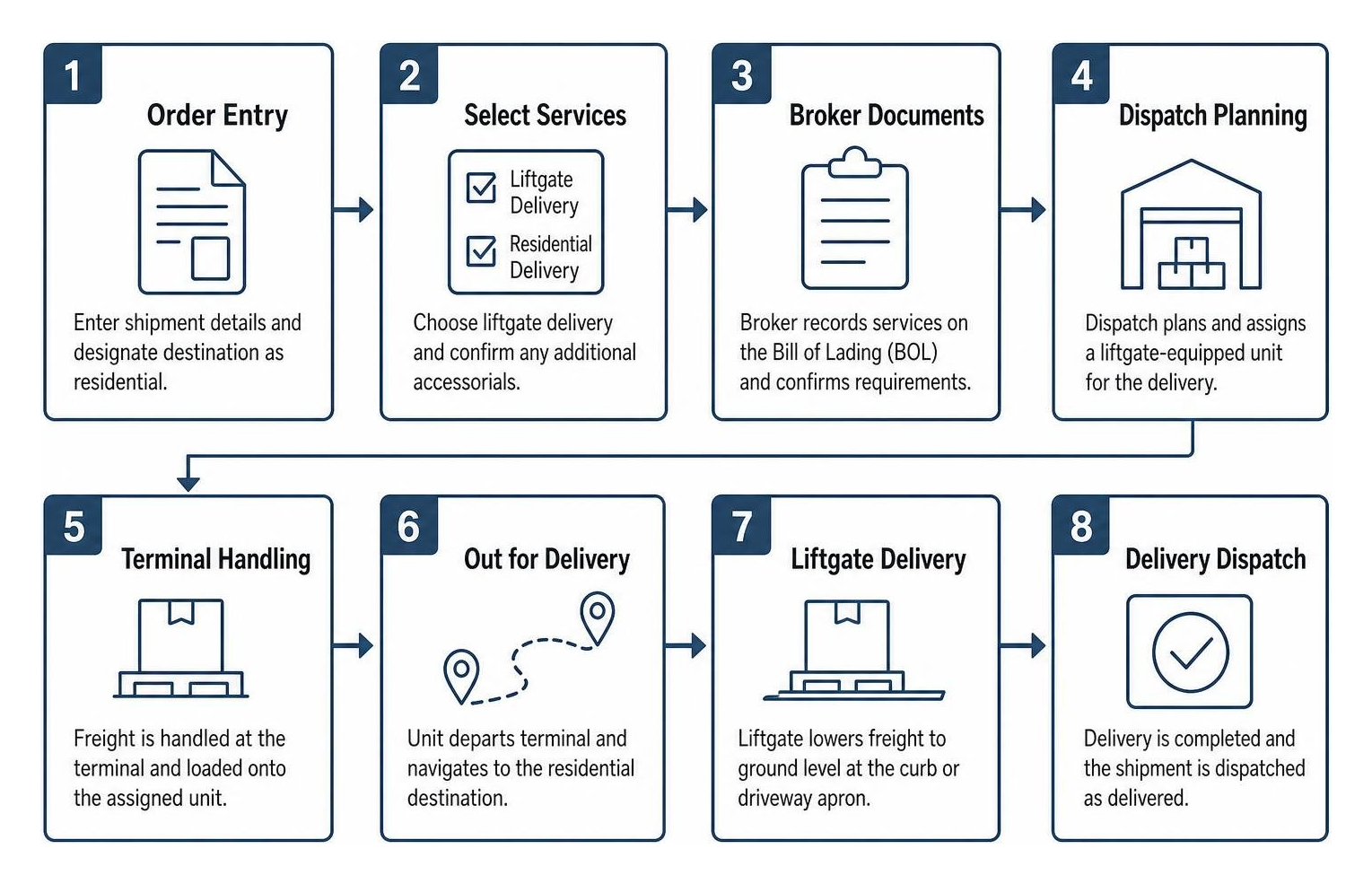
Coordination begins at order entry. When submitting cargo details to your freight broker, explicitly designate the destination type as residential and select liftgate delivery on your initial shipping documentation.
Clear residential freight coordination ensures the broker notes the accessorials directly on the Bill of Lading (BOL). This instruction signals the carrier’s dispatch team to allocate a liftgate-equipped unit right from the terminal dock.
Managing Vehicle Size Restrictions on Residential Streets
Standard 53-foot tractor-trailers face strict operational constraints in neighborhoods. Tight street corners, cul-de-sacs, low tree canopies, and passenger cars parked along curbs make maneuvering full-size commercial trucks hazardous.
When your freight broker knows the destination is residential, they route the shipment through local carrier partners using smaller straight trucks or 26-foot box trucks. These maneuverable vehicles handle neighborhood roadways safely while carrying the hydraulic liftgates required for ground-level offloading.
Step-by-Step Guide to Preparing for Your Scheduled Delivery Appointment
Carrier partners typically contact the freight receiver 24 hours in advance to confirm an appointment window. Smooth unloading requires site preparation before the truck pulls onto the street.
Logistics managers should share clear site details with the receiver, including knowing when a liftgate is required to keep operations streamlined.
Site Preparation Checklist for Residential Liftgate Delivery
To ensure a successful delivery, verify the following site conditions prior to the scheduled delivery window:
- Driveway Clearance: Move personal vehicles, trailers, garbage bins, and children’s toys out of the driveway to create an unobstructed parking and turnaround path.
- Paved Unloading Surface: Identify a firm, level asphalt or concrete surface. Manual pallet jacks cannot roll across gravel, dirt, thick mud, wet turf, or steep inclines.
- Overhead Clearances: Check for low-hanging utility lines, tree branches, and building eaves along the vehicle’s approach and unloading perimeter.
- Path of Travel: Clear a wide, smooth path from the planned curb drop point to the storage location, ensuring no steep steps, garden borders, or threshold obstacles block the way.
- Receiver Availability: Ensure the designated contact person is present on site with a phone readily available during the entire appointment window.
Receiving Heavy Freight and Inspecting the Bill of Lading
When the driver lowers the pallet to the pavement, the receiver must thoroughly inspect the cargo before signing any paperwork. Freight custody legally transfers to the receiver the moment the delivery receipt is endorsed.
Follow these standard inspection steps:
- Count the Pieces: Verify that the pallet and handling unit counts match the numbers listed on the driver’s delivery receipt.
- Inspect the Exterior: Check all shrink wrap, banding, wooden crating, and cardboard cartons for tears, punctures, crushing, or moisture stains.
- Record Any Anomalies: If damage or shortages are visible, write specific notes directly on the delivery receipt before signing (e.g., “Pallet top carton crushed, torn outer wrap”).
- Take Photographs: Document the shipment from multiple angles while it sits on the pallet jack or driveway pavement.
- Retain Documentation: Keep a legible copy or clear photograph of the fully signed delivery receipt for your company’s logistics records.
Alternatives and Upgrades for Complex Residential Shipments
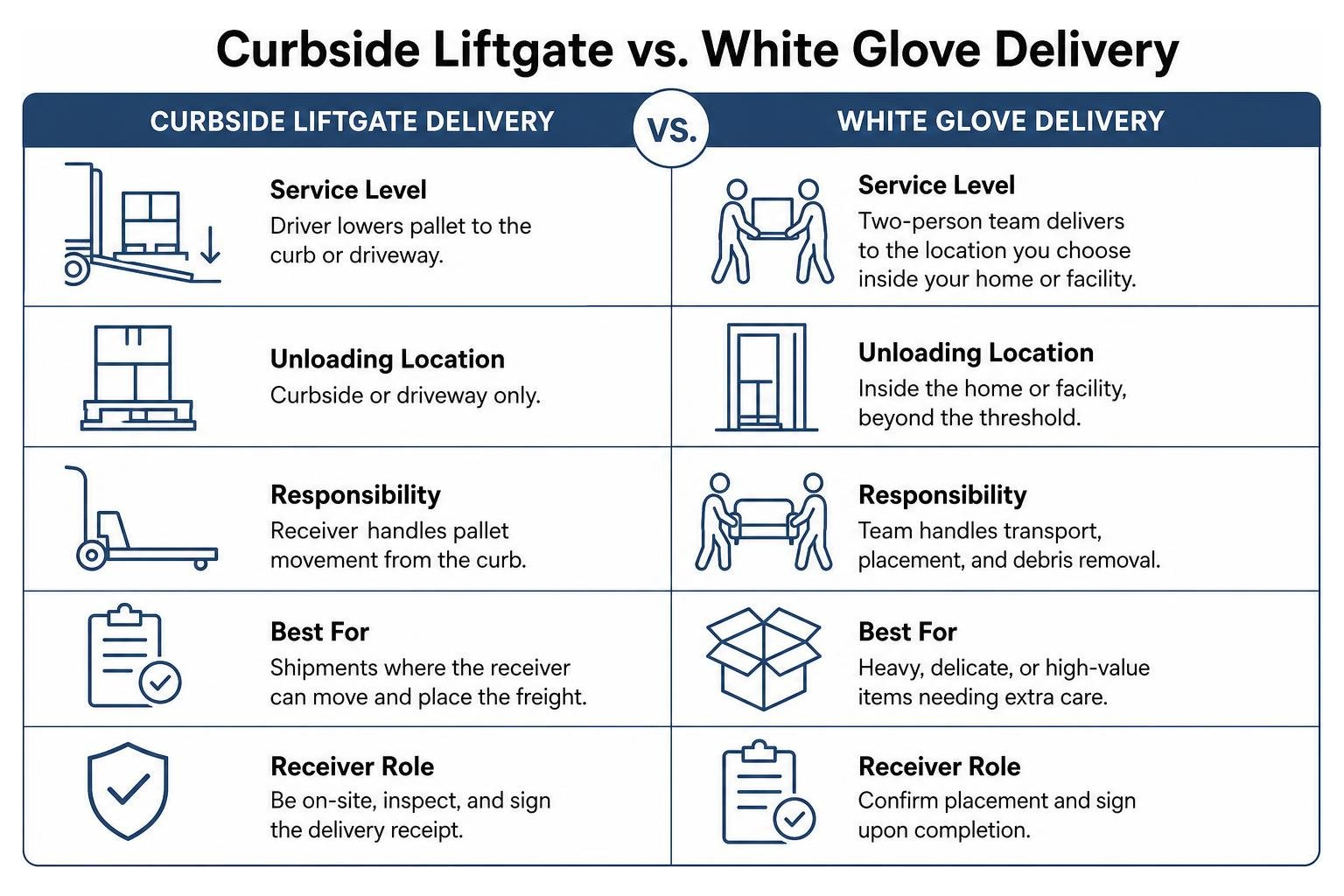
When standard curbside liftgate offloading is insufficient for complex equipment, businesses can explore upgraded transport models. Heavy machinery, delicate electronics, or high-value architectural fixtures often require premium staging beyond the driveway apron.
In these operational scenarios, shippers can select white glove residential logistics and specialized two-person handling services. These specialized services arrange for inside placement, unpacking, threshold negotiation, and complete packaging debris removal.
Frequently Asked Questions About Residential Liftgate Delivery
What happens if I do not request a liftgate before the truck arrives?
If a liftgate is omitted from the initial booking and the delivery site lacks an offloading dock or forklift, the driver will not be able to offload the cargo. The carrier will return the pallet to the nearest regional terminal, requiring dispatchers to reassign the shipment to a liftgate-equipped truck, which leads to transit delays.
Will the freight driver move the pallet into my garage or home?
Standard liftgate delivery includes lowering the freight to ground level at the curb or driveway edge. Moving items into a garage, across grass, up exterior steps, or through interior doorways requires booking specialized inside delivery or white glove handling prior to dispatch.
How much weight can a standard residential delivery liftgate handle?
Standard hydraulic liftgate platforms on regional delivery trucks generally support loads ranging from 1,500 to 2,500 pounds, depending on the platform size and hydraulic rating. Shippers moving single items or consolidated crates exceeding these limits must coordinate with their freight broker to ensure appropriately rated equipment is assigned.
Conclusion
Properly planning your ground freight avoids operational bottlenecks and keeps your critical projects running smoothly. Since 2007, Pro Express, Inc. has served as a trusted freight broker coordinating expedited ground shipping across the contiguous United States. With over 10,000 delivered shipments and a 99% client satisfaction rating, we connect commercial shippers with a dependable carrier network for time-sensitive, specialized deliveries. When your business needs tailored ground transport and expert equipment planning, explore expedited ground delivery solutions with our operations team.
Ready to coordinate your next time-critical shipment? Contact Us Today to speak with our ground logistics specialists.