
Demystifying Expedited 2 Day Shipping: Definition and Operational Realities
Expedited 2-day shipping is a freight service designed to deliver within two business days of carrier pickup — not two calendar days from when an order is placed. For B2B operations managers, understanding that distinction can mean the difference between keeping an assembly line running and shutting it down.
Quick answer: What is expedited 2-day shipping?
- What it is: A time-definite shipping service that delivers freight by the end of the second business day after the carrier accepts the shipment
- Business days vs. calendar days: Weekends and holidays do not count — a Friday pickup typically means a Tuesday delivery
- Cutoff times matter: Missing a carrier’s daily cutoff pushes your clock to the next business day
- Not one-size-fits-all: Parcels under 150 lbs use express parcel services (FedEx 2Day, UPS 2nd Day Air); freight over 150 lbs requires dedicated expedited freight solutions
- “Beyond points” add time: Destinations outside a carrier’s core metro network can add one or more days automatically
- Committed vs. estimated: Some services carry a firm delivery commitment; others are best-effort estimates
Here is where most logistics managers run into trouble: the label on the service says “2-day,” but the freight arrives on day three or four. That gap usually comes down to order processing delays, missed cutoffs, geographic service boundaries, or carrier network constraints — none of which are obvious until a deadline is already at risk.
For B2B operations teams managing critical freight — whether it is automotive parts, medical supplies, or manufacturing components — the mechanics behind multi-day expedited transit deserve a clear-eyed look. This guide breaks it all down so you can make faster, more confident decisions when your supply chain is under pressure.
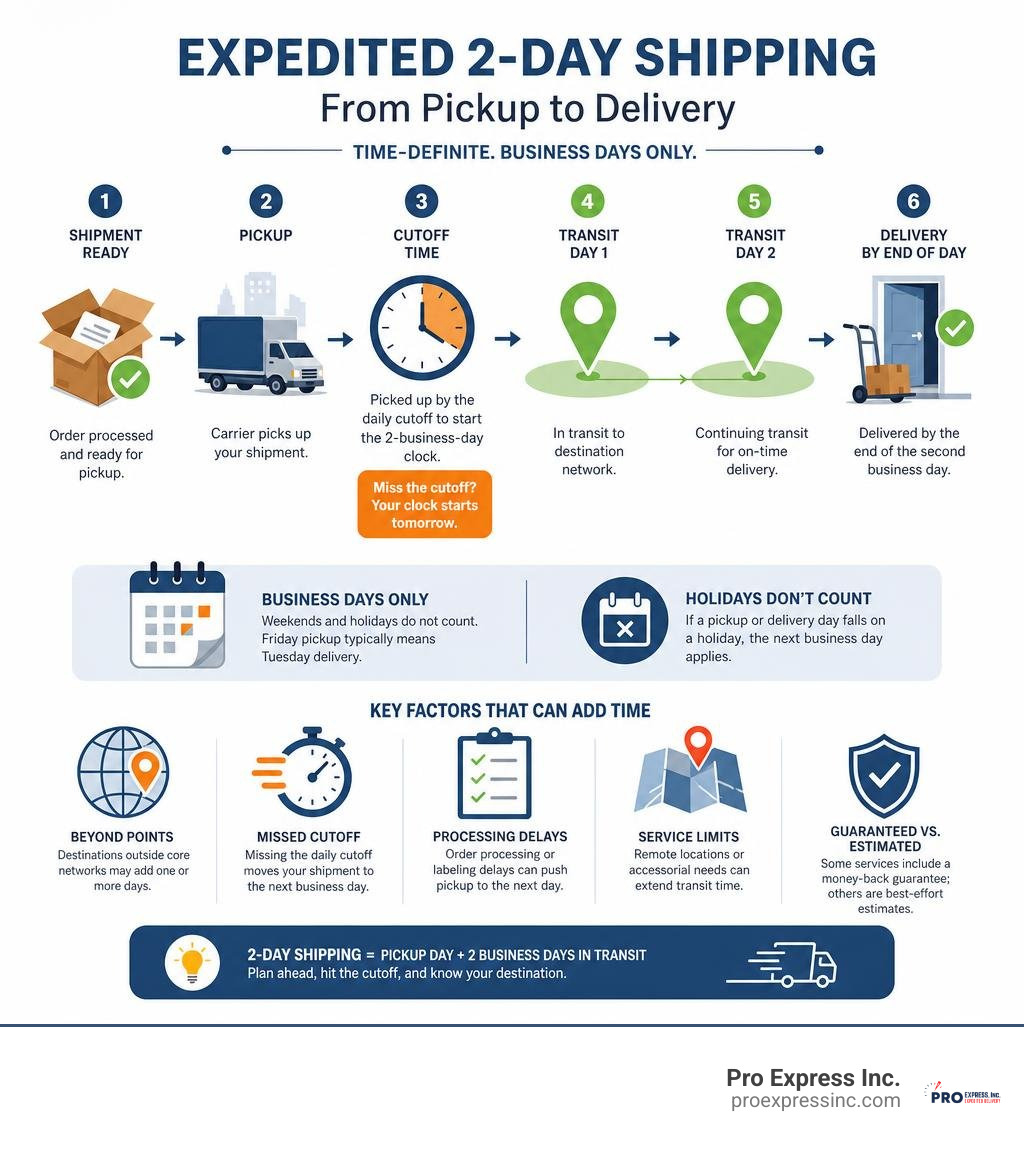
Expedited 2 day shipping word guide:
When we talk about transit speeds in modern logistics, the terminology can quickly become a tangled web of marketing jargon. To cut through the noise, we must define exactly what happens when a shipment is upgraded from a standard service to an expedited tier.
Standard shipping is typically a best-effort service. The cargo moves through a hub-and-spoke network, where it is loaded, unloaded, sorted, and reloaded multiple times. There is no strict timeline commitment. If a terminal experiences a sudden volume spike or a driver shortage, standard shipments are the first to be deprioritized and delayed.
In contrast, expedited 2-day shipping places your cargo on a priority track. From the moment the carrier scans the barcode, the shipment bypasses standard consolidation queues. It is routed along optimized lanes designed to deliver by the second business day. For a deeper dive into how priority handling is structured, you can read expedited shipping your complete 2026 guide and explore what is expedited shipping the 2026 guide.
However, operational realities dictate that “2-day” does not mean “48 hours from order placement.” If a facility manager orders critical components at 11:00 PM on a Thursday, the shipment will not arrive on Saturday. The carrier clock only begins when the physical cargo is loaded onto the vehicle and scanned. If the order is processed on Friday and picked up by the carrier, the two-business-day countdown starts on Monday, resulting in a Wednesday delivery.
How Freight Brokers Structure Expedited 2-Day Transit Lanes
To consistently achieve two-day transit times across the contiguous United States, freight brokers must coordinate highly structured regional networks. We do not rely on a single carrier or a single transport method. Instead, we arrange transit by mapping out the most efficient routes using a combination of dedicated ground assets and regional hubs.
These structured lanes are aligned with the Federal Highway Administration freight routing guidelines to ensure compliance, safety, and optimal transit speeds. By analyzing historical traffic patterns, construction zones, and regional carrier capacity, we can coordinate shipments that travel hundreds of miles without getting stuck in bottlenecked terminals.
For example, a two-day lane from the Midwest to the Southeast is scheduled with precise departure windows. The vetted carrier partners we work with must dispatch vehicles at specific hours to sync with regional sorting schedules. If a shipment misses its scheduled window, the entire transit chain is disrupted. This is why professional logistics coordinators place immense emphasis on strict pickup schedules and real-time tracking.
Why B2B Logistics Managers Rely on Expedited 2 Day Shipping for Critical Freight
In the B2B world, a delayed shipment is never just an inconvenience — it is a financial and operational risk. Manufacturing plants, medical facilities, and automotive assembly lines operate on tight schedules. They do not have the luxury of waiting for standard ground services when a critical component fails.
Logistics managers rely on expedited multi-day transit to maintain supply chain continuity. If an automotive assembly plant in Michigan is missing a specific sensor, every minute of downtime can disrupt production schedules down the line. By arranging an expedited shipment, the plant manager can plan around a firm delivery window, allowing them to schedule maintenance crews and minimize operational disruptions.
Similarly, the medical and pharmaceutical sectors depend on time-definite transit to move sensitive diagnostic equipment or temperature-controlled medical supplies. To understand how these specialized sectors utilize priority routing, refer to expedited shipping services the 2026 guide. When we coordinate these shipments, we ensure that every link in the transportation chain is optimized for speed, security, and reliability.
The Mechanics of Multi-Day Transit: Business Days, Cutoffs, and Geographic Barriers
To master expedited logistics, one must understand the difference between calendar days and business days. Most carriers define a business day as Monday through Friday, excluding national holidays.
Additionally, every carrier terminal operates with a strict daily cutoff time. The cutoff time is the latest hour a shipment can be checked into the facility to begin transit that same day. If your cargo is ready for pickup at 4:30 PM, but the local terminal cutoff is 4:00 PM, the shipment will sit at the dock until the following business day.
This weekend gap is one of the most common points of friction in B2B logistics. According to the Bureau of Transportation Statistics freight transit data, weekend freight movement operates under different regulatory and capacity constraints than weekday transit. Understanding these patterns allows operations managers to plan their dispatches more strategically.
Navigating Beyond Points and Regional Transit Delays
Another critical factor that can disrupt a two-day delivery promise is the destination’s geographic classification. In the logistics industry, locations are divided into metropolitan service areas and “beyond points.”
A beyond point is a postal code located outside a carrier’s primary service network — typically in rural, remote, or less-populated regions. When a shipment is destined for a beyond point, the primary carrier will often transfer the cargo to a local cartage agent for the final leg of the delivery. This transfer of custody can automatically add one to two business days to the transit time, regardless of the service level selected.
Furthermore, interstate transit must comply with the Federal Motor Carrier Safety Administration interstate guidelines, which regulate driver hours of service (HOS). If a two-day ground route exceeds the maximum distance a single driver can legally cover within their daily driving limit, the shipment will require either a team of two drivers or an overnight layover, which must be factored into the logistics plan from the very beginning.
How B2B Operations Secure Reliable Multi-Day Delivery via Dedicated Freight Networks
To bypass the bottlenecks of standard hub-and-spoke parcel networks, forward-thinking B2B operations partner with third-party logistics (3PL) providers and freight brokers to access dedicated freight networks.
Instead of letting a critical cargo shipment get mixed in with thousands of consumer parcels, we coordinate dedicated ground solutions that keep the cargo moving directly from origin to destination. For a comprehensive overview of how these strategic networks operate, read the ultimate guide to expedited shipping and learn about the advantages of expedited ground shipping.
By utilizing distributed warehousing and strategic dispatching, businesses can position their critical inventory closer to major industrial hubs, ensuring that a two-day delivery window is always logistically feasible.
Leveraging Dedicated Ground Freight and Hot-Shot Solutions
When standard shipping options fail or a deadline is too tight for comfort, the most reliable alternative is a dedicated ground or hot-shot delivery.
A hot-shot delivery involves arranging an exclusive-use vehicle — such as a sprinter van, straight truck, or a 53-foot dry van — dedicated solely to your shipment. Because the vehicle does not stop to pick up or deliver other cargo, there are zero hub transfers, zero consolidation delays, and zero risk of your freight being misplaced at a sorting terminal.
To learn more about how these specialized ground solutions can protect your supply chain, explore our resources on expedited ground services and read our expedited ground freight a strategic guide for logistics managers 2026 guide.
Key Operational Factors Influencing Multi-Day Transit Times
When planning an expedited shipment, several physical and operational characteristics of the cargo will dictate how the transit is structured. The most critical of these are dimensional weight, package density, and freight classification.
Dimensional (DIM) weight reflects a package’s density, calculated by multiplying the length, width, and height of a container and dividing by a standard industry divisor (typically 166 for domestic shipments). If a package is large but lightweight, carriers will bill based on the space it occupies rather than its actual physical weight.
To help logistics managers understand their options, we have compiled a comparison of how different shipping methods handle priority cargo:
| Feature / Metric | Standard LTL (Less-Than-Truckload) | Dedicated Expedited Freight |
|---|---|---|
| Transit Commitment | Estimated (Best-Effort) | Firm Time-Definite |
| Handling Frequency | High (Multiple Hub Transfers) | None (Direct Point-to-Point) |
| Vehicle Sharing | Co-loaded with other shippers | Exclusive-Use Vehicle |
| Tracking Granularity | Checkpoint-based updates | Real-time GPS Tracking |
| Ideal for | Non-urgent bulk inventory | Critical, time-sensitive cargo |
For more insights on selecting the right speed for your cargo, check out expedited ground freight faster shipping solutions for your business needs.
Packaging and Handling Requirements for Heavy Cargo
Heavy industrial cargo requires robust packaging to survive the physical stresses of rapid transit. When coordinating expedited shipments, we always recommend that shippers follow best practices for securing their freight.
All heavy items should be properly palletized, shrink-wrapped, and secured with heavy-duty metal or plastic banding on all sides. For shipments that exceed the weight limits of standard delivery vehicles, or facilities that do not have a dedicated loading dock, arranging a vehicle equipped with a liftgate is essential.
If you are dealing with last-minute shipments that require immediate, specialized handling, our guide on next day shipping a guide for people who needed it yesterday offers practical advice on preparing your cargo for rapid transit.
Frequently Asked Questions About Multi-Day Expedited Transit
What is the difference between multi-day expedited shipping and standard ground shipping?
The primary difference lies in transit priority and handling speed. Standard ground shipping moves cargo through a network of consolidating hubs with no guaranteed delivery date. Multi-day expedited shipping bypasses these standard queues, utilizing optimized routing and priority handling to help the shipment arrive within a firm, defined window. To understand the foundational elements of rapid transit, read next day delivery 101.
How do weekend orders affect the delivery timeline of a two-day transit?
Because carriers operate on a business-day calendar, weekends do not count toward the transit timeline. An order picked up on a Friday will typically not begin active transit until the following Monday, resulting in a Wednesday delivery. For a survival guide on managing urgent, round-the-clock shipping needs, see the 24 hour shipping service survival guide.
When should a business transition from standard LTL to dedicated expedited freight?
A business should transition to dedicated expedited freight when the cargo is highly time-sensitive, high-value, or fragile. If a delayed shipment risks stopping a production line, or if the cargo cannot risk the physical handling associated with standard LTL hub transfers, dedicated transport is the safest choice. Read more about this strategic transition in expedited freight meaning and why your logistics need a turbo boost.
Conclusion
When standard shipping options fail and your supply chain is on the line, you need a partner who can cut through the complexity and arrange a seamless, reliable solution.
Pro Express, Inc. is a trusted freight brokerage specializing in expedited ground shipping — same-day, next-day, and hot-shot deliveries nationwide across the contiguous United States. Founded in 2007 by Peter Jałowiec, we have built our reputation on nearly 20 years of logistics expertise. Having coordinated more than 10,000 successful shipments with a 99% client satisfaction rate, we know exactly what it takes to move urgent, time-sensitive cargo safely.
We coordinate a comprehensive suite of premium services through our vetted carrier network, including:
- Exclusive Hot Shots for direct, uninterrupted transit
- White Glove & Two-Man Delivery for high-value, delicate cargo
- Liftgate & Inside Delivery for facilities without loading docks
Whether you are shipping critical automotive components, sensitive medical and pharmaceutical supplies, heavy manufacturing machinery, or delicate lighting fixtures, we are here to manage the logistics so you can focus on your operations.
Don’t let carrier failures or missed cutoffs disrupt your business. Let us arrange the reliable, time-definite delivery your operations deserve.