
When Every Minute Counts: Why Expedited Freight Tracking Matters
Expedited freight tracking gives you real-time visibility into your most urgent shipments — from the moment a carrier is dispatched to the second your cargo is delivered.
Here’s how to track an expedited freight shipment:
- Get your tracking number from your freight broker or carrier at the time of booking.
- Log in to the tracking portal provided by your logistics partner, or use a public tracking link.
- Enter your reference number — this could be a PRO number, Bill of Lading (BOL), or Purchase Order (PO) number.
- Monitor live status updates — look for milestones like Picked Up, In Transit, and Delivered.
- Set up automated alerts via email or SMS so you’re notified the moment a status changes.
- Contact your single point of contact (SPOC) immediately if you see a “Delayed,” “Late,” or “Missing Documents” status.
Your regular carrier just failed. A client deadline is hours away. A critical part is sitting somewhere between Chicago and Dallas, and no one is picking up the phone.
This is the moment when real expedited freight tracking separates a manageable situation from a full operational crisis.
Same-day and next-day shipping demand has exploded — same-day alone has grown 164% over the past five years. That kind of volume means more shipments, more carriers, and more opportunities for things to go wrong without warning.
For operations and logistics managers, blind spots in transit aren’t just frustrating. They’re expensive. A manufacturing line-down event can cost thousands of dollars per hour, and without live tracking, you’re making decisions based on guesswork.
At Pro Express Inc., we’ve spent nearly 20 years coordinating urgent, time-critical freight through a vetted carrier network — so when your supply chain is under pressure, you have a trusted partner who actually picks up the phone.
This guide walks you through everything you need to know about expedited freight tracking: how it works, what the statuses mean, which technologies power it, and how to use it to protect your operations.
Expedited freight tracking word roundup:
What is Expedited Freight Tracking and How Does It Differ from Standard Methods?
To understand how tracking keeps high-priority shipments on schedule, we first have to look at how standard freight tracking falls short.
Standard Less-Than-Truckload (LTL) tracking is milestone-based. Your cargo is scanned when it is loaded onto a truck, scanned again when it passes through a regional hub, and scanned once more when it reaches the destination terminal. If a truck gets stuck in traffic or sits at a transfer point for 12 hours, you have no way of knowing until it misses its next scheduled scan.
This terminal-to-terminal model is too slow for critical shipments. When you are coordinating hot-shot or next-day shipments, you cannot afford to wait for a manual barcode scan to find out where your freight is.
Expedited freight tracking relies on continuous, real-time visibility. Instead of waiting for terminal check-ins, tracking systems utilize active telemetry to transmit location details constantly. Because expedited shipping typically bypasses intermediate terminals and moves directly from dock to door on dedicated vehicles, the tracking data is continuous and unbroken.
To learn more about how these express systems bypass standard bottlenecks, explore The Ultimate Guide to Expedited Shipping.
Key Benefits of Real-Time Visibility for B2B Operations
When you arrange high-urgency shipping through a vetted carrier network, real-time tracking is not just a passive monitor — it is an active tool that protects your operations.
- Operational Control: Knowing the exact location of your cargo allows you to coordinate warehouse personnel and dock availability. If a critical shipment is scheduled to arrive at 2:00 AM, you can schedule receiving teams precisely when the truck arrives, preventing unnecessary labor expenses.
- Customer Trust: In B2B logistics, your reputation is built on reliability. Providing your clients with precise, dynamic ETAs helps them plan their own operations, building long-term trust even during urgent supply chain disruptions.
- Proactive Problem-Solving: If a storm or traffic bottleneck slows down a shipment, real-time alerts allow logistics coordinators to reroute the vehicle instantly. You can address the issue hours before it impacts your client’s receiving dock.
To dive deeper into how 24/7 visibility transforms logistics management, check out our guide on Tracking Your Package at 3 AM and Other Expedited Service Perks.
The Operational Journey: From Booking to Final Delivery
Arranging an expedited shipment requires a highly structured workflow to ensure that time-critical cargo moves without delay. Because these shipments run on tight schedules, tracking must be integrated into every step of the transit journey.
When standard carriers fail or a last-minute emergency occurs, we coordinate a seamless process to ensure your cargo receives exclusive use of the vehicle, eliminating intermediate stops and maximizing transit speed. For a complete breakdown of these rapid transit options, review Expedited Shipping Services The 2026 Guide.
Step-by-Step Workflow of Expedited Freight Tracking
To understand how tracking works in practice, let us look at the lifecycle of a high-priority shipment:
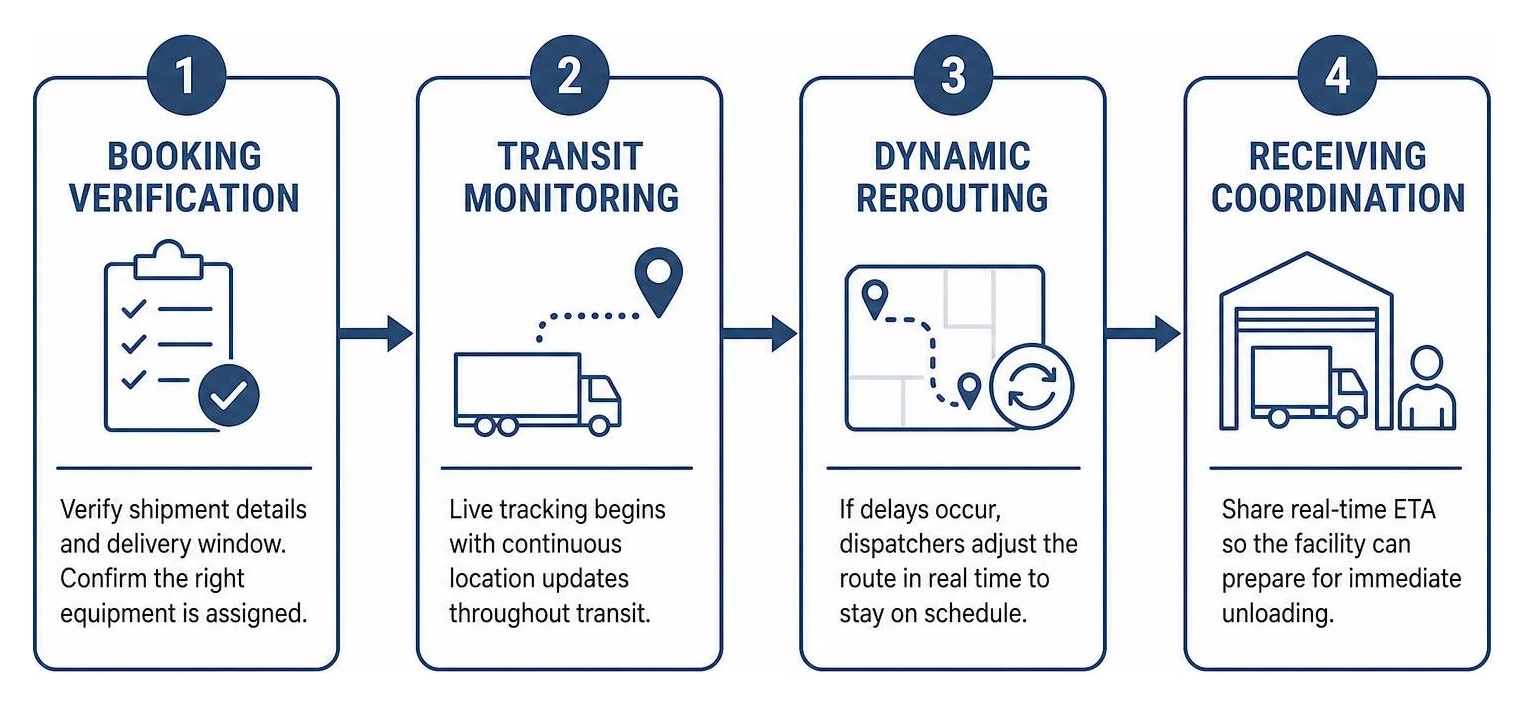
- Booking Verification: Before dispatching a vehicle, all shipment details — including dimensions, weight, and strict delivery windows — are verified. This ensures the correct equipment is deployed and prevents delays at the pickup dock.
- Transit Monitoring: Once the vetted carrier departs, live tracking begins. The system transmits coordinates continuously, allowing logistics managers to monitor progress against the scheduled timeline.
- Dynamic Rerouting: If an unexpected delay occurs, dispatchers analyze live traffic and weather patterns to adjust the route in real time, keeping the shipment on schedule.
- Receiving Coordination: As the vehicle approaches the destination, real-time ETA updates are shared with the receiving facility so they can prepare specialized equipment, such as liftgates or inside delivery teams, for immediate unloading.
Supporting Logistics Planning and Route Optimization
Effective tracking data does more than just show a point on a map; it actively supports route optimization. By analyzing live traffic patterns, construction zones, and weather disruptions, logistics coordinators can select the most efficient path before the vehicle even departs.
For long-haul lanes across the contiguous United States, team drivers are often coordinated to keep the vehicle in continuous motion. While one driver rests, the other drives, allowing the shipment to compress a two-day ground move into a single continuous push. Tracking systems monitor these driver changes and transit milestones to ensure compliance with federal hours-of-service regulations without sacrificing speed.
To see how operations managers utilize these strategies to streamline urgent freight, read our Expedited Ground Freight A Strategic Guide for Logistics Managers 2026 Guide.
The Tech Stack Behind High-Urgency Logistics
Modern expedited tracking is powered by a sophisticated combination of hardware and software designed to eliminate blind spots.

By combining global positioning systems with advanced telemetry, logistics managers can monitor not just where a shipment is, but how it is performing. For an overview of the technology that makes this possible, explore Expedited Ground Freight Faster Shipping Solutions for Your Business Needs.
Advanced Technologies Powering Modern Expedited Freight Tracking
- GPS Tracking: High-frequency GPS devices transmit location coordinates every 60 seconds, providing an accurate, real-time breadcrumb trail of the vehicle’s journey.
- Cellular Telemetry & IoT Sensors: Internet of Things (IoT) sensors can be placed directly inside cargo containers. These sensors transmit data over cellular networks, providing continuous updates even when cargo is moved between different handling points.
- Temperature Validation: For sensitive industries like medical/pharma, specialized tracking portals integrate live temperature-validation readings. This ensures that climate-controlled shipments remain within strict parameters throughout transit.
To learn more about the advanced equipment used to secure time-critical shipments, read The Complete Guide to Expedited Freight Services 2026 Guide.
Maximizing Supply Chain Efficiency and Preventing Downtime
For industries like automotive assembly and manufacturing, a single missing component can halt an entire production line. Real-time tracking acts as an early-warning system that allows plant managers to coordinate receiving schedules and adjust labor shifts dynamically.
By monitoring shipments continuously, businesses can optimize their inventory levels, operate on just-in-time schedules, and avoid the steep penalties associated with production delays. Discover how implementing these systems can protect your bottom line in our article on Why Your Business Needs an Expedite Delivery System Now.
Decoding Common Tracking Statuses and Exceptions
When monitoring high-stakes shipments, understanding what your tracking status means is crucial for making timely operational decisions.
| Tracking Status | Operational Meaning | Action Required |
|---|---|---|
| On Time | The shipment is en route and is expected to meet its scheduled delivery window. | None. Continue monitoring automated updates. |
| Delayed | The shipment has missed an en route milestone, but the final ETA may still be recoverable. | Contact your logistics coordinator to review dynamic rerouting options. |
| Late | The vehicle is currently en route but has surpassed its originally scheduled delivery date. | Coordinate with receiving facilities to adjust labor schedules and prepare for arrival. |
| Missing Documents | Required compliance paperwork (such as a commercial invoice or packing list) is missing. | Upload the required digital documents immediately to prevent transit holds. |
Understanding ‘Delayed’, ‘On Time’, and ‘Late’
It is important to distinguish between a “Delayed” status and a “Late” status. A shipment marked as delayed means it has encountered a temporary obstacle — such as a traffic bottleneck or weather disruption — but can still meet its final delivery window through route adjustments.
A status of late indicates that the shipment has officially missed its scheduled milestone and will arrive past the original delivery window. When this occurs, automated tracking systems recalculate the ETA using live driver Hours of Service (HOS) data and current transit conditions to provide a realistic arrival time.
Resolving ‘Missing Documents’ and Transit Holds
A “Missing Documents” status is one of the most common administrative bottlenecks in freight shipping. High-value and specialized freight should not move without completed paperwork, including bills of lading, packing lists, and any required shipping declarations.
Modern tracking portals allow shippers to upload these digital documents directly into the tracking interface, allowing compliance teams to resolve holds quickly and keep the cargo moving.
For more information on resolving tracking exceptions, you can consult the Tracking Information – ExFreight resource page.
Enterprise Integration and Communication Strategies
To get the most value out of tracking data, businesses must be able to access and share it seamlessly across their existing systems.
Integrating tracking tools directly into your operations reduces administrative work and ensures all departments are working with the same data. To see how digital integration speeds up cargo transit, read How to Speed Up Your Cargo with Expedited Freight Delivery.
Programmatic Tracking via API and EDI
For enterprises managing high volumes of urgent freight, manual tracking is inefficient. By utilizing REST APIs and EDI integrations, companies can connect their internal Transportation Management Systems (TMS) or ERP software directly to carrier networks.
These hardware-agnostic APIs allow your systems to request real-time tracking data automatically. For developers looking to integrate these capabilities, technical specifications can be found through platforms like the GET shipments/exactmatch API documentation.
Additionally, standard tracking portals such as Tracking, delivery status for DHL Express shipments | MyDHL+ and help systems like Track show how modern platforms structure tracking data by reference, container, or PO number. Shippers can also utilize tools like Freight Line Tracking | Track & Trace Shipments to set up automated milestones directly within their internal workflows.
The Power of a Single Point of Contact (SPOC)
While advanced software is essential, technology is only as good as the people managing it. When an urgent shipment is on the line, navigating a generic call center or waiting for an email response from an automated helpdesk can waste critical minutes.
The Single Point of Contact (SPOC) model eliminates this friction. When you arrange shipping through Pro Express Inc., you are assigned a dedicated logistics specialist who manages your shipment from booking to final delivery. Your SPOC monitors the live tracking data, anticipates disruptions, and contacts you proactively with solutions if an issue arises.
To learn how a personalized communication strategy improves shipping outcomes, see our guide on Choosing the Best Expedited Freight Companies for Your Business.
Frequently Asked Questions about Expedited Freight Tracking
How does real-time tracking prevent assembly line shutdowns?
Real-time tracking provides manufacturing plant managers with precise, minute-by-minute visibility of inbound components. If a shipment carrying critical microchips or automotive sensors is delayed, managers can use the live ETA to adjust assembly line schedules, reallocate labor, or coordinate a rapid-response hot-shot delivery to bridge the gap, preventing an expensive line-down event.
Can I track expedited shipments across multiple transportation modes?
Yes. Modern logistics tracking platforms can consolidate data from different ground vehicles — including hot shots, sprinter vans, and straight trucks — into a single, unified dashboard. This keeps visibility continuous from pickup to final delivery.
What is the best way to use tracking data for future performance improvements?
Tracking data is a valuable resource for continuous improvement (Kaizen) initiatives. By analyzing historical tracking logs, businesses can identify recurring transit bottlenecks, evaluate carrier performance, optimize routing strategies, and refine scheduling models to improve the speed and reliability of future shipments.
Conclusion
When your supply chain is under pressure, guesswork is not an option. Expedited freight tracking provides the real-time visibility, predictive data, and operational control you need to keep your business moving forward.
At Pro Express Inc., we have spent nearly 20 years acting as the trusted freight broker that operations and logistics managers rely on when critical deadlines are at risk. Specializing in expedited ground shipping nationwide across the contiguous United States, we coordinate same-day, next-day, and hot-shot deliveries through a vetted carrier network.
Whether your shipment requires Exclusive Hot Shots, White Glove handling, Liftgate, Two-Man, or Inside Delivery, we back every shipment with a 99% client satisfaction rating and a dedicated single point of contact who is available 24/7/365.
Don’t let carrier failures or last-minute emergencies disrupt your operations. Request a Quote with Pro Express Inc. today, and let us coordinate your next time-critical shipment with complete visibility.