
Ship Freight Directly From Warehouse to Customer
Warehouse to customer direct shipping moves freight from your warehouse to its final recipient without a stop at a retailer’s distribution center. For an urgent shipment, confirm that the freight is ready for pickup, check its size and handling needs, and arrange a ground carrier that can serve the delivery address.
If your regular carrier falls through, Pro Express Inc. can coordinate expedited ground shipping through its vetted carrier network in the contiguous United States, including hot-shot, liftgate, and inside delivery options.
Important warehouse to customer direct terms:
Fundamentals of Warehouse to Customer Direct Fulfillment
Direct-to-customer logistics bypasses traditional intermediary stocking points to transport manufactured goods or bulk commodities straight from a storage facility to the end destination. By cutting out extra handoffs at intermediate distribution hubs, shippers gain tighter control over freight velocity, packaging integrity, and delivery timelines across the lower 48 states.
Modern fulfillment models vary significantly based on who owns the stock, where it sits, and how carrier dispatch operates:
| Fulfillment Model | Inventory Ownership | Facility Control | Typical Transport Mode |
|---|---|---|---|
| Warehouse to Customer Direct | Shipper / Brand | Centralized or Regional Warehouse | Dedicated Ground Freight / Expedited Truckload |
For B2B shippers, warehouse-to-customer direct fulfillment is most useful when a missed delivery window, production interruption, or project deadline makes extra terminal handoffs impractical. This fulfillment model keeps the shipment focused on a single receiving location and lets the shipper align pickup readiness, handling requirements, appointment details, and delivery instructions before dispatch. That preparation can reduce avoidable delays when expedited ground transportation is needed for a time-sensitive commercial load.
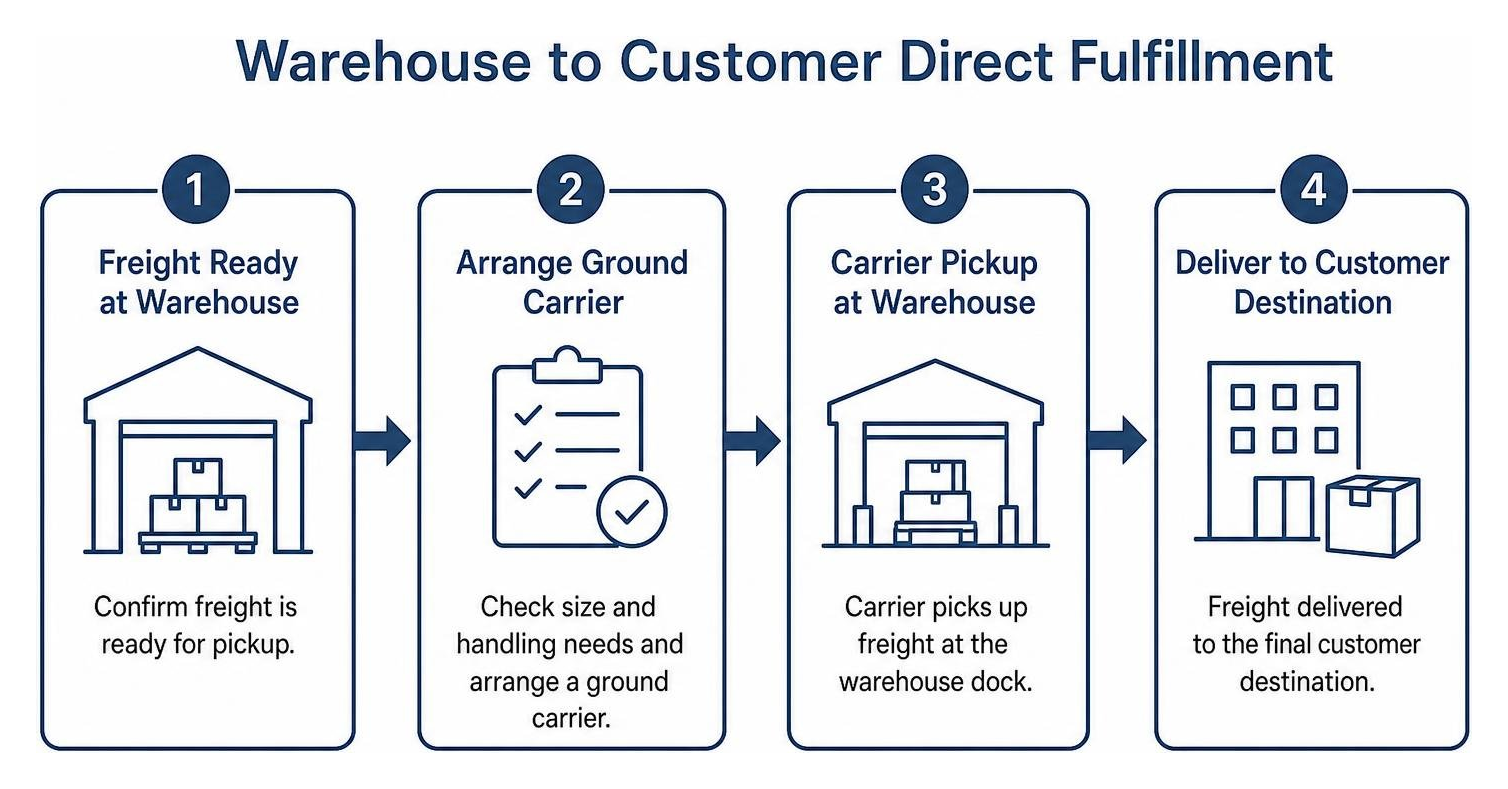
Core Operational Workflows in Warehouse to Customer Direct Models
Executing seamless direct-from-warehouse dispatch requires an orderly operational chain:
- Order Ingestion and Validation: Electronic transmission of orders into warehouse systems triggers instant inventory allocation.
- Dynamic Slotting and Picking: Fast-moving items staged near outbound staging lanes reduce internal transit time across facility aisles.
- Packaging and Pallet Staging: Cargo is secured, shrink-wrapped, and labeled for direct transit to eliminate dock re-sorting.
- Carrier Dispatch and Loading: Coordinated ground transport backs directly into the dock door for dedicated loading.
When sudden project deadlines or factory production targets demand immediate transit, leveraging accelerated ground order delivery ensures that shipments move without mid-transit cross-dock delays.
Balancing Scheduled and Urgent B2B Freight Under One Roof
Many industrial facilities manage scheduled bulk freight alongside urgent direct B2B shipments from a shared inventory pool. Managing these two distinct streams under one roof requires clear dock separation and reliable communication among warehouse staff, receivers, and the carrier network.
Bulk commercial orders typically demand standard palletization, master-carton labeling, and Electronic Data Interchange (EDI) advance ship notices. Urgent B2B shipments instead depend on rapid staging, specialized delivery notes, and precise carrier scheduling. Clear dock workflows help high-volume wholesale commitments and time-sensitive commercial loads move through the facility without competing for the same staging space.
Overcoming Operational Hurdles in Direct Customer Freight Delivery
Moving freight directly from commercial storage to client sites introduces unique delivery challenges. Commercial loading docks feature standard dock-height bays, whereas many destination facilities, job sites, and commercial storefronts lack standard unloading infrastructure. When freight schedules face sudden disruptions or standard carriers lack specialized equipment, professional coordination is essential to keep shipments moving smoothly.
Maintaining visibility throughout the haul helps prevent transit exceptions and communication breakdowns. Proactive tracking, accurate receiver instructions, and tailored ground transportation help shippers manage delivery requirements at commercial facilities and job sites.

Specialized Delivery and Heavy Freight Handling
Heavy equipment, architectural lighting, automotive machinery, and industrial components cannot simply be dropped at a curb. Delivering bulky freight directly to commercial destinations frequently requires:
- Hydraulic Liftgate Equipment: Essential for ground-level offloading when no raised loading dock is available.
- Two-Man Handling Crews: Required for heavy or fragile crated assemblies that cannot be safely maneuvered by a single operator.
- Inside Delivery and Debris Removal: Positioning cargo past the threshold directly into an assembly room or job site.
For fragile or high-value commercial shipments, coordinated white glove handling, liftgate service, or inside delivery can help align the equipment and delivery instructions with the receiving location’s requirements.
Streamlining Reverse Logistics and Return Processing
Direct distribution models must also account for return freight. Whether dealing with overstock returns, warranty replacements, or misrouted cargo, reverse logistics requires clear inspection and intake procedures at the warehouse dock.
Establishing clear return workflows ensures returned items are triaged, inspected for structural integrity, and restocked quickly to protect inventory availability. Shippers managing large commercial returns benefit from structured protocols for handling oversized goods, turning reverse logistics from an operational headache into a smooth, controlled process.
Technology Stack and Location Strategy for Direct Shipping
Operating a high-velocity direct shipping network across the lower 48 states requires modern software integration and smart geographic placement. Enterprise platforms connect inventory records directly to outbound dispatch bays, ensuring operational alignment from the moment an order is confirmed.
Integrated warehouse management systems (WMS) and transportation management software synchronize order flow with carrier dispatch. Advanced systems utilize standardized architectures, such as enterprise sales order processing protocols, to bridge front-end order entries with physical warehouse docks. Placing facility nodes within central ground corridors allows shippers to reach commercial markets throughout the contiguous United States via dedicated ground routing.
Key Performance Indicators for Warehouse to Customer Direct Shipping
To maintain operational control and protect delivery timelines, logistics managers monitor critical warehouse metrics:
- Dock-to-Stock Time: The speed at which inbound freight is received, verified, and made available for outbound picking.
- Order Picking Accuracy: The percentage of orders assembled without SKU or quantity discrepancies.
- On-Time Outbound Dispatch Rate: The proportion of shipments loaded and rolling within the scheduled dock appointment window.
- Carrier Dwell Time: The duration a transport vehicle spends waiting at the facility dock before loading commences.
- Order Cycle Time: The total time elapsed from initial order receipt to final carrier departure.
Tracking these KPIs highlights facility bottlenecks early, allowing operations teams to resolve staging delays before they affect delivery schedules. For an urgent B2B shipment, this visibility also helps the shipper confirm that freight is packaged, labeled, staged, and ready when the coordinating broker secures a suitable carrier. Clear status updates among the warehouse, broker, carrier, and receiver can reduce confusion around dock appointments, equipment needs, and delivery access. Before pickup, the shipper can document the freight class, dimensions, weight, packaging condition, pickup contact, receiving hours, and any site-access constraints. That information helps the broker coordinate with a carrier whose equipment and availability fit the shipment’s needs. At delivery, the receiver should know whether a liftgate, appointment, inside delivery, or two-person handling is required so the shipment can be planned around the actual site conditions. This approach keeps urgent freight coordination focused on practical details rather than last-minute assumptions. It also gives each party a shared reference point if delivery conditions change after dispatch or receiver requirements shift unexpectedly.
Ground Transportation Networks and Final-Mile Routing
When critical production lines face shutdowns or construction projects require urgent parts, standard multi-stop freight networks can introduce unwanted delays. Dedicated ground transportation pairs shipments with vetted carriers who run direct, point-to-point routes from the loading dock to the receiver.
For time-sensitive commercial deliveries, coordinating dedicated courier logistics eliminates hub-and-spoke transfers. Moving goods directly on dedicated vehicles keeps transit focused and avoids unnecessary terminal handoffs across the lower 48 states.
Frequently Asked Questions About Warehouse to Customer Direct Logistics
How does direct warehouse fulfillment differ from multi-stop freight routing?
Direct warehouse fulfillment moves a B2B shipment from the warehouse to its receiving location with fewer intermediate handoffs. Multi-stop freight routing may involve additional terminals or delivery points, which can add handling and scheduling complexity for time-sensitive commercial loads.
Can a single facility handle both retail pallet freight and urgent B2B shipments?
Yes, modern hybrid warehouses can manage both distribution models through a shared inventory pool supported by an integrated WMS. Separate picking zones and staging areas help teams prepare bulk palletized freight while keeping urgent commercial shipments accessible for coordinated pickup.
What freight equipment is needed for bulky warehouse goods at commercial destinations?
Delivering heavy or oversized freight to locations without loading docks may require liftgates, pallet jacks, and cargo-securing equipment. For complex indoor placements at a commercial facility or job site, two-person handling crews and inside-delivery coordination can help match the shipment to the receiver’s access requirements.
How does warehouse positioning impact contiguous US ground delivery timelines?
Facility placement directly dictates ground transit duration. Positioning inventory near major freight corridors across the lower 48 states allows point-to-point ground transport to reach major commercial hubs rapidly without relying on complex terminal transfers.
Conclusion
Streamlining warehouse-to-customer direct freight requires tight inventory synchronization, organized dock workflows, and responsive ground transportation. When unexpected supply chain interruptions or urgent customer timelines demand immediate action, having a dependable freight partner makes all the difference.
Operating from Oak Brook, Illinois, Pro Express Inc. brings nearly 20 years of experience as an expedited freight broker. Since 2007, the team has arranged over 10,000 delivered shipments through a trusted, vetted carrier network across the contiguous United States, with clients returning for over 13 years. Pro Express coordinates 24/7 dedicated ground shipping, including exclusive hot shot freight solutions, two-man handling, liftgate service, and inside delivery for time-sensitive B2B freight.
Contact Us Today to coordinate your expedited ground freight shipments.